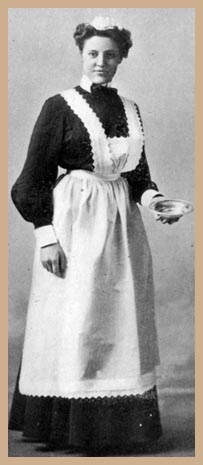
Afternoon dress for a maid: In the morning the waitress may wear a light print dress, a plain, full-skirted white apron, white collar and cuffs. Before serving luncheon the print dress is changed for a light-weight black wool dress and a more dressy apron, and a black bow is added to the cap. Boots or slippers with soft soles and low flat heels, if any, enable the waitress to move about noiselessly.— Image from “A Guide for Edwardian Servants,” by Janet McKenzie Hill,” 1908
PERSONAL QUALIFICATIONS AND DRESS OF A WAITRESS
The up-to-date waitress needs an eye quick to see and a hand deft to execute. She needs to be able to tell at a glance whether the window shades exclude the right quantity of sunlight or the open window admits the proper quantity of air. She needs to have an eye that never fails when an object is to be disposed in the centre of anything or two or more objects in exactly straight lines. Her first duty in regard to everything she touches is to “keep it straight.” On all occasions she is to be neatly dressed and manicured, calm and unruffled; no matter how many duties claim her attention at one and the same time, she needs to be absolutely deliberate, self-poised, and unhurried.
A waitress needs to be quick and light of foot; thus youth and a trim figure, not too large, are the first requisites in one who wishes to make a success of the calling. It is needless to add that a quiet, unobtrusive manner – is absolutely essential. A waitress needs to possess a mind unwearied by detail and a willingness to cultivate nice ways of doing work.
In the morning the waitress may wear a light print dress, a plain, full-skirted white apron, white collar and cuffs. Before serving luncheon the print dress is changed for a light-weight black wool dress and a more dressy apron, and a black bow is added to the cap. Boots or slippers with soft soles and low flat heels, if any, enable the waitress to move about noiselessly.
maid.
The up-to-date waitress is not superficial; she knows full well that daintiness secured by cleanliness must be part and parcel of her own person as well as of the inanimate things which she handles. She will no more think of omitting her full morning bath than of sending the butter to the table on an unwashed dish.
She is surrounded with choice articles often of great value, of which she is the caretaker. She comes in close contact with people who are ultra-fastidious. Her position is a responsible one, and calls for dignified bearing. She needs to maintain her own self-respect and claim that of those whom she serves. To do this, she can ill afford to neglect any of the personal niceties classed as “minor moralities.”
The daily bath and immaculate undergarments are at the foundation of these moralities. Cleanliness is next to godliness, and opportunity for cleanliness should be freely given and freely accepted. — From “A Guide for Edwardian Servants,” by Janet McKenzie Hill,” 1908
🍽️Etiquette Enthusiast, Maura J. Graber of The RSVP Institute of Etiquette, is the Site Editor of the Etiquipedia© Etiquette Encyclopedia

No comments:
Post a Comment
Note: Only a member of this blog may post a comment.