Showing posts with label Mourning Etiquette. Show all posts

Sunday, December 13, 2020

Gilded Age Mourning

“To go to the opera, or a dinner, or a party, before six months have elapsed, is considered heartless and disrespectful. If one chooses, as some do, to wear no mourning, then he can go, unchallenged, to any place of amusement, but if he put on mourning he must respect its etiquette.” — Above is an antique mourning brooch.
– Photo source Etiquipedia private library


The death of Mrs. August Belmont, Sr. had been so long anticipated, that it did not cause any shock, but brought with it no less a feeling of sadness to the members of New-York society. Mrs. Belmont ruled the New-York society at a time when it was much smaller than at present, with a gentle hand, and all who knew her regret her death. The families of Cornelius Vanderbilt, Astor, and Belmont are now withdrawn from the gates of the season, all being in mourning, and this will of itself somewhat affect the season. — The New York Times, 1892


Etiquette Enthusiast, Maura J. Graber, is the Site Editor for the Etiquipedia© Etiquette Encyclopedia

Sunday, October 22, 2017

The Etiquette of Sorrow

If we are not intoning with mere lip-service our ‘blessed are the dead who die in the Lord,’ why this ostentation of crape, of bowed windows and darkened chambers? Either we do not really believe that our friends are happy, that we shall see them again, or we are hypocrites with this outward paraphernalia, this etiquette of sorrow. “Why should we darken our houses? The sunshine is sent to purify, to resurrect; its mission is to stricken lives as well as to frost-bound fields. 

Customs of Mourning for the Dead

A writer in a late number of the Christian Union has some very sensible remarks on the subject of modern funeral observances, as in singular contrast with the spirit and claims of a religious faith which looks beyond this world into the next, and recognizes the fact of a blessed immortality, and instances the case of David, who, after his seven days of abandonment to the most extravagant grief for the loss of his child, arose and “washed and anointed himself, and changed his apparel and did eat.” Our funeral observances, and the set fashion of mourning, are, says this writer, “in as direct contrast with the manly resignation of the Hebrew King as they are in glaring contradiction to the professions we make of faith in the present happiness and continued existence of those dear ones taken from our sight. 

If we really believe that it is well with the child for whom the mother's arms are aching and empty, if we are not intoning with mere lip-service our ‘blessed are the dead who die in the Lord,’ why this ostentation of crape, of bowed windows and darkened chambers? Why do we shun the sunlight and avert our faces from all gladness, and hold ourselves disloyal to the dead if a smile or laugh steals upon us unawares? Either we do not really believe that our friends are happy, that we shall see them again, or we are hypocrites with this outward paraphernalia, this etiquette of sorrow. “Why should we darken our houses? The sunshine is sent to purify, to resurrect; its mission is to stricken lives as well as to frost-bound fields. 

In the heavy hours, weighed down with the unnecessary gloom and circumstance of the customary funeral rites, surely we have need of all that can cheer, and warm, and inspire us. Worn out with watching, it may be, depressed with the care, the suffering, with all that has gone before, the mourning household is the one of all others that should throw open its casements, should gladden itself with flowers and the comfort that twitters through the chirp of even the city sparrows. “Some people seem to think they show tenderest memory of the dead by allowing despondency to develop into ill-health; they cultivate illness and weakness as a fine art of sorrowful remembrance. Robust health that waits on good appetite and accustomed exercise, that is springy of step and full of energy, is a reproach to them; it savors of disrespect. Could we but see that the truest and tenderest way of honoring our dear ones is to live our honest lives right on in the usual way, adding, if possible, to our work that which their tired hands lay down! 

“We pay dearly for the etiquette which would keep us sitting in darkness when a midden impulse comes to hear some music, see a bright picture, or visit a friend in whose voice and eyes we find both. ‘But the impulse does not come to true mourners.’ Ah, the heart beats humanly enough beneath the heaviest veil. Decorum teaches us to repress each impulse to the light, ‘if it come too soon.’ Shallow, indeed, is the loneliness and loss that one maps out the months into districts of dress and behavior, and let in the sunshine and the world hand in hand by a computed time table and registry of days.” – Pacific Rural Press, 1875


Etiquette Enthusiast, Maura J. Graber, is the Site Editor for the Etiquipedia© Etiquette Encyclopedia 


Wednesday, September 21, 2016

Hilary Robinson on Etiquette and Grief

How to Help Friends in Grief
Early 20th C. Black mourning attire for a woman– 
Give some thought to the way in which one deals with having friends who are in mourning.

“I wrote this several years ago (although have little memory of doing so) but because the subject is too often part of our lives, and advice about it is often wanted but not sought out, I thought it was worth re-posting.”– Hilary Robinson

I’ve recently been on the receiving end of condolences and it has caused me to give some thought to the way in which we deal with having friends who are in mourning.

The conclusion of a life is a strange time for all those involved, not just immediate family but friends, acquaintances, work colleagues and even people we see casually or sparingly throughout life – the friendly dry-cleaner, the nice woman at the deli. No one really knows what to say, what to do or how to act, including the person doing the grieving.

I had this pointed out to me afresh the other day. Someone I haven’t seen or spoken to since all this happened sent me an instant message saying “how are you? how’s the family?”.

I, in my still slightly foggy state, couldn’t remember when we’d last spoken and couldn’t actually remember if he knew my news. What to do? It seemed blunt to just come out with it and stupid to beat around the bush so I took a half-way approach and said that I was fine but mourning was a tiring business. He, because he knew of the underlying situation, understood immediately and sent his condolences but, poor thing, was then completely stymied about what to say next. He felt badly because to his mind he didn’t have the ‘right’ words. He felt like he should say something profound.


Should I call?

Telephone calls can be difficult so unless you are very close to the person grieving stick to writing a note. Aside from the fact that there are many arrangements that need to be made in the first few weeks (all by telephone) it is also a much more wearisome thing for the person having to say “I’m fine thank you” or “We’re about as you’d expect” and so on.

When they are ready for calls, they will let you know.


Should I write?

I think many people are put off writing letters of condolence because they don’t know what to say. Somehow they think they need to be profound and have the ‘right’ words, or they think they’ll sound stupid, overly-sentimental or that the person they are writing to won’t want to be reminded of the situation.

I can only speak to my own experience, but I feel sure it’s not unique: it was lovely to get notes, letters and emails; it was lovely to know that the person I loved, respected, admired and missed so much, was loved and missed by others and that friends had me in their thoughts.

If you find yourself in a situation where someone you care about has lost someone they care about, write to them. They will, eventually, be glad to have it; it may even be passed to other generations – we still have all the letters written to my grandmother after my grandfather died and they give me an insight into someone who exists only on the edges of my memory.

If you think you would struggle with what to say in your letter, card or email (in these cases hand-written is so much nicer, but email works too), here are some places to start – it’s not necessarily easy, but it’s not necessarily meant to be:

If you were well acquainted with the person who died and spent time with them:

Include a few of your memories of them, such as: “I remember when we…” or “I still laugh when I think of…”

Talk about their character or personality “I always admired the way he…”

Don’t be afraid to say that you too will miss them: “I’ll miss the way she brightened up a room”.

If you really only know the person or people left behind simply speak to their sense of loss and/or use things that you know about the person who has died:

You can use phrases such as, “I know you will miss his tenacity and strength of character” or simply, “I know how much you will miss her.”

There are a few things that it’s best to steer clear of, at least for the first while:

Talking about it being a release; best for the person who has gone; that they have been relieved of their suffering. All this may be true but it doesn’t take away from the reality that a much loved person was taken “too soon”, for whatever reason – keeping in mind that too soon can be from 0 to 102 – and that this pill is a bitter one to swallow.

Be careful about religious references unless you know the strength and depth of the person’s faith; grieving can test these things, so tread lightly.


What do I say?


Often times running into someone in mourning is the most difficult thing of all. Grief is the elephant in the room. Should you ask them how they are? Give them your condolences? Give them a hug? Tell them it will be get better with time?

The best thing to do is judge the situation carefully – the better you know someone the easier that is. These few tips might help no matter how well you know the person:

By all means, give your condolences but keep the encounter short, not ‘rude short’ just not prolonged. There are only so many ways for someone to say they are fine when they don’t mean it.


Be careful about asking how they are, sometimes the mere question is enough to provoke upset (usually unexpectedly for all concerned). You can get around this (if you feel you need to ask the question) by asking about other family members and working your way back to the person in front of you.

Hugs are great if you are somewhere out of the way and if you know the person well, otherwise, steer clear. Someone gave me a hug at the office – quite unexpectedly – and it really threw me.


The thing that should be avoided is telling someone things will get better with time. Things will, but no one in that situation believes it and all it means is that they have to summon up the strength to agree with you.
Should I bake a pie, make a casserole, send food?

One of the loveliest things that someone did for us was send a grocery order. An old and cherished friend went online and ordered all the things we had loved and shared in my parents’ kitchen over the years. It made us all cry but it also made us laugh as we unpacked and commented on her choices.

Others made food or brought over good coffee or dropped things off on the front porch. It was all welcome – we certainly weren’t going to be cooking, even eating was touch-and-go; having the food in the fridge ensured that if we were hungry we could eat.
Kindness is the key

As I said at the beginning, the conclusion of a life is a strange time for all those involved. The key thing to remember is to be kind.

To the person in mourning: Be kind to yourself. Don’t put pressure on yourself to be happy (or sad), to go out or stay home – you get a pass, pretty much, to do what you need to do for yourself.

To the friends, family and others who surround the person grieving: Be kind. Mourning doesn’t finish at a funeral, it merely begins. It is a very strange time and no one ever knows how it will affect them; some days are good, some are less so. Give the person the space they need, or the company they crave but feel they can’t ask for. Keep in touch but don’t force; call but don’t bombard.

Make sure they know they are loved and supported and you will be doing your job as a friend.


Hilary Robinson is the Senior Trainer and Owner of Polished Professionals in Toronto, Canada. With her background, spent running events for Prime Ministers, CEOs and academics (in the UK and Canada), one might think that she’s all about following the rules. However, she prefers to train people to understand their parameters, what it means to follow them, what advantages there are in knowing how and when to bend them, and the value in using good manners to put others at ease. With 20 years working worldwide in events and communications, Hilary believes manners and courtesy are not only powerful communication tools but the foundations on which self-confidence and success grow.


Etiquette Enthusiast, Maura J Graber, is the Site Editor for the Etiquipedia© Etiquette Encyclopedia

Sunday, April 10, 2016

Etiquette, Mourning and Friends

The family friend buys or orders gowns if necessary, sees the dressmaker and arranges fittings. She sends home hats and bonnets to be tried on for approval, and the selection of gloves, veils and even wraps, falls to her lot. 


Loss, Mourning Etiquette and the Valued Family Friend

Strictly defined is the etiquette governing funerals, and only by observing it can one avoid giving offense. For instance, it is customary, as soon as a death occurs, for the immediate relatives and associates to be notified either by telephone, post or telegram. As immediate relatives are too sorrow stricken to attend to such matters, an intimate friend or relative is usually asked to carry out such details, and from that time until the family returns from the cemetery is in charge.

In point of fact, such an office is certainly one of friendship, for not an instant passes but that something is required. All persons who may feel privileged to call to offer sympathy must be met by this efficient individual. She must look after shopping, which, strangely enough to those who have not had death in the family, must be done at once. She buys or orders gowns if necessary, sees the dressmaker and arranges fittings. She sends home hats and bonnets to be tried on for approval, and the selection of gloves, veils and even wraps, falls to her lot. Nor is this all.

If she is wise, she watches the effect of grief upon members of the family, and if necessary calls in a physician before they arrive at the point of breaking down. The writing of notes is part of her duties, and she must be able to tell details concisely, but not brusquely, to persons whom she never saw. Besides all this there is a constant demand upon her sympathies, and she, too, must bear in mind that it is only by not overdoing that she will be helpful; that it will not be of the slightest use for her to wear herself out and to last through the trying time she must eat, sleep and not become exhausted.

On the day of the funeral, the duties of this friend of the family are incessant. As a rule, she has neither time nor strength to arrange the flowers herself and has provided for them by asking other friends to see that they are correctly placed. If the services are held in the home, she has a room made ready for the clergyman in which he may put on his vestments, and either she, or someone else who is helping, must be near the front door to be certain that close relatives are put together in the same room. Whether or not they are with the immediate family depends upon the wish of the latter, but in any event they should be given precedence before friends.

If the funeral is held in the country, so persons are at the house at lunch time or have taken a long journey for the ceremony, it is customary to provide some refreshment after the services. Coffee and sandwiches will be enough, and they should be on the dining room table and ready to serve. That this is done properly, is another duty for the officiating friend to look after. This person, or another, stays at the house after the family has left for the cemetery and puts everything in order. There is always disarrangement of furniture, and it is a tactful and considerate thought to have all in order when the mourners return. —Los Angeles Herald, 1909


Etiquette Enthusiast, Maura J Graber, is that Site Editor for the Etiquipedia© Etiquette Encyclopedia

Monday, January 4, 2016

More Retro Etiquette Advice

"Make sure you don't miss a spot dear. Have I told you how handsome you look in that apron?"
More Mid-20th Century 
"Modern Etiquette"
By Advice Columnist, Roberta Lee

From 1952

Q. Is it proper for the bride-groom's family to send announcements of the marriage to their own friends when the bride's family is not sending any? 

A. The bridegroom's family may properly notify their own friends by telephoning the society editors of the newspapers, as well as by writing personal letters to their relatives. But it would be questionable taste should they mail out engraved announcements. 

Q. Is it considered good manners for a man to examine the items on his check when dining with a girl in a restaurant? 
A. This is perfectly all right. But he should do so in a casual and unobtrusive manner. 

Q. When calling on a friend who is ill and one is not permitted to see him, is it proper to write a short message on one’s card? 
A. Yes. This is a very nice thing to do.


From 1962

Q. Is it considered good manners to enter someone’s home with a lighted cigarette in one's hand? 

A. No. 

Q. When a wedding gift is given to a bridegroom by his fellow workers in an office, should he thank them, or should his bride (who does not know them) thank them? 
A. He should thank them. 

Q. Will you please comment on the art of correct handshaking in general? 
A. In addition to the much-frowned-upon limp, flabby handshake, try to avoid the bone-crushing type, which is painful if the other person is wearing a ring; the pump-handle technique; and the refusal-to-let-go technique, which is usually reserved for women and is supposed to indicate great ardor. A good handshake is at elbow level, and is firm but brief.

From 1963

Q. Is the black-bordered type of mourning stationery still in good use? 

A. This has not been in “popular” usage for many years. If, however, you still feel that you'd like to use it, your paper should be white with a narrow black border ranging from 1\4 to 1/32 of an inch in width. 

Q. When attending a buffet dinner, is it permissible for a guest to revisit the serving table for a second helping? 
A. This is perfectly proper and expected. The big rule to remember is never to take more than you are sure you can eat. It would be very poor manners to heap your plate with food, and then leave half of it uneaten. 

From 1965

Q. Is it possible to correct someone's grammar without being impolite ? 
A. No one likes to be corrected in group conversation, and efforts at improvement of grammar and diction had better be reserved for members of one's family or friends who you are SURE will consider them as favors, and not insults.

Q. Is it all right to eat bananas with the fingers when at the table? 

A. No; they should be skinned on the dessert plate, then cut and eaten with the fork. —From The Madera Tribune


🍽Etiquette Enthusiast, Maura J Graber, is the Site Editor for the Etiquipedia© Etiquette Encyclopedia

Monday, October 12, 2015

More Mourning Etiquette

“To go to the opera, or a dinner, or a party, before six months have elapsed, is considered heartless and disrespectful. If one chooses, as some do, to wear no mourning, then he can go, unchallenged, to any place of amusement, but if he put on mourning he must respect its etiquette.”– Scarlett O'Hara seemed to be in mourning through a third of the film, "Gone with the Wind," yet she still sought amusement at social gatherings.
The duration of a mourner’s retirement from the world has been much shortened of late. For one year no formal visiting is undertaken, nor any gayety. Black is often worn for a husband or wife two years, for parents one year, and for brothers and sisters one year; a heavy black is lightened after that period. Ladies are beginning to wear a small black gauze veil over the face, and are in the habit of throwing the heavy crape veil back over the hat. It is also proper to wear a quiet black dress when going to a funeral, although not absolutely necessary. Friends may call on the bereaved family within a month, not expecting, of course to see them. Kind notes expressing sympathy are welcome from intimate friends; and flowers, or any similar testimonial of sympathy, are thoughtful and appropriate.

Cards and note-paper are put in mourning, but very broad borders of black are in bad taste. A narrow border of black is correct. The use of handkerchiefs with a two-inch square of white cambric and a four-inch border of black is to be deprecated.

Mourning which soldiers, sailors, and courtiers wear is pathetic and effective. A flag draped with crape, a gray cadet-sleeve with a black band, or a piece of crape about the left arm of a senator, a black weed on a hat, are in proper taste.
      
Advertisement for mourning attire from a Victorian publication
Before a funeral the ladies of a family see no one but the most intimate friends. The gentlemen, of course, see the clergyman and officials who manage the ceremony. It is now the almost universal practice to carry the remains to a church, where the friends of the family can pay the last tribute of respect without crowding into a private house. Pall-bearers are invited by note, and assemble at the house. They, accompanying the remains, after the ceremonies at the church, to their final resting-place. The nearest lady friends seldom go to the church or to the grave. This is, however, entirely a matter of feeling, and they can go if they wish. After the funeral only the members of the family return to the house. It is not expected that a bereaved wife or mother will see any one other than the members of her family for several weeks.

All the preparations for a funeral in the house are committed to the care of an undertaker, who removes the furniture from the drawing-room, filling all the space possible with camp-stools. The clergyman reads the service at the head of the coffin, the relatives being grouped around. The body, if not disfigured by disease, is often dressed in the clothes worn in life, and laid in an open casket, as if reposing on a sofa, and all friends are asked to take a last look. The body of a man is usually dressed in black.

The custom of decorating the coffin with flowers is beautiful, but has been overdone, and now the request is frequently made that no flowers be sent.

No one in mourning for a parent, child, brother, or husband, is expected to be seen at a concert, a dinner, a party, or at any other place of public amusement, before three months have passed. After that one may be seen at a concert. But to go to the opera, or a dinner, or a party, before six months have elapsed, is considered heartless and disrespectful. If one choose, as some do, to wear no mourning, then he can go, unchallenged, to any place of amusement, but if he put on mourning he must respect its etiquette. –From How to Behave and How to Amuse, by G. H. Sandison, 1895


🍽Etiquette Enthusiast, Maura J. Graber is the Site  Editor for Etiquipedia© Etiquette Encyclopedia

Tuesday, April 21, 2015

Etiquette – East Met West in DC, Part 2

More on the wife the Corean Chargé d'Affaires in Washington D.C Society of the late- 19th Century 

This building in Washington, D.C., was once used as the legation building for the Korean Empire. In 1892, the first State Dinner was held there, to celebrate the 19th birthday of Corean Crown Prince Ye.  It was reacquired in 2012, by the Korean government, after 102 years.
The 19th birthday of Crown Prince Ye, the only son of his Chosun majesty, the King of Corea, was celebrated last night by the first state dinner ever given at the Corean legation. The Chargés d'Affaires and Mrs. Ye arranged the details of the banquet, which will long be remembered by the guests present as a notable one in the cleverness with which the national colors were carried out in the decorations of the rooms and table. 
In the dining-room the mantle was banked with smilax, which also twined the mirror. The green was studded with American Beauty roses. On either side of the fireplace were tall growing plants, among the branches of which were artificial birds of the vivid blue and red peculiar to Corea. The central lamp suspended from the ceiling was covered with a wide-spreading red silk shade garlanded with smilax. Down the center of the table, over a white damask cloth, were three squares of white silk, the borders bright with native embroidery. On the middle one was a circular centerpiece of American Beauty roses and ferns arranged to represent the middle figure of the Corean flag, and on either side the silver candelabra work with scarlet shades.

A pretty idea of Mrs. Ye, who honored the occasion by wearing a gown of the national colors, was to have at each place for the ladies, instead of a bouquet, a single American Beauty rose. Tied about the stem in a rich bow was a broad white satin ribbon, on one end of which in red lettering was the name of the guest. On the opposite end was the striking blue and red device of the Corean flag, beneath which with the letters "C. P.-19-B. A., "signifying the Crown Prince's 19th birthday anniversary." The letters were in blue and the numerals in red.

In addition to the decorations already described at the legation were two large screens of nearly a dozen sections, each resplendent with native embroidery, the gift of the King to Mr. Ye. On the west wall of the dining-room hung the great white flag of Corea with blue and red decorations. Mrs. Ye, wife of the Corean secretary has not been well for some months past and will leave the city September 5th for a visit to her home in Corea, to which country she will be accompanied by Miss Davis of Abingdon, Virginia, who will go as a missionary. They will sail September 17th from San Francisco, to which city they will be accompanied by Mr. Ye, who will return to Washington in time to celebrate His Majesty's birthday at the legation. Mr. Ye's official duties will not permit him to accompany his wife to Corea. Last month they visited the Natural Bridge and Luray Cave. The Washington Post, 1892
19th C. photo of a Corean baby, carried by his sister ~ The first Corean born in the United States was named after the American capital, Washington D.C. : On October 12, 1890, wife of Charge d’Affaires of the Korean legation, Ye Cha-yun,  gave birth to a son they named "Washon," in honor of the nation's capitol. Washon sadly lived for only a few months though. He died shortly before Christmas. It was reported that Ye never saw the two month old son, due to a Corean custom that prevents a father from seeing a child until three months after its birth. The American press and D.C. social circles were already quite taken with Mrs. Ye, and were sympathetic to her tremendous loss. Less than a month after Washon's death, the NY Times read: “Since the death of their infant son, the poor little woman has suffered greatly from loneliness, as in the absence of the Minister's wife she has no companion at the legation." Mr. and Mrs. Ye used black-edged cards, an American mourning tradition, after the death of their baby. But as they were in Court mourning for the Queen Dowager of Corea, Mrs. Ye wore a strip of plain white ribbon across the front of her gown on the left side, white being the color of mourning in Corea.
                         
On 'Corea' vs 'Korea' ~ Three Corean dignitaries visit Washington D.C. in the late 1880s. "SEOUL — Is alphabetical order destiny? Yes, say Korean scholars and politicians who have begun a drive to change the official English-language name of their country to "Corea." The seemingly arcane campaign is based on an increasingly prevalent belief that the original "C" was switched to a "K" by the Japanese at the start of their 1910-45 occupation of the peninsula so that their lowly colonials would not precede them in the English alphabetical hierarchy. The controversy used to be fodder only for linguists and historians, but lately the debate has seeped out of academia and into the realm of the political. Twenty-two South Korean legislators last month introduced a resolution in their parliament calling for the government to adopt the Corea spelling -- the first time such a proposal has been made in official quarters in South Korea. North and South Korean scholars, who rarely agree on much, also held an unusual joint conference last month in Pyongyang, the North's capital, and resolved to work together for a spelling change. They hope it can be accomplished in time for the 2004 Olympics in Athens, when the estranged countries intend to field a joint team." 2003, Los Angeles Times News


Etiquette Enthusiast, Maura Graber, is the Site Editor for the Etiquipedia© Etiquette Encyclopedia

Saturday, August 2, 2014

Victorian Manners and Mourning Etiquette

Circa 1875 portrait of a young, "Master Hackett." He is wearing a black armband – a signal that he was mourning the recent death of a close relative. An important aspect of Victorian etiquette was to wear black clothes, black armbands or "mourning jewelry" for a defined period. This was a sign of respect for the deceased and a way of conveying the news of a bereavement to others.

MOURNING


Those in mourning for parent, child, brother, or husband should not be seen at any public function or private entertainment before six months have passed.

CARDS

These are the same size as visiting-cards. A black border is used, the width to be regulated by the relationship to the deceased relative. They should be sent to indicate temporary retirement from and re-entrance into society.

Within a month after death in a family friends should leave cards. The persons receiving the same should acknowledge the remembrance and sympathy when they are ready to resume their social functions. This may be done by letter or card.

MEN

Mourning cards are the same size as visiting-cards, and a black border is used, the width to be regulated by the relationship of deceased relative.
Victorian mourning brooch.
WOMEN

Mourning cards should be sent, to indicate temporary retirement from society. Later cards should be sent, to indicate return to society.

CHILDREN

Children under twelve need not be dressed in mourning, though they often are. Only the lightest material should be used. Girls of more advanced age do not wear veils, but crape may be worn in hat or dress, according to taste. For parent, brother, or sister, mourning is worn for about one year. 

MEN

Men wear mourning one year for loss of wife. A crape band should be worn around the hat, its width being determined by the nearness of the relative mourned for. It is usually removed after eight months. A widower wears mourning for one year, or, if he wishes, eighteen months, and for a brother, sister, parent, or a child, from six months to a year, as he desires. For the loss of other relatives, duration of mourning is generally regulated by the members of the family.

The wearing of a black band on the coat sleeve in token of half-mourning is an English custom, and is somewhat practised in this country.

STATIONERY-MEN

A widower uses a black border about one-third of an inch on his stationery, and this at intervals is diminished. All stamping should be done in black.

WOMEN

A widow's stationery should be heavily bordered, and is continued as long as she is in deep mourning. This is gradually decreased, in accordance with her change of mourning. All embossing or stamping should be done in black.

WEDDINGS

Mourning should never be worn at a wedding, but it should be laid aside temporarily, the wearer appearing in purple.

“Carson says, ‘The universality of human desire for symbolic signs of private emotions is ever standing. The emotion of grief at the loss of relatives and friends by death has found in dress fertile fields for expressing the desire. Black, death’s particular emblem, has been used for this purpose certainly since the early part of the 14th century. Chaucer and Shakespeare give occasional allusions to it to use, particularly in the case of the widow.’ He tells us also of a curious custom of giving away black gloves to be worn ‘in memoriam.’ In 1736 at the funeral of Gov. Belcher of Boston more than 1000 pairs of mouning gloves were distributed. At the funeral of Andrew Faneuil 3000 pairs were given away.” From Lillian Eichler’s “The Customs of Mankind”

WIDOWS

A widow should wear crape with a bonnet having a small border of white. The veil should be long, and worn over the face for three months, after which a shorter veil may be worn for a year, and then the face may be exposed. After six months white and lilac may be used, and colors resumed after two years.

WOMEN

The mourning dress of a woman for parent, sister, brother, or child is the same as that worn by a widow, save the white bonnet ruche--the unmistakable mark of a widow.

For parents and children, deepest mourning is worn at least one year, and then the change is gradually made by the addition of lighter material or half-mourning.

For other members of the family--as, aunts, uncles, grandparents, cousins, etc.--black clothes should be worn, but not heavy mourning.

Complimentary mourning is worn for three months; this does not necessitate crape and veil, but any black material can be used.

WOMEN, FOR CHILDREN

For a child, mourning is usually worn for six months, thereafter substituting black and white.

FOR BROTHER AND SISTER, ETC…

Mourning for a brother or sister, step-parents, or grandparents is the same as for parents, but the time is shorter, generally about six months. For an aunt, uncle, or cousin the time is three months.
The city of Toronto's proclamation for a day of mourning befitting Queen Victoria
FOR FIANCE

In the event of the death of a woman's betrothed shortly before the date of the wedding, she may wear black for a short period or full mourning for a year.

FOR HUSBANDS

Mourning cards are sent out, to indicate that they are not making or receiving calls.

Mourning is generally worn for two years, and sometimes much longer. Woolen material of the deepest black and crape should be worn during the first year. When out-of-doors a crape veil should be worn for a year, or at least three months, covering the face, or, if preferred, the veil may be thrown over the shoulder, and a small one of tulle, or other suitable material, edged with crape, worn over the face.

A crape bonnet should be worn, and a very small white ruche may be added if desired. After the first year a gradual change to lighter mourning may be made by discarding the widow's cap and shortening the veil. Dull silks are used in place of crape, according to taste. In warm weather lighter materials can be worn--as, pique, nun's veiling, or white lawn.

Black furs and sealskin may be worn. Precious stones, such as diamonds and pearls, may be used if mounted in black enamel. Gold jewelry should not be used. A woman should avoid all pretensions to excessive styles.

FOR HUSBAND'S RELATIVES

A married woman wears mourning for her husband's immediate relatives.

FOR PARENTS AND GRANDCHILDREN

Mourning for these persons is generally worn for one year. During the first six months, black material trimmed with crape is used, and also a deep veil, which is thrown over the back of the head and not worn over the face, as for a husband. After this period the mourning may be lightened, according to taste.


From W.C. Green, “The Book of Etiquette”


Etiquette Enthusiast, Maura J. Graber, is the Site Editor for the Etiquipedia© Etiquette Encyclopedia

Friday, April 5, 2013

19th C. Women’s Etiquette and Dress

Victorian Attire for Women 

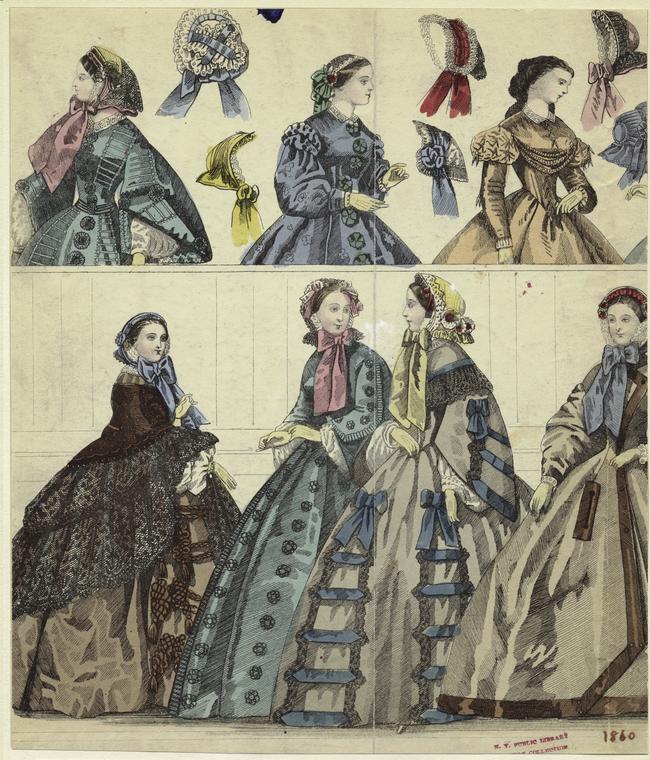
Women in pink capes, France, 1860
“A lady is never so well dressed as when you cannot remember what she wears.”

No truer remark than the above was ever made. Such an effect can only be produced where every part of the dress harmonizes entirely with the other parts, where each color or shade suits the wearer's style completely, and where there is perfect neatness in each detail. One glaring color, or conspicuous article, would entirely mar the beauty of such a dress. It is, unfortunately, too much the custom in America to wear any article, or shape in make, that is fashionable, without any regard to the style of the person purchasing goods. If it is the fashion it must be worn, though it may greatly exaggerate a slight personal defect, or conceal or mar what would otherwise be a beauty. It requires the exercise of some judgment to decide how far an individual may follow the dictates of fashion, in order to avoid the appearance of eccentricity, and yet wear what is peculiarly becoming to her own face or figure. Another fault of our fair countrywomen is their extravagance in dress. No better advice can be given to a young person than to dress always according to her circumstances. She will be more respected with a simple wardrobe, if it is known either that she is dependent upon her own exertions for support, or is saving a husband or father from unnecessary outlay, than if she wore the most costly fabrics, and by so doing incurred debt or burdened her relatives with heavy, unwarrantable expense. If neatness, consistency, and good taste, preside over the wardrobe of a lady, expensive fabrics will not be needed; for with the simplest materials, harmony of color, accurate fitting to the figure, and perfect neatness, she will always appear well dressed.

GENERAL RULES.

Women in dresses and bonnets, 1860

NEATNESS—
This is the first of all rules to be observed with regard to dress. Perfect cleanliness and careful adjustment of each article in the dress are indispensable in a finished toilet.  Let the hair be always smooth and becomingly arranged, each article exquisitely clean, neat collar and sleeves, and tidy shoes and stockings, and the simplest dress will appear well, while a torn or soiled collar, rough hair, or untidy feet will entirely ruin the effect of the most costly and elaborate dress. The many articles required in a lady's wardrobe make a neat arrangement of her drawers and closets necessary, and also require care in selecting and keeping goods in proper order. A fine collar or lace, if tumbled or soiled, will lose its beauty when contrasted with the same article in the coarsest material perfectly pure and smooth. Each article of dress, when taken off, should be placed carefully and smoothly in its proper place. Nice dresses should be hung up by a loop on the inside of the waistband, with the skirts turned inside out, and the body turned inside of the skirt. Cloaks should hang in smooth folds from a loop on the inside of the neck. Shawls should be always folded in the creases in which they were purchased. All fine articles, lace, embroidery, and handkerchiefs, should be placed by themselves in a drawer, always laid out smoothly, and kept from dust. Furs should be kept in a box, alone, and in summer carefully packed, with a quantity of lump camphor to protect from moths. The bonnet should always rest upon a stand in the band-box, as the shape and trimming will both be injured by letting it lie either on the face, sides, or crown.


ADAPTIVENESS —
Let each dress worn by a lady be suitable to the occasion upon which she wears it. A toilet may be as offensive to good taste and propriety by being too elaborate, as by being slovenly. Never wear a dress which is out of place or out of season under the impression that "it will do for once," or "nobody will notice it." It is in as bad taste to receive your morning calls in an elaborate evening dress, as it would be to attend a ball in your morning wrapper.


HARMONY—
To appear well dressed without harmony, both in color and materials, is impossible. When arranging any dress, whether for home,  street,  or evening,  be careful that each color harmonizes well with the rest, and let no one article, by its glaring costliness, make all the rest appear mean. A costly lace worn over a thin, flimsy silk, will only make the dress appear poorer, not, as some suppose, hide its defects. A rich trimming looks as badly upon a cheap dress, as a mean one does upon an expensive fabric. Observe this rule always in purchasing goods. One costly article will entirely ruin the harmony in a dress, which, without it, though plain and inexpensive, would be becoming and beautiful. Do not save on the dress or cloak to buy a more elaborate bonnet, but let the cost be well equalized and the effect will be good. A plain merino or dark silk, with a cloth cloak, will look much better than the most expensive velvet cloak over a cheap delaine dress.

"The war stopped being a joke when a girl like you doesn't know how to wear the latest fashion. And those pantalettes: I don't know a woman in Paris who wears pantalettes any more..." Rhett Butler after bringing Scarlett O'Hara the gift of a new hat, and she doesn't know how it's worn

FASHION—
Do not be too submissive to the dictates of fashion; at the same time avoid oddity or eccentricity in your dress. There are some persons who will follow, in defiance of taste and judgment, the fashion to its most extreme point; this is a sure mark of vulgarity. Every new style of dress will  admit of adaptation to individual cases, thus producing a pleasing, as well as fashionable effect. Not only good taste, but health is often sacrificed to the silly error of dressing in the extreme of fashion.  Be careful to have your dress comfortable and becoming, and let the prevailing mode come into secondary consideration; avoiding, always, the other extreme of oddity or eccentricity in costume.


STYLE AND FORM OF DRESS—
Be always careful when making up the various parts of your wardrobe, that each article fits you accurately. Not in the outside garments alone must this rule be followed, an ill-fitting pair of corsets, or wrinkles in any other article of the under-clothes, will make a dress set badly, even if it has been itself fitted with the utmost accuracy. A stocking which is too large, will make the boot uncomfortably tight, and too small will compress the foot, making the shoe loose and untidy. In a dress, no outlay upon the material will compensate for a badly fitting garment. A cheap calico made to fit the form accurately and easily, will give the wearer a more lady-like air than the richest silk which either wrinkles or is too tightly strained over the figure. Collars or sleeves, pinned over or tightly strained to meet, will entirely mar the effect of the prettiest dress.

ECONOMY—
And by economy I do not mean mere cheapness. To buy a poor, flimsy fabric merely because the price is low, is extravagance, not economy; still  worse if you buy articles because they are offered cheap, when you have no use for them. In purchasing goods for the wardrobe, let each material be the best of its kind. The same amount of sewing that is put into a good material, must be put into a poor one, and, as the latter will very soon wash or wear out, there must be another one to supply its place, purchased and made up, when, by buying a good article at first, this time and labor might have been saved. A good, strong material will be found cheapest in the end, though the actual expenditure of money may be larger at first.


COMFORT—
Many ladies have to trace months of severe suffering to an improper disregard of comfort, in preparing their wardrobe, or in exposure after they are dressed. The most exquisite ball costume will never compensate for the injury done by tight lacing, the prettiest foot is dearly paid for by the pain a tight boot entails, and the most graceful effects will not prevent suffering from exposure to cold. A light ball dress and exquisite arrangement of the hair, too often make the wearer dare the inclemency of the coldest night, by wearing a light shawl or hood, to prevent crushing delicate lace or flowers. Make it a fixed rule to have the head, feet, and chest well protected when going to a party, even at the risk of a crushed flower or a stray curl. Many a fair head has been laid in a coffin, a victim to consumption, from rashly venturing out of a heated ball room, flushed and excited, with only a light protection against keen night air. The excitement of the occasion may prevent immediate discomfort in such cases, but it adds to the subsequent danger.

DETAILS—
Be careful always that the details of your dress are perfectly finished in every point. The small articles of a wardrobe require constant care to keep in perfect order, yet they will woefully revenge themselves if neglected.  Let the collar, handkerchief, boots, gloves, and belts be always whole, neat, and adapted to the dress. A lace collar will look as badly over a chintz dress, as a linen one would with velvet, though each may be perfect of its kind. Attention to these minor points are sure tests of taste in a lady's dress. A shabby or ill fitting boot or glove will ruin the most elaborate walking dress, while one of much plainer make and coarser fabric will be becoming and lady-like, if all the details are accurately fitted, clean, and well put on. In arranging a dress for every occasion, be careful that there is no missing string, hook, or button, that the folds hang well, and that every part is even and properly adjusted. Let the skirts hang smoothly, the outside ones being always about an inch longer than the under ones; let the dress set smoothly, carefully hooked or buttoned; let the collar fit neatly, and be fastened firmly and smoothly at the throat; let shoes and stockings be whole, clean, and fit nicely; let the hair be smooth and glossy, the skin pure, and the colors and fabric of your dress harmonize and be suitable for the occasion, and you will always appear both lady-like and well-dressed.

HOME DRESSES

Woman in a "Home" or "Promenade" Dress 1860

MORNING DRESS—
The most suitable dress for breakfast, is a wrapper made to fit the figure loosely,  and the material, excepting when the winter weather requires woolen goods, should be of chintz, gingham, brilliante, or muslin. A lady who has children, or one accustomed to perform for herself light household duties, will soon find the advantage of wearing materials that will wash. A large apron of domestic gingham, which can be taken off,  if the wearer is called to see unexpected visitors, will protect the front of the dress, and save washing the wrapper too frequently. If a lady's domestic duties require her attention for several hours in the morning, whilst her list of acquaintances is large, and she has frequent morning calls, it is best to dress for callers before breakfast, and wear over this dress a loose sack and skirt of domestic gingham. This, while protecting the dress perfectly, can be taken off at a moment's notice if callers are announced. Married ladies often wear a cap in the morning, and lately, young girls have adopted the fashion. It is much better to let the hair be perfectly smooth, requiring no cap, which is often worn to conceal the lazy, slovenly arrangement of the hair. A few moments given to making the hair smooth and presentable without any covering, will not be wasted. Slippers of embroidered cloth are prettiest with a wrapper, and in summer black morocco is the most suitable for the house in the morning.


DRESS FOR MORNING VISITS—
A lady should never receive her morning callers in a wrapper, unless they call at an unusually early hour, or some unexpected demand upon her time makes it impossible to change her dress after breakfast. On the other hand, an elaborate costume before dinner is in excessively bad taste. The dress should be made to fit the figure neatly, finished at the throat and wrists by an embroidered collar and cuffs, and, unless there is a necessity for it, in loss of the hair or age, there should be no cap or head dress worn. A wrapper made with handsome trimming, open over a pretty white skirt, may be worn with propriety; but the simple dress worn for breakfast, or in the exercise of domestic duties, is not suitable for the parlor when receiving visits of ceremony in the morning.

 
EVENING DRESS—
The home evening dress should be varied according to circumstances. If no visitor is expected, the dress worn in the morning is suitable for the evening; but to receive visitors, it should be of lighter material, and a light head-dress may be worn. For young ladies, at home, ribbon or velvet are the most suitable materials for a head-dress. Flowers, unless they be natural ones in summer, are in very bad taste, excepting in cases where a party of invited guests are expected. Dark silk in winter, and thin material in summer, make the most suitable dresses for evening, and the reception of the chance-guests ladies in society may usually expect.


WALKING DRESSES—
Walking dresses, to be in good taste, should be of quiet colors, and never conspicuous. Browns, modes, and neutral tints, with black and white, make the prettiest dresses for the street. Above all, avoid wearing several bright colors. One may be worn with perfect propriety to take off the sombre effect of a dress of brown or black, but do not let it be too glaring, and wear but little of it. Let the boots be sufficiently strong and thick to protect the feet from damp or dust, and wear always neat, clean, nicely fitting gloves. The entire effect of the most tasteful costume will be ruined if attention is not paid to the details of dress. A soiled bonnet cap, untidy strings, or torn gloves and collar will utterly spoil the prettiest costume. There is no surer mark of vulgarity than over dressing or gay dressing in the street. Let the materials be of the costliest kind, if you will, but do not either wear the exaggerations of the fashion, or conspicuous colors. Let good taste dictate the limits where fashion may rule, and let the colors harmonize well, and be of such tints as will not attract attention.

FOR MORNING CALLS—
The dress should be plain, and in winter furs and dark gloves may be worn.


FOR BRIDAL CALLS—
The dress should be of light silk, the bonnet dressy, and either a rich shawl or light cloak; no furs, and light gloves. In summer, a lace or silk mantle and white gloves should be worn.


SHOPPING DRESSES—
Should be of such material as will bear the crush of a crowded store without injury, and neither lace or delicate fabrics should ever be worn. A dress of merino in winter, with a cloth cloak and plain velvet or silk bonnet is the most  suitable.  In summer,  a dress and cloak of  plain mode colored Lavella cloth, or any other cool but strong fabric, with a simply trimmed straw bonnet, is the best dress for a shopping excursion.

Women's fashions for winter in England

STORM DRESSES—
A lady who is obliged to go out frequently in bad weather, will find it both a convenience and economy to have a storm dress. Both dress and cloak should be made of a woolen material, (varying of course with the season,) which will shed water. White skirts are entirely out of place, as, if the dress is held up, they will be in a few moments disgracefully dirty. A woolen skirt, made quite short, to clear the muddy streets, is the proper thing. Stout, thick-soled boots, and gloves of either silk, beaver-cloth, or lisle thread, are the most suitable. The bonnet should be either of straw or felt, simply trimmed; and, above all, carry a large umbrella. The little light umbrellas are very pretty, no doubt, but to be of any real protection in a storm, the umbrella should be large enough to protect the whole dress.


MARKETING—
Here a dress of the most inexpensive kind is the best. There is no surer mark of vulgarity, than a costly dress in the market. A chintz is the best skirt to wear, and in winter a dark chintz skirt put on over a delaine dress, will protect it from baskets, and the unavoidable soils contracted in a market, while it looks perfectly well, and can be washed if required.


"A friendly hint to young ladies who wear those dear delightful barege dresses. Always let the slip (or whatever the mysterious garment is called) be as long as the outer dress?"- Punch


TRAVELING—
Traveling dresses should be made always of some quiet color, perfectly plain, with a deep mantle or cloak of the same material. When traveling with a young babe, a dress of material that will wash is the best, but it should be dark and plain. A conspicuous traveling dress is in very bad taste and jewelry or ornaments of any kind are entirely out of place. Let the dress be made of dark, plain material, with a simple straw or felt bonnet, trimmed with the same color as the dress, and a thick barege veil. An elastic string run through a tuck made in the middle of the veil, will allow one half to fall over the face, while the other half falls back,  covering the bonnet, and protecting it from dust. If white collars and sleeves are worn, they should be of linen, perfectly plain. Strong boots and thick gloves are indispensable in traveling, and a heavy shawl should be carried, to meet any sudden change in the weather. Corsets and petticoats of dark linen are more suitable than white ones, as there is so much unavoidable dust and mud constantly meeting a traveler.

Woman in Ball Costume 1860

EVENING DRESSES—
Must be governed by the number of guests you may expect to meet, and the character of the entertainment to which you are invited. For small social companies, a dark silk in winter, and a pretty lawn, barege, or white muslin in summer, are the most appropriate. A light head-dress of ribbon or velvet, or a plain cap, are the most suitable with this dress. For a larger party, low-necked, short-sleeved silk, light colored, or any of the thin goods made expressly for evening wear, with kid gloves, either of a color to match the dress or of white; black lace mittens are admissible, and flowers in the hair. A ball dress should be made of either very dressy silk, or light, thin material made over silk. It should be trimmed with lace, flowers, or ribbon, and made dressy. The coiffure should be elaborate, and match the dress, being either of ribbon, feather, or flowers. White kid gloves, trimmed to match the dress, and white or black satin slippers, with silk stockings, must be worn.

"There is such a variety of opinion upon the subject of mourning, that it is extremely difficult to lay down any general rules upon the subject." Mourning Dresses 1860

MOURNING—
There is such a variety of opinion upon the subject of mourning, that it is extremely difficult to lay down any general rules upon the subject. Some wear very close black for a long period, for a distant relative; whilst others will wear dressy mourning for a short time in a case of death in the immediate family. There is no rule either for the depth of mourning, or the time when it may be laid aside, and I must confine my remarks to the different degrees of mourning.

For deep mourning,  the dress should be of  bombazine, Parramatta cloth, delaine, barege, or merino, made up over black lining. The only appropriate trimming is a deep fold, either of the same material or of crape. The shawl or cloak must be of plain black, without border or trimming, unless a fold of crape be put on the cloak; the bonnet should be of crape, made perfectly plain, with crape facings, unless the widow's cap be worn, and a deep crape veil should be thrown over both face and bonnet. Black crape collar and sleeves, and black boots and gloves. The next degree is to wear white collar and sleeves, a bow of crape upon the bonnet, and plain white lace facings, leaving off the crape veil, and substituting one of plain black net. A little later, black silk without any gloss, trimmed with crape, may be worn, and delaine or bombazine, with a trimming of broad, plain ribbon, or a bias fold of silk. The next stage admits a silk bonnet trimmed with crape, and lead color, dark purple, or white figures on the dress. From this the mourning passes into second mourning. Here a straw bonnet, trimmed with black ribbon or crape flowers, or a silk bonnet with black flowers on the outside, and white ones in the face, a black silk dress, and gray shawl or cloak, may be worn. Lead color, purple, lavender, and white, are all admissible in second mourning, and the dress may be lightened gradually, a white bonnet, shawl, and light purple or lavender dress, being the dress usually worn last, before the mourning is thrown aside entirely, and colors resumed. It is especially to be recommended to buy always the best materials when making up mourning. Crape and woolen goods of the finest quality are very expensive, but a cheaper article will wear miserably; there is no greater error in economy than purchasing cheap mourning, for no goods are so inferior, or wear out and grow rusty so soon. 

From “The Ladies’ Book of Etiquette and Manual of Politeness” by Florence Hartley, 1860

🍽️Etiquette Enthusiast, Maura J. Graber of The RSVP Institure of Etiquette, is the Site Editor for Etiquipedia© Etiquette Encyclopedia