Showing posts with label Regency Era Tea. Show all posts

Friday, February 7, 2020

Sugar Etiquette in Jane Austen’s Era

When entertaining guests with afternoon tea, sugar and milk are essential to the properly set tea table. — Socially conscious Georgian and Regency era tea drinkers would either refuse sugar in their brew or only drink their tea with non-slave trade, East India Sugar. — Above are Georgian era sugar tongs: “These early scissor-shaped sugar tongs resembled candle douters, with loop handles and scrolled stems, terminating in wide, flat, shell-shaped claws for holding the sugar.”


“The introduction of coffee, tea, and cocoa into Europe provided the well-off with an alternative to alcohol for the 1st time in history. Chocolate drinking, coffee houses, and afternoon tea all acquired a gentility far removed from ale house bawdiness, and became 1st a luxurious amenity, then by the 4th quarter of the 17th century a middle-class necessity. But all 3 were crude, often bitter, and unconsumable, it was said, without sugar. From about 1680 the fashion for these hot drinks became a potent factor in the surge in sugar demand and consequent increased production, which progressively raised the sugar trade to the point of importance which it had assumed by 1700.During the 2nd half of the 18th century the temperance cause developed into an important social movement, initiated by various Protestant denominations and therefore strongest in northern Europe, in countries such as Britain and the Netherlands. 

“Sugared tea became the respectable alternative to beer or wine long before water was safe to drink without boiling. These changes in social habits significantly increased the demand for sugar and were probably responsible for about half of the increased trade. Socially conscious tea drinkers would either refuse sugar in their brew or only drink East India Sugar. The ingenious wording of a certain English china ware-house’s advertisement for sugar basins in the early 1800s exploited the contemporary wave of liberal thinking: ‘East India Sugar not made by Slaves,’ the pots were printed, thus enabling the purchaser to display his conscience publicly. ‘A Family that uses 5lb of Sugar a Week,’ the advertisement continued, ‘will, by using East India instead of West India, for 21 Months, prevent the Slavery, or Murder, of one Fellow Creature! Eight such Families in 191⁄2 years will prevent the Slavery, or Murder of 100!’” — from “Sugar and the Slave Trade,” H. Hobhouse

In the Georgian era, lumps of sugar, cracked from the loaf with steel sugar nippers, were lifted from sugar bowl to tea cup, with the aid of sugar tongs. The earliest reference to this constituent of the silver tea-equipage appears in W. King's cookery book, published in 1708. These early scissor-shaped sugar tongs resembled candle douters, with loop handles and scrolled stems, terminating in wide, flat, shell-shaped claws for holding the sugar.

The scissor design long retained its popularity and, as with scissors themselves, included the stork design of the third quarter of the eighteenth century. In this the tongs resembled a long-beaked stork, consisting of two long has joined together by a rivet forming the bird's eyes and serving as a pivot the body was shaped and chased to resemble wing feathers and the legs ended in circular loops for the fingers. — “1500-1820: Three Centuries of English Domestic Silver,” by Bernard and Therle Hughs, 1952


Etiquette Enthusiast, Maura J Graber, is the Site Editor for the Etiquipedia©️ Etiquette Encyclopedia

Thursday, January 2, 2020

Etiquette of Mote Spoon Use

Shown above, 3 Victorian era, hand painted, china tea strainers next to an Edwardian era, treen tea caddy, holding a sterling tea caddy spoon. Also shown are Regency era sugar tongs and a Georgian era mote spoon. Tea caddies are special containers used to store tea. When tea was first introduced to European market, tea was extremely expensive, and often kept under lock and key, under the watchful eyes of the mistress or master of the house.


Seventeenth century and 18th century “mote spoons” were originally known as “tea strainer spoons.” In that time period, a speck or tiny piece of something was called a “mote” – in this case, it would refer to a bit of tea leaf. back in the Georgian era, the loose tea leaves were added directly into the teapot and then the tea was poured into waiting cups. It was difficult to keep errant leaves from escaping into the tea cups, which would cause the tea to continue steeping, resulting in bitterness. By using the sharp, pointed end of the mote spoon, one could remove blockages from the inside of the spout of the tea pot, thus saving the intended flavor of the tea. This was one easy way to ‘de-mote’ one’s teapot. But what about one’s cup of tea?
According to ACSilver.co.uk.com, “The mote spoon’s short life began in the late 17th century, with the London Gazette describing these elegant and charming spoons as: ‘long or strainer spoons with narrow pointy ends’. Intended to be used to strain tea, the general public did not take especially well to the mote spoon, and they only remained as part of a tea-ware service until the end of the 18th century due to the arrival of the tea strainer.”

As with many other tea accoutrements, there is a debate in the overall tea community as to how the mote spoons’ pierced bowls were originally used. While the pierced bowl was perfect for skimming the tea poured into a cup, to remove any stray motes or bits of tea leaves, it also, as others believe, was correctly used for removing tea leaves from the tea caddy, allowing the dust or mote to drop through its pierced holes prior to use. This was presumably done by gently tapping the side of the spoon. Until more information is uncovered though, the debate will remain unresolved. – Information from a variety of sources, including TeaHappiness.com and MortonsAntiques.com


Etiquette Enthusiast, Maura J Graber, is the Site Editor for the Etiquipedia© Etiquette Encyclopedia

Thursday, March 19, 2015

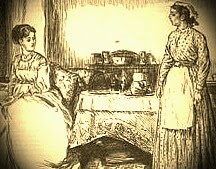
Regency Etiquette, Servants and Society

Regency Era British Authoress, Frances "Fanny" Trollope, was a keen observer of the life and people she met on her travels.

The greatest difficulty in organising a family establishment in Ohio, is getting servants, or, as it is there called, "getting help," for it is more than petty treason to the Republic, to call a free citizen a servant. The whole class of young women, whose bread depends upon their labour, are taught to believe that the most abject poverty is preferable to domestic service. Hundreds of half-naked girls work in the paper-mills, or in any other manufactory, for less than half the wages they would receive in service; but they think their equality is compromised by the latter, and nothing but the wish to obtain some particular article of finery will ever induce them to submit to it. A kind friend, however, exerted herself so effectually for me, that a tall stately lass soon presented herself, saying, "I be come to help you." The intelligence was very agreeable, and I welcomed her in the most gracious manner possible, and asked what I should give her by the year.


"Oh Gimini!" exclaimed the damsel, with a loud laugh, "you be a downright Englisher, sure enough. I should like to see a young lady engage by the year in America! I hope I shall get a husband before many months, or I expect I shall be an outright old maid, for I be most seventeen already; besides, mayhap I may want to go to school. You must just give me a dollar and half a week, and mother's slave, Phillis, must come over once a week, I expect, from t'other side the water, to help me clean." I agreed to the bargain, of course, with all dutiful submission; and seeing she was preparing to set to work in a yellow dress parseme with red roses, I gently hinted, that I thought it was a pity to spoil so fine a gown, and that she had better change it. "'Tis just my best and my worst," she answered, "for I've got no other."


And in truth I found that this young lady had left the paternal mansion with no more clothes of any kind than what she had on. I immediately gave her money to purchase what was necessary for cleanliness and decency, and set to work with my daughters to make her a gown. She grinned applause when our labour was completed, but never uttered the slightest expression of gratitude for that, or for any thing else we could do for her. She was constantly asking us to lend her different articles of dress, and when we declined it, she said, "Well, I never seed such grumpy folks as you be; there is several young ladies of my acquaintance what goes to live out now and then with the old women about the town, and they and their gurls always lends them what they asks for; I guess you Inglish thinks we should poison your things, just as bad as if we was Negurs." And here I beg to assure the reader, that whenever I give conversations they were not made À LOISIR, but were written down immediately after they occurred, with all the verbal fidelity my memory permitted.
                               
"I fear it may be called bad taste to say so much concerning my domestics, but, nevertheless, the circumstances are so characteristic of America that I must recount another history relating to them." Fanny Trollope, in her book "Domestic Manners of the Americans" 

This young lady left me at the end of two months, because I refused to lend her money enough to buy a silk dress to go to a ball, saying, "Then 'tis not worth my while to stay any longer." I cannot imagine it possible that such a state of things can be desirable, or beneficial to any of the parties concerned. I might occupy a hundred pages on the subject, and yet fail to give an adequate idea of the sore, angry, ever wakeful pride that seemed to torment these poor wretches. In many of them it was so excessive, that all feeling of displeasure, or even of ridicule, was lost in pity. One of these was a pretty girl, whose natural disposition must have been gentle and kind; but her good feelings were soured, and her gentleness turned to morbid sensitiveness, by having heard a thousand and a thousand times that she was as good as any other lady, that all men were equal, and women too, and that it was a sin and a shame for a free-born American to be treated like a servant.


When she found she was to dine in the kitchen, she turned up her pretty lip, and said, "I guess that's 'cause you don't think I'm good enough to eat with you. You'll find that won't do here." I found afterwards that she rarely ate any dinner at all, and generally passed the time in tears. I did every thing in my power to conciliate and make her happy, but I am sure she hated me. I gave her very high wages, and she staid till she had obtained several expensive articles of dress, and then, UN BEAU MATIN, she came to me full dressed, and said, "I must go." "When shall you return, Charlotte?" "I expect you'll see no more of me." And so we parted. Her sister was also living with me, but her wardrobe was not yet completed, and she remained some weeks longer, till it was.
             
The famous Georgian era painting, "Heads of Six of Hogarth's Servants," was seen as almost subversive in its day. It is unique among other paintings of the time, as the artist William Hogarth, chose to depict 5 servants of his household, in a manner more like those of the wealthier classes in the mid to late 1700s.  With the butler, closely surrounded by the others in the center of the painting, it depicts a close knit group. And it is just their heads depicted, as opposed to the servants performing their routine household duties. Thus, the artwork not only dignifies them, but humanizes them as well. The painting was displayed conspicuously in his estate home in full view of Hogarth's somewhat bemused guests, while at the same time the servants' facial expressions were purposely painted to convey all of the sincerity and deference expected of servant-class members of the era.
                   
I fear it may be called bad taste to say so much concerning my domestics, but, nevertheless, the circumstances are so characteristic of America that I must recount another history relating to them. A few days after the departure of my ambitious belle, my cries for "Help" had been so effectual that another young lady presented herself, with the usual preface "I'm come to help you." I had been cautioned never to ask for a reference for character, as it would not only rob me of that help, but entirely prevent my ever getting another; so, five minutes after she entered she was installed, bundle and all, as a member of the family. She was by no means handsome, but there was an air of simple frankness in her manner that won us all. 

For my own part, I thought I had got a second Jeanie Deans; for she recounted to me histories of her early youth, wherein her plain good sense and strong mind had enabled her to win her way through a host of cruel step-mothers, faithless lovers, and cheating brothers. Among other things, she told me, with the appearance of much emotion, that she had found, since she came to town, a cure for all her sorrows, "Thanks and praise for it, I have got religion!" and then she asked if I would spare her to go to Meeting every Tuesday and Thursday evening; "You shall not have to want me, Mrs. Trollope, for our minister knows that we have all our duties to perform to man, as well as to God, and he makes the Meeting late in the evening that they may not cross one another." Who could refuse? Not I, and Nancy had leave to go to Meeting two evenings in the week, besides Sundays.


One night, that the mosquitoes had found their way under my net, and prevented my sleeping, I heard some one enter the house very late; I got up, went to the top of the stairs, and, by the help of a bright moon, recognised Nancy's best bonnet. I called to her: "You are very late." said I. "what is the reason of it?" "Oh, Mrs. Trollope," she replied, "I am late, indeed! We have this night had seventeen souls added to our flock. May they live to bless this night! But it has been a long sitting, and very warm; I'll just take a drink of water, and get to bed; you shan't find me later in the morning for it." Nor did I. She was an excellent servant, and performed more than was expected from her; moreover, she always found time to read the Bible several times in the day, and I seldom saw her occupied about any thing without observing that she had placed it near her.


At last she fell sick with the cholera, and her life was despaired of. I nursed her with great care, and sat up the greatest part of two nights with her. She was often delirious, and all her wandering thoughts seemed to ramble to heaven. "I have been a sinner," she said, "but I am safe in the Lord Jesus." When she recovered, she asked me to let her go into the country for a few days, to change the air, and begged me to lend her three dollars. While she was absent a lady called on me, and enquired, with some agitation, if my servant, Nancy Fletcher, were at home. I replied that she was gone into the country. "Thank God," she exclaimed, "never let her enter your doors again, she is the most abandoned woman in the town: a gentleman who knows you, has been told that she lives with you, and that she boasts of having the power of entering your house at any hour of night." She told me many other circumstances, unnecessary to repeat, but all tending to prove that she was a very dangerous inmate. 


I expected her home the next evening, and I believe I passed the interval in meditating how to get rid of her without an eclaircissement. At length she arrived, and all my study having failed to supply me with any other reason than the real one for dismissing her, I stated it at once. Not the slightest change passed over her countenance, but she looked steadily at me, and said, in a very civil tone, "I should like to know who told you." I replied that it could be of no advantage to her to know, and that I wished her to go immediately. "I am ready to go," she said, in the same quiet tone, "but what will you do for your three dollars?" "I must do without them, Nancy; good morning to you." "I must just put up my things," she said, and left the room. About half an hour afterwards, when we were all assembled at dinner, she entered with her usual civil composed air, "Well, I am come to wish you all goodbye," and with a friendly good-humoured smile she left us.


This adventure frightened me so heartily, that, notwithstanding I had the dread of cooking my own dinner before my eyes, I would not take any more young ladies into my family without receiving some slight sketch of their former history. At length I met with a very worthy French woman, and soon after with a tidy English girl to assist her; and I had the good fortune to keep them till a short time before my departure: so, happily, I have no more misfortunes of this nature to relate.
 
          
Such being the difficulties respecting domestic arrangements, it is obvious, that the ladies who are brought up amongst them cannot have leisure for any great development of the mind: it is, in fact, out of the question; and, remembering this, it is more surprising that some among them should be very pleasing, than that none should be highly instructed. 

Had I passed as many evenings in company in any other town that I ever visited as I did in Cincinnati, I should have been able to give some little account of the conversations I had listened to; but, upon reading over my notes, and then taxing my memory to the utmost to supply the deficiency, I can scarcely find a trace of any thing that deserves the name. Such as I have, shall be given in their place. But, whatever may be the talents of the persons who meet together in society, the very shape, form, and arrangement of the meeting is sufficient to paralyze conversation. The women invariably herd together at one part of the room, and the men at the other; but, in justice to Cincinnati, I must acknowledge that this arrangement is by no means peculiar to that city, or to the western side of the Alleghanies.

Sometimes a small attempt at music produces a partial reunion; a few of the most daring youths, animated by the consciousness of curled hair and smart waistcoats, approach the piano forte, and begin to mutter a little to the half-grown pretty things, who are comparing with one another "how many quarters' music they have had." Where the mansion is of sufficient dignity to have two drawing-rooms, the piano, the little ladies, and the slender gentlemen are left to themselves, and on such occasions the sound of laughter is often heard to issue from among them. But the fate of the more dignified personages, who are left in the other room, is extremely dismal.

The gentlemen spit, talk of elections and the price of produce, and spit again. The ladies look at each other's dresses till they know every pin by heart; talk of Parson Somebody's last sermon on the day of judgment, on Dr. T'otherbody's new pills for dyspepsia, till the "tea" is announced, when they all console themselves together for whatever they may have suffered in keeping awake, by taking more tea, coffee, hot cake and custard, hoe cake, johny cake, waffle cake, and dodger cake, pickled peaches, and preserved cucumbers, ham, turkey, hung beef, apple sauce, and pickled oysters than ever were prepared in any other country of the known world. After this massive meal is over, they return to the drawing-room, and it always appeared to me that they remained together as long as they could bear it, and then they rise EN MASSE, cloak, bonnet, shawl, and exit.


From "Domestic Manners of the Americans," first published in 1832, by Frances 'Fanny' Trollope, 1780—1863 (Mother of the author Anthony Trollope)


Etiquette Enthusiast, Maura J. Graber, is the Site Editor for the Etiquipedia © Etiquette Encyclopedia 

Monday, April 7, 2014

Both Sugar and Slavery Shunned

 
Sugar in novelist Jane Austen’s England: Sugar chests with locks were popular in 18th century Regency Era home furnishings of the wealthy. ~ Above, image of an antique sugar chest from Pinterest.
Because it was so costly, sugar was kept locked up in the 18th century. It was sold in many grades, from the highly refined, pure white sugar that only the well-off could afford, down to the darkest of brown sugars used by the poor. Granulated sugar had been only recently invented and was not yet widely available. Sugar was molded into large, cone-shaped loaves weighing several pounds each that had to be broken up or grated before the sugar could be used. Sugar cubes would not be invented until 1843 – if people wanted sugar for tea, they had to first break it into irregular lumps with special tools called ‘sugar nippers,’ from which practices comes the traditional question “One lump or two?” ~ Bernadette Petrotta, Polite Society School


Sugar scuttles, servers and a cone of sugar ~ Sugar was molded into large, cone-shaped loaves weighing several pounds each that had to be broken up or grated before the sugar could be used.

Regency Era "tea time” varied according to the time of day and type of foods to accompany one's tea.  The High Tea, or “meat tea,” was more of an early evening meal. It would have been accompanied by hot dishes like cottage pie, shepherd’s pie, or baked fish or other savory dishes with  root vegetables. The Afternoon Tea, or “low tea,” did not become the fashion until the early 1840s.  

Concerned Regency Era women like Barbara Spooner Wilberforce, (depicted by Romola Garai in the movie Amazing Grace), boycotted sugar in an attempt to end the British slave trade.

For a time however, sugar in one's tea, or anything else for that matter, became very unfashionable across every segment of society. In Britain, women were very influential in the anti-slavery movement. Many authors in this time period emphasized the connection between British daily life and that of slaves. Famous poet, Robert Southey, spoke of tea as “the blood-sweetened beverage,” and Sir William Fox urged the tea drinker to “As he sweetens his tea, let him…say as he truly may, this lump cost the poor slave a groan, and this a bloody stroke with a cartwhip.” 

At a time when many citizens could not vote, the sugar boycott provided the underrepresented with a chance to act when Parliament had yet to do so. Isaac Cruikshank’s “The gradual abolition of the slave trade: or leaving of sugar by degrees in 1792” embodies the outcry against the consumption of slave-produced sugar in England


By 1791, according to Thomas Clarkson, an English abolitionist and leading campaigner against the slave trade in the British Empire, no fewer than 300,000 Britons had abandoned the use of slave-produced sugar in the West Indies. As Clarkson conducted his travels, he reported that there was no town through which he passed in which there was not one person who had stopped using sugar.
Quakers were at the forefront of the movement to boycott goods produced by slave labour in not only England, but the U.S. In 1824 Elizabeth Heyrick from Leicester in England wrote a pamphlet entitled “Immediate, not Gradual Abolition or An Inquiry Into the Shortest, Safest, and Most Effectual Means of Getting Rid of West Indian Slavery” which sold thousands of copies in Britain and the USA. She and many other women, many of whom were Quakers, believed that a boycott of sugar, one of Britain’s major imports, would help to make people aware of the suffering of slaves.
Some people used sugar from East India during this period. There were sugar bowls and other items produced which stated that the sugar a hostess or host was serving, had not been produced by slave labour. It seems that those who forsook sugar came from all classes and age groups within society. 

Inspired by her, women’s societies put out boycott pamphlets and started to compile a national list of all those who had given up West Indian sugar. Conditions in the plantations in which the slaves worked to produce sugar were appalling. Together with Susannah Watts she canvassed large areas of Leicester and promoted a boycott of sugar produced in the West Indies. By the following June almost a quarter of the town’s population had given up sugar. A few people used sugar from East India and there were sugar bowls and other items produced which stated that the sugar had not been produced by slave labour. It seems that those who forsook sugar came from all classes and age groups within society. – Compiled by Bernadette M. Petrotta and Maura J. Graber


 🍽Etiquette Enthusiast, Maura J. Graber of The RSVP Institute of Etiquette, is the Site Editor for the Etiquipedia© Etiquette Encyclopedia