Showing posts with label Japanese Customs. Show all posts

Tuesday, July 2, 2024

Etiquette of Banknotes in Japan

In Japan, there are books on etiquette for children, where there is always a chapter or even a separate book that talks about banknotes, who is depicted on them, and how to correctly understand and manage something. Moreover, for example, in Japan, according to tradition, children are given envelopes with money - “otoshidama” - on New Year’s Day. 

The topic of money and financial status is not directly a topic of etiquette. It is not customary to develop your own well-being, much less be interested in the well-being of other people. And just as we live in a world where paper bills are still used, I think it is important to know and have small talk on this topic.  

For example, in Japan there are books on etiquette for children, where there is always a chapter or even a separate book that talks about banknotes, who is depicted on them, and how to correctly understand and manage something. Moreover, for example, in Japan, according to tradition, children are given envelopes with money - “otoshidama” - on New Year’s Day. 

There are rules on how to put money in envelopes and how to give them. This suggests that traditions are preserved in this way, and children can learn to manage money from childhood. Perhaps this is why there are a large number of millionaires living in Japan.

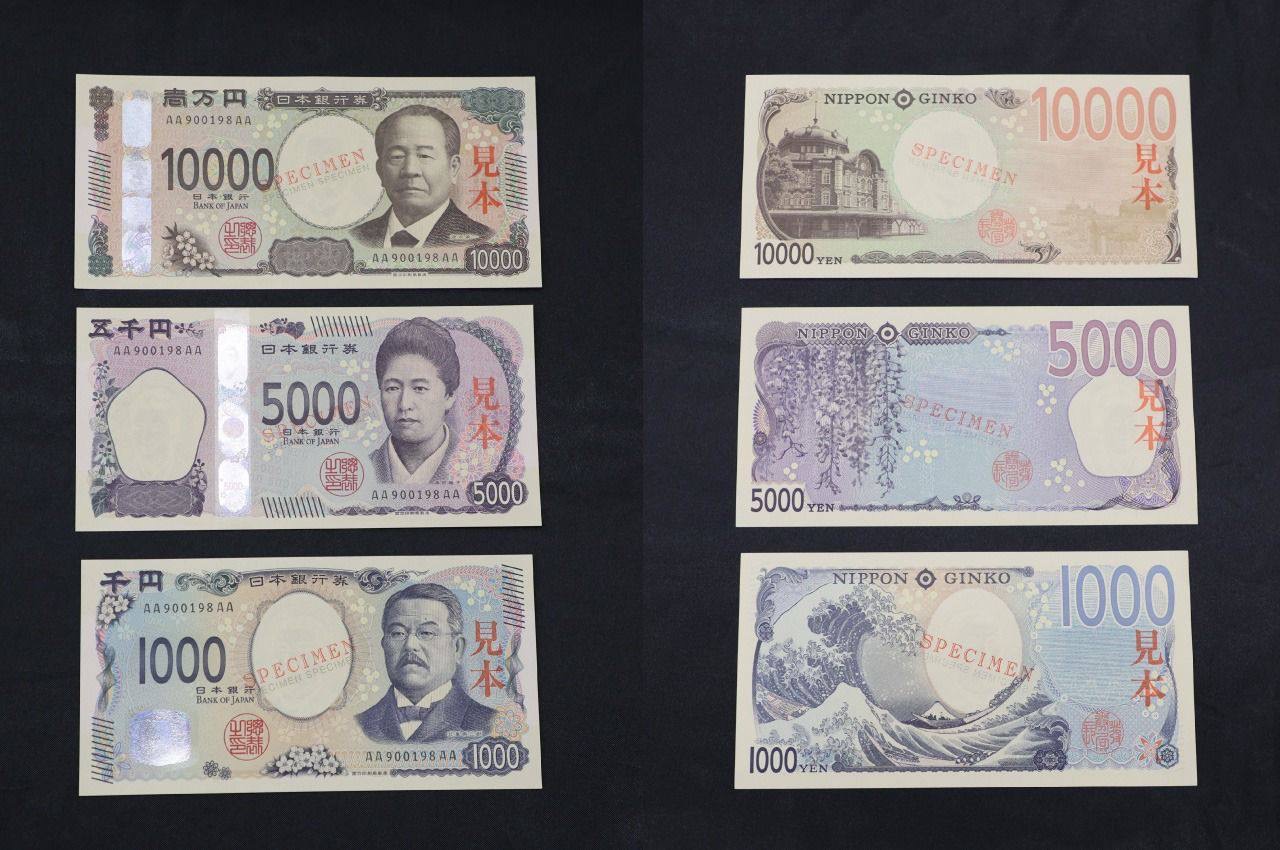
Each country has its own traditions about who and what is depicted on banknotes. Since I live in Japan, I want to tell you that new banknotes will be issued this year, namely on July 3, 2024. This was announced on December 12, 2023 by the Ministry of Finance and the Bank of Japan. I would like to note that this is the first update of banknotes in 20 years since 2004. 
In Japan, there is a tradition of depicting famous people; it so happens that on banknotes we see people from four main areas of life: representatives of education, business, medicine and art. The new 10,000 yen note features Shibusawa Eiichi, known as the "father of Japanese capitalism." Currently, this banknote depicts the writer, translator and philosopher, founder of Keio University, the first president of Tokyo Academy - Fukuzawa Yukichi. His portrait graced the 10,000 yen bill in 1984 and remains on the 2004 banknote, so the face on this banknote will change for the first time in 40 years.

On the 5,000 yen note, instead of Higuchi Ichiyo, the Meiji era writer (1868-1912), the portrait of Tsuda Umeko, who contributed to the development of women's education, will be used. It is recently that the situation of women has been changing. Beautiful representatives of Japan occupy high positions in various fields of activity. On the 1000 yen banknote, Noguchi Hideyo, a bacteriologist and eminent physician, will be replaced by Kitasato Shibasaburo - known as the "father of modern medicine" in Japan.
The reverse side of the bills has also been changed. So on the back of 10,000 yen there will be an image of the Tokyo station building, on the 5,000 yen note there will be wisteria flowers, and on the 1,000 yen note there will be the famous “Great Wave off Kanagawa” by the Japanese artist of the Edo period Katsushika Hokusai. This work influenced foreign artists and modern designers and jewelers.

I would also like to note that for the first time in the world, the banknotes will use hologram technology, which allows you to see portraits in three dimensions when viewed from different angles. As part of efforts to create a barrier-free environment, the bills have markings for tactile recognition of the denomination, and the numbers on the front side themselves are larger than on bills currently in use. 
From the moment the new banknotes are released, they will be available at cash desks of financial institutions and automated teller machines (ATMs). Banknotes currently in circulation can continue to be used. This is how you can pick up a banknote and learn the history of the country. In Japan, they treat everything with care, especially banknotes. For me, as an expert in the field of etiquette, the topic of banknotes from the point of view of historical facts and prominent people of Japan is both a good topic for small talk and a wonderful topic for small talk.

Meet Elena Gavrilina-Fujiyama, our newest contributor to Etiquipedia. Elena is a specialist in Japanese protocol and etiquette, and European social etiquette. The founder of the project Etiquette748, Elena is also a member of the National Association Specialist of Protocol. She authored the best-selling book “Japanese Etiquette: Ancient Traditions and Modern Rules” after living in Japan for over 20 years.
 

🍽️Etiquette Enthusiast, Maura J. Graber, is the Site Editor for the Etiquipedia© Etiquette Encyclopedia

Monday, May 16, 2022

Japanese Chopstick “Don’ts”

According to an article on Mashable, “Western foods,” like a breakfast of bacon and eggs, are eaten with a knife and fork, but, “In Japanese culture, chopsticks are more than utensils; they can be works of art.  It is common for families to have sets made of abalone or painted gold. Painted sets, which may include designs like cranes or cherry blossoms, are usually sealed with lacquer.”


Chopstick Etiquette
🥢 Saguri-bashi
To look for contents in a soup with chopsticks

🥢 Mayoi-bashi
To wander chopsticks over several foods without decision

🥢 Sashi-bashi
To pick up food by stabbing it

🥢 Neburi-bashi
To lick the tips of the chopsticks

🥢 Yose-bashi
To pull plate or bowl around with chopsticks

🥢 Hotoke-bashi
To stand chopsticks up in rice

🥢 Kaki-bashi
To shovel food into one’s mouth attached to plate or bowl

🥢 Nigiri-bashi
To hold two sticks together as one would grasp a knife to attack

🥢 Hashi-watashi
To pass food to another person, from chopsticks to chopsticks

🥢 Namida-bashi
To drip the sauce from the food or from the chopsticks


🍽Etiquette Enthusiast, Maura J. Graber, is the Site Editor for the Etiquipedia© Etiquette Encyclopedia

Friday, November 6, 2020

A Liberating Dining Etiquette Solution

The liberation wrapper is their solution — a paper wrapper that hides a large burger. On it is a picture of a women’s closed, smiling mouth. The video shows side shots of a woman eating behind the wrapper so you can see all the glorious big biting in action. From the front, it just looks like she’s slightly moving her head around. 


In 2013 the Liberation Wrapper was a way for Japanese women to chow down and look pretty


Chowing down on a cheeseburger as big as your head is one of life’s greatest pleasures. And getting ketchup on your nose or some meat juice on your chin is a welcome hazard. But according to the 
Freshness Burger chain in Japan, opening wide for a big bite is anything but attractive.

The restaurant has come up with something called the liberation wrapper. It’s a way for women in particular to take big bites of a burger and still look ladylike. The idea behind the wrapper is explained in a video. In it, Japanese etiquette and the concept of “ochobo” or small, modest mouth, are explained.

“In public, a large open mouth is regarded as ugly and rude,” says the video narrator. "... This means they are denied the wild pleasure of taking mouth-size bites of this big tasty burger freely in public.”

The restaurant explains that women are encouraged to cover their mouths in public when opening them, and that as a result, they never seem to sell their biggest burger.


The liberation wrapper is their solution to the problem. It’s a paper wrapper that hides the burger. On it is a picture of a women’s closed, smiling mouth. The video shows side shots of a woman eating behind the wrapper so you can see all the glorious big biting in action. From the front, it just looks like she’s slightly moving her head around. 


The wrapper is “freeing women from the spell of the “ochobo” mouth” says the video. It also says sales of the classic burger (the big one) to female customers is up 213% from the previous month.

Burger-eating etiquette for women in Japan is a complete 180 degrees from how it’s seen in the United States. Carl’s Jr. has turned hot girls and big burgers into its main ad campaign. You know the ones where a supermodel eats a burger and gets it all over the place and there isn’t a napkin in sight? — Jean Harris for L.A. Times, 2013


Etiquette Enthusiast, Maura J. Graber, is the Site Editor for Etiquipedia© Etiquette Encyclopedia


Wednesday, October 28, 2020

Work of Art or Diplomatic Insult?


Segev proudly posted a close-up photo of the offending shoe-filled dessert on his Instagram account, writing: “Chocolate selection from the world by #SegevArt — A metal shoe by @tomdixonstudio” ... “The dessert was served inside a sculpture by international artist Tom Dixon, whose works are displayed in major museums around the world and for the first time was displayed in Israel at a meal. This is a high-quality piece of art made of cast metal in the shape of a shoe; it is not a real shoe,” Segev’s publicist said in a statement, according to Yediot Aharonot.


There aren’t that many cultures where putting a shoe on the dining room table is acceptable behavior, but for the Japanese there is clear etiquette against allowing outdoor shoes inside.

That might explain the furor following a visit by Japanese Prime Minister Shinzo Abe and his wife, Akie Abe, to Israel last week.

After a day of high-level meetings on May 2, the Japanese leader was treated to a festive meal at the official residence of Prime Minister Benjamin Netanyahu and his wife, Sara Netanyahu. It was their second time in Israel, and the visiting couple were served a top-notch meal by celebrity Israeli chef Segev Moshe.

But then came dessert. A selection of delectable chocolate pralines - artistically arranged inside a shiny leather shoe.

Israel’s popular daily newspaper Yediot Aharonot wrote Monday that “Japanese diplomats, Israeli Foreign Ministry officials and high-ranking Israeli diplomats who previously served in Japan were shocked by the idea.”

“This was an insensitive decision,” the article quoted one unidentified senior Israeli official as saying. “There is nothing lowlier than a shoe in Japanese culture. Not only do they not wear shoes at home, you also won’t find shoes in their offices. This is disrespect of the first order.”

A Japanese diplomat, also not named by the paper, said: “There’s no culture in the world in which you put shoes on the table. What was the distinguished chef thinking? If it was humor, we don’t think it is funny; we were offended on behalf of our prime minister.”

Israel’s Foreign Ministry said in a statement that it was not involved in approving the dishes for the meal.

“We respect and appreciate the chef. He is very creative,” the ministry said.
Not an actual shoe, but a work of art filled with chocolate.


Segev’s creative side was displayed last May when President Trump visited Israel. Then, the celebrity chef served up a dessert in the shape of a double-headed Trump and Netanyahu.

On Sunday, Segev proudly posted a close-up photo of the offending shoe-filled dessert on his Instagram account, writing: “Chocolate selection from the world by #SegevArt — A metal shoe by @tomdixonstudio”

“The dessert was served inside a sculpture by international artist Tom Dixon, whose works are displayed in major museums around the world and for the first time was displayed in Israel at a meal. This is a high-quality piece of art made of cast metal in the shape of a shoe; it is not a real shoe,” Segev’s publicist said in a statement, according to Yediot Aharonot.

On Instagram, however, some of his 72,000 followers offered a different opinion:

“When you cook at a diplomatic meal, the minimum you can do is inquire about the guest. In Japan, shoes are considered contemptible, they always take off their shoes at the entrance to every home, both for themselves and for others,” wrote one person.

Another person wrote: “you don’t need to know any culture to know that serving shoes at a dinner is WRONG!” 


— From an article by R. Eglash, the Washington Post, Jerusalem 2018


Etiquette Enthusiast, Maura J. Graber, is the Site Editor for Etiquipedia© Etiquette Encyclopedia

Friday, October 16, 2020

Japanese Fan Etiquette


The Japanese have not, like the Spaniards, a “language of fans,” but an elaborate etiquette governs the design, material and use of fans.
  Photo source, Pinterest


The Fans of Japan

The art of Japan is a subject of interest to all cultivated people, and women have a constant affection for fans. Mrs. Salway, an English lady, in a recent lecture on “The Fans of Japan,” showed that fans (originally imitated from the palm leaf) were used in Japan upon almost every in life. Warriors went forth to fight bearing an iron fan, upon which a blood red sun was painted, as a shield, and upon the ensign borne by the army fluttered again, a fan. The Japanese have not, like the Spaniards, a “language of fans,” but an elaborate etiquette governs the design, material and use of fans. 

The Empress of Japan has a fan unlike that of any of her court ladies. It is adorned with chrysanthemums, orange and plum blossoms, and from the ends are suspended seven cords of seven colors, the cords having also their special significance. When a boy attains manhood on his 16th birthday, he is presented with a fan. Fans are exchanged also on making an acquaintance or betrothal, and at the New Year. 

In the most ordinary, occasions of life, also, fans are used. There is a fan upon which to hand cake at tea-time, and a fan to blow the fire with. Waterproof fans, too, there are, which ladies dip in water during the hottest weather and cool themselves by the evaporation. Many charming games are played with fans. Besides the fan and butterfly game there is a pastime in which the fan is flung at a small target in a particular manner. This game was illustrated by two Japanese gentlemen present.

Another sport, indulged in by ladies, is to catch fireflies on summer nights with their fans. And equally, popular is a kind of oriental ducks and drakes, in which fans are thrown upon a stream and caused to float for as long. —Colusa Daily Sun, 1893


Etiquette Enthusiast, Maura Graber, is the Site Editor for the Etiquipedia© Etiquette Encyclopedia


Monday, September 21, 2020

Japanese Spring Tea Ceremony

The springtime, Hanamatsuri, or “Flower Festival”— One of the key rituals practiced in spring is the tea ceremony, an ancient art that promotes appreciation of nature and beauty. 
-Photo source, Pinterest

The spring season in Japan is typically heralded by Hanamatsuri, or “Flower Festival,” and one of the key rituals practiced at this time of year is the tea ceremony, an ancient art that promotes appreciation of nature and beauty.
The tea ceremony, with its strict rules of etiquette, epitomizes the politeness that is a means of self-preservation in crowded Japan. Rules govern how to brew and serve the fine tea, how to hold and admire the tea bowls, and how the guest verbally responds to the server.
The goal of the ceremony is contentment in one’s lot and the teaching of the virtues of urbanity, respect, cleanliness and imperturbability, according to one published assessment.
More and more ceremonies are being conducted in the misono-dana style, in which participants sit in chairs rather than on their knees on tatami mats. Guests are traditionally served tea and small cakes, typical of those served at similar traditional celebrations in Japan.

Etiquette Enthusiast, Maura J Graber , is the Site Editor for the Etiquipedia© Etiquette Encyclopedia

Wednesday, September 11, 2019

Japanese Table Etiquette

Japanese food is usually cut up conveniently for eating, so a knife is not necessary. 
Photo source, Tumblr

On the whole, this is the same as for foreign meals, but the following points should be noted...
  • 1) When various dishes appear together, for example miso-soup, clear soup, chawanmushi (steamed egg and fish or meat), the hot things should be partaken of first. 
  • 2) The lids of bowls containing hot things are somewhat difficult to remove, owing to the steam inside, so the bowl must be held firmly, and then the lid may be easily taken off, and put upside down on the table. 
  • 3) Japanese food is usually cut up conveniently for eating, so a knife is not necessary. 
  • 4) Chopsticks—One of the two chopsticks is held between the first and second fingers, and moved, the other chopstick is held between the thumb and third finger. 
  • 5) The vessel is taken up in the right hand, placed in the palm of the left, and the food is eaten with the right hand holding the chopsticks. 
  • 6) When the meal is over, all lids must be replaced. 
  • 7) When chopsticks are taken from an envelope, they should be put back in it after use. 
  • 8) When no more wine is desired, the cup should be placed on the stand upside down. –Shin Nichibei, 1954 


Etiquette Enthusiast, Maura J Graber, is the Site Editor for the Etiquipedia© Etiquette Encyclopedia

Thursday, September 5, 2019

Customs and Etiquette in Japan

“In Japan one must spend at least half his time in the bath tub if he wants to be thought up to the customs of the country. Eminent doctors have agreed that the Japanese carries his cleanliness too far and makes too frequent use of his bath, which he always takes boiling hot. The hot bath is advisable in this climate, as every one soon learns by experience, and the publicity of the bath tubs, which are barely screened from the passers by in the streets, is a revelation of Japanese modesty. For centuries this nation has had her public baths, while we of the New World have brought them into our cities with the past generation.” 

Japan is a land of small things, and this fact is impressed on one as he goes from city to city, where he sees every family, however poor, occupying its own house and enjoying an existence apart from every other household—a state of things wholly unknown to the overcrowded centers in the United States and Europe. Most strangers have the impression that the people of Japan and China are so crowded together in their cities that they scarcely have breathing room. That this is a mistake is discovered on reaching Tokio, which numbers half a million less inhabitants than does New York, yet extends over 100 square miles. 

One may start out in a kuruma in the early morning and ride the greater part of the day through the residence portion of the capital of Japan, looking out upon the one-story wooden buildings. The foreigner who goes to Japan to see things, avoids the railroad when he contemplates short journeys or pleasure excursions into the country. Railway travel is cheaper in Japan than any other mode of traveling, but the natives prefer to travel by water or by kurumas if they are not going a great distance. When one contemplates traveling about over the country his route must be specified minutely, and no deviations are allowed other than his passport calls for. There is no more delightful trip than a ride of a few hours through the rice fields and mulberry plantations, beautified by lotus ponds. The mulberries have no chance to grow up into the trees, but are simply clusters of green leaves on the tender shoots which feed the silkworm. 

You are surprised that at the inns everywhere you eat in your own room, as there is no such thing as a separate dining room. When you arrive at an inn, they assign you a room in which you sleep, eat and entertain your friends. All this is quite compatible with comfort, for at the clapping of your hands, your dinner table glides in, guided by a pretty Japanese girl, who kneels and bows before you so often, as she comes and goes, that you begin to wonder if you are not a Prince instead of an ordinary traveler seeing the sights of the orient. 

The fine tablecloth is spread and the dishes appear as if by magic, one girl serving each guest. You sit on your mat with your chin on a level with the tiny table and its hand-painted china, and all your wants are looked after without your having to utter a command. The samisen played by nimble fingers aids your digestion and supplies the finishing touch to the dinner. After the meal the girls remove tho table and all traces of the dinner and the dining room becomes the reception room. The college professor may be one of the curious callers, and as Japanese etiquette permits a man to stretch out his visit to any length from two hours to ten, you are the unwilling victims of the professor's insatiable curiosity, which permits him to ask questions pertinent and impertinent. For instance, when you show him a pair of very old and handsome bracelets, a brooch and an amulet collected in a trip through the country, he insists on knowing the exact price of each. 

At bedtime the little girls came running in, their arms filled with quilts and white sheets, which they spread on the floor for beds. Then they bring the makura, or pillows, which are little wooden boxes with rocker bottoms, and the most uncomfortable inventions that ever sprang from the brain of man. Across the entire room they stretch a large mosquito net. Their duties at an end, they retire with many bows and leave you to woo sleep between the sheets on the hardest floor in Christendom. 

In Japan one must spend at least half his time in the bath tub if he wants to be thought up to the customs of the country. Eminent doctors have agreed that the Japanese carries his cleanliness too far and makes too frequent use of his bath, which he always takes boiling hot. The hot bath is advisable in this climate, as every one soon learns by experience, and the publicity of the bath tubs, which are barely screened from the passers by in the streets, is a revelation of Japanese modesty. For centuries this nation has had her public baths, while we of the New World have brought them into our cities with the past generation. 

The Japanese have a multitude of quaint customs, many of which have common sense as their basis. When a guest has outworn his welcome, the mistress of the-house does not grow outwardly impatient in his presence and throw out little hints of what duties will claim her attention soon, but she prepares the daintiest luncheon imaginable and puts it into the prettiest of boxes, which she wraps with rice paper and ties with a ribbon. Then, come morning when no other members of the household are present, all having been warned to keep out of the way, she puts the lunch box with the sweetest of smiles into his hands. Before the lunch hour the guest, if he be wise, has vanished like a morning cloud, and no one can tell whither. Even the poorest people have the habit of going every morning between the hours of 5 and 7 to the water's edge, carrying in their hands their tooth brushes, which they use vigorously as soon as they reach the stream, which is not any too clean because it flows down from the rice fields. – Los Angeles Herald, 1904


Etiquette Enthusiast, Maura J Graber, is the Site Editor for the Etiquipedia© Etiquette Encyclopedia

Friday, August 9, 2019

Etiquette of Japan’s Urasenke Tea

Although the tea ceremony originally was an art practiced only by upper class men, today tea schools have become girls’ finishing schools. “It is true that young people in Japan today lack knowledge in etiquette, but that is because there is so little opportunity to learn or use it in the home,” Yaeko Shiozuki, 1976


History of Japanese Etiquette in Tea Ceremony

Learning to serve or drink a cup ot tea takes months of instruction and embodies a history of Japanese etiquette, says Yaeko Shiozuki of Japan, a woman whose ancestors founded the tea ceremony. Shiozuki, 58, has 3000 tea ceremony students in Tokyo and has used her knowledge of this art and its philosophy to write seven books on manners and etiquette. The ceremony, dating back to the 15th century, enjoys a steady popularity among Japanese men and women of all ages, she said. Founded in Zen Buddhism and long practiced for its spiritual value, it is also a source of good manners in private Japanese life. The ritual includes the proper way to walk, turn around, sit, handle drinking and eating utensils, bow, and many other forms of behavior prescribed by the strict code of etiquette for polite society in the Orient. 

“It is true that young people in Japan today lack knowledge in etiquette, but that is because there is so little opportunity to learn or use it in the home,” said Mrs. Shiozuki as she relaxed in a rattan chair in the spacious, carpeted lobby to her tea ceremony school. “Today's parents grew up in the World War II years when there were few chances to learn this etiquette.” Mrs. Shiozuki, however, comes from an illustrious family whose ties to tradition have transcended wars and the coming of Western ways. Her father, Soshitsu Sen, is the 14th generation of the family that founded the Urasenke Tea Ceremony, the most prominent of various styles, with an estimated five million followers. Her brother, also taking the name Soshitsu Sen, now holds the venerable position that includes among its privileges performing the tea ceremony for visiting state guests. 

Mrs. Shiozuki's name became a household word with the publication in 1970 of her bestseller “A Guide to Ceremonies,” which gives step-by-step instructions for weddings, funerals and other formal occasions. Seated on traditional tatami or straw mats in a Tokyo tea room, officers of Japanese Self-Defense Forces hear lecture on manners from Mrs. Yaeko Shiozuki, whose ancestors founded the tea ceremony. Her other books tell how to give presents, write letters, wear kimonos, meet people, associate with relatives and behave in different areas of society. She also tells how to live in crowded apartment complexes without becoming angry or frustrated. Japanese manners have had to undergo substantial changes with the move from living in traditional straw-matted, or tatami, rooms to the beds, high tables and chairs of Western-style homes, Mrs. Shiozuki said. But she insists that the basics of modern etiquette must still be founded in the tea ceremony. 

“It teaches us how the hostess and guest can make each other feel as welcome as possible. It is more than just actions, but something deep down,” she explained. Although the tea ceremony originally was an art practiced only by upper class men, today tea schools have become girls’ finishing schools. Mrs. Shiozuki's grandfather began to admit women to tea classes during the Meiji era (1862-1912). Now women are 80 per cent of its followers. In the years of Japan's rapid Westernization the number of male students dropped greatly, but now it has begun to increase. “I think, there is a feeling of wanting to go back to the home town and do something the same way their ancestors did,” said Hiroo Masuda, a tea master in one of Mrs. Shiozuki's three schools. “After World War II Japan became too Americanized and threw away many of the old traditions.” There are about a thousand places to learn the tea ceremony in Tokyo alone, with enrollments averaging about 20 to 30 people. –By Kathryn Tolbert, Tokyo (AP), 1976


Etiquette Enthusiast, Maura J Graber, is the Site Editor for the Etiquipedia© Etiquette Encyclopedia

Wednesday, August 7, 2019

Japanese Candy Etiquette


Candy etiquette for Japanese children in the US was just as stringent as the etiquette for those in Japan, ten years later. 


It Is Not Considered Good Form to Partake of Sweets 
(or any other foods) on the Street in Japan...
Children Observe Rule

Homer Croy writes of the Japanese in Leslie's: “One day as I was going along the street I saw a candy man sitting on a stool beside his cart fashioning delicacies with his two flying thumbs. Taking a ball of candy mixture, he would give it a few pinches, a twist, dab on a red spot and there would be a fish. Taking up another ball he would give it a few twists and he would have a radish. Half a dozen of these, he would put into a thumb-made candy plate, the size of a chocolate wrapper, and sell for half a cent. Buying a plate of tiny delicacies I gave it to a girl, expecting to see her down it in good old American fashion, but instead of falling on it greedily, she made a courtly bow and tore down the street as fast as her wooden shoes would let her. 

I looked after her in astonishment, thinking that this upset every child theory I had, and I determined to try it again. So I waited until the two flying thumbs had molded another delicacy and proffered this to a second child. Down the street she flew, too, her walnut knot of hair wobbling excitedly. When I bought the third delicacy I gave it to a child that was weighted down with a baby on her back and followed after, while she went bobbing down the street, the baby's head rolling heavily. I found her sitting on the floor, eating the sirupy fish and candy radishes with many delighted sucks and appreciative grunts. Then I understood; it was not polite to eat on the street, but under her father's gray tile roof it was the height of form to dispose of the sweets with all the gustatory gurglings that her delighted soul wished. – Sausalito News, 1916


Etiquette Enthusiast, Maura J Graber, is the Site Editor for the Etiquipedia© Etiquette Encyclopedia 

Tuesday, December 4, 2018

Etiquette, Custom and Conscience

In the 1980 historical miniseries, Shogun, John Blackthorn, self-conciously bathing with Mariko, is the first English person to arrive in Japan and must find a way to survive in a culture which considers him to be a barbarian due to his European habits (eating the meat of birds he has killed, eating with one’s hands and rarely bathing.)– photo source Pinterest


It is said that “it is conscience that makes cowards of us all,” and there is much talk ot the “whisperings or conscience,” the “wee small voice” and all that; but whence comes that voice? Is there an immutable principal of right and wrong placed somewhere in the mind that tells one of right and wrong? Or is, it not custom —that to which we have been accustomed? A writer in the New York Sun says that travelers in Japan tell of the unconcern with which a Japanese will take a bath in full publicity, and the custom has impressed foreigners as immodest. 

An Englishman who has been long in the country says there is really nothing immodest in the promiscuous bathing of men, women and children from a Japanese point of view. With them, cleanliness is the object sought for, and the etiquette of the bathroom differs from the etiquette of the parlor. With Europeans, he says, the attitude of waltzers is only permitted when the music is played. It is something like this with the Japanese bathers. When the necessary operation of washing or doing other work requires it, to strip becomes a duty. 

On the other hand, a Japanese woman would scorn to appear decollete. To her eye, our ballrooms are an astonishment, and the exposure of the person for display is incomprehensible. This writer thinks that the Japanese are not excelled by their Western brethren in modesty.– Weekly Colusa Sun, 1892


Etiquette Enthusiast, Maura J Graber, is the Site Editor for the Etiquipedia© Etiquette Encyclopedia

Friday, July 27, 2018

Japanese Etiquette and Kissing

Young love blossoms in the wonderful Japanese film, “Our Little Sister”... “Public displays of affection have always been frowned upon, and still generally are: a kiss on the lips is serious business.” Western-style, or American-style kissing, was not something many Japanese had seen, as it was cut out of movies shown there until after WWII. When many first saw it, they considered it strange, if not to mention, unhygienic. 
“There are all kinds of kissing all over the world, but traditionally, in Japan there has only been two kinds and they are the romantic kissing done by couples or kissing babies. Public displays of affection have always been frowned upon, and still generally are: a kiss on the lips is serious business.” – Source of quotes, JapanToday.com, 2012. Photo source Pinterest

The  Notion Counter... He Wants Kissing Taught

As more or less generally known, kissing has never been developed to any great extent, either as a science or as an art, among the Japanese. Some time ago, Judd Mortimer Lewis, famed columnist of the Houston Post-Dispatch, visited the flowery kingdom, and noting the neglect of this delectable practice, humorously suggested the establishment of a chair of osculation at a Japanese university, going so far as to offer his services as instructor. 

A forward-looking native, who perhaps had visited the Occident, eagerly expressed approval of the idea, in the following letter to Mr. Lewis: 
‘‘I am the only investigator on kissing in Japan. Kissing must be known of the Japanese, but they do not care for it. The Japanese governor does not permit to teaching them obviously even if it is so important a thing in etiquette. I wrote five times an essay on kissing,  but the Japanese Metropolitan Police look at them as demoralization. You say you will be able to be the lecturer on kissing. The day will come, I am wishing, when I myself will teach. The Japanese government are cutting the scene of kissing in the film without the knowledge of it.”
- LaHabra Star News, 1933

Etiquette Enthusiast, Maura J. Graber, is the Site Editor for the Etiquipedia© Etiquette Encyclopedia 

Sunday, September 3, 2017

Thai Diplomacy, Japanese Etiquette

In many ways, Thai and Japanese societies are similar, with sophisticated rules of etiquette and many shared cultural affinities...

In 2014, the Thai embassy released a "do’s and don’ts" list for Thai tourists when visiting Japan — Here is the list below:

BANGKOK – The Thai Embassy in Japan has some tips for Thai visitors: Don’t put your chopsticks in the serving bowl. If driving, stop for pedestrians at crosswalks. And just because you have kids doesn’t mean you can cut ahead in line.

The advice is part of an online manners guide the embassy posted on its Facebook page in response to criticism on social media about the behavior of Thai tourists in Japan. Most of the criticism came from Thai residents in Japan who reported sightings of “inappropriate” behavior on a popular Thai web forum, which inspired the embassy’s consular chief to pen the list of "10 do’s and don’ts."

“Japanese society is very unique. It is a society with strict rules that are not always obvious to visitors,” said Jessada Nanthachaiporn, the embassy’s first secretary. He said he intended the list as an educational tool, not as criticism of either culture.

Written in Thai, the code of conduct begins with escalator etiquette: Stand on the left, or walk on the right — except in the Kansai region, where the opposite applies.

There is separate elevator advice: The first person in holds the open button for others and should be the last person to leave.

In many ways, Thai and Japanese societies are similar, with sophisticated rules of etiquette and many shared cultural affinities, Jessada said. From a young age, Thais are taught the concept of “marayat” — or “good manners” — and values like humility and respect for elders, which are similar in Japan. But the same rules do not always apply.

His list offers advice on mobile phone use in buses and trains (“turn the ringer to silent”) and shopping: “Do not interrupt salespeople who are helping other customers.”

In Thailand, drivers often ignore crosswalks and zoom past pedestrians trying to cross. But in Japan, “Drivers must stop at zebra crossings and wait for people to cross the road, without honking the horn.”

Thais tend to eat family-style, sharing dishes, often without serving spoons. In Japan: “Do not use your chopsticks to pick up food for other people.”

Rather than take offense, Thais have applauded the list. The Facebook post has been shared and liked more than 1,300 times since it was posted last week. Commentators on Thai blogs have expressed admiration for Japanese customs, suggesting that if Thais adopted similar manners at home, the country would be seen as more developed. — Japan Times, 2014


Etiquette Enthusiast, Maura J. Graber, is the Site Editor for the Etiquipedia© Etiquette Encyclopedia 

Saturday, June 4, 2016

Etiquette Japan: Visits, Gifts and More

In modern day Japanese culture, wrapping paper and boxes are extremely common. However, the traditional cloth wrapping (furoshiki) is increasing in popularity, particularly as an ecological alternative to wrapping paper.

Etiquette of Present Giving

The etiquette of present-giving is in itself very complicated, and not the least arduous of the duties which fall on the head of a household. A present is not necessarily confined to any season, but may be given at any time; indeed it is the appropriate accompaniment of a visit. Fish, fruit, eggs neatly packed in wooden boxes, cake or a piece of silk or crepe are the most common presents. They are brought in by the guest on a neat tray, or else sent beforehand by a servant. Presents are usually wrapped up in white paper, folded so that the left edge of the paper will lie under the right, and they are tied with a peculiar string, half red and half white. This string must be not only tied in a certain way, but the package must bear on it written characters which signify that it is a present.

There are a number of symbols which may be used, representing a greater or less amount of humility and respect on the part of the giver. The characters have various meanings, some being words of good luck and others signifying the smallness and unfitness of the present for acceptance, a term most commonly used being so shina—literally a common, coarse, or rough article. Accompanying each present is a little bit of dried fish, which is neatly folded in paper and is sent for good luck. On occasions of misfortune, when there has been death in the family, the etiquette is entirely different, and not only the gift itself but the manner of wrapping and the charmed characters it bears must all be changed. 


Visits Are Infrequent

Formal visits are exchanged in person between relatives and friends, but Japanese ladies go out much less frequently than the men, and after the visit at New Year's, which every one makes, perhaps only one or two calls may be made on any one friend during the year. Gentlemen are far more social, and frequently exchange visits with each other, but there is no friendly intercourse with the ladies of the family. The mistress of a household exchanges salutations with the guests, provides for their entertainment, and accompanies them to the door on their return, but she is not expected to remain in the guest room and converse with them, except in the absence of her husband and of other male members of the family.

Refreshments —usually tea and cake —are always served to a guest almost immediately on his arrival, together with the charcoal brazier, which holds the fire for lighting the little Japanese pipes carried by almost every one in the girdle of the kimono. If the guest does not eat the cake or candy served to him it is quite the proper thing when he is leaving for some member of the household to wrap it up in the paper in which it has been placed and give it to him to take home and it is the guest's part to show his appreciation by taking it, rather than leaving it behind as something worthless. He slips it into the long sleeve of his dress, whence it is taken out by the little ones at home, who are only too happy to have the father's omiyage for their own, for the children are very fond of the sweet dainties, of which there is such an abundance in Japan. 


Hospitable Japanese Customs

A guest who has come from any distance is always asked to a meal, but it is frequently served to him separately on a little lacquer table brought in to the guest room. One or two members of the family may take their meal with him, while the others of the household have their dinner in a separate room. The host, in asking his guest to dine, must always preface his invitation by modestly saying that there is nothing fitting for his friend's entertainment, but he begs him to partake of what they have. The guest bows his thanks and then begins the meal on the little lacquer table, with rice bowl, soup bowl, saucers and chopsticks neatly arranged in place, and a kneeling maid ready to serve the hot rice whenever it is called for. 

As sandals and clogs are worn in the streets and left outside at the door on entering a house, the footgear of a guest must be looked after and neatly placed for him at the door before his return. Should it not have been fixed by the servants, some member of the family must do it at the time the guest departs. As the touching of any article of footgear is a very lowly act in Japan, as in all Eastern countries, the guest must feel honored by this courtesy, make his bow, and say the appropriate words of thanks. 

Whether or not a guest is welcomed and entertained as he should be, he is sure of being well-sped when he is departing. Custom orders that all members of the family and those of the servants who happen to be around shall accompany the guest to the door to bow and see him off. Five or six bowing figures around a doorway is by no means an unusual sight, and it gives one a sense of importance to depart with such a show as a family of even moderate size can make, not to speak of larger and wealthier households, with their retinues of servants.

Curious Every Day Ceremonies

Besides these every-day customs there are many curious ceremonials in Japanese life, many of which the present era has given up or abbreviated. Of those that remain, the most interesting is, perhaps, the old ceremonial tea making, which is a very complicated and difficult affair, and can only be learned after much practice and many instructions from a master of etiquette. Their service at a ceremonial tea party is an art in itself and there are professionals who teach exactly how it is to be carried out. 


The ceremony of making this peculiar and rare kind of tea and of serving the dinner which accompanies it lasts several hours, and the whole entertainment is from beginning to end a very curious and complicated one, in which rules of etiquette are very rigid. Every motion of the hand when preparing the powdered tea is fixed by rule, as are also the manner of presentation and the accepting of the cup by the guest. It takes many long hours of practice before one is skillful enough to do it gracefully and without one mistake. 

The tea room in which the entertainment is held, the utensils, the ornaments of the tea room and everything connected with it are and they must be in keeping with the esthetic regulations which govern the whole entertainment. The making of the tea is taught in many girls' schools and by special masters in the profession.—Sacramento Daily Union, 1897


🎁Etiquette Enthusiast, Maura J Graber, is the Site Editor for the Etiquipedia© Etiquette Encyclopedia

Saturday, January 23, 2016

Japanese Etiquette News

 Pasadena's Gurinalda Hotel, ca. 1907 — "Pasadena’s Japantown was established in the early 1900’s... While some Japanese immigrants became more conversant in English, they often branched into related businesses, such as wholesale and retail produce, grocery stores, nurseries, and gardening. Also, many found work in domestic services as houseboys, laundry service, cafes, and boarding houses." From www.japantowns.org

Japanese Immigrant Starts Daily Paper to Instruct in Etiquette, Morals and Customs

Pasadena, CA. 1910 —A Japanese daily paper of four pages has been started in this city by Maurice Tanahi, an employee of Hotel Gurinalda and former student of the Congregational Japanese mission on South Marengo Avenue. 

Editor Tanahi is 20 years of age and has been in this country four years. He says he will endeavor to instruct his people in American etiquette, morals and customs. He declares that to win success the Japanese must lay aside Oriental customs. He says he will confine his editorials largely to educational development. — Los Angeles Herald, 1910

Etiquette Enthusiast, Maura J. Graber, is the Site Moderator and Editor for the Etiquipedia© Etiquette Encyclopedia

Friday, June 12, 2015

Etiquette for Sushi Bars

When kids and teens find fun at the table, they take to dining etiquette more easily ~ A Panda Shaped, DIY, Bento Sushi Maker Rice Ball Onigiri Mold Mould with Nori Punch found on Ebay 
If you are serious about your sushi, always sit at the sushi bar. Make eye-contact with the itamae or head sushi chef. He is traditionally the one closest to the sushi bar's entrance. If that is not doable, make eye-contact with the junior chef nearest to you. Always remember to ask, "What’s fresh?" This shows you’re serious about your dining experience at the sushi bar and you are more likely to get the freshest fish in the house.


Eat in order. Appreciating sushi means detecting the subtle flavors of the food, noting the texture and the temperature. Start with sashimi, then sushi with rice, then miso soup. The pickled ginger should only be eaten as a palate cleanser. Do this between bites. 


Use your chopsticks if you are eating sashimi. If eating rice topped with fish (nigiri sushi), or sushi rolls, it is proper etiquette to use your hands and not your chopsticks. The loosely packed rice will fall apart if pinched, especially with well-made sushi.


"While there really are no absolute requirements, other than general politeness, there are certain behaviors that may make your dining experience more pleasant, and the staff more attentive and interested in you." - From Sushifaq.com

Nigiri sushi already contains a bit of wasabi between the fish and the rice. It reflects what the sushi chef feels is the proper balance of wasabi to fish, and he will appreciate your enjoyment of that balance. For eating sashimi, mixing a small bit of wasabi into your soy sauce is allowable.


Your fish is already on dry land, so please don’t drown your sushi. Some people immediately dump a lot of salt onto their food, which drives foodies, chefs and sushi fans just nuts! A person who promptly dunks into the soy sauce is considered the equivalent. A little sauce is fine, however, please just don’t dip into it with the sushi rice-side first, otherwise it will crumble and fall apart. Instead, try flipping the piece over and letting the fish lightly touch the sauce.


Sashimi, nigiri sushi, and maki rolls should be consumed all in one bite if possible. This is much easier done in Japan than in the super-size-me U.S.A. In Japan, slices of fish and rolls tend to be much smaller. If you are eating your sushi or roll in more than two bites, you need to master a more elegant style of dining.

Friday, April 24, 2015

Japanese Etiquette and Lollipops

Eating on sidewalks, or while walking down a street, has long been considered bad manners in Japan, as well as in many other countries. 

Bad Form for Japanese Children to Eat Sweets on the Streets of Seattle


Seattle Washington, December 25, 1906-
“While agitation is in progress on the question of Japanese attending American schools a sidelight thrown on the decorum demanded of Japanese schoolchildren at home is interesting. The Minister of Education, Mr. Makino, according to Tokio advices, has just issued private instructions to Governors of prefectures concerning the behavior of school children on the streets. 

“The Minister says: ‘Boys and girls are to be seen eating sweets and fruits on their journeys to and from school. This habit is to be condemned at once as very bad manners. This highly reprehensible contact tends to impair the youthful character and the social manners and education are likewise affected. I urge upon you therefore, to take stringent measures to put a stop to this evil.’”
 
In 1906, for five months, all “Oriental” children, based on their parentage and not their origin of birth, were ordered by the Board of Education to be pulled out of their schools and be segregated into “Oriental” schools. The parents of these children, first generation Japanese immigrants known as the Issei, fought adamantly for their reintegration into public schools. Their argument was, “The Nisei never could be expected to be good Americans if they were not permitted to associate freely with Americans of other racial and ethnic backgrounds, and if they were to be segregated on the basis of race.” The parents wanted to spare their children from experiencing the prejudices that were forced upon them. In successfully overturning the order of school segregation, the first generation Issei encouraged their children to make the most of the opportunities that they never had. The Issei felt their children were the “pioneer generation,” who must “carry on the proud heritage of our forefathers to make contributions to American life.” Source~ Seattle Dept. of Education

In Seattle, a large “Japantown” flourished at the south end of downtown in the early 1900s. A wide variety of small businesses served the growing population of Japanese immigrants and their descendants.

Early immigrants arrived in Washington state from Japan, just before the turn of the 20th century. They came to work on railroads, in sawmills and canneries. They endured discrimination in immigration, employment, and housing, as they did not blend in as easily as European immigrants that had arrived for similar reasons. Some turned to farming, converting land covered with marshes and tree stumps into productive cropland. Hardships notwithstanding, they raised families, ran businesses, eked out livings and developed a vibrant community life.

Despite their segregation, Japanese residents became fully involved in American life and in their newspaper, "The Japanese-American Courier" they encouraged individual conduct and behavior that reflected well on the Japanese immigrant community as a whole. They formed churches, attended area schools and colleges, joined grpups such as the Boy Scouts and Girl Scouts, played popular American sports, and enjoyed much of the music and movies of the day. Source, Online Encyclopedia of Washington State History


Etiquette Enthusiast, Maura Graber, is the Site Editor for the Etiquipedia© Etiquette Encyclopedia