Showing posts with label Naval Etiquette. Show all posts

Monday, December 18, 2017

Naval Dance Etiquette

Dancing Etiquette Ordained for Gobs

Newport, Rhode Island, March 18 – Dancing etiquette must be maintained at the Saturday afternoon dances at the Naval Training station for the enlisted men. An official bulletin just issued reads: "It has been noticed that a number attending these dances do not ‘request’ the young women, their guests, to dance. The men must realize that these young ladies are pleased to dance with them and, therefore, they should do their part, If they desire to meet any of the ladies, they should ask the chaperon for an introduction. The uniform of the enlisted men of this section for these dances will be dress blue, shoes neatly shined, neat haircut, clean shave and clean white undershirt.” – Los Angeles Herald, 1919


Etiquette Enthusiast, Maura J. Graber, is the Site Editor for the Etiquipedia© Etiquette Encyclopedia 

Sunday, July 5, 2015

Etiquette and Diplomacy Gone Awry

Baron Saverio Fava founded the Italian Ministry in Washington, D.C.. He served as the first Italian Ambassador of the then recently unified Italy to the U.S. from 1881-1893. As Ambassador, Baron Fava also served as the Dean of the Diplomatic Corps. Prior to service in the U.S., Fava served Italy as an Ambassador in Brazil and Romania.

The Baron vs the Lieutenant
“A Story of American Independence and Official Etiquette” ???

The Washington Capital publishes the following story of Lieutenant Lucien Young, the naval officer who is not permitted to publish his book on Hawaii, because it is considered to reflect on the record of the Cleveland administration. That scene of the present incident is laid during the Harrison regime, when Benjamin P. Tracy was Secretary of the Navy.
             
It was Lieutenant Young, according to the story, who a few years ago offered to teach Baron Fava, the Italian Embassador, a lesson in American manners. The international episode was the request made by the Embassador to the Secretary of the Navy for a report upon a subject of great importance to him, which he begged might be delivered the same evening, in order that he could forward it to his Government in the morning mail. Lieutenant Young was detailed to prepare the information. 


He worked all day and all the evening, with only a sandwich and a cup of coffee, excused himself from a dinner party and from an engagement he had made to take some ladies to a ball. The memorandum was completed about midnight, when he got a cab and drove to the Italian legation. It was closed and dark, and no one answered his summons. Then he went to Baron Fava's residence, where he was told that the Embassador was dining out. He went to the house where the dinner had been given and learned that the Baron was at the ball which he himself wanted to attend, but found there the Baron had left a few minutes before.

Then Young gave up the search and went to his club. The first man he saw after entering the door was the Italian Embassador drinking wine with a party of friends. Lieutenant Young approached him with a proper salute and, after a few words of explanation, offered him the. papers. The Baron haughtily declined them. "You impertinent fellow," said he; "why did you follow me all over the town? I am the Embassador of Italy, and I do my business at the legation of my Government. You should have had the papers there before I left this afternoon. Instead of that you disturb my friends by entering their houses and intrude upon my club. I will report your impertinence to the Secretary of the Navy tomorrow."  

Lieutenant Lucien Younger has an interesting and colorful history, complete with a ship being named in his honor and complaints of anti-semitism.

The sea dog from Kentucky was very red in the face by this time, and made the following remarks: "You ungrateful old macaroni-chewing monkey tamer, I am a member of this club and you are only a guest, but if you will come out into the street for five minutes I will teach you a lesson in North American manners. There are the papers I have spent fifteen hours in preparing for you," and he threw them on the table. "You can take them or leave them, as you like." The Baron called upon Secretary Tracy the next day and complained that Lieutenant Young had insulted him. The Secretary sent for the offender, who related the affair as I have told it, including the benediction he had pronounced. The Secretary had pressing business in the next room for a few moments and when he recovered himself asked what the Embassador had to suggest. Baron Fava demanded that the lieutenant be reprimanded. "Consider yourself reprimanded," said the Secretary gravely, and Lieutenant Young bowed and left the room.
—The Washington Capital, 1895


Etiquette Enthusiast, Maura J. Graber, is the Site Editor  for the Etiquipedia© Etiquette Encyclopedia

Monday, July 28, 2014

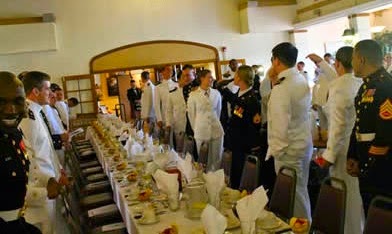
More on U.S. Military Etiquette of the “Dining-In”

2013 San Diego Dining-In ~ "In November of 1964, the Chief of Naval Operations Naval History Division prepared an article on the mess night for the BUPERS Mess Newsletter. The article was aimed at Commissioned Officers Mess Managers and provided a synopsis of the Navy dining-in. This was the first official mention of the event. A renaissance of the dining-in can be linked to the 200th birthday of both the country and the Navy. During the bicentennial, officials were reviving virtually every traditional event to celebrate the occasion. The Chief of Naval Information (CHINFO) prepared a pamphlet entitled "How to Conduct a Dining-In." The guide was published as an article in the March 1975 issue of U.S. Navy Medicine. This is a most important document because it describes the basic format of the Navy dining-in." From Military Facts, History of the Navy 


Introduction To The Dining-In

1. The purpose of this booklet is to familiarize the junior officer with an old custom that has begun to experience a resurgence of popularity after a period of considerable decline.

This custom is known as the Dining-In. Simply stated, the Dining-In is the assemblage of all the officers of a particular unit for a formal dinner. There is of course much more involved in conducting the Dining-In than just sitting down to dinner. It is a rather complex affair that can and often does include a receiving line, cocktail hour, a ceremonial posting of the colors, a punch ceremony, ceremonial toasts, etc. All of these will be discussed in detail later in this booklet.

2. The formal Dining-In has several purposes. First, it brings together the unit officers on a social basis. Second, it fosters a spirit of team work in the unit as the officers get to know each other better. Finally, each officer has an opportunity to see his place in the unit history. He learns that many brave and capable men have gone before him and have left him a legacy of falor and efficiency. He also learns that his own day-to-day activities become a part of the unit’s history which encourages higher standards of performance from him. It is to this end that the Dining-In should be conducted.

3. The Dining-In should be compared to an officers’ call as far as its purpose and function are concerned. Therefore, when invited you should consider your attendance as obligatory and your absence should occur only for those reasons for which you would be excused from any military formation.


Background On The Dining-In


1. GENERAL. Conduct of the British Officers’ Mess over the years has had great influence on many of the procedures practiced today by US organizations in the formal Dining-In. The British mess was a source of solemn formality; a cause for living above one’s means; and a source of long-lasting customs and traditions.

2. THE OFFICERS’ BILLET


a. Today’s colorful British officers’ dinners continue a custom which arose in the eighteenth century. In those days there were no barracks. Consequently, officers and men were billeted wherever lodging was available. When a battalion entered a town the Quartermaster would select billets for the unit. Then the unit would hold a parade and group the colors at the officers’ billet. This billet became known as the officers’ mess and was the central meeting place for officers.

b. The custom of dining together was especially useful in large units where many officers did not normally come in contact with one another. However, during dinners they were brought together in a fraternal atmosphere. The mess, besides entertaining guests in the surroundings of traditions and customs of the regiment, served to make the officers aware of the social amenities. Young officers received training which enabled them to give formal entertainment later as senior officers.

c. While the mess served a functional purpose it also served as a constant source of satire and junior officer horseplay. Additionally, they served as a method of transmitting the histories and traditions of the Regiment to junior officers.


BACKGROUND ON US ARMY REGIMENTAL MESS


1. GENERAL:

a. US Army Dining-In traditions are related directly to those of the British Army prior to the American Revolution, and in many instances, more modern British Army Mess procedure has been incorporated into our unit social events. The oldest recorded American Dining-In occurred in September 1776.

b. In the regimental mess of the 1920’s the colonel or senior officer presided and sat at the head of the table with the lieutenant colonel to his right and the adjutant to his left. The other officers were seated on both sides of the table according to rank. Dinner was a formal meal with everyone wearing the uniform prescribed. The officers of the mess assembled and upon arrival of the presiding officer followed him into the mess and took seats when he had taken his. In general, the US Army Dining-In has been more formal and restrained than its
usual British Army counterpart.

c. The importance of the mess as related to the image of the officer corps was evidenced by the recommendation that all newly commissioned officers should carefully make arrangements for messing to enable them to “live with the quiet dignity becoming their station.” It was sufficient for expenses, and he owed it to the service to “dress and live, though simply, yet always like gentleman.”

2. TRADITION: As with the British Mess, the US Army Dining-In has served as a vehicle for transmitting the histories and traditions to junior officers. This is particularly true in our Army where rotation between units is quite frequent. As an example of this tradition, the punch bowl for 1st Battalion, 9th Infantry (MANCHU) reflects upon each of the major battles and wars in which that fine regiment fought.


ORGANIZATION AND SEQUENCE FOR THE DINING-IN


1. Principal officers of the mess are listed below. Their duties and responsibilities are also listed. 


a. PRESIDENT OF THE MESS. The Presiding Officer is the company commander. He is the President of the Mess. It is his responsibility to oversee the entire organization and operation of the Dining-In. His operational techniques will follow those of any formal dinner affair and will include appointment of a host and persons or committees to take care of the arrangements, food, and protocol. The President will appoint a Vice-President, Mr. Vice, who is one of the senior trainers of the company; open the mess and close the mess; and call upon Mr. Vice for performance of any duty deemed appropriate during the conduct of the affair.

b. MR. VICE. Mr. Vice opens the lounge at the appointed time. When the dinner chimes are to be used, he sounds them as appropriate. He may be called upon to provide items of unit history, poems, or witticisms in good taste relating to particular personalities present. He is seated at the opposite end of the dining room to permit the President of the Mess to face him easily during the dinner.

c. THE COMMANDER. The formal Dining-In is the one occasion when the battalion commander is a guest. Planning by the President and Mr. Vice should be so thorough that the commander may relax and enjoy a smooth, efficiently run dinner. He may participate actively or remain an observer. The option is and should be his.

d. THE ESCORT OFFICER. Escorts should be appointed for each guest attending the dinner to act as personal hosts.

(1) The Escort should welcome his guest upon his arrival and join his guest immediately after the receiving line.

(2) The Escort should familiarize himself with the guest’s background prior to the night of the Dining-In.

(3) It is the Escort’s job to make the guest feel at home explaning the different portions of the Dining-In and its history.

(4) He should introduce the guest to the members of the mess during the cocktail hour and be sure that the guest understands the Punch ceremony procedure.

(5) The Escort has a large responsibility. Many of the guest’s impressions of the unit will be formed due to the actions of the Escort.

(6) The Escort’s duties terminate when the guest leaves the Officers’ Club, or place of the Dining-In. 

2.  APPROPRIATE DRESS.  Black tie is the appropriate dress for a formal Dining-In and is the designation used on invitations.  Civilians wear the tuxedo while military personnel wear the black bow tie with one of four appropriate uniforms, Army Blue, Army Blue Mess, Army White, or Army White Mess.  The black tie designation also implies the wearing of miniature decorations on the Army Blue Mess or Army White Mess uniforms and the wearing of ribbons, miniature or full size, on the Army Blue or Army White uniforms.  The term military black tie may appear on invitations directed to a predominately military group, but the same uniform implications apply. 


 🍽️Etiquette Enthusiast, Maura J. Graber of The RSVP Institute of Etiquette, is the Site Editor of the Etiquipedia© Etiquette Encyclopedia