Showing posts with label Using Proper Utensils at the Table. Show all posts

Monday, November 6, 2023

Some Afternoon Tea Necessities

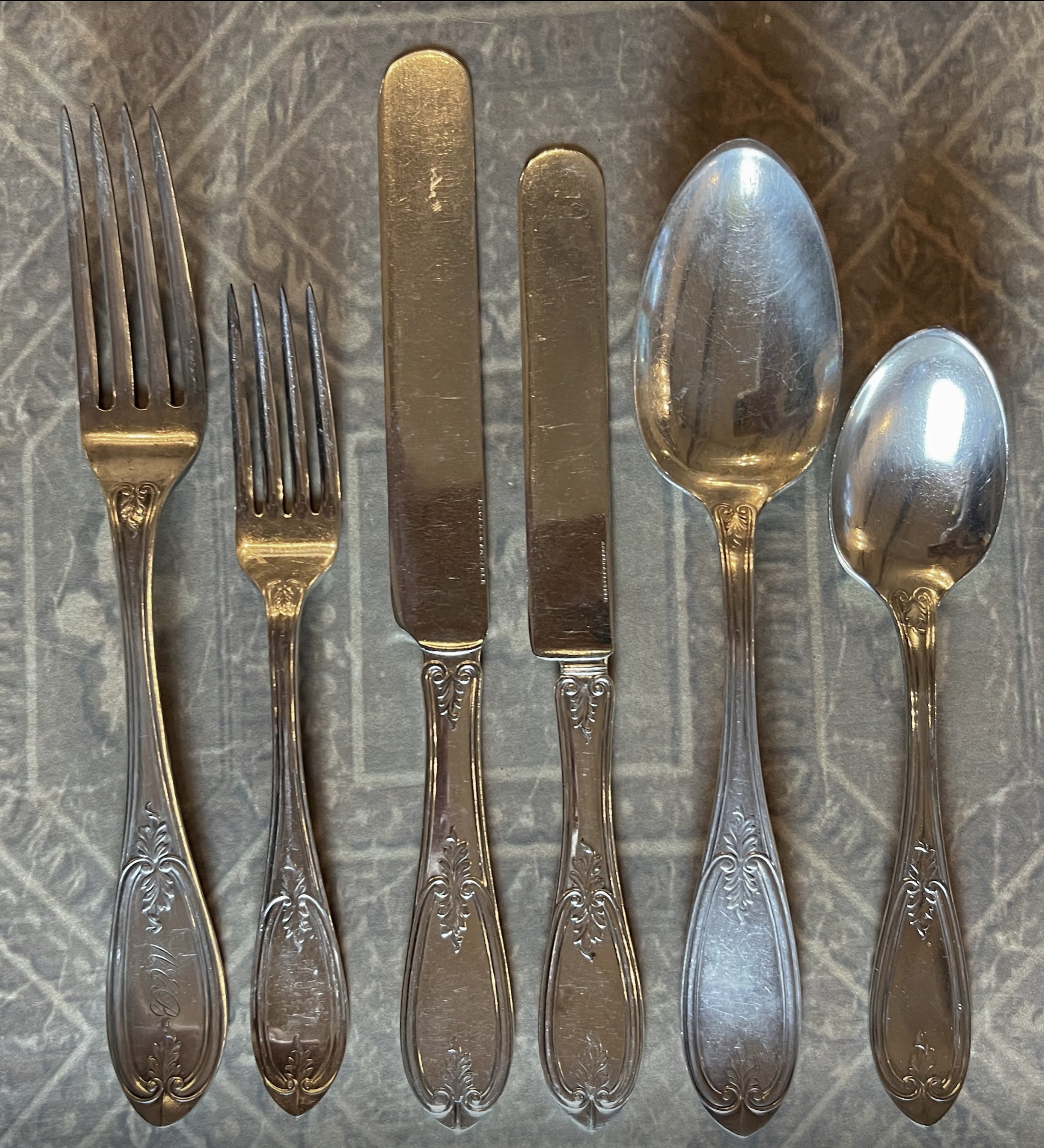
Pictured above is a typical five piece place setting in one of the oldest patterns of silver; the Olive pattern. The pattern can be found in several variations by several different silver makers. The teaspoon on the far right is the smallest spoon of regular place setting spoons, though it does not belong at a formal place setting. The teaspoon should only be at a dinner setting if it is being used for a fruit cocktail, a dessert  or a sorbet, though a fruit spoon, dessert spoon or a sorbet spoon are far more appropriate and designed to eat those specific foods. A teaspoon and cup and saucer are allowable at breakfast and luncheon settings. Coffee spoons are a bit smaller than teaspoons and demitasse spoons are smaller still. 

After your cups and saucers, here are some other afternoon tea necessities: “Naturally your necessary silver is only a spoon since, customarily, forks are not used for afternoon tea. The food should be only what can be picked up in the fingers. After all, afternoon tea is little more than a bit of refreshment at the end of the day, a stimulant- it's not a meal and whatever there is to eat should not be enough to spoil the appetite for dinner.

Tea napkins are about fourteen inches square, quite rightly dainty and decorative bits of fabric edged with lace or embroidery, a hemstitched hem or just a plain rolled one. White or in color, they are anything that you want to make them, providing they harmonize with your other tea appointments.

When you are entertaining at tea for six or eight, you merely enlarge the tray set-up. Use a table low enough so that seated at it, you can pour conveniently. Cover the table with a tea cloth and then set out your tea equipment on its tray. Use the hot-water kettle if you have one. Arrange the napkins, plates and some of the cups and saucers on the tabletop. Add, if there is room, a low flower arrangement; also, if it is autumn or winter, a candle or two.” – From Helen Sprackling, 1960


 🍽Etiquette Enthusiast, Maura J. Graber, is the Site Editor for the Etiquipedia© Etiquette Encyclopedia

Thursday, October 7, 2021

Gilded Age Dinner Party Etiquette

None but a low-bred clown will ever carry fruit or bon-bons away from the table.

To use one's own knife, spoon or fingers, instead of the butter knife, sugar-tongs or salt-spoons, is to persuade the company that you have never seen the latter articles before, and are unacquainted with their use. 

Never eat all that is on your plate, and above all never be guilty of the gaucherie of scraping your plate, or passing your bread over it as if to clean it. 

Never fill your mouth so full that you cannot converse; at the same time avoid the appearance of merely playing with your food. 

Eat in small mouthfuls, and rather slowly than rapidly.

Peel fruit with a silver knife in your right hand. Eat it in small slices cut from the whole fruit, but never bite it, or anything else at table. Need I say no fruit should ever be sucked at the table? 

If upon opening fruit you find it is not perfect, or there is a worm in it, pass your plate quietly and without remark to the waiter, who will bring you a clean one. 

None but a low-bred clown will ever carry fruit or bon-bons away from the table. 

Drinking wine with people is an old custom, but it will nowadays be found to exist only among the past or passing generation. 

When the hostess thinks her lady friends have taken as much dessert as they wish, she catches the eye of the principal among them; an interchange of ocular telegraphing takes place, the hostess rises, and with her all the company rise; the gentlemen make a passage for the ladies to pass; the one who is nearest to the door opens it, and holds it open until all the ladies have passed out of the room. 

As soon as the ladies have retired the gentlemen may resume their seats for more wine and conversation, but it is a very poor compliment to the lady guests to linger long in the dining-room. 

The ladies upon leaving the dining-room, retire to the drawing-room, and occupy themselves until the gentlemen again join them. 

It is well for the hostess to have a reserve force for this interval, of photographic albums, stereoscopes, annuals, new music, in fact, all the ammunition she can provide to make this often tedious interval pass pleasantly. 

If you dine in the French fashion, the gentlemen rise with the ladies, each offering his arm to the lady he escorted to dinner, and all proceed to the drawing-room together. 

If the gentlemen remain to have coffee served in the dining-room, tea may be served in the drawing-room to the ladies. 

Upon returning to the drawing-room the gentlemen should never cluster round the door, but join the ladies at once, striving to repay the hospitality of the hostess by making themselves as agreeable as possible to the guests. 

From two to three hours after dinner is the proper time to leave the house. From Sarah Annie Frost, 1877


Etiquette Enthusiast, Maura J. Graber, is the Site Editor, for Etiquipedia© Etiquette Encyclopedia