Showing posts with label Properly Addressing Servants. Show all posts

Thursday, June 25, 2020

Etiquette Regarding Servants

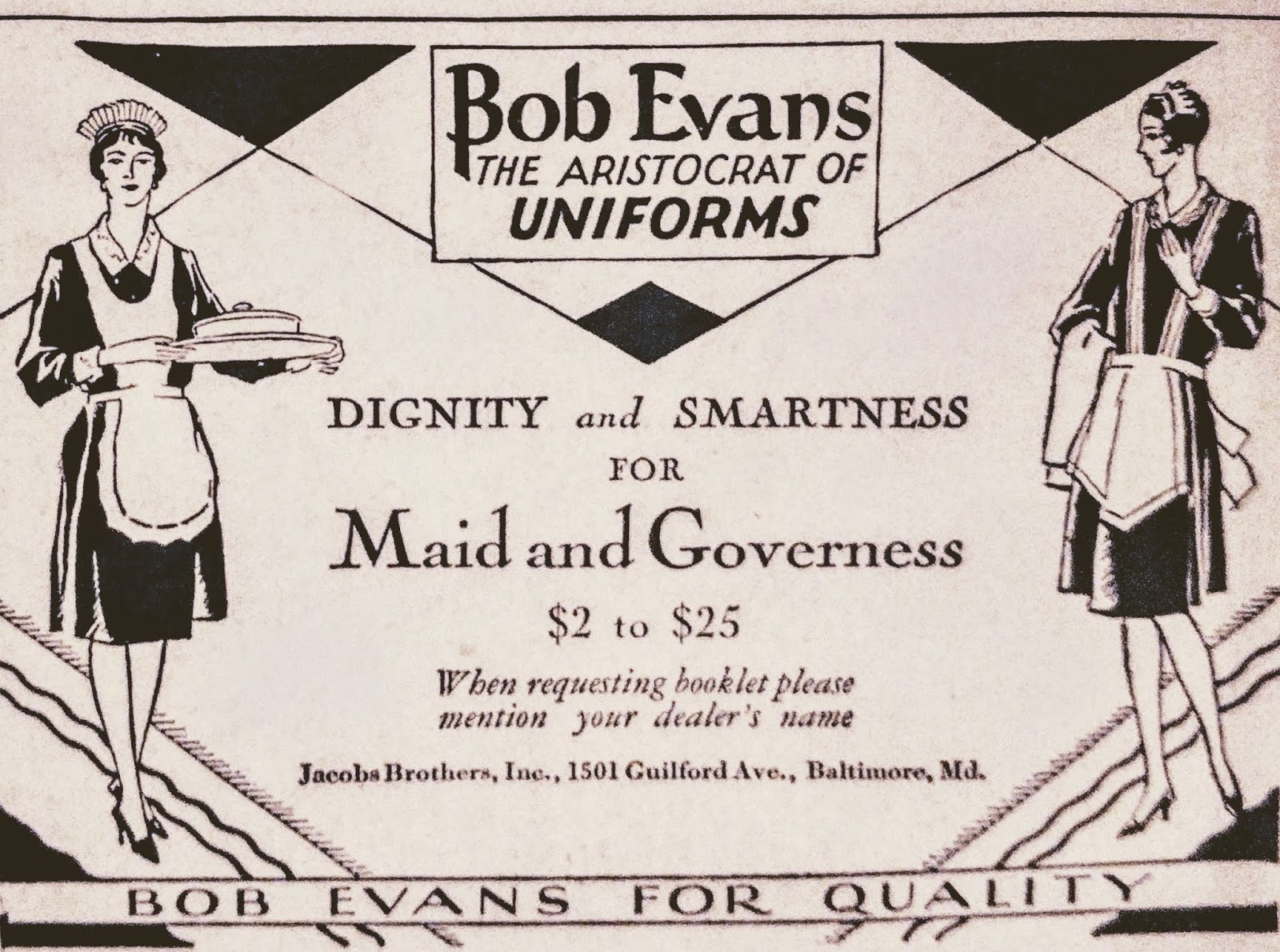
An early 19th century magazine advertisement for American maids’ outfits. —“A Housekeeper, a Lady’s Maid and a Head Nurse belong to the hierarchy of a household. A Lady’s Maid wears no cap and when in attendance on her Lady, is expected to be well, but quietly dressed, in black or some sober coloring. Her wages are from $150 to $200 a year, with the reversion of her employer’s wardrobe.” 

Servants in England 
There Are Fixed Forms of  Etiquette Governing Their Treatment

While mistresses and housemaids in this country are struggling to solve the vexed “servant problem” they do not appear to take into consideration the fixed forms of etiquette governing the treatment of servants in England, which probably do much toward promoting mutual understanding between the servants and the served over there. 

A Housekeeper, a Lady’s Maid and a Head Nurse belong to the hierarchy of a household. A Lady’s Maid wears no cap and when in attendance on her Lady, is expected to be well, but quietly dressed, in black or some sober coloring. Her wages are from $150 to $200 a year, with the reversion of her employer’s wardrobe. 

An English maid is always called by surname, “Smith” or “Jones,” but a foreign maid’s first name is used, “Marie” or “Françoise.” A Lady speaking of her maid to other upper servants, such as the Butler or the Housekeeper, would style her “Smith” or “Marie,” but when mentioning her to Housemaids or Footmen, she would he careful to allude to her as “Miss Smith” or “Mlle. Marie.”- New York American, 1905


Etiquette Enthusiast, Maura J. Graber, is the Site Editor for the Etiquipedia© Etiquette Encyclopedia


Friday, October 30, 2015

Etiquette and Treatment of Servants

Policy, as well as good breeding, inculcates the necessity of gentle treatment and courteous behavior to servants... though your parents may not want you to marry one of them.
There is no surer sign of ill breeding and ill feeling than the rude treatment of dependents. The obligation of civility to servants should be inculcated especially upon the young American, who ought to learn at the earliest period that the accidental relation of advantage of position, which is ever alternating in a country free from prescriptive right, gives no title to a haughty demeanor and a domineering conduct.

The recognition of the mutual obligation of master and man, and mistress and maid, is a certain sign of the true gentleman and lady, who will never exact from those temporarily placed in subjection to them the civility they are unwilling to bestow. The “thank you,” “please,” and other courteous expressions of a kindly consideration of the obligation of the employer to the employed, will be freely proffered by all who are fully conscious of their social duties and willing to acknowledge them.

Policy, as well as good breeding, inculcates the necessity of gentle treatment and courteous behavior to servants, who will seldom fail to respond with a more zealous service and a readier obedience to exactions and commands rendered less harsh and domineering by a soft word and a subdued mastery. 
–From How to Behave and How to Amuse, by G. H. Sandison, 1895

Etiquette Enthusiast, Maura J. Graber is the Site Moderator and Editor for Etiquipedia© Etiquette Encyclopedia

Sunday, September 20, 2015

Etiquette and Gilded Age Servants

The “hired girl” is a phrase which has been banished from good society, and we say instead “the maids.” – Servants are very imitative, and if those who employ them are gentle, soft voiced and uniformly polite they become so too. 

It is of great importance that girls who wish to show perfect breeding at every turn should know how to properly treat servants. These dependents, either in one's own household or in the homes of one's friends, are entitled to courtesy and consideration, and there is a well defined etiquette in regard to them.

Some girls act as if their inferiors were not to be recognized except when service is required of them and then adopt a manner of haughty disdain, demanding everything and taking the attitude that the servant is a mere machine. There is, of course, the other extreme that of intimacy with a servant, and the latter attitude is as much to be as the former.

Every girl of wealth in these luxurious days has her own maid and this domestic naturally comes into close contact with her. It is the maid's business to be at the beck and call of her young mistress at all hours, but the mistress should remember that the maid is human and not make unreasonable demands on her. 

It is unreasonable to expect perfection, for none of us possess it in any capacity, and it is unreasonable to expect an intelligence equal to your own, for if the maid had it she would be something of a higher order than a menial. Politeness is an important part of good manners with servants, and you are not only served better when you are courteous but you present to them a model of manners.

Servants are very imitative, and if those who employ them are gentle, soft voiced and uniformly polite they become so too. One should always preface or end an order with “Please,” and one should say “Thank you” in acknowledgment of service. Do not say “Thanks,” even to a servant as the word is no longer considered good form. Always say “Good morning” to the servants of your household and, also to other people's servants when they are known to you, as in the homes of your intimate friends.

As a rule, young girls rarely give orders to servants with the exception of their own maids, but often give orders for their mothers. There is only one correct form in which to do this. You must not say, “Mary, mother wishes you to go up to her room.” But supposing your mother's name to be Mrs. Brown, you should say, “Mary, Mrs. Brown wishes you.” etc... The formal prefix applies not only to your mother, but to all the other members of your family. Never say “father,” “sister” or “brother” to a maid, but always “Mr. Brown,” “Mr. Harold,” if that is your brother's name, and “Miss Beatrice,” supposing that to be your sister's. 

Do not call or refer to the domestics in your mother's establishment as “girls.” The “hired girl” is a phrase which has been banished from good society, and we say instead “the maids” or “the women” when speaking of the servants if they are all of one sex. 

When you are staying in other people’s houses never give orders of any sort to the maids unless it be that one has been assigned to you for your own personal use, in which case, of course, you treat her as you would your own. Otherwise, when you wish things done, ask permission of the hostess to use a servant for this or that. And when at the table you must not request things directly of the maid, as etiquette requires, that you make your request to the hostess. –1909


Etiquette Enthusiast, Maura J. Graber, is the Site Editor for the Etiquipedia© Etiquette Encyclopedia