Showing posts with label 1930’s - 1940’s Entertaining Etiquette. Show all posts

Wednesday, April 29, 2026

Taking Advantage of Hospitality

Nisei is referring to a person in the United States or Canada born, to a Japanese immigrant. Evidently back in the 1930s, some Nisei born in the US, felt quite comfortable taking a handful of cigarettes from a hostess’s or host’s cigarette box, to put in their pockets for later, as opposed to just taking one at a time, much to the chagrin of their immigrant parents… 
“We have gone to social affairs where hostesses have had cigarette boxes lying around with cigarettes therein. And we have seen some Nisei open these boxes and help themselves to it without asking the hostess, or even having received her invitation to do the same. Of course, we know that the cigarettes are there for the benefit of the guests; but we hardly think that it is good etiquette for the guests to help themselves to it, when the hostess has not said, ‘Please help yourselves.’” – It was common for hosts and hostesses to have boxes of cigarettes, usually highly decorative, in their homes for guests. Like with bowls of candy, however, Etiquette dictated that one should wait until offered a cigarette before taking one, and only one, at a time. Good manners would keep most people from grabbing several at one time to stick in their pockets! – 
Above, An early 20th C. Art Deco Glass Cigarette Box and Lid by Cambridge Glass Co. As Etiquipedia does not smoke, hers is used to hold cotton swabs on her vanity tray.


In “I’m Telling You, DEIRDRE!” 

A Breach of Nisei Etiquette

While we are on the subject of Nisei manners and such, another thing comes to our mind which we cannot help mentioning. Most likely many of our young Nisei friends have noticed the common sin which we are about to mention, as well some of our hostess friends.

We have gone to social affairs where hostesses have had cigarette boxes lying around with cigarettes therein. And we have seen some Nisei open these boxes and help themselves to it without asking the hostess, or even having received her invitation to do the same. Of course, we know that the cigarettes are there for the benefit of the guests; but we hardly think that it is good etiquette for the guests to help themselves to it, when the hostess has not said, “Please help yourselves.”

Another thing which is a more glaring faux pas that we have seen some Nisei boys commit, is that one of grabbing a handful of these cigarettes and pocketing them. We are sure the hostess or host may not be stingy but it is hardly good form for the guests to “chisel” in this manner. At least, it does not look very nice to an observer on the side. 

Our readers may have seen at some time or another, a similar breach of etiquette committed with candies and other such refreshments. Our Issei elders and hosts have often commented on this to us, and we do happen to know that they are very displeased at such actions on the part of the Nisei. 

One Issei man told us that he has actually seen college students and so-called college graduates doing these things as well as the younger high school “kids.” Even if our young people are not really bad people, the Issei are very likely to judge us by these actions, and of course the impressions that we leave behind are hardly favorable.

Often we do these things because we are careless and thoughtless rather than intentional or downright rudeness. About the only thing which we can do to remedy the situation with our young people is to point out some of our shortcomings can check up on themselves. — The New World Sun, 1938


🍽Etiquette Enthusiast, Maura J. Graber, is the Site Editor for the Etiquipedia© Etiquette Encyclopedia

Wednesday, March 20, 2024

Etiquette at Club Teas


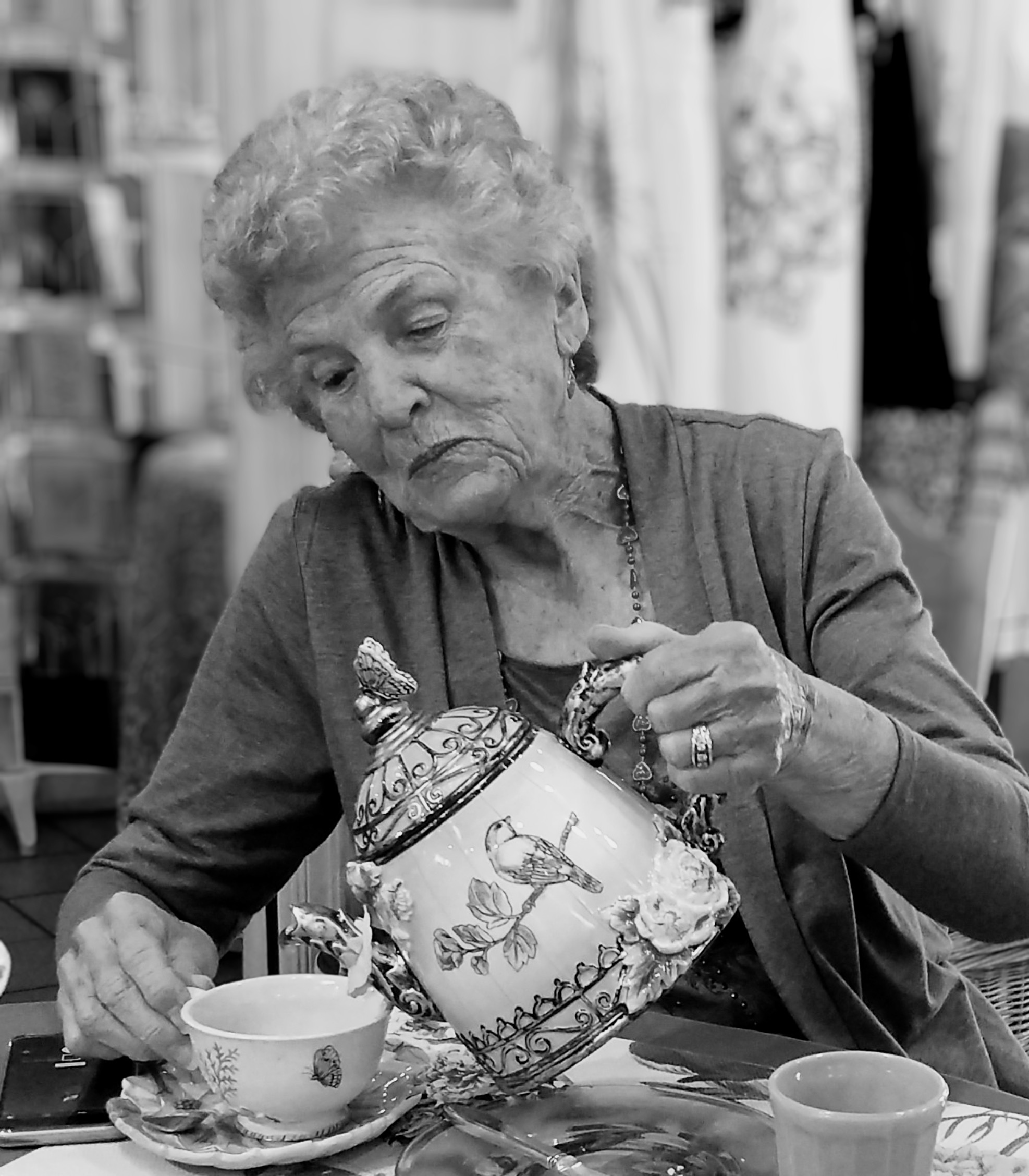
As has long been custom, being asked to pour at a tea is an honor. It should always be looked upon as just that. If a hostess asks you to pour at her afternoon tea, she sees you as friendly, cheerful, competent and, probably, a person who is tidy and detailed. — “If sufficient members of the committee take turns at pouring, it should not be too tiring for any one of them, and there is no question that club hostesses at the tea table would create a more friendly atmosphere.” ~ Emily Post, 1937

Let the Women Pour

Dear Mrs. Post: Our women's club is giving a large tea for approximately a hundred and fifty guests. Would you suggest that it is better at a tea of this size to let the hotel do all the serving, or do you think it more friendly to have members of the committee preside at the tea table?

Answer: At a tea for as many as fifty, the details of serving are more often than not taken care of by the caterers, or by the servants in a private house. However, in your case, if sufficient members of the committee take turns at pouring, it should not be too tiring for any one of them, and there is no question that club hostesses at the tea table would create a more friendly atmosphere. In any case, all the other details of replacing used cups and saucers with fresh ones and replenishing sandwiches and cakes and passing them will be taken care of by the hotel.
 
Emily Post in “Good Taste Today,” 1937


🍽Etiquette Enthusiast, Maura J. Graber, is the Site Editor for the Etiquipedia© Etiquette Encyclopedia

Monday, March 18, 2024

Emily Post on Finger Bowl Doilies

Originally, the word “doily” referred to as small napkin or decorative “piece of linen.” The word doily, also originally “doyley” was first used in 1711. Over the decades, doily has come to mean a small, lacy, decorative mat or crocheted piece of lace for finger bowls or desserts to be placed on. – “ Finger-bowls and doylies are brought in on the dessert-plates. Each person at once removes the bowl and doyley to make ready for whatever is to be put on the plate.” – From the Etiquette of Gilded Age Dinners and Service

Don't Dirty a Doily

Dear Mrs. Post: When the finger bowl is brought to the table on the dessert plate, on which is a lace doily, how does one remove the finger bowl to the table, and where is it put? Is the doily removed with it, or is dessert put on the doily?

Answer: The doily should be lifted off with the finger bowl and both put down at your place wherever there is room. On no account put anything eatable on top of a lace doily.

Emily Post, in “Good Taste Today,” 1937 


🍽Etiquette Enthusiast, Maura J. Graber, is the Site Editor for the Etiquipedia© Etiquette Encyclopedia

Monday, December 4, 2023

Table Set for New Year’s 1930

  
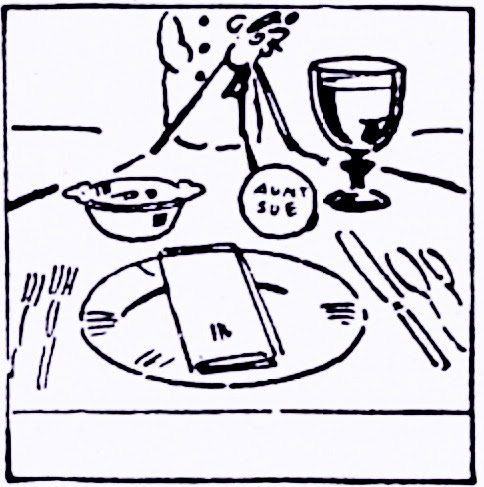
Early Depression Era Entertaining Crafts and Place Setting ~ Not only was this dinner party thrown in the early days of America’s Great Depression, but it was held during Prohibition in the U.S., as well. As, presumably, no wines would be served at this multi-course dinner, the water goblet is the lone glass at the setting.– The snow man was made by taking a cardboard cone standing 15 inches high. He was padded with cotton. Over this was put well crushed and crinkled white crepe paper. Bulges were made for arms, tucked apparently into overcoat pockets for warmth.

SNOWY WHITE AND BLUE SHADOWS ARE ON TABLE

One of the prettiest tables Nancy had seen in a long time was the New Year’s table at the Jack Pettingills’ home. The cloth was white damask. In the center was a large snow man in white. His features were back but his hat was deep blue. He held a bouquet of freesia and laurel in the crook of his arm. Leading from his snow overcoat were ribbons of blue. They extended to the place cards and favors combined, snowballs of white crumpled crepe paper.

The goblets were of deep blue glass. The condiment dishes were of pewter. The whole effect was of white snow with its blue shadows and its wintry gleam under the frosty moonlight. Near the snow man's abiding place were flecks of artificial snow. Flakes of it were on his coat and hat. The wall sconces of pewter gleamed in the candlelight. Pure white candles were in deep blue candle holders.

The snow man was made by taking a cardboard cone standing 15 inches high. He was padded with cotton. Over this was put well crushed and crinkled white crepe paper. Bulges were made for arms, tucked apparently into overcoat pockets for warmth.

The buttons of the coat were of black crepe paper. Small wads of this same paper made his features. He smirked over his necktie of broad blue ribbon. The head had to be stuffed like a ball and extended beyond the apex of the foundation cone. The bow the was placed about two inches below the peak, thus giving the effect of a slender neck. – By Florence La Ganke, aka “Nancy Page, 1930


🍽Etiquette Enthusiast, Maura J. Graber, is the Site Editor for the Etiquipedia© Etiquette Encyclopedia
Monday, August 28, 2023

Luncheon Menu Etiquette

Once fruit and fruit cocktail could be purchased in cans, fruit cocktail was a popular starter at meals and could be served regardless of the season. Normally served in a small soup-type cup, berry bowl, or a champagne saucer, this mid-century modern place setting features grille-sized, silver plated flatware and Desert Rose plates, with the fruit cocktail served in a fashionably tall martini glass. – Originally made for decades by Franciscan Pottery, then sold to Josiah Wedgwood & Sons,Ltd., the wildly popular “Desert Rose” dinnerware line was first introduced in 1941. It was created in the style of Mexican folk pottery, which was very typical of Southern California décor of the early 20th C.. Inspired by the pink, rosa rugosa flower, “Desert Rose” remains a beloved china pattern today, though production in China stopped in 2004. Let the buyer beware! The earlier made pieces have a high lead content and need to be handled, used and even washed with great care. 

Filed Under “Standard Rules of Etiquette”
Question: What is an appropriate menu for a luncheon?

Answer: At a formal luncheon never more than five courses are served and the smartest of hostesses usually content themselves with serving four in contrast to the previous generation when luncheons were almost as long as dinner.

For a five course luncheon some such menu as the following 18 served: Fruit, or soup in cups, eggs, meat and vegetables, salad, dessert.

For a four course luncheon, fruit, or soup may be served, and the eggs omitted, or sometimes, the dessert. – Imperial Valley Press, 1931


🍽Etiquette Enthusiast, Maura J. Graber, is the Site Editor for the Etiquipedia© Etiquette Encyclopedia