Showing posts with label Good Breeding. Show all posts

Sunday, April 12, 2020

For Brits, “Roof is Introduction”

The fact that you and the other guests are under the same roof is introduction ... “Simplicity of both thought and action is the basis of good breeding. One must use her common sense as well as her kindliness of heart and take into consideration that pretension is always a mark of vulgarity.” 


Introductions manners always improve with the cultivation of the mind, and we can turn the rule around, for the acquirement of good manners can only be attained by education and observations, followed by habitual practice. It would be a good thing if we had another Addison or Steel to turn our attention to the manners of our time, as these distinguished writers did in the ‘Spectator.’ The great mistake that most people make is in acquiring too much manner. Simplicity of both thought and action is the basis of good breeding. One must use her common sense as well as her kindliness of heart, and take into consideration that pretension is always a mark of vulgarity. 
Introductions are made indiscriminately in America and there is much to be learned in almost any set about the proper way to present one person to another. In the first place, you should never introduce one person to another unless you know that it is agreeable to both of them. “But.” you exclaim, “perhaps they are both at my home for an evening party!” Then these ladies should know the English law that “roof is introduction,” and remember that a casual conversation does not hurt anyone, neither does it entail a further acquaintance which might be awkward. In making an introduction the gentleman is always presented to the lady. The younger woman to the older woman.

In her own house a hostess should always extend her hand to a person introduced to her. At a dinner party the hostess need only introduce the gentleman to the lady that he is to take in to dinner. Even after introduction a man must wait for the woman to bow first when next they meet. When introducing a man, always give him his title, even if you are his wife. Introductions on the street are not in good taste, as one should not stop long enough on a promenade to present one person to another. If you are with someone and a friend stops her on the street, it is good taste for you to walk on slowly. • • • • Memo: Strive to live up to your favorable introduction. — By Idah McGlone Gibson


Etiquette Enthusiast, Maura J Graber, is the Site Editor for the Etiquipedia©️ Etiquette Encyclopedia 

Thursday, August 15, 2019

Etiquette Training – Early is Best

Good manners are but the expressions of a nature controlled... The rules of good breeding cannot be learned late in life, politeness cannot be assumed when one enters society at a given age. Training in good manners must be begun when the baby first learns to speak and continued through the years, for politeness is not always innate and spontaneous.


“Facts on Etiquette”

“Etiquette is not a body of formulas for the use of adults only; the rules of good breeding cannot be learned late in life, politeness cannot be assumed when one enters society at a given age. Training in good manners must be begun when the baby first learns to speak and continued through the years, for politeness is not always innate and spontaneous. The child does not know that all life is made smoother and simpler and sweeter by good behavior, and so this precept and its practice must be early inculcated. This constant rubbing off of rough comers produces a polish that makes it possible for the child to grow into the adult without awkwardness. Good manners are but the expressions of a nature controlled. They may be artificial, but anything is better than bad manners.” – The Weekly Calistogan, 1914


Etiquette Enthusiast, Maura J Graber, is the Site Editor for the Etiquipedia© Etiquette Encyclopedia

Etiquette and Its History


The History of Etiquette

Etiquette is a form of fashion more important than style in dress, for the reason that the varying codes of manners have influenced morals, something changing the cut of a coat cannot be said to have done. When etiquette demanded that a gentleman accept a challenge or acknowledge himself a coward in the minds of his fellow citizens, it encroached sharply upon ethics. Now that it has gone out of fashion to kill, gentlemen find small difficulty in keeping the sixth commandment. The less formal etiquette becomes, the less wanton taking of life there is among those who consider good breeding of consequence. 

As the civilized race now stands, either man or woman can be refined, regardless of shape of hat he or she wears. This was true in any century, but 200 years ago and back of that period, a gentleman and lady could, according to approved etiquette, gobble food with their hands from a common dish set in the center of the dining table and filled with the entire fashionable bill of fare prepared for the occasion. Gratefully we now acknowledge such proceedings to he “bad form” and in so doing pronounce ourselves two centuries removed from the table manners of swine and one point away from that brute, no matter how similar to him our turn of mind may remain in some other respects. –National Magazine, 1901


Etiquette Enthusiast, Maura J Graber, is the Site Editor for the Etiquipedia© Etiquette Encyclopedia

Sunday, June 21, 2015

Etiquette and "Good Breeding"


Retrieving one's handkerchief does not necessarily make one a "gentleman" and being "well-bred" doesn't automatically make one a truly polite young lady.


The Letter and Spirit of "Good Breeding"

An excellent old gentleman, once upon a time, discussed the virtues and faults of his son with the young woman who was to be his daughter-in-law. "Dan's mother died when he was a baby," he said; "he has no near female relatives, he has spent nearly all his life in school and at college, so that he has never had that training which comes from association with well bred women. He is a good boy—as good as gold. There is nothing that he would not do for you. He will give you all that he has, he will be as true as steel, he will honor you and love you with all his heart, although he may forget to tell you so. He would die for you, but he will probably not pick up your pocket handkerchief for you." The young woman listened respectfully to a father's pardonable praise of his son, then she said, "But I do not want him to die for me, and I shall want him to pick up my pocket handkerchief." 


She preferred, says a correspondent of The InterOcean, who relates this little incident, the letter to the spirit. There are among many superficially polite people tremendous respect for certain requirements which they believe are an index to social position and indication of honorable origin, says the same writer. They would consider themselves hopelessly disgraced were they to put the knife to an improper use; to confuse the various spoons, forks and glasses about their plate at dinner, but other matters which affect their relations with their fellow being are passed over as of no consequence. 


One of the most common offenses among the superficially well bred is the slight and discourtesy which they show to dependents, or those whom they consider their social inferiors. The poor relation in his shabby coat and patched boots receives scant courtesy. The faithful dressmaker, met by chance in a public assemblage, is confronted with a stony stare, or is passed by and not seen at all. This is always the ill breeding of the snob, of the newly rich who, not feeling sure of themselves, knowing well what they are and whence they came, believe that their hardly earned place can be retained only by this stern discrimination. They believe that, like liberty, eternal vigilance is the price of "position."
Los Angeles Herald, 1891


Etiquette Enthusiast, Maura Graber, is the Site Moderator for the Etiquipedia© Etiquette Encyclopedia

Tuesday, May 19, 2015

Etiquette of the "Well Bred"

Though the original, priggish "Dame Grundy" may, or may not, have been a fictional character, one can find her in real life and in period dramas. Titanic's Ruth DeWitt Bukater was so overly pretentious and conscious of everyone's manners around her, she wasn't aware she was breaking a cardinal rule of glove etiquette. Molly Brown may have been viewed as ill-bred and vulgar, but she certainly wasn't having her tea with her gloves on! ~ Countess of Rothes: "Look, here comes that vulgar Brown woman." Ruth DeWitt Bukater : "Quickly, get up before she sits with us!"

Little, things so often indicate good breeding, and the manners of those with whom one associates, that a person can not be too careful in observIng the rules of etiquette. For instance, to say "What?" as an interrogation, when not understanding a remark or question, is considered rude and bad form. It is too brusque, according to the theories of Dame Grundy.   
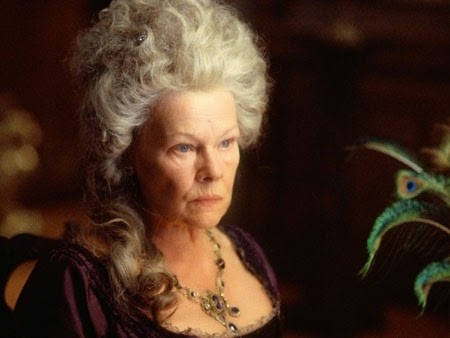
Curiosity, amusement or disdain? Upon observing the "well-bred," the emotions can sometimes be hard to distinguish.
Either "I beg your pardon" or "well," as an interrogation, is correct, and children, particularly, should be trained on these points. To go in front of a person without saying "Excuse me," denotes carelessness in minor points of breeding; also leaving the room without going through the form of asking permission is a solecism, "Excuse me a moment," if the person is soon returning, is correct, or should the absence be for an indefinite time, "Excuse me" is enough to say. 

To seal an envelope the whole length of the gum on the flap is another trifling matter for which a person is judged unfavorably. Unless the envelope contains an enclosure that might slip through an opening, only the very tip of the flap should be fastened. And, while on the subject of stationery, no two things are more indicative of ill breeding than to put a stamp on the left side of an envelope or, indeed, any place but squarely in the upper right-hand corner; and for a woman to sign her name with a prefix of Mrs. or Miss. to a note or letter, if she wishes to indicate her formal name she should put the prefix in parenthesis beside her name in full, or, in the case of a married woman, she signs her own name with her formal name in brackets beneath, as "Mary Jane Smith." and below, ("Mrs. John James Smith"). This is a form that should never be forgotten. 
 Pride and Prejudice's Elizabeth Bennet found that "nothing was beneath this great lady's (Lady Catherine DeBourgh) attention, which could furnish her with an occasion of dictating to others." The Lady Catherine De Bourgh is another priggish, Dame Grundy, tsk-tsking at every perceived lack of "good breeding."
Leaving a spoon in a tea or coffee cup is not uncommon but it is ill bred, and to butter a whole slice of bread at once and eat from it is another social mistake. The slice must be broken into small pieces and each buttered as it is eaten. Loud talking in public places is vulgar, as it is to push and shoulder in a crowd. If every person would remember his or her manners at such times crowds would cease to be objects for dread. —From The Los Angeles Herald, 1909


Etiquette Enthusiast, Maura J. Graber, is the Site Editor for Etiquipedia© Etiquette Encyclopedia

Saturday, October 27, 2012

19th C. Gent's Etiquette

On Good Breeding

Men's Fashions 1837
The formalities of refined society were at first established for the purpose of facilitating the intercourse of persons of the same standing, and increasing the happiness of all to whom they apply. They are now kept up, both to assist the convenience of intercourse and to prevent too great familiarity. If they are carried too far, and escape from the control of good sense, they become impediments to enjoyment. Among the Chinese they serve only the purpose of annoying to an incalculable degree. "The government," says De Marcy, in writing of China, "constantly applies itself to preserve, not only in the court and among the great, but among the people themselves, a constant habit of civility and courtesy.
French Essayist and Moralist, La Bruyre
The Chinese have an infinity of books upon such subjects; one of these treatises contains more than three thousand articles.-- Everything is pointed out with the most minute detail; the manner of saluting, of visiting, of making presents, of writing letters, of eating, etc.: and these customs have the force of laws--no one can dispense with them. There is a special tribunal at Peking, of which it is one of the chief duties, to ensure the observance of these civil ordinances?" One would think that one was here reading an account of the capital of France. It depends, then, upon the spirit in which these forms are observed, whether their result shall be beneficial or not. 

The French and the Chinese are the most formal of all the nations. Yet the one is the stiffest and most distant; the other, the easiest and most social. "We may define politeness," says La Bruyére, "though we cannot tell where to fix it in practice. It observes received usages and customs, is bound to times and places, and is not the same thing in the two sexes or in different conditions. Wit alone cannot obtain it: it is acquired and brought to perfection by emulation. Some dispositions alone are susceptible of politeness, as others are only capable of great talents or solid virtues. It is true politeness puts merit forward, and renders it agreeable, and a man must have eminent qualifications to support himself without it."

Perhaps even the greatest merit cannot successfully straggle against unfortunate and disagreeable manners. Lord Chesterfield says that the Duke of Marlborough owed his first promotions to the suavity of his manners, and that without it he could not have risen.  La Bruyére has elsewhere given this happy definition of politeness, the other passage being rather a description of it. "Politeness seems to be a certain care, by the manner of our words and actions, to make others pleased with us and themselves." We must here stop to point out an error which is often committed both in practice and opinion, and which consists in confounding together the gentleman and the man of fashion. No two characters can be more distinct than these. 

Lord Chesterfield
Good sense and self-respect are the foundations of the one--notoriety and influence the objects of the other. Men of fashion are to be seen everywhere: a pure and mere gentleman is the rarest thing alive. Brummel was a man of fashion; but it would be a perversion of terms to apply to him "a very expressive word in our language,--a word, denoting an assemblage of many real virtues and of many qualities approaching to virtues, and an union of manners at once pleasing and commanding respect,-- the word gentleman."* The requisites to compose this last character are natural ease of manner, and an acquaintance with the "outward habit of encounter"--dignity and self-possession--a respect for all the decencies of life, and perfect freedom from all affectation. Dr. Johnson's bearing during his interview with the king showed him to be a thorough gentleman, and demonstrates how rare and elevated that character is. When his majesty expressed in the language of compliment his high opinion of Johnson's merits, the latter bowed in silence. 

If Chesterfield could have retained sufficient presence of mind to have done the same on such an occasion, he would have applauded himself to the end of his days. So delicate is the nature of those qualities that constitute a gentleman, that there is but one exhibition of this description of persons in all the literary and dramatic fictions from Shakespeare downward. Scott has not attempted it. Bulwer, in "Pelham," has shot wide of the mark. It was reserved for the author of two very singular productions, "Sydenham" and its continuation "Alice Paulet"--works of extraordinary merits and extraordinary faults--to portray this character completely, in the person of Mr. Paulet.*  


Charles Butler's Reminiscences                   

Charles Butler, Esq.

Lord Chesterfield on Manners and Deportment

Lord Chesterfield (1694–1773) wrote Principles of Politeness, and of Knowing the World (Boston, 1794), was an adaptation of letters written to instruct his son in the ways of the world. 

"Next to good-breeding," said Chesterfield, "is genteel manners and carriage," and the best method to acquire these is through a knowledge of dance. "Now to acquire a graceful air, you must attend to your dancing; no one can either sit, stand or walk well, unless he dances well. And in learning to dance, be particularly attentive to the motion of your arms for a stiffness in the wrist will make any man look awkward. If a man walks well, presents himself well in company, wears his hat well, moves his head properly, and his arms gracefully, it is almost all that is necessary."