Showing posts with label Etiquette and Ladylike Behavior. Show all posts

Wednesday, October 29, 2025

Etiquette and Womanly Women

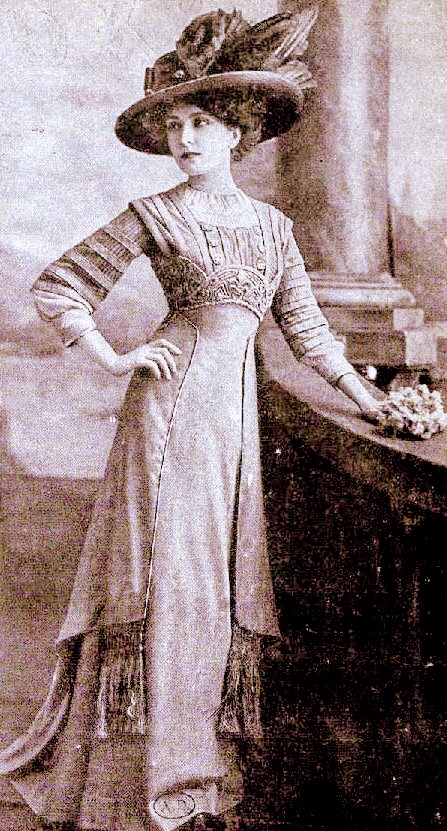
Loud talk and slang words are not for the ladylike girl, and although some people tolerate the loose manner some girls have, they do not admire it. Far more to be appreciated is the girl who openly avows that she likes nice clothes and is given over to many little feminine vanities, than the one who dresses so mannishly, and who imitates the walk of her brother, though she may be able to discuss the most abstruse subjects with an air of confident knowledge that her elders cannot even boast. – Four ladylike college girls in the early 1900’s.

The Womanly Woman

There is nothing more truly lovable than the woman who is genuinely womanly. There is a charm in her femininity that no acquired grace can lend. More especially in this age is the genuinely womanly woman admired, for girls seem to have a desire to be so manly, so loud, not only in mannerism, but in talk and dress, many choosing the sports of men in preference to the pastimes of women. The majority of men, I think, really prefer the quiet, lady-like girl with a soft, sweet voice, an affectionate disposition, and the girl who knows how to be a little lady, not only in her manners, but talk.

Loud talk and slang words are not for the ladylike girl, and although some people tolerate the loose manner some girls have, they do not admire it. Far more to be appreciated is the girl who openly avows that she likes nice clothes and is given over to many little feminine vanities, than the one who dresses so mannishly, and who imitates the walk of her brother, though she may be able to discuss the most abstruse subjects with an air of confident knowledge that her elders cannot even boast.

To be a ladylike woman does not mean that one need adopt fads and follies indiscriminately. The woman who can make her home bright and attractive, who can be the model hostess as well as wife and mother, who is well informed and able to talk intelligently, yet who is wise enough to realize that woman's privileges are preferable to woman’s right’s is the girl or woman we must all admire and the one fit to be taken to any honorable man's heart. - Mc Calls's Magazine, 1914


🍽️Etiquette Enthusiast, Maura J. Graber of The RSVP Institute of Etiquette, is the Site Editor of the Etiquipedia© Etiquette Encyclopedia 

Monday, October 27, 2025

Too Lady-like to Attract Men?

Idealized images of the ultimate “lady-like women,” shopping for gloves in a 1906 Ivory soap advertisement.

TOO LADYLIKE?

We note that the new coffee club is to have “no smoking” rule; also that dominoes, crokinole, and like ladylike games are to be provided. We don't know much about coffee clubs and perhaps our advice is foolish; but we do know a great deal about the sort of men who hang around saloons, and if it is the purpose of the coffee club to attract these men it is our opinion that the less ladylike and Sunday-schooly its atmosphere, the better. 

These men will not go where they are not comfortable. Most of them like to smoke a pipe and those of them who do not would feel uncomfortable in a place where it is forbidden. They may not care much to play cards, but they would feel more comfortable if card-playing were permitted and some of them might be kept from gambling if there were a decent place available to play cards without gambling. 

Even a rule against swearing, if enforced very strictly, would make the place uncomfortable to men to whom an occasional “damn” is part of their daily vocabulary. If these are the men that are wanted, and if there is any serious purpose to compete with the saloons in providing a pleasant and comfortable meeting place, it would be a mistake to enforce Sunday school morals or church-parlor manners. If this is not the purpose, of course that is a different matter. A ladylike: coffee club doubtless has its uses. But it will not keep anybody away from the saloons.– Fresno Republican, 1906


🍽️Etiquette Enthusiast, Maura J. Graber of The RSVP Institute of Etiquette, is the Site Editor of the Etiquipedia© Etiquette Encyclopedia 

Saturday, October 21, 2023

The Thermometer of Character


The oft quoted, Lord Chesterfield, was Philip Dormer Stanhope, the 4th Earl of Chesterfield. An acclaimed wit and admired man of his day, the British statesman was a diplomat and a scholar.

The Manners of a People

ARE the American people impolite? This is a question often asked by travelers, who, coming in contact with the people of other and older nations, are tempted to draw comparisons not always favorable to the American people. Doubtless the older section of the world are better behaved than the newer communities. This is true in our own country, but it does not follow that where men are better behaved they are more virtuous. 

It is a rule, but not without its exceptions, that manners indicate the man. They are the thermometer of character, the outward expression of the moral nature, but sometimes, as Emerson says, “they form at last a rich varnish with which the routine of life is washed, and its details adorned.” 

The strongest type of American has the poorest manners. He is not your well-dressed New Yorker, nor your pretty Philadelphian, but the robust man of the Western plains, uncultivated but rugged; not refined as to expression in social life, but with a big, warm, manly heart. He is as manly as the swift pony he rides. However, it is well to hold to the general rule that the manners of a people reflect the spirit and character of that people. 

A scholar may or may not be refined. Some scholarship is like raw sugar — it has never gone through the refining process. Once I took tea with one of the great men of the world. Fancy my surprise when he poured his tea into the saucer and supped it up like a child. That little act illustrated his character and gave me entrance into a strangely mixed personality. 

The basis of good manners is character which has been touched with culture. Chesterfield somewhere writes: “As learning honor, virtue is absolutely necessary to gain you the esteem and admiration of mankind, politeness and good breeding are equally necessary to make you welcome and agreeable in conversation and common life.” 

Politeness to the English people is a custom. Because it is a custom, it sometimes loses its influence. The barber furnishes his shave and the waitress her service with a conventional but certainly effective, “Thank you.” If you were to strike a cockney on the nose he would probably reply with a, “Thank you.” 

Naturally it was an Englishman Who said of Christ: “He was the first true gentleman that ever lived.” Politeness is kindness of manner; it is art and religion in one. It was Goldsmith who said of Johnson that he had nothing of the bear about him but his skin. To be a gentleman is to be a Christian, for manners are simply the character turned inside out. 

The manners of a people may be seen in the individual, in the toothpick man, the spitting man, the streetcar monopolist, the table pig, the man who never behaves in public places, whether in a hotel or a church. It may be seen in the fellow who easily loses his temper and “sasses back” in the many painful evidences of a lack of self-reliance and self-control. It may be seen in the ill breeding of women who are ignorant of taste in dress and in the social expressions of real intelligence.  

“Ladyhood is an emanation from the heart subtilized by nature.” To hear a pretty girl laugh and talk with painful loudness, to see the evidences of vulgarity in dress and manner, is to lead to the conviction that training in behavior was neglected in the home, or the school, or the social circle. Behavior has to do not only with society, but with life. It is just as necessary to be polite in business as it is in society. Many a man is a bear in the one and a Chesterfield in the other. 

Quoting Emerson again: “The highest compact we can make with our fellow is, ‘Let there be truth between us two forevermore. Our culture will be open to the charge of superficiality until it permeates behavior in the drawing-room, the streetcar, the theater, the funeral, the wedding and business.’”

Worship itself is behavior. It is being polite to God. It is a proper behavior in the presence of the Eternal. The first school of politeness is the home; It is a question whether children who are impolite at home will ever be trained in grace of courtesy outside of the home. 

I plead, then, for the cultivation of a courtesy which smoothes down the wrinkles of business turmoil, oils the machinery of trade and helps men to live together as brethren, not as beasts. I plead for the old, simple virtues of the lady and gentleman, not for elaborate adornment and superficial culture, but for the genuine cultivation of the true, moral nature expressed in manners, both gracious and good. Such a culture is not like the polish on the shoe, but like the gleam of a precious stone struck through and through with an arrow of silver light. – By Reverend William Rader for the San Francisco Call, 1904


 🍽Etiquette Enthusiast, Maura J. Graber, is the Site Editor for the Etiquipedia© Etiquette Encyclopedia

Friday, September 16, 2022

Applauding the Queen’s Manners


Queen Elizabeth II meeting Hollywood luminaries in February of 1983 — Etiquette has long dictated that a lady best applauds demurely, and notably different from the men, by clapping with the fingers only of the right hand, clapping (or tapping) in the palm only of the left hand. The WikiHow site has a post on something they call the “Royalty Clap,” and write that it is done, “just by clapping with the first two fingers, tapping them into your palm. It should make very little noise, giving the impression that you’re clapping more than actually contributing to the group.” Is that what the Queen was doing? It’s entirely possible. After all, she was the ultimate “lady” in public.
– Photo of Hollywood Reporter Magazine image

On HRH Queen Elizabeth’s Visit to the West Coast in 1983... “The sound of one hand clapping. Her hands never touch.” 

Several weeks back, my copy of The Hollywood Reporter arrived and I read of how all Tinseltown was abuzz with the upcoming visit by the Duke and Duchess of Cambridge. In the back of the magazine however, there was a nifty article about the visit by Queen Elizabeth and Prince Phillip back in February of 1983. An event that The Hollywood Reporter covered at the time.

The glitterati they met was breathlessly listed... Rod Stewart! Frank Sinatra! Joan Collins! Jimmy Stewart! Lucille Ball! Fred Astaire! George Burns! ... along with what Chasen's served; “The dinner menu included: Papaya with Bay Shrimp, Chicken Pot Pie, Fresh Spinach with Bacon and a Toasted Coconut Snowball.” A truly unique assortment, to be sure.

One of the more humorous quotes came from the magazine at that time, “... one guest described the Queen applauding as ‘the sound of one hand clapping. Her hands never touch.’”

But what really had me giggling was the story about Bette Davis and the issue of her not being issued an invitation; “And, of course, in the entitlement department, the royals had nothing on Old Hollywood.” 

Barbara Davis recalls that her late husband, Marvin – who bought Fox in 1981 and hosted the event – was deluged by requests to attend. One came from Bette Davis, who asked why she hadn't received an invitation. The studio owner told her the event was “full up.” She replied, “I want a f****ing invitation.” Somehow it was arranged, and at the dinner, the actress shook hands with the studio owner on the receiving line and said, “I'm so glad I was able to change my plans so I could attend.”

Jennifer Lopez immediately comes to mind as I read this story again now. According to actress Mary Louise Parker, when asked if she’d met the royal couple at the recent Hollywood BAFTA event, she responded, “I didn't meet them. I was shoved out of the way by Jennifer Lopez. Uh oh, I shouldn't have said that.” I guess that green dress Ms. Lopez wore to the event was not the only thing deemed inappropriate about her behavior that evening. — Originally written by Maura J Graber and published July 29, 2011 on the Etiquette Sleuth Blogspot


👑Etiquette Enthusiast, Maura J. Graber, is the Site Editor for the Etiquipedia© Etiquette Encyclopedia

Sunday, January 31, 2021

Etiquette: That was No “Lady,” Sir!


When speaking of females one has encountered while out and about, please keep mindful of the fact that the terms “Lady” and “ Woman,” just like the terms “Men” and “Gentlemen”— are not always synonymous.
———————————
“There are many good chances wasted by lack of promptness and businesslike habits, also by the inability to take up new ideas.” from ‘The Lady Magazine,’ on ‘How to Live,’ 1903
Photo source, Pinterest 

No True “Lady” Would Indulge in Such Bad Manners

Not long ago, a resident of New York went into the post office in that city to procure a money order. As there were half a dozen persons ahead of him he naturally awaited his turn, although he was in a great hurry, as most New Yorkers try to make themselves believe they always are. The other prospective customers of Uncle Sam did not form into line, but herded themselves about the window. When those who were there first had transacted their business, this New Yorker, considering that his turn had arrived, stepped to the window to be served. What happened at this juncture, he relates in these words:

“Just as I was about to enter my application, a lady, who had just come, crowded past several people who had been waiting, as I had, and calmly shoved her application in before mine. I told her as politely as I could that I had been waiting there at least fifteen minutes and thought that, seeing I was in a great hurry, I should have precedence before her, whereupon she told me I was the rudest man she had ever seen, and besides went into a long discourse concerning the manners of modern men. I, nevertheless, held to my point and saw that I was served first.” After having cooled off he asks: “Was I right In doing so?” He thinks he was, but to satisfy himself on the ethics of the case, he has asked, through the New York Times, that others express their opinions regarding his course of action. 

We are genuinely surprised that any man who has long enjoyed the refining social advantages of the peerless town upon the historic Hudson; who has knocked elbows with the descendants of Diedrich Knickerbocker; who has been privileged to gaze upon the sacred person of a descendant of the famous game-leged governor of New Amsterdam; who, perhaps, may have enjoyed the more than a bowing acquaintance with the creator of that justly prized appendage which in a later day wrought the undoing of the distinguished mollycoddle from Indiana; who certainly must have read more or less of the newspaper condensations of the work of the illustrious Ward McAllister, entitled “How to Behave After You Have Succeeded in Breaking In” — we are surprised, aye, we are astounded that there should have arisen any doubt as to the channel into which this anxious inquirer should have diverted his behavior.

Under any and all circumstances this New Yorker, whose appeal for enlightenment indicates his gross ignorance of the commonest laws of etiquette as they relate to social intercourse between ladies and gentlemen, should have.

Avaunt there! The Herald narrowly escaped committing itself! It retreats in time! It seeks further enlightenment, more definite evidence, before it dare to pass judgment.

This New Yorker has not been fair. He has tried to trip us. He is paradoxical, equivocal, deceitful — we may be pardoned, we trust, for suggesting the possibility that he has innocently perpetrated an untruth, lacking the antecedent intention to deceive.

He says: “A lady who had just come crowded past several people who had been waiting.”

Impossible. No “lady” would ever “crowd past several people who had been waiting.” Our friend from New York needs one of two things: A new pair of spectacles or a new lexicon.— Los Angeles Herald, 1907


🍽️Etiquette Enthusiast, Maura J. Graber of The RSVP Institute of Etiquette, is the Site Editor for the Etiquipedia© Etiquette Encyclopedia