Showing posts with label Tea Customs. Show all posts

Tuesday, February 13, 2024

Tea Etiquette: Reading the Leaves

"Floating tea leaves mean 'watch for strangers coming.' To tell the gender and the day of arrival, put them on the back of one hand and tap with the back of the other until they adhere - each tap is one day - and if they are soft leaves it is a woman; if hard, a man." 

The story of tea is as strange and as fascinating as any that one can read. A prehistoric event dating back some five thousand years is bound to be shrouded in many mysteries, but the exceptional qualities of tea are such that many legends developed concerning its beginnings. A highly civilized people like the Chinese considered it a special gift from heaven. In India, too, it was much the same. In Japan a special ceremony grew around it. This habit of drinking tea is the only purely Asian custom which commands universal interest. Through it the East and West have met - in a teacup! 

Its introduction had a charming influence on our Western culture, even though a great deal of smuggling and piracy helped to bring it about. Discriminating Chinese taste insisted that tea should be drunk from porcelain; and this subsequently had a tremendous effect on world trade and the voyages of clipper ships. Art, politics, and religion were all involved.

All this mystery and adventure stirred up many superstitions. Even today some tea companies attach a little saying to each teabag, such as:

"To stir tea in the pot is to stir up strife."

"Floating tea leaves mean 'watch for strangers coming.' To tell the gender and the day of arrival, put them on the back of one hand and tap with the back of the other until they adhere - each tap is one day - and if they are soft leaves it is a woman; if hard, a man." 

Fortune-telling from tea leaves is not solely a gypsy custom. Many people have read meanings into the shapes and groups of leaves that form in the bottom of the cup - how accurately is, of course, another matter. — By Patricia Easterbrook Roberts, 1967


 🍽Etiquette Enthusiast, Maura J. Graber, is the Site Editor for the Etiquipedia© Etiquette Encyclopedia

Tuesday, June 30, 2020

Chinese Tea Etiquette

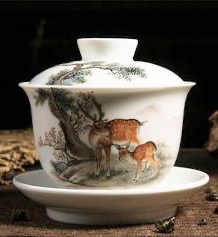
A traditional Chinese covered tea cup in dish, with naturalistic scene 
Photo source, Pinterest 


How the Chinese Man Drinks Tea


The Chinese man, in preparing tea, places a pinch of leaves in a Chinese teacup, which is without a handle, pours boiling water over them and places the cover on the cup. In a few seconds the tea is ready for drinking; the covered cup is raised to the mouth, and, with the fingers of the hand holding the cup, the lid is moved just sufficiently to permit the liquid to flow into the mouth as the cup is tilted. — By United States, Bureau of Foreign and Domestic Commerce, 1919


Etiquette Enthusiast, Maura J Graber, is the Site Editor for the Etiquipedia© Etiquette Encyclopedia

Sunday, April 15, 2018

Scone History, Etiquette and More

Freshly baked blueberry scones sit properly on their lofty perch, the top of the 3–tiered tea stand, as biscuits or scones are traditionally eaten first at tea time. The etiquette for tiered tea stands is simple. The order of items eaten is from the top tier to the bottom tier, with the bottom tier’s treats eaten last.  – “There are all manner of variations: afternoon-tea scones, cheese scones, herb scones and spice scones, to name a few. Try the Scottish Cream Scones with the addition of your favorite herb or spice and create your own royal version.”


There is a village in Perthshire, in central Scotland west of the modern village of New Scone, called, simply, Old Scone. It was the seat of Scottish Kings and Parliaments until the 15th century and it was here with the Coronation Stone the Scottish Stone of Destiny, called The Scone that the Kings of Scotland from Kenneth I to Charles II were crowned. A most Royal beginning for this humble breakfast and tea-time treat. The root of the word scone is probably Dutch, Schoonbrot or Schoonbrood, which means fine bread.

Although scones have a reputation for being dry, when they are made correctly, with the proper ingredients, they are, oh, so fine. Scones are a plain, homey mixture and should have a low fat content, a lot of baking powder to give them an open, light texture and a high proportion of liquid to ensure a soft, elastic dough. They should be mixed just until large lumps form, are gently gathered, pressed together and then lightly kneaded with the finger tips for a few minutes to develop some elasticity. Lovingly shaped into inch-thick rounds, they are placed on a baking sheet and cut into four quarters that are left in place or, sometimes, separated slightly. They may be brushed with a milk or egg wash to insure some browning, but traditionally they are simply dusted with flour. There are all manner of variations: afternoon-tea scones, cheese scones, herb scones and spice scones, to name a few. Try the Scottish Cream Scones with the addition of your favorite herb or spice and create your own royal version. 

Muffins in the British Isles are, of course, English Muffins. So popular, they were once sold on the streets of London by the Muffin Man with his tray and bell. English muffins should always be pulled apart never cut! You may use a fork for the operation or there are special pronged instruments available for this delicate maneuver that is imperative if you want to experience the crunchy, toasty hills and valleys so necessary to contain gobs of fresh butter and jam. –Santa Cruz Sentinel 1990

Etiquette Enthusiast, Maura J. Graber, is the Site Editor for the Etiquipedia© Etiquette Encyclopedia

Sunday, January 24, 2016

Etiquette and Russian Tea Festival

Gay Costumes, Music and Tea-Drinking Have Caught the Popular Fancy

RUSSIAN TEA FESTIVAL ATTRACTING LARGE CROWD


Gay Costumes, Music and Tea-Drinking Have Caught the Popular Fancy

The second day of the Russian tea festival, held in the parlors of the Graeco - Russian Church, under the auspices of the ladies of the church, for the Indian famine sufferers, was even more successful than the first. 

Hundreds of people, attracted by the pretty tea girls in their charming Eastern costumes and the music and mirth that pervaded the whole place, gathered around the tables and enjoyed the tea that had been carried nearly around the world and was served from massive samovars by charming maids and matrons. 

The scene at night was partlcularly charming, the costumes of the ladies under the bright lights giving a kaleidoscopic effect as they glided in and out among the assembled guests. Mrs. Metropolsky and Mrs. Krasoff presided at the samovars. 

The costumes of the tea girls were as follows: Mrs. O. C. Schroder, Roumanian; Miss Mary Dabovich, Serbian; Miss G. Ayov, Syrian; Misses Natalie and Alexandria Metropolsky, Russian; Miss Krasoff, North Russian Peasant; Miss Lizzie Kashevnikoff and Miss Valentine Ligda, Russian; Miss George and Miss Holtz; Roumanian. 

The musical programme yesterday afternoon and last night was very entertaining. George Leron and Mr. Warren played the piano and violin, respectively; the Misses Sophia and Lucy Czarnecke rendered a charming vocal duet and Miss Mary Burin entertained at the piano in the afternoon. 

Professor Moser's Zither Club was an attraction in the evening. Father Popoff made a hit by singing a bass solo, and the Russian church choir sang several national hymns and popular Russian songs. Vocal solos were given by Miss Lottie Irving, Mrs. Irving and Mrs. Whitney. 

To-day will be the last day of the festival and the ladies expect to have a big crowd to take care of this afternoon. There will be a special programme, full of novelties for those who have not attended a Russian tea drinking. Everybody is invited to be present — San Francisco Call, 1900


Etiquette Enthusiast, Maura J Graber, is the Site Editor for the Etiquipedia© Etiquette Encyclopedia

Sunday, May 17, 2015

Etiquette and French Tea Customs

"le 5 o'clock," has by this time become thoroughly domesticated in Paris


French Tea Drinking

The afternoon tea habit, or as it is known to our French cousins, "le 5 o'clock," has by this time become thoroughly domesticated in Paris. It is not so long ago that the name was greeted with an indulgently superior smile as "so English you know," and therefore hardly worth the serious consideration of the Parisienne, whose duty was not to follow fashions, but to set them. Yet gradually the tea table began to make its appearance in Paris salons. 

Those who had been in the habit of paying calls where mere words were exchanged found it pleasant also to receive a dainty cup of tea. The visitor, when her turn as hostess came about, repeated the refreshment, and the fashion spread. But the foreign custom in passing into Parisian life is always, to a certain extent, transformed and Parisianised.
Tea gown, circa 1902

The case of afternoon tea was to transplant the little function from the home circle, making it a feature of more public life. Between 4 and 6 o'clock every afternoon, French society now betakes itself to certain well known tea rooms.

Visits must, of course, be paid at this season, but they are cut short so as not to interfere with the tea. A Parisian now says, "Come and have tea with me at Ritz's," whereas not so long ago she would have said. "Come and see me at home." 
                 – From The Los Angeles Herald, 1904


Etiquette Enthusiast, Maura J. Graber, is the Site Editor for Etiquipedia© Etiquette Encyclopedia

Saturday, May 16, 2015

Etiquette and Victorian Tea Science

Making Tea Scientifically 

An English Analyst Sets Down the Rules of the Process


Professor Goodfellow, the well known English analyst, gives these rules for making "good" tea: 

1. Always use good tea. 

2. Use "two" hot, dry earthenware teapots. 

3. Use soft water which has just got to the boil. 

4. Infuse about four minutes. 

5. Pour off into the second hot, dry teapot. 

6. Avoid second brews with used tea leaves. 

The fact that tea, as served in France is so often bad, may be accounted for by the omission of some one, or perhaps all, of the above rules in its preparation. They are all necessary to make a, cup of really good tea, and if they were more often strictly adhered to tea would oftener be a delicious beverage. Even at the best "afternoon tea" rooms in England, America and France I do not believe that "two" hot, "dry" teapots are often used to make tea "fresh for each customer," or that the tea leaves thereafter are thrown away.– The Los Angeles Herald, 1899


Etiquette Enthusiast, Maura Graber, is the Site Moderator for Etiquipedia Etiquipedia© Etiquette Encyclopedia