Showing posts with label Hill’s Manual of Social and Business Forms. Show all posts

Sunday, June 27, 2021

Great 19th C. Social Reforms

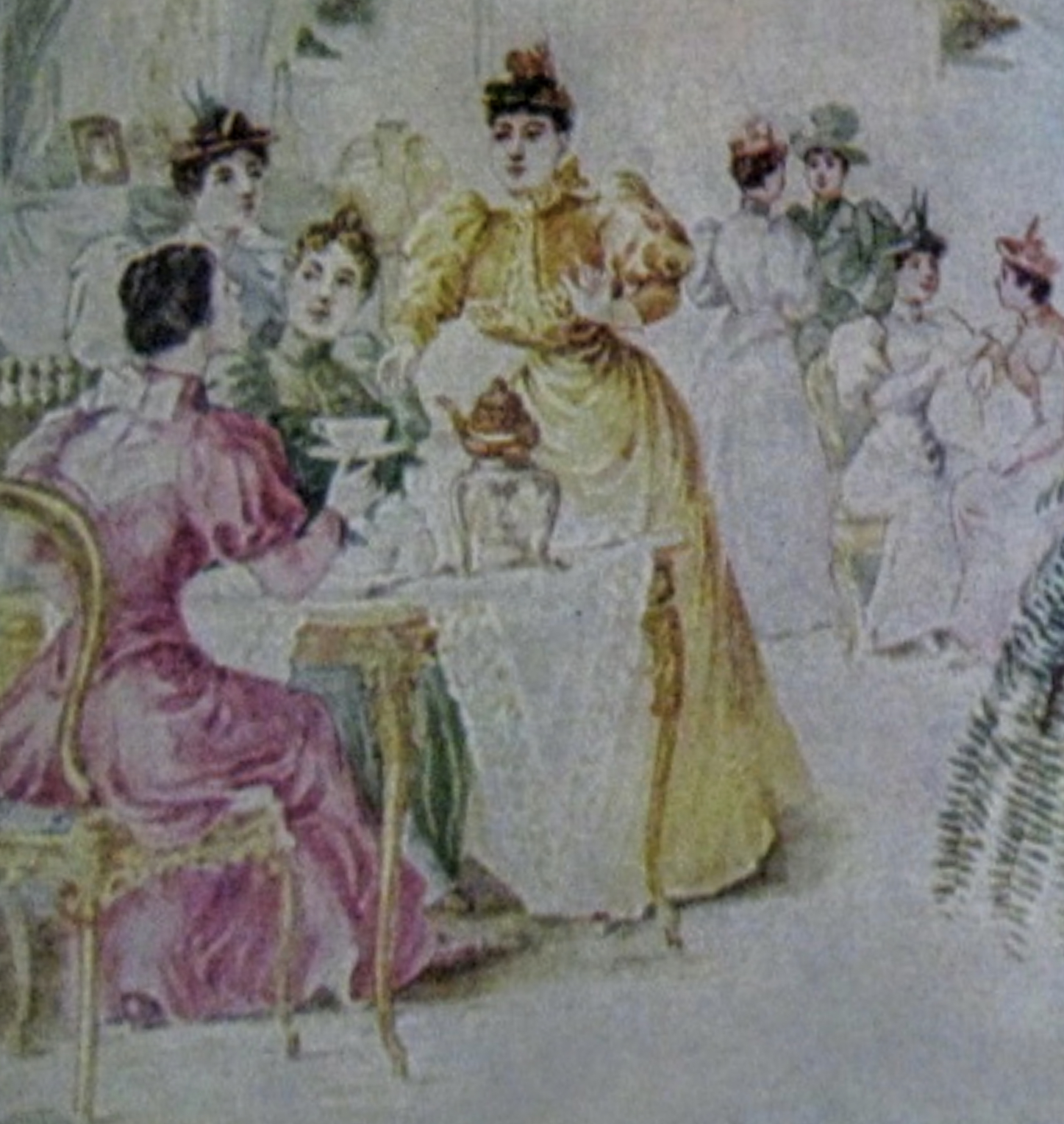
Though Queen Victoria’s own manners were questionable at best, the period in time named for the Queen – the Victorian Era– conjures up images of gentility and gracious living. 
The following is a list of Victorian Social Etiquette and Manners:
Bowing: “A gentleman should not bow from a window to a lady on the street, though he may bow slightly from the street upon being recognized by a lady in a window. Such recognition should, however, generally be avoided, as gossip is likely to attach undue importance to it when seen by others.”
Dignity: “To greet someone by saying ‘Hello, old fellow’ indicates ill-breeding. If you are approached in this vulgar manner, it is better to give a civil reply and address the person respectfully, in which case he is quite likely to be ashamed of his own conduct.”
Small talk: “No topic of absorbing interest may be admitted to polite conversation. It might lead to discussion.”
Conduct to avoid at the ball: “No gentleman should enter the ladies’ dressing room at a ball.”
Card-playing: “If possible, do not violate the rules of the game and do not cheat. Should you observe anyone cheating, quietly and very politely call it to his attention, and be careful that you do not get excited. People who experience ill-feeling at the game should avoid playing.”
Marriage: “Anyone with bright red hair and a florid complexion should marry someone with jet-black hair. The very corpulent should marry the thin and spare, and the body, wiry, cold-blooded should marry the round-featured, warmhearted, emotional type.”
Husbands: “Always leave home with a tender goodbye and loving words. They may be the last.”
Train travel: “People with weak eyes should avoid reading on trains, and those with weak lungs should avoid talking.”
Street etiquette: “When crossing the pavement, a lady should raise her dress with the right hand, a little about the ankle. To raise the dress with both hands is vulgar and can only be excused when mud is very deep.” - From The Old Farmer’s Almanac.com


Since Victoria Was Crowned

“Great social reforms belong to Queen Victoria’s reign,” writes William George Jordan, in the Ladies’ Home Journal, narrating the progress of the world since Queen Victoria ascended the throne sixty years ago. “The degrading practice of flogging has been abolished in the armies and navies of America and England. Children are no longer permitted to work in the mines of Britain. Press gangs no longer force men into the service of the Queen’s navy. The Red Cross Society, approved by forty-nine nations, has softened the horror of war. The transportation of criminals, with its many evils, has been suppressed. Executions are no longer conducted in public. The treatment of criminals has become humane. Factory laws and building acts make life easier for the poor. 

“Inventive science has made marvelous progress in every department during Victoria’s sixty years as Queen. Cantilever bridges have surprised the world. Travel has been wonderfully quickened by street cars, cabs, trolleys, cable cars, elevated roads and other triumphs of invention. In 1837 there were no typewriters, no passenger elevators, no modem bicycles, no soda-water fountains, no horseless carriages, no chemical fire-extinguishers, no ironclads, no perfecting presses. Fully chronicling the inventive progress of the last six decades would make it seem as if nothing of real consequence to man’s comfort had been done before 1837.” –Placer Herald, 1897


Etiquette Enthusiast, Maura J. Graber, is the Site Editor for the Etiquipedia© Etiquette Encyclopedia

Friday, December 5, 2014

Pre-Eminent Etiquette Book of 1800’s

… and Dining Dont’s
Professor Thomas E. Hill, author of “Hill’s Manual of Social and Business Forms,” (regarded as the pre-eminent etiquette book of the late Victorian Era in America) had been a teacher, newspaper publisher and served two terms as mayor of Aurora, Illinois.

MIND YOUR MANNERS

Many Americans in the 19th Century were concerned with how to establish order and authority in a society which was becoming increasingly industrialized and urban. Etiquette, in the broad sense of correctness in many facets of both business and personal life, was one way to address this problem. "Hill’s Manual," first published in 1873, presented proper letter-writing, penmanship, legal forms, family records, and “speaking and acting in various relations of life.” 

The section of this popular, comprehensive volume entitled, “The Laws of Etiquette: What to Say and How to Do,” included helpful advice on improving one's manners, the proper use of calling cards, conduct when shopping, how to engage in conversation, traveling, proper behavior in church and school, rules of parties and dances, courtship, marriage, etc...
“Never allow butter, soup or other food to remain on your whiskers. Use the napkin frequently.” Thomas E. Hill
Dining was a popular social pastime, and a meal could be twelve courses or more. "Etiquette of the Table” was prominently featured in "Hill's Manual." Politeness at the table was to be cultivated; ways to achieve it were outlined on one page and illustrated with properly dressed and well-behaved diners.
       
           
“Errors to be Avoided” were presented, along with a comical, numbered depiction of “Bad Manners at the Table,” including:
  1. Tips back his chair.
  2. Eats with his mouth to full.
  3. Feeds a dog at the table.
  4. Holds his knife improperly.
  5. Engages in violent argument at the meal-time.
  6. Lounges upon the table.
  7. Brings a cross child to the table.
  8. Drinks from the saucer, and laps with his tongue the last drop from the plate.
  9. Comes to the table in his shirt-sleeves, and puts his feet beside his chair.
  10. Picks his teeth with his fingers.
  11. Scratches her head and is frequently unnecessarily getting up from the table.
Some of Thomas Hill’s advice may seem overly fussy or ridiculous to the modern reader. However, one must consider that many people in the Victorian Era, both in the U.S. and abroad, were seriously concerned with promoting civility in all aspects of their lives. In an updated “Hill’s Manual,” one writer suggests that “Perhaps we would add: Do not talk on your cell phone or text at the table.”


From a variety of sources and Thomas E. Hill’s, “The New Revised Hill’s Manual of Social and Business Forms: A Guide to Correct Writing,” 1893


🍽Etiquette Enthusiast, Maura J. Graber of The RSVP Institute of Etiquette, is the Site Editor for the Etiquipedia© Etiquette Encyclopedia

Sunday, March 23, 2014

The Unclassified Laws of Etiquette

From “Hill’s Manual of Social and Business Forms: Guide to Correct Writing with Approved Methods in Speaking and Acting in the Various Relations of Life” 

 Thomas E. Hill, 1875

Hill's Unclassified Laws of Etiquette

  • Never exaggerate.
  • Never point at another.
  • Never betray a confidence.
  • Never leave home with unkind words.
  • Never neglect to call upon your friends.
  • Never laugh at the misfortunes of others. 
  • Never give a promise that you do not fulfill.
  • Never question a child about family matters.
  • Never send a present, hoping for one in return.
  • Never speak much of your own performances.
  • Never fail to be punctual at the time appointed.
  • Never make yourself the hero of your own story.
  • Never pick the teeth or clean the nails in company.
  • Never fail to give a polite answer to a civil question.
  • Never present a gift saying that it is of no use to yourself.
  • Never read letters which you may find addressed to others.
  • Never fail, if a gentleman, of being civil and polite to ladies.
  • Never call attention  to the features or form of anyone present.
  • Never refer to a gift you have made, or favor you have rendered.
  • Never associate with bad company. Have good company, or none.
  • Never look over the shoulder of another who is reading or writing.
  • Never call a new acquaintance by their first name unless requested.
  • Never appear to notice a scar, deformity, or defect of anyone present.
  • Never arrest the attention of an acquaintance by touch. Speak to him.
  • Never punish your child for a fault to which you are addicted yourself.
  • Never answer questions in general company that have been put to others.
  • Never, when traveling abroad, be over boastful in praise of your own country.
  • Never lend an article you have borrowed, unless you have permission to do so.
  • Never attempt to draw the attention of the company constantly upon yourself.
  • Never exhibit anger, impatience or excitement, when an accident happens.
  • Never pass between two persons who are talking together, without an apology.
  • Never enter a room noisily; never fail to close the door after you, and never slam it.
  • Never forget that, if you are faithful in a few things, you may be ruler over many.
  • Never exhibit too great familiarity with the new acquaintance, you may give offense.
  • Never will a gentleman allude to conquests which he may have made with ladies.
  • Never be guilty of the contemptible meanness of opening a private letter addressed to another.
  • Never fail to offer the easiest and best seat in the room to an invalid, an elderly person, or a lady.
  • Never neglect to perform the commission which the friend entrusted to you. You must not forget.


  • Never send your guest, who is accustomed to a warm room, off into  a cold, damp, spare bed, to sleep.
  • Never enter a room filled with people, without a slight bow to the general company when first entering.
  • Never fail to answer an invitation, either personally or by letter, within a week after the invitation is received.
  • Never accept of favors and hospitality without rendering an exchange of civilities when opportunity offers.
  • Never cross the leg and put one foot in the street-car, or places where it will trouble others when passing by.
  • Never fail to tell the truth. If truthful, you get your reward. You will get your punishment if you deceive.
  • Never borrow money and neglect to pay. If you do, you will soon be known as a person of no business integrity.
  • Never write to another asking for information, or a favor of any kind, without enclosing a postage stamp for the reply.
  • Never fail to say kind and encouraging words to those whom you meet in distress. Your kindness may lift them out of their despair.
  • Never refuse to receive an apology. You may not receive friendship, but courtesy will require, when a apology is offered, that you accept it.
  • Never examine the cards in the card-basket. While they may be exposed in the drawing room, you are not expected to turn them over unless invited to do so.
  • Never, when walking arm in arm with a lady, be continually changing and going to the other side, because of change of corners. It shows too much attention to form.
  • Never insult another with harsh words when applied to for a favor. Kind words do not cost much, and yet they may carry untold happiness to the one to whom they are spoken.
  • Never fail to speak kindly. If a merchant, and you address your clerk; if an overseer, and you address your workman; if in any position where you exercise authority, you show yourself to be a gentleman by your pleasant mode of address.
  • Never attempt to convey the impression that you are a genius, by imitating the faults of distinguished men. Because certain great men were poor penmen, wore long hair, or had other peculiarities, it does not follow that you will be great by imitating their eccentricities.
  • Never give all your pleasant words and smile to strangers. The kindest words and the sweetest smiles should be reserved for home. Home should be our heaven.