Showing posts with label Gilded Age Polite Society. Show all posts

Thursday, February 19, 2026

Gilded Age Polite Society

Life brings a discipline to all; a discipline which bears directly upon every human being, making it his duty to be acceptable to his fellow-creatures. And unless certain tenets of good behavior are acknowledged and endorsed by society, how is the novice to know when he has trespassed upon good manners?


A subject which has been handled in many ways, and by many minds, always presents difficulties to one who attempts to set it forth in a new light. And yet the theme of our book is susceptible of many new thoughts, and many changes of old thoughts which are of value to the reader. The etiquette of polite society changes so materially in some phases, and with such marked contrast among different peoples and periods, that it is almost a hopeless task to formulate rules that shall absolutely govern with the same unchangeability that stamped the laws of the Medes and the Persians.

The nearest approach to such a task is to give to the inquirer those usages and forms which prevail in good society, and which, with slight modifications, are adapted to any part of the habitable globe. And while these rules are, in their general contour, applicable to any position in life, the good sense and knowledge of fitness of things, will help to a comprehension of those exceptional occasions, when even the etiquette which obtains everywhere, can be changed in a slight degree, without marring the force of the custom as usually accepted. 

The fact that the rules of good behavior are current everywhere, is based on their being the outgrowth of something more substantial than mere forms. They are grounded in that kindness of heart, that unselfish desire to make one'self agreeable and attractive, which must have a place with all, ere they can lay claim to being truly polite.

Life brings a discipline to all; a discipline which bears directly upon every human being, making it his duty to be acceptable to his fellow-creatures. And unless certain tenets of good behavior are acknowledged and endorsed by society, how is the novice to know when he has trespassed upon good manners?

The deepest thinkers all unite in pronouncing human nature essentially selfish. But, by studying the rules laid down by good society for guidance, and practicing them continually, they become second nature, and selfishness is kept in the background. Politeness becomes easy, if habitual, and performs its mission in bringing its followers up from the plane of self-love to a higher moral one, where thoughtless self-gratification is subdued, and time and attention are devoted to looking after the comfort and welfare of others.

Much remains to be said upon the value of good manners. They should be the outgrowth of character; a character built up in youth. Character is more than reputation. The young should learn its value, and early acquire it. The world may misunderstand - it generally does misconstrue human actions. But a clear conscience, a kindly nature, and fine manners, can conquer all things.

But even though certain customs may change, the principles which underlie social laws ever remain the same. Regarding etiquette then, from a higher standpoint than the mere following of certain set forms, we have added to those forms truths that lie deeper than outward observances. Mere politeness, unaccompanied by a desire to make it a nature of daily life, is very empty and unsatisfying. The moral nature must be developed at the same time, and the innate tendency to prefer self, must be kept in abeyance.

The life will then grow beautiful, the expressions of good will to all become spontaneous, and a broader culture, which is an aid to success in the world, will result. Good manners are pivots upon which a man's fortunes may be said to turn. Who is so unwelcome as the person destitute of them? No one likes to transact business with such a one, no pleasure is afforded by his society.

It is the aim of this work to impress upon all the importance of acquiring them; not alone for the pleasure which they afford, but because they are links in the chain which binds human beings to each other, and to a Higher Power.

Indifference to the comfort of others betokens a selfish, coarse nature, and repels those whose sympathies are active, and to whom civility is the natural expression of gentle def- erence, ever seeking to confer pleasure upon others. To all our readers is this volume especially addressed, with the sincere desire that profit and instruction may be gathered from its pages. And we feel certain that it will help the novice or the timid one, to know just what to do under all circumstances, assisting all to avoid those mortifying mistakes which are so distressing to a proud and sensitive nature. 

Every line has been penned with the hope that our treatment of the important subject of etiquette will make the duties of social life more clear, and awaken a desire for that culture which raises the soul to a more lofty ideal of the life we live here. –THE AUTHOR. 

From Polite Society at Home and Abroad, by Annie Randall White, 1895

 🍽️Etiquette Enthusiast, Maura J. Graber of The RSVP Institute of Etiquette, is the Site Editor of the Etiquipedia© Etiquette Encyclopedia

Wednesday, March 5, 2025

Gilded Age Practices in Polite Society

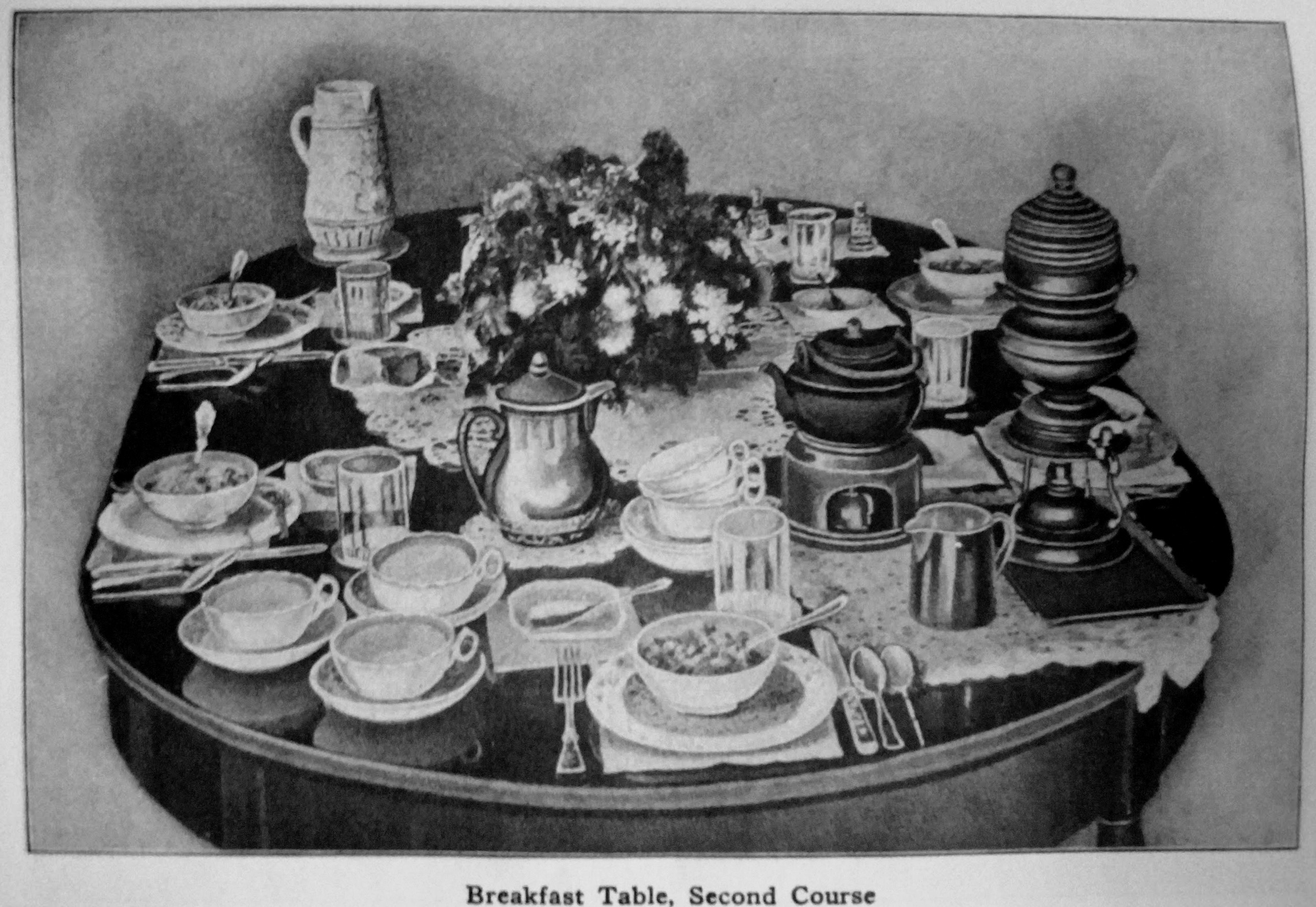
A Gilded Age Table set for the second course of a breakfast. – The American breakfast is all placed upon the table, unless oatmeal or other porridge are to be served as a third course. Changes of plates are also necessary when cakes requiring syrup are served, or when fruit is served.


Manners and Social Usages Practiced in Polite Society

It is at the present time a pleasant custom for a bride to announce with her wedding cards one or more reception days during the season after her marriage on which her friends can call upon her. The certainty of finding a bride at home is very pleasing. On the occasion of these receptions she should not wear her wedding, dress, but receive as if she had entered society as one of its members. The wedding accessories are all put away, and she wears any handsome reception dress she chooses. 

As regards a bride wearing her wedding dress to balls or dinners after her marriage, it is perfectly correct to do so, provided she divests herself of the veil and the orange blossoms.

Over Supply is Not Hospitality

Never overload a plate nor over supply a table. It is a vulgar hospitality. At a small dinner no one should hesitate to ask for more if he desires it. It will only be considered a flattering tribute to the dish. At large companies, where there is necessarily a greater variety of dishes, the most voracious appetite must be satisfied with a little of each. 

The French understand better than the people of any other nation how to supply a table. Their small family dinners are gems of perfection. There is plenty for every person, yet every morsel is eaten. The flowers or plants are fresh and odoriferous; the linen is a marvel of whiteness: the dishes are few, but perfect of their kind.

Writing Notes

The writer of notes ought to carefully discriminate between the familiar note and the note of ceremony, and consequently should learn how to write both. Custom demands that all notes written in the first person should begin with “My Dear Mrs. Smith,” and close with the expression “Yours cordially,” “Yours with regards,” etc… 

The laws of etiquette do not permit the use of numerals, as 1, 2, 3, but demand that one, two, three be written out in full. Abbreviations are considered inelegant.

A common mistake much indulged in by beginners is the confusion of the first and third persons. A note in answer to an invitation should be written in the third person, if the invitation was expressed in the third person. Formal notes are usually thus written. It is not considered good forin to write a note on ruled paper.

Breakfast at Home and Abroad

In France the first breakfast consists merely of a cup of coffee and a roll, with sometimes a little fruit. A second breakfast, at 11 o'clock, is more substantial, dishes being served which may be eaten with a fork. 

In England breakfast is a very informal meal, the breakfast hour being at any time one chances to be ready for it. The substantial dishes are served from the sideboard, where they are kept hot in chafing dishes. 

The American breakfast is all placed upon the table, unless oatmeal or other porridge are to be served as a third course. Changes of plates are also necessary when cakes requiring syrup are served, or when fruit is served. – Riverside Enterprise, 1891


🍽️Etiquette Enthusiast, Maura J. Graber, is the Site Editor for the Etiquipedia© Etiquette Encyclopedia 
Thursday, September 17, 2020

Minor Points of Victorian Etiquette

An old style “bow” — a lady bows first to a gentleman in the street —an action positively forbidden to him—and you see in it the whole theory of the superior innocence of women.
— Photo, Etiquipedia’s private library


The Usages of Polite Society

Harper’s Bazar thus pleasantly calls attention to some minor points of every-day etiquette: Take, for instance, the fact that a lady bows first to a gentleman in the street —an action positively forbidden to him—and you see in it the whole theory of the superior innocence of women. A man keeps his place in society, and has the entree of respectable houses, when, it is possible, his life has become questionable; the innocence of women of any such conduct is asserted and maintained by giving her the right to say who shall be her acquaintances. 

It is a safeguard of society; if he chooses lower women, he cannot have her. And thus many things that seem trifling have in reality important bearings. Among these let us mention the circumstance that previous permission is needed before the introduction of the friend who may be walking with you to the friend whom you may meet, and that it is equally necessary to know if it be desirable to the other party; unless this is understood, the friend who is with you will walk on a few paces slowly, should you find it necessary to stop and speak. 

Of course, cases arise where this rule must be violated, but in those you probably know circumstances that warrant your taking the law into your own hands. Permission, however, is not needed at a ball to introduce a gentleman to a lady for a dance, provided that you have the right of introduction, probably for the reason that she is at liberty in that case to continue or end the acquaintance next day. — 1877


Etiquette Enthusiast, Maura J Graber, is the Site Editor for the Etiquipedia© Etiquette Encyclopedia