Showing posts with label Helen Sprackling. Show all posts

Monday, November 6, 2023

Some Afternoon Tea Necessities

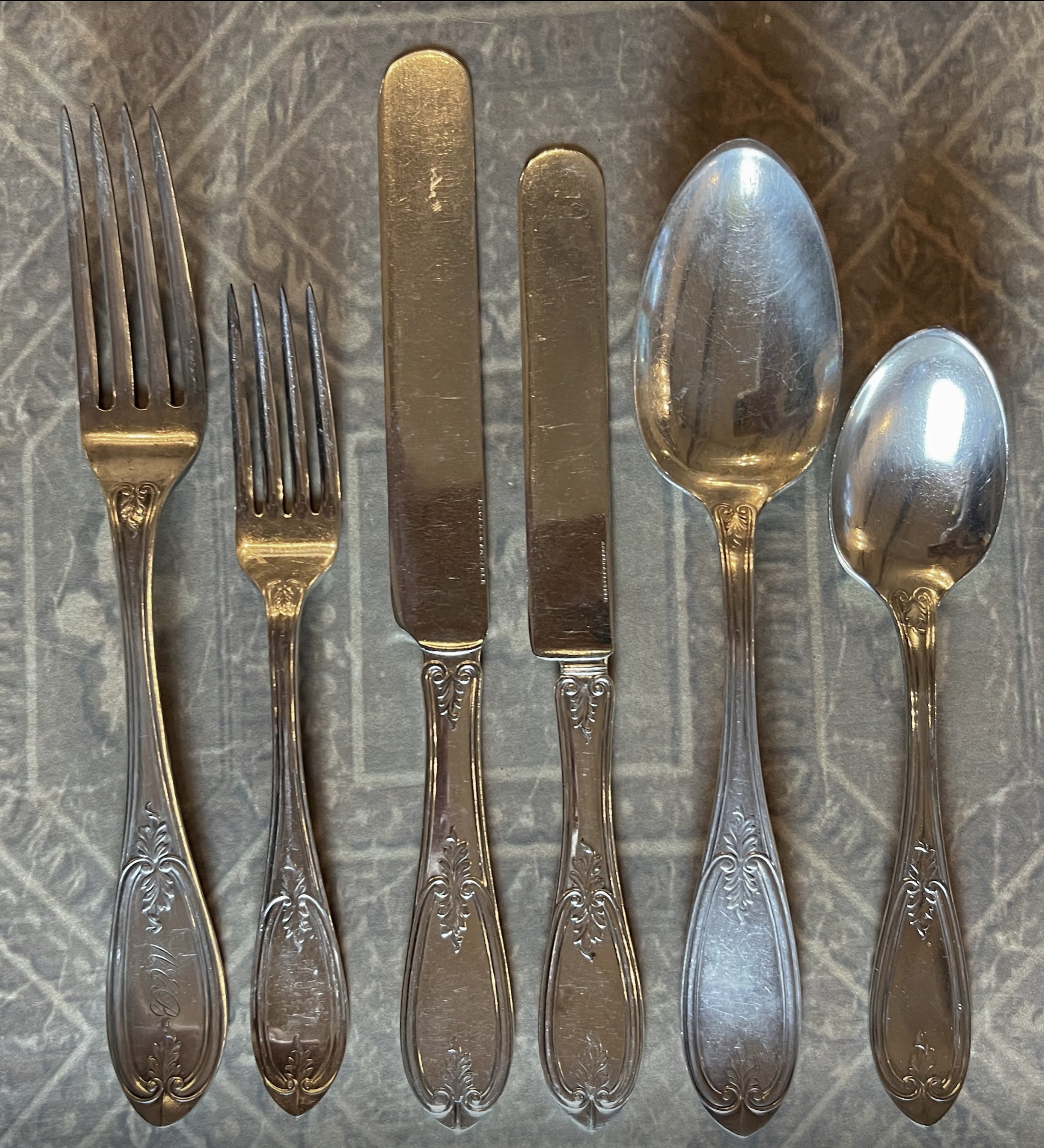
Pictured above is a typical five piece place setting in one of the oldest patterns of silver; the Olive pattern. The pattern can be found in several variations by several different silver makers. The teaspoon on the far right is the smallest spoon of regular place setting spoons, though it does not belong at a formal place setting. The teaspoon should only be at a dinner setting if it is being used for a fruit cocktail, a dessert  or a sorbet, though a fruit spoon, dessert spoon or a sorbet spoon are far more appropriate and designed to eat those specific foods. A teaspoon and cup and saucer are allowable at breakfast and luncheon settings. Coffee spoons are a bit smaller than teaspoons and demitasse spoons are smaller still. 

After your cups and saucers, here are some other afternoon tea necessities: “Naturally your necessary silver is only a spoon since, customarily, forks are not used for afternoon tea. The food should be only what can be picked up in the fingers. After all, afternoon tea is little more than a bit of refreshment at the end of the day, a stimulant- it's not a meal and whatever there is to eat should not be enough to spoil the appetite for dinner.

Tea napkins are about fourteen inches square, quite rightly dainty and decorative bits of fabric edged with lace or embroidery, a hemstitched hem or just a plain rolled one. White or in color, they are anything that you want to make them, providing they harmonize with your other tea appointments.

When you are entertaining at tea for six or eight, you merely enlarge the tray set-up. Use a table low enough so that seated at it, you can pour conveniently. Cover the table with a tea cloth and then set out your tea equipment on its tray. Use the hot-water kettle if you have one. Arrange the napkins, plates and some of the cups and saucers on the tabletop. Add, if there is room, a low flower arrangement; also, if it is autumn or winter, a candle or two.” – From Helen Sprackling, 1960


 🍽Etiquette Enthusiast, Maura J. Graber, is the Site Editor for the Etiquipedia© Etiquette Encyclopedia

Sunday, November 5, 2023

Cups on Plates for Tea?

“… if you have a set of the regular English tea plates and cups this is a different matter. Notice please, that each plate has a deep well to keep the cup from slipping and the shape of the plate is usually oval, more spacious and easier to hold in the hand. It is a fashion that however has never really taken hold in this country.” – Most early British cups had no handles and there were no rings inside the deep, bowl-like saucers, like this old set above. Though examples of tea cups with handles can be found from centuries earlier in the V&A Museum in England, handles weren’t truly common place throughout England until the early 19th century.

Cups Directly on the Plates?

This is answer to that frequently asked question about the advisability and good usage of putting the tea cup directly on the tea plate and omitting the saucer entirely. The answer is an emphatic NO. It is neither practical nor attractive, it is uncomfortable for the guest, and thoughtful and discriminating hostesses do not do it. The well of a saucer holds a cup more securely than any plate, thereby cutting down the hazard of spilling the tea. Since they were not designed for each other the plate and the cup look very awkward together. It is a makeshift combination which always gives the impression that the hostess has broken the saucer that belongs with the cup or is trying to cut down on dish-washing, the latter probably true.

At a large or formal tea there should be only bite-size portions of sandwiches and cakes which can easily fit on the edge of a saucer. If the tea fare is more extensive, as it might be with a small informal gathering of friends, and you were serving cake to be eaten with a fork or hot muffins to be spread with honey or jam for which a plate with a fork or small knife would be required, then seat your guests around the dining-room table or provide them with small tables.

At a church affair or a club meeting not in a home, where large numbers are to be served and dish-washing may be a factor, there might be some excuse for placing a tea cup without its accompanying saucer directly on a small plate but it is no less awkward. In a home, it is a provincial way of serving tea and inexcusable for a hostess who would be considered discriminating and tasteful.

Of course if you have a set of the regular English tea plates and cups this is a different matter. Notice please, that each plate has a deep well to keep the cup from slipping and the shape of the plate is usually oval, more spacious and easier to hold in the hand. It is a fashion that however has never really taken hold in this country. – Helen Sprackling, 1960


 🍽Etiquette Enthusiast, Maura J. Graber, is the Site Editor for the Etiquipedia© Etiquette Encyclopedia

Thursday, September 7, 2023

The Unexpected Dinner Guests

“Freezer Living… better living for your family!” from 1959  — With a freezer anything is possible from soup to nuts. And if you have one, I know I hardly need to tell you what you can do with it. For short notice and quick serving, however, there is nothing better than stew, beef, veal or what you prefer, complete with its vegetables…

For the Last Minute Dinner Guest

For last-minute menus, for the moment when your husband walks in the front door with an unexpected guest, or your darling child asks, "Mother, may I ask Mary to stay to dinner?" a reserve shelf is the only answer. You can think of it in two general categories: instantaneous and one hour's notice.

The former is definitely the moment for the can-opener. While your husband is mixing cocktails, it is but the work of a moment to get out a can or two — soup to begin with. This is usually the night you have decided to have the hash from yesterday's roast. Then open a can of sliced pineapple and garnish the hash with pineapple rings sautéed in butter or slipped for a moment under the broiler or, open a can of grapefruit which you keep already chilled in the refrigerator against just such emergencies; this makes a refreshing last-minute salad. Always keep a can or two of fruit in reserve in the refrigerator.

Keep a bottle of sherry on hand even if you don't drink it. A tablespoon or two per cup added to the soup, a wine glass of it to chilled canned fruit for dessert adds special flavor to an otherwise routine dish.

The second category for your emergency shelf includes the quick mixes, biscuits, cakes, the package desserts which you can use on just a little longer notice— when, for instance, your husband telephones from the office. The list of such items is wide and varied. The secret is to stock them, however, with three or four definite menus in mind.

With a freezer anything is possible from soup to nuts. And if you have one, I know I hardly need to tell you what you can do with it. For short notice and quick serving, however, there is nothing better than stew, beef, veal or what you prefer, complete with its vegetables. Dishes such as macaroni and cheese are emergency assets. And, of course, desserts of all kinds.

I hold no brief for the emergency dinners which you buy and store away; they add nothing to a hostessreputation, whereas a fragrant, well-seasoned homemade stew rich with chunks of good meat, plenty of vegetable and gravy, plus a biscuit or two hot from the oven, and a fresh green salad—mmh! what more could any unexpected guest ask for! — By Helen Sprackling, 1960


🍽Etiquette Enthusiast, Maura J. Graber, is the Site Editor for the Etiquipedia© Etiquette Encyclopedia

Wednesday, September 6, 2023

Before Glass was Affordable

A half Gill or half Jill measure, originally for rum.

Glass did not appear on the average table until close to the end of the first quarter of the nineteenth century. Glass could be had if one could afford it, for the merchant who sold “crockery” also sold glassware, which like his earthenware generally came from England or perhaps Ireland. “. . . Pint and half pint tumblers, Wine Glasses, Goblets, Vinegars, cut and common Salts, glass pint Mugs, Bird fountains, Inks, Mustards, Smelling Bottles, Proof Vials, Jill, and half Jill Tumblers, Butter Coolers, &c.” ran a Hartford ad of 1790 which also listed a large supply of “blue and white and cream coulor'd.” But glass was much more expensive. — From “Customs on the Table Top: How New England housewives set out their tables,” by Helen Sprackling, 1958


What were “Jill, and half Jill Tumblers”?

 Jack and Gill (pronounced "Jill") cups have been used since the 14th century to accurately measure liquids - often wine and spirits.

It is reported that, in an attempt to increase tax revenue, Charles I reduced the size of the 2 oz Jack and consequently the 4 oz Gill came tumbling after, so the rhyme goes. This cup is a reproduction of an original cup of the reduced size. This Gill Cup is handcrafted by redsmith Peter Goebel. Tin-lined and food safe, it measures 2" tall x 2" diameter and holds approximately 3 oz.

From the writings of George Washington, July 3, 1782 "Tomorrow being the anniversary of the Declaration of Independence...the Army is to be served an Extra gill of rum per man on this joyful occasion". A gill (pronounced "Jill") of rum, or a half-cup, was the standard daily ration for soldiers and sailors alike during the Revolutionary War. The rum ration remained in effect for the British Navy all the way up to July 31, 1970. – From Townsends.US


Reminder: We have a free webinar on Dining According to Hollywood and Dining Etiquette as Presented on Film! You can watch it live on September 23rd at 4:00 pm PST (Pacific Standard Time). We have a limited number of viewers who can attend via Zoom, however, if you are registered and cannot watch the event live, you’ll be sent a video link to watch a copy at your leisure. Link to the Free Webinar –– https://events.humanitix.com/dining-according-to-hollywood-the-art-of-dining-on-film Please email any questions to: theetiquettechannel@gmail.com


🍽Etiquette Enthusiast, Maura J. Graber, is the Site Editor for the Etiquipedia© Etiquette Encyclopedia

Sunday, September 3, 2023

Please, No Cups and Saucers...

An informal alfresco table — At the time, morning, noon or night, that coffee is served at the table any to family and/or guests, the equipment should be placed on a small tray at the hostess' place or on an adjacent small table. 

No matter how informal or casual the gathering it is neither attractive table-setting, nor good serving practice, to place a cup and saucer at each individual place on the home table. At the time, morning, noon or night, that coffee is served at the table any to family and/or guests, the equipment should be placed on a small tray at the hostess' place or on an adjacent small table. 

The cups and saucers with a spoon on each saucer to the right of the cup are grouped at the hostess' place, each to be served in turn by her. Cream and sugar on a small tray might be placed on the table and passed by the guests themselves, especially if the hostess has other serving to do. At luncheon or dinner, if there is a maid, she will bring the cup of coffee to the guest after the hostess has poured it, placing it at the right. She will then serve sugar and cream on a small tray from the guest's left. —Helen Sprackling, 1960


🍽Etiquette Enthusiast, Maura J. Graber, is the Site Editor for the Etiquipedia© Etiquette Encyclopedia

Tuesday, March 21, 2023

Colonial American Dining Etiquette

Early wooden handled fork with tines of steel.


When a family dined alone the whole dinner was set on the table at the same time and no fuss about it. In the farm household the only concession to a guest, perhaps the minister come to call, was a clean white cloth and an extra dish of pickles or so, but down in the village, particularly at the squire's home, a special feast would consist of two courses, each enough to be a dinner in itself. Tables were not "set" as we do them today. They were "covered." No pretty arrangement of silver, no sparkling glassware, no floral decoration not until much later. The attractiveness of the table depended first upon the symmetrical arrangement of the dishes and secondly upon their individual garnishment. It was an indication of a hostess's achievement when the tablecloth was hardly visible. A characteristic dinner menu, as suggested by Susannah Carter for the month of July, might be:

FIRST COURSE

1 Mackerel, etc… 

2 Herb Soup

3 Boiled goose and stewed red cabbage

4 Breast of Veal al la Braise

5 Venison Pasty

6 Chickens

7 Lemon pudding

8 Neck of Venison

9 Mutton Cutlets

SECOND COURSE

1 Roast Turkey

2 Fruit

3 Roast Pigeons

4 Stewed Peas

5 Sweetbreads

6 Custards

7 Apricot Tart

8 Fricassee of Rabbits

9 Cucumbers

Hostesses might not follow these menus to the letter but that they served dinners equally ample is well documented by sundry travelers of our period from New England's own John Adams, to the English Mrs. Hall. Writing to his wife in Braintree from Falmouth in 1774, John Adams declared, ". . . and a very genteel dinner we had. Salt fish and all its apparatus, roast chicken, bacon, peas, as fine a salad as ever was made, and a rich meat pie. Tarts and custards, &c., good wine and as good punch as ever you made." No wonder a hostess needed guidance! Mrs. Rundell stated only, "the mode of covering the table differs in taste," but Mrs. Carter's publishers wisely provided her readers not only with a bill of fare for every month but also with a chart to show the position of each dish so that the hostess knew exactly how to place her dishes on the table. No need to mark the individual places; a plate for each diner, a knife and fork, perhaps a wine glass though it was generally advised to place the glasses on the side table or sideboard and let the diners ask for what they wanted in the way of liquid refreshment. That was all that was necessary.— From “Customs on the Table Top: How New England housewives set out their tables,” by Helen Sprackling, 1958


🍽️Etiquette Enthusiast, Maura J. Graber, is the Site Editor for the Etiquipedia© Etiquette Encyclopedia

Saturday, March 18, 2023

Early American Dining Table Etiquette

Farm dinner table, early nineteenth century, with white linen cloth, Staffordshire, redware, and pewter.

Glass did not appear on the average table until close to the end of the first quarter of the nineteenth century. Glass could be had if one could afford it, for the merchant who sold “crockery” also sold glassware, which like his earthenware generally came from England or perhaps Ireland. “. . . Pint and half pint tumblers, Wine Glasses, Goblets, Vinegars, cut and common Salts, glass pint Mugs, Bird fountains, Inks, Mustards, Smelling Bottles, Proof Vials, Jill, and half Jill Tumblers, Butter Coolers, &c.” ran a Hartford ad of 1790 which also listed a large supply of “blue and white and cream coulor'd.” But glass was much more expensive.

There was actually little need for glass on a country table in those days. “Cyder” was the rural New England drink for adults and children morning, noon, and night-for breakfast, dinner, and supper, with a big pitcher of it for evening entertainment, the daily drink of sustenance and the gesture of hospitality. It never tasted better than out of a wooden noggin, a pewter tankard, or a “pottle-sized” (two quart) mug.

A man’s social standing and his pocketbook, both, could be gauged by what he drank. To the man of substance in the village, for example, who had just built a handsome mansion for himself and had acquired his tastes and fashions “down Boston-way,” glass was a definite asset if not a positive necessity. His more urbane standard of living and the friends who came to see him required the proper glass. — From “Customs on the Table Top: How New England housewives set out their tables,” by Helen Sprackling, 1958

 🍽️Etiquette Enthusiast, Maura J. Graber, is the Site Editor for the Etiquipedia© Etiquette Encyclopedia

Monday, July 11, 2022

Etiquette for Table Decor

Candles are used only on the evening dinner table. Generally speaking, the preferred arrangement for candles is a balanced arrangement on either side of the centerpiece.


The Decorative Motif

This includes the flower or fruit arrangement, candle equipment, compotes if you use them, and other purely decorative items.

There's no reason why you shouldn't arrange them as soon as you have put on your cloth or placemats and before you set the individual places, if it is easier for you. I prefer to do it last, since I can arrange my flowers and other decorative items and place my candles according to the empty space that is left and see that they are in proportion to and do not overbalance the table-setting as a whole.

It is important, especially on a small table, to keep your central arrangement low, so that diners may see each other across the table and carry on a conversation if they wish.

Candles are used only on the evening dinner table. Generally speaking, the preferred arrangement for candles is a balanced arrangement on either side of the centerpiece. If you are setting a narrow refectory-type table you may place them at either end.

The arrangement of accessory decorative pieces such as compotes or added containers of flowers or fruit, figurines and so forth, must depend on the length and size of your table. 

Remember that crowding and overdisplay is awkward; it's poor taste and bad design. Space is important. It is restful to the eye and a foil for the beauty of your accessories and equipment. You will never go wrong if you set your table with restraint and simplicity. This is a good rule to remember. — Helen Sprackling, 1960


🍽Etiquette Enthusiast, Maura J. Graber, is the Site Editor for the Etiquipedia© Etiquette Encyclopedia

Friday, May 27, 2022

Tabletop Linen Etiquette and History

Nowadays the tablecloth is only one of several features in the decoration of the table and must share its responsibility with fine china, shining silver and sparkling glass and serve as a background and foil for all of them as well. — Green table linens (as shown above), more than just about any colored linens, seem to go with just about every manner of tabletop accessories, from china and ceramics, to flatware and crystal.


The oldest decorative appointment of the table is the cloth. When plates were still slabs of bread or wooden trenchers, when fingers preceded forks and every guest brought his own knife, nevertheless, strips of cloth were laid over the bare boards with meticulous care and detailed ceremony. By the sixteenth century the cloth had become a specially designed adornment for the table, woven (by hand, of course) in a diaper, basket weave, or damask, and always of linen. Frequently it was ornamented with fringed edges, inset strips of lace, or richly embroidered, those of Italy reveling in color. Save perhaps for a standing salt of silver it was, until the food appeared, the only decoration of the table.

Nowadays it is only one of several features in the decoration of the table and must share its responsibility with fine china, shining silver and sparkling glass and serve as a background and foil for all of them as well. For what is on the tabletop — cloth, place mats or only the fine finish of the table itself — must have the quality of building up all the other appointments or toning them down, of pulling them all together into a unified scheme. With all this responsibility this cover has to be completely right in itself, intrinsically, decoratively, functionally.


From “Setting Your Table... Its Art, Etiquette and Service,” by Helen Sprackling, 1960

🍽Etiquette Enthusiast, Maura J Graber, is the Site Editor for the Etiquipedia© Etiquette Encyclopedia

Thursday, May 26, 2022

Place Setting Etiquette

Lay the silver so that the piece to be used first is always on the outside. The piece or pieces for each succeeding course should follow in logical progression of use. — Above is a mid-century modern setting featuring the Franciscan Ware “Desert Rose” patterned tableware with the 1940 Grille Flatware in the “Treasure” pattern.

The Individual Place

Place plate: Mark each individual place with the place (as frequently called “service”) plate. If you have no special plates for the purpose, use a regulation dinner or luncheon-size plate. Space the plates evenly. See that those that you intend to have opposite each other are really opposite each other. The plate should be set just far enough in from the edge of the table so that it will not slip off. A plate at each place is standard table setting except at the most informal meals. Special service plates are nice if you can afford them but any sizable plate will do.

Silver flatware: Lay the silver so that the piece to be used first is always on the outside. The piece or pieces for each succeeding course should follow in logical progression of use. This brings the silver to be used last closest to the plate, which generally is the silver for the salad course.

Lay all silver pieces in a neat parallel arrangement, with the tips of the handles in line with the edge of the service plate and far enough back from the edge of the table so that they are not easily brushed off. They should be laid close enough to each other and to the service plate, yet without crowding, to give a feeling of unity to the complete place setting. Sprawling silver is a pretty sure indication of a careless hostess.

Silver used in the left hand lies at the left side of the plate; that used in the right hand at the right of the plate. In other words, forks are at the left, knives and spoons are at the right.

The oyster fork is the exception to the above rule. It is used in the right hand only and quite naturally lies at the right of the plate. The cutting edges of the knife blades are turned toward the plate.

Whatever your menu, there should be no more than three forks at the left of the plate and three knives at the right on a well-set table. This is a matter of taste and good usage. If the menu requires more knives and forks, they should be brought as needed. Dessert silver is brought later with the dessert service or may be laid at the top of the plate for an informal luncheon or dinner.

 —From “Setting Your Table... Its Art, Etiquette and Service,” by Helen Sprackling, 1960


🍽Etiquette Enthusiast, Maura J Graber, is the Site Editor for the Etiquipedia© Etiquette Encyclopedia


Monday, April 5, 2021

An Improper Formal Dinner Course

The term “fruit cup” denoted a type of “fruit cocktail” which was chopped fruits amidst the occasional maraschino cherry, served in a thick, sweet syrup. Special orange cups or fruit holders, like these which were developed in the gilded age, made oranges enticing and eating the fresh fruit elegant. These antiques would have been a welcome and refreshing change to the 1960’s formal table, as a break from that ‘ubiquitous fruit cup.’


“No Fruit Cup!”

“Avoid anything sweet for the beginning of a menu. If you serve fruit, serve it in its natural state, such as a melon with a wedge of lime or lemon, or a grapefruit cut in half. One of the famous banquet menu-makers in this country says that the ‘ubiquitous fruit cup’ is badly placed on American menus as a beginning course and should appear only at the end of a meal, ‘its normal place.’ Out of his experience he added that the custom of fruit cup came in during Prohibition, as a substitute for cocktails, frequently ‘bathed in a pink sweet liquid vaguely reminiscent of liquor, and the custom continued after repeal.’ — Helen Sprackling, 1960


Etiquette Enthusiast, Maura J. Graber, is the Site Editor for the Etiquipedia© Etiquette Encyclopedia

Sunday, April 4, 2021

12 Rules for American Formal Dinners

From 1 to 4 —1. Service plate, 2. Water glass, 3. White wine goblet, 4. Red wine goblet. A to H — A. Large dinner making, triple folded, B. First course fork, C. Main course fork, D. Salad fork, E. Main course knife, First course knife, G. Soup spoon (oval bowl for formal meals and soup plates, H. Seafood fork or Appetizer cocktail spoon.— Patricia Easterbrook Roberts — At very formal dinners, bread and butter is not served, so the bread plate is omitted. 

1. Invitations are sent in the third person, answered by the guests in writing, and in the third person. 
2. Full evening dresses required. This means white tie and tails for the men. 
3. While still in the hall, each male guest is given a card naming his dinner partner. 
4. Guests are announced by the butler as they enter the drawing room. 
5. The indicated dinner partners go arm in arm into the dining room. 
6. The table is covered with a cloth, white or in the palest of tints. The candle-and-flowers and fruit arrangement is lavish and elegant. 
7. Place cards have the names written in full. 
8. There are menus written in French. 
9. There are usually 6 or 7 courses of food, which is strictly traditional in type. 
10. The 6 or 7 courses are served with meticulous form. There are never second helpings. 
11. Large, broad rim suit plates are customarily used and the soup spoon is the large table-size. 
12. Unless specific entertainment is provided, one usually leaves earlier than if dining at an intimate little dinner, but not until after the guest, or guests, of honor, no matter how long they stay. — Helen Sprackling


🍽️Etiquette Enthusiast, Maura J. Graber of The RSVP Institute of Etiquette, is the Site Editor for Etiquipedia© Etiquette Encyclopedia