Showing posts with label How to Behave. Show all posts

Sunday, January 14, 2018

Victorian Etiquette of Hair

“Hair is to the human aspect, what foliage is to the landscape.” 
Gentleman from New York City, in 1889, with fashionable beard and moustache. – “There is no worthier accomplishment for a man with a moustache than to take soup in an inoffensive manner… and by no means should the moustache be used to strain the soup.” ~ Cornelia Dobbs


The hair and beard, in one of their aspects, belong to the dress. In reference to the style of wearing them, consult the general principles of taste. A man to whom nature has given a handsome beard, deforms himself sadly by shaving—at least, that is our opinion; and on this point fashion and good taste agree. The full beard is now more common than the shaven face in all our large cities.

In the dressing of the hair there is room for the display of a great deal of taste and judgment. The style should vary with the different forms of face.

Victorian hairstyles and bonnets for women.
Lardner's “Young Ladies' Manual” has the following hints to the gentler sex. Gentlemen can modify them to suit their case:

“After a few experiments, a lady may very easily decide what mode of dressing her hair, and what head-dress renders her face most attractive.”

“Ringlets hanging about the forehead suit almost every one. On the other hand, the fashion of putting the hair smoothly, and drawing it back on either side, is becoming to few; it has a look of vanity instead of simplicity: the face must do every thing for it, which is asking too much, especially as hair, in its pure state, is the ornament intended for it by nature. Hair is to the human aspect what foliage is to the landscape.”

“Light hair is generally most becoming when curled. For a round face, the curls should be made in short, half ringlets, reaching a little below the ears. For an oval face, long and thick ringlets are suitable; but if the face be thin and sharp, the ringlets should be light, and not too long, nor too many in number.”

“When dark hair is curled, the ringlets should never fall in heavy masses upon the shoulders. Open braids are very beautiful when made of dark hair; they are also becoming to light-haired persons. A simple and graceful mode of arranging the hair is to fold the front locks behind the ears, permitting the ends to fall in a couple of ringlets on either side behind.”

“Another beautiful mode of dressing the hair, and one very appropriate in damp weather, when it will keep in curl, is to loop up the ringlets with small hair-pins on either side of the face and behind the ears, and pass a light band of braided hair over them.”

“Persons with very long, narrow heads may wear the hair knotted very low at the back of the neck. If the head be long, but not very narrow, the back hair may be drawn to one side, braided in a thick braid, and wound around the head. When the head is round, the hair should be formed in a braid in the middle of the back of the head. If the braid be made to resemble a basket, and a few curls permitted to fall from within it, the shape of the head is much improved.”–
From “How To Behave: A Pocket Manual Of Republican Etiquette, And Guide To Correct Personal Habits” by Samuel R Wells, 1887

Etiquette Enthusiast, Maura J Graber, is the Site Editor for the Etiquipedia© Etiquette Encyclopedia 

Tuesday, November 10, 2015

Victorian Etiquette of Tobacco Use

You have the same right to smoke, take snuff, and chew that you have to indulge in the luxuries of a filthy skin and soiled garments, but you have no right, in either case, to do violence to the senses and sensibilities of other people by their exhibition in society. 


Victorian Etiquette Advice on Tobacco

If you use tobacco, in any forth, allow us to whisper a useful hint or two in your ear...

Smoking, snuff-taking, and especially chewing, are bad habits at best, and in their coarser forms highly disgusting to pure and refined people, and especially to ladies. You have the same right to smoke, take snuff, and chew that you have to indulge in the luxuries of a filthy skin and soiled garments, but you have no right, in either case, to do violence to the senses and sensibilities of other people by their exhibition in society. 

Smoke if you will, chew, take snuff (against our earnest advice, however), make yourself generally and particularly disagreeable, but you must suffer the consequences — the social outlawry which must result.

Shall we convert our parlors into tobacco shops, risk the ruin of our carpets and furniture from the random shots of your disgusting saliva, and fill the whole atmosphere of our house with a pungent stench, to the discomfort and disgust of everybody else, merely for the pleasure of your company? We have rights as well as you, one of which is to exclude from our circle all persons whose manners or habits are distasteful to us. You talk of rights. You can not blame others for exercising theirs.

There are degrees here as everywhere else. One may chew a little, smoke an occasional cigar, and take a pinch of snuff now and then, and if he never indulges in these habits in the presence of others, and is very careful to purify his person before going into company, he may confine the bad effects, which he can not escape, mostly to his own person. But he must not smoke in any parlor, or sitting-room, or dining room, or sleeping chamber, or in the street, and particularly not in the presence of ladies, anywhere. – From 1887's "How to Behave"


Etiquette Enthusiast, Maura J .Graber, is the Editor and Site Moderator for Etiquipedia© Etiquette Encyclopedia

Monday, November 9, 2015

Etiquette and Public Grooming

You wouldn't wear this in public, so why would you  pick your teeth, comb your hair, or perform any of the necessary operations of the toilet in public or company?
Personal Grooming in Public

Never pare or scrape your nails, pick your teeth, comb your hair, or perform any of the necessary operations of the toilet in company. All these things should be carefully attended to in the privacy of your own room. 

To pick the nose, dig the ears, or scratch the head or any part of the person in company is still worse. Watch yourself carefully, and if you have any such habits, break them up at once. 

These may seem little things, but they have their weight, and go far in determining the character of the impression we make upon those around us. –From 1887's "How to Behave"


Etiquette Enthusiast, Maura J .Graber, is the Editor and Site Moderator for Etiquipedia© Etiquette Encyclopedia
Friday, April 10, 2015

Gilded Age Etiquette of Evening Parties

“Versailles” was a Gilded Age flatware pattern. This pattern was a “multi-motif, figural pattern” which made it very popular. The Gilded Age unofficially is believed to be the period between 1870-1900, though many people count the period all the way up to the U.S. involvement in WWI. “Gilding” is to cover, or coat, with gold, as many silver items were at the time. The period also got its name from the title of a book. “The Gilded Age: A Tale of Today” was an 1873 novel by Mark Twain and Charles Dudley Warner.

EVENING PARTIES
Evening parties are of various kinds, and more or less ceremonious, as they are more or less fashionable. Their object is or should be social enjoyment, and the manners of the company ought to be such as will best promote it. A few hints, therefore, in addition to the general maxims of good behavior already laid down, will suffice.
                 
A married man should never accept an invitation from a lady in which his wife is not included. 

1. Invitations
Having accepted an invitation to a party, never fail to keep your promise, and especially do not allow bad weather, of any ordinary character, to prevent your attendance. A married man should never accept an invitation from a lady in which his wife is not included.

2. Salutations
When you enter a drawing-room where there is a party, you salute the lady of the house before speaking to any one else. Even your most intimate friends are enveloped in an opake (sic) atmosphere until you have made your bow to your entertainer. You then mix with the company, salute your acquaintances, and join in the conversation. You may converse freely with any person you meet on such an occasion, without the formality of an introduction.
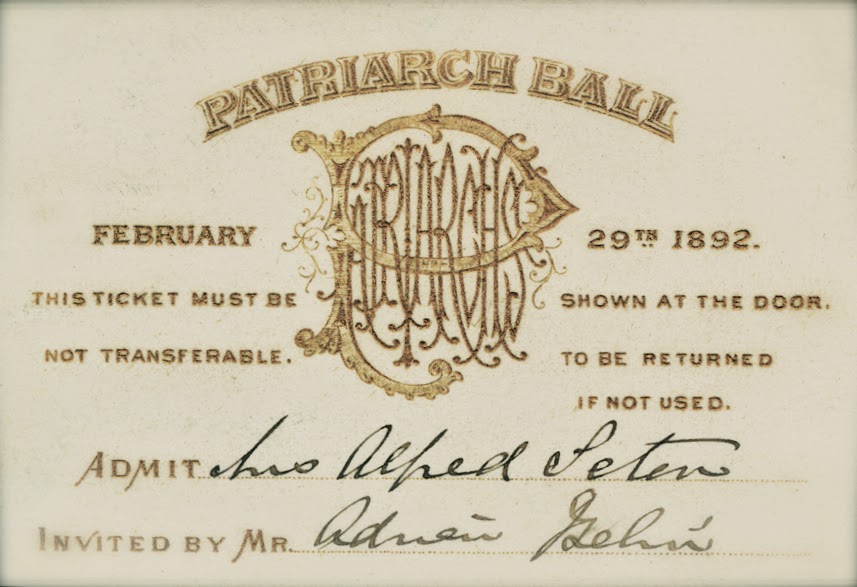
The Vanderbilts at a Gilded Age, fancy dress, costume ball. The Vanderbilts were one of the richest American families at the time. 
3. Conversation 
When conversation is not general, nor the subject sufficiently interesting to occupy the whole company, they break up into different groups. Each one converses with one or more of his neighbors on his right and left. We should, if we wish to speak to any one, avoid leaning upon the person who happens to be between. A gentleman ought not to lean upon the arm of a lady’s chair, but he may, if standing, support himself by the back of it, in order to converse with the lady partly turned toward him. The members of an invited family should never be seen conversing one with another at a party. 
French leave is a leave of absence, without announcing one’s departure. This includes leaving a party without bidding farewell to the host. With food and entertainment like that of the Gilded Age, would one really want to leave early? An not thank the host and hostess?!?
4. French Leave 
If you desire to withdraw before the party breaks up, take “French leave” — that is, go quietly out without disturbing any one, and without saluting even the mistress of the house, unless you can do so without attracting attention. The contrary course would interrupt the rest of the company, and call for otherwise unnecessary explanations and ceremony. 
5. Sports and Games 
Among young people, and particularly in the country, a variety of sports or plays, as they are called, are in vogue. Some of them are fitting only for children; but others are more intellectual, and may be made sources of improvement as well as of amusement. Entering into the spirit of these sports, we throw off some of the restraints of a more formal intercourse; but they furnish no excuse for rudeness.  
You must not forget your politeness in your hilarity, or allow yourself to “take liberties,” or lose your sense of delicacy and propriety. The selection of the games or sports belongs to the ladies, though any person may modestly  propose any amusement, and ask the opinion of others in reference to it. The person who gives the party will exercise her prerogative to vary the play, that the interest may be kept up.   
If this were the proper place, we should enter an earnest protest against the promiscuous kissing which sometimes forms part of the performances in some of these games, but it is not our office to proscribe or introduce observances, but to regulate them. No true gentleman will abuse the freedom which the laws of the game allows; but if required, will delicately kiss the hand, the forehead, or, at most, the cheek of the lady. A lady will offer her lips to be kissed only to a lover or a husband, and not to him in company. 
A lady will offer her lips to be kissed only to a lover or a husband, and not to him in company. 
 
The French code is a good one: “Give your hand to a gentleman to kiss, your cheek to a friend, but keep your lips for your lover.” Never prescribe any forfeiture which can wound the feelings of any of the company, and “pay” those which may be adjudged to you with cheerful promptness. — From “How to Behave,” 1887


 🍽Etiquette Enthusiast, Maura J. Graber of The RSVP Institute of Etiquette, is the Site Editor for the Etiquipedia© Etiquette Encyclopedia