|
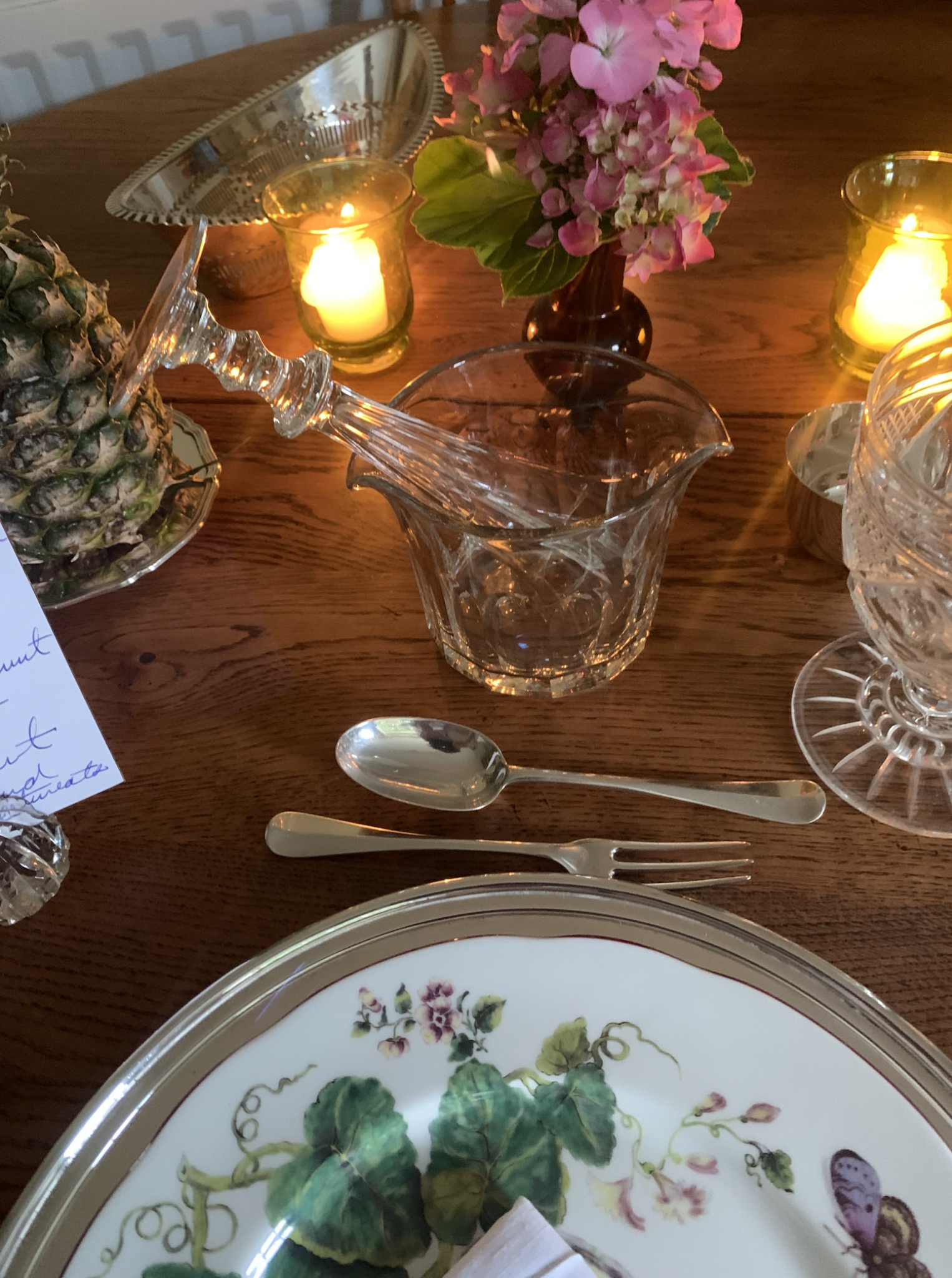
| Amy Willcock was the Best in Show winner for the Professional category in the 2nd Annual Etiquipedia International Place Setting Competition with this spectacular Georgian Era place setting. Amy is an author who contributes to several publications and has authored several books. The following post is an extract from a book she wrote for English Heritage. |
The Customs and Culture from the Georgian Era to the Regency Era: An Age of Elegance, from 1714-1837, with Four Georges and a William (IV), by Amy Willcott
While we can see that so far people were entertaining from Eve taking the apple to up to this moment, the Georgians seemed to take dining to another level.
The middle and professional classes were growing and the aristocracy and gentry were still enjoying the high life but for the majority of the population little advance in their standard of living. Bread and wheat, still a staple went through ups and downs due to wheat prices falling because of a number of bad seasons. Spiced buns and fruit breads were still popular and muffins so popular in the North moved South and were eaten with lots of butter. Butter was extensively eaten from very early times but you could also say that butter, cream and nutmeg were major features of Georgian cookery. Fashionable families built Ice houses and ice was (Edwardians brought it over from America) taken off the estate ponds. It was used for preserving and the making of elaborate Ices- ice cream.
The English were well known throughout the continent for being massive meat eaters and the enclosure of land and the new game laws made poaching an offence with a death penalty attached to it if caught; making Game highly prized and only legally available through a land owner. Rabbit was still able to be eaten by the ordinary people but hare was not. Jugged Hare was a favourite dish in the 18th century. Fish eating habits changed. Gone were the compulsory “fish days” of the church. Salmon and trout was plentiful but salmon still reigning as the king of fish and was expensive. Towards the end of the Georgian period ice houses were being built along the salmon rivers in Scotland so that Londoners and other towns could enjoy fresh iced packed salmon. One dish that I am glad has not survived is turtle soup. Green turtles would be kept alive in fresh water tanks on ships from the West Indies.
The skills of the Head Gardeners and the wealth of their employers were shown off in the fruits and vegetables they served in and out of season. The masses still ate greens, roots and potatoes regularly. While the upper classes and the aristocracy were eating asparagus, cucumbers and melons. Pineapples now a little more accessible were the great show off – If you wanted to stick it to your neighbour you grew and served pineapples. Greenhouses were built so that pineapples, grapes, melons, nectarines and peaches could be grown by the great estates.
Dairies were also a great source of pride so much so that one Gentleman in his 70’s courted a fine Dairy maid and eventually married the dairy maid. Dairy Maids were well known for their beautiful complexions and soft skin. (The reason was down to cox pox – the dariy maids became immune hence the first vaccines) Cream was eaten in abundance and cheese was so popular that cheese mongers ran their own fleet of ships to distribute the cheeses from Liverpool to London. Stilton was named after a village near Peterborough. The landlord of the Bell Inn at Stilton was supplied by his sister in law, a farmer’s wife who made a variety of cheese now known as Stilton although back then it was eaten with a spoon so that you didn’t miss the maggots! Cheese was, for the fashionable set the end of the meal with it being eaten in pieces or in savoury dishes such as Welsh Rabbit.
Because of the political troubles with France, wines and brandies were not being brought into the country legally and were very expensive, (a lot of smuggling was going on) so wines from Portugal and Spain were drunk instead. The government encouraged the production of home-made wines and brandies to combat the lack of and price of imports. Gin was cheap and widely available. Also known as Geneva, from the French genievre-juniper- that it was estimated that over 9,000 children died in 1751 after being given gin to keep them quiet.
As well as the rise in spirit drinking Tea was taking the nation by storm and so to was the rise in sugar consumption. The introduction of treacle, a by-product of sugar was used for sweetening cakes and biscuits. Coffee and chocolate while remaining expensive were gaining momentum. Bell calling systems in houses appeared around 1760’s. Georgian kitchens were moved to a separate part of the house and in some cases a whole other wing. The risk of fire was quite high. Cooking ranges became more sophisticated and kitchen equipment and eating utensils changed.
Eating times changed from mid-day to 3pm around 1780’s but by the early 1800’s it was 7pm. Dining rooms were now fitted out with side boards, wine coolers, knife boxes. The Family plate was shown off -The Georgians were all about showing off the new dining rooms and furniture to great effect. Up until the early part of the 19th century, the furniture was arranged around the room leaving the centre of the room open. By the end of the century, it was fashionable to leave the table and chairs ready for dining.
Soon into the 1780’s people, especially in the country, started changing for dinner. It was considered important for dinner guests to wash and change into their finery and eating etiquette was moving in fast. By this time the usual seating arrangements of women at one end of the table and men at the other had made way to the “promiscuous” seating arrangements of boy girl boy girl…or should I say gentleman lady gentleman lady! Precedence was hugely important and had to be given great thought.
Huge white table cloths down to the floor were used not only for covering the table but in place of napkins. Although thankfully napkins, which were indeed used earlier, came back into fashion especially in sophisticated house with French habits.
Table decorations were very important to the Georgians. Silver candlesticks, fruit bowls and other silver was laid down the centre of the table and the food was arranged around it then later sugar was molded and shaped into bucolic scenes or seascapes and were placed on mirrors. In some houses porcelain figures adorned the tables.
Forks were by now three pronged and knives round bladed. Fish was eaten with two forks. It is worth noting that forks were placed face down to avoid lace cuffs catching the tines. Food and Fashion once again intermingling. Glass was still very expensive and “rinsers” were common so one could rinse the same glass before starting a different wine. Porcelain and bone china were being pioneered by the likes of Spode, Worcester and Wedgwood (names still around today) and Chinese porcelain although highly desirable and expensive was making way for English porcelain.
The skills of the Head Gardeners and the wealth of their employers were shown off in the fruits and vegetables they served in and out of season. The masses still ate greens, roots and potatoes regularly. While the upper classes and the aristocracy were eating asparagus, cucumbers and melons. Pineapples now a little more accessible were the great show off – If you wanted to stick it to your neighbour you grew and served pineapples. Greenhouses were built so that pineapples, grapes, melons, nectarines and peaches could be grown by the great estates.
Dairies were also a great source of pride so much so that one Gentleman in his 70’s courted a fine Dairy maid and eventually married the dairy maid. Dairy Maids were well known for their beautiful complexions and soft skin. (The reason was down to cox pox – the dariy maids became immune hence the first vaccines) Cream was eaten in abundance and cheese was so popular that cheese mongers ran their own fleet of ships to distribute the cheeses from Liverpool to London. Stilton was named after a village near Peterborough. The landlord of the Bell Inn at Stilton was supplied by his sister in law, a farmer’s wife who made a variety of cheese now known as Stilton although back then it was eaten with a spoon so that you didn’t miss the maggots! Cheese was, for the fashionable set the end of the meal with it being eaten in pieces or in savoury dishes such as Welsh Rabbit.
Because of the political troubles with France, wines and brandies were not being brought into the country legally and were very expensive, (a lot of smuggling was going on) so wines from Portugal and Spain were drunk instead. The government encouraged the production of home-made wines and brandies to combat the lack of and price of imports. Gin was cheap and widely available. Also known as Geneva, from the French genievre-juniper- that it was estimated that over 9,000 children died in 1751 after being given gin to keep them quiet.
As well as the rise in spirit drinking Tea was taking the nation by storm and so to was the rise in sugar consumption. The introduction of treacle, a by-product of sugar was used for sweetening cakes and biscuits. Coffee and chocolate while remaining expensive were gaining momentum. Bell calling systems in houses appeared around 1760’s. Georgian kitchens were moved to a separate part of the house and in some cases a whole other wing. The risk of fire was quite high. Cooking ranges became more sophisticated and kitchen equipment and eating utensils changed.
Eating times changed from mid-day to 3pm around 1780’s but by the early 1800’s it was 7pm. Dining rooms were now fitted out with side boards, wine coolers, knife boxes. The Family plate was shown off -The Georgians were all about showing off the new dining rooms and furniture to great effect. Up until the early part of the 19th century, the furniture was arranged around the room leaving the centre of the room open. By the end of the century, it was fashionable to leave the table and chairs ready for dining.
Soon into the 1780’s people, especially in the country, started changing for dinner. It was considered important for dinner guests to wash and change into their finery and eating etiquette was moving in fast. By this time the usual seating arrangements of women at one end of the table and men at the other had made way to the “promiscuous” seating arrangements of boy girl boy girl…or should I say gentleman lady gentleman lady! Precedence was hugely important and had to be given great thought.
Huge white table cloths down to the floor were used not only for covering the table but in place of napkins. Although thankfully napkins, which were indeed used earlier, came back into fashion especially in sophisticated house with French habits.
Table decorations were very important to the Georgians. Silver candlesticks, fruit bowls and other silver was laid down the centre of the table and the food was arranged around it then later sugar was molded and shaped into bucolic scenes or seascapes and were placed on mirrors. In some houses porcelain figures adorned the tables.
Forks were by now three pronged and knives round bladed. Fish was eaten with two forks. It is worth noting that forks were placed face down to avoid lace cuffs catching the tines. Food and Fashion once again intermingling. Glass was still very expensive and “rinsers” were common so one could rinse the same glass before starting a different wine. Porcelain and bone china were being pioneered by the likes of Spode, Worcester and Wedgwood (names still around today) and Chinese porcelain although highly desirable and expensive was making way for English porcelain.
Food was all brought to the table at the same time, with soup served in large tureens followed by fish then meat. That is why we see so many large silver covers as decoration scattered around dining rooms now. Kitchens today are much closer to the dining room and courses come out one at a time. Dessert was the grand finale to dinner and was a whole course on its own. The table would be deconstructed, cloths removed and everything changed. Fresh napkins, glass dishes and water bowls for rinsing, dipping and freshening of the fingers and mouth – quite disgusting really!
The dessert was taken to extreme lengths with lots of the confectionery and sweet meats being bought from continental confectioners. Glass tazza’s were piled high and on top of one another in diminishing order and were covered with candied fruits, dried fruits, flowers and sweet meats. All of it shimmering and sparkling against fantastically polished wooden tables. Port, Madeira, claret or sherry would be served. And passed round the table – there are many stories about how and why port is passed to the left - in my research none of them have been conclusive but the one I like the best is a Naval tradition. The Port passes to Port. Port of course being on the left.
The ladies would then withdraw and the men would then and “speak freely” around the dining table. — By Amy Willcock, 2022
The ladies would then withdraw and the men would then and “speak freely” around the dining table. — By Amy Willcock, 2022
🍽Etiquette Enthusiast, Maura J. Graber, is the Site Editor for the Etiquipedia© Etiquette Encyclopedia