Showing posts with label Etiquette in Spain. Show all posts

Tuesday, November 1, 2022

Spain’s Victoria’s Etiquette at Home

Victoria found the company at her husband’s dinner table somewhat mixed at first. The exuberant young King would sit anywhere and invite almost any one. But his bride soon changed the etiquette and abolished indiscriminate gatherings – Queen Victoria Eugenia of Spain by Kaulak – Public domain image of Queen Victoria of Spain

Quite tactfully and skillfully, the young Queen is playing her part. Like her famous Royal grandmother, she is a very early riser, and her English breakfast of ham, roast beef and poached eggs, alone with the King, is one of the pleasantest functions of the day. After his cigarette, with which Alphonso concludes even this early meal, he must need repair to his state duties; and in the ordinary way, they do not meet again until lunch time.  
Victoria found the company at her husband’s dinner table somewhat mixed at first. The exuberant young King would sit anywhere and invite almost any one. But his bride soon changed the etiquette and abolished indiscriminate gatherings – not forgetting, however, that certain high functionaries and prelates have the right of access to the royal table. – Harper’s Bazar, 1908

 šŸ½Etiquette Enthusiast, Maura J. Graber, is the Site Editor for the Etiquipedia© Etiquette Encyclopedia

Monday, July 12, 2021

Etiquette and the Restive King

“He loves horses, and every moment that he can contrive to escape from the confining duties of his position as King he spends on the race track, or in the company of jockeys, bookmakers and the general run of race-goers. Then, he is like a boy, free from the straint of home or school, a man among men, a good fellow…” Alphonso “would hie him with his family to some South American republic, to raise horses and forget Madrid. He would flee from his Queen mother, a strict follower of the Royal Code of the House of Hapsburg and a stickler for the letter of the rule and every word of tradition in regard to court functions.” 


Uneasy rests the head that wears the crown of Spain. Alfonso, harassed by politics and bored by the formalities and limitations of Court etiquette, longs to doff the glittering symbol of authority and become a private gentleman. He could be a horse breeder and trainer. He loves horses, and every moment that he can contrive to escape from the confining duties of his position as King he spends on the race track, or in the company of jockeys, bookmakers and the general run of race-goers. Then, he is like a boy, free from the straint of home or school, a man among men, a good fellow. 

He knows whereof he speaks when horses form the subject of his discourse, whereas, alas, even the wisest wearer of the purple cannot always be sure that he knows what he is talking about when he gives oracular utterance to his decisions upon affairs of state. So he would hie him with his family to some South American republic, to raise horses and forget Madrid. He would flee from his Queen mother, a strict follower of the Royal Code of the House of Hapsburg and a stickler for the letter of the rule and every word of tradition in regard to court functions. 

But the addition of a real Spanish King to a South American republic is something not to be contemplated lightly. No place in South America that we know of could be trusted to maintain its republican equilibrium a day after he had taken up his abode there. A Monarchist party would be formed on the night of his arrival, and a revolution would be afoot the following morning. The United States, in the interest of peace, would have to ship poor, weary Alfonso back to Spain and its surfeit of pomp and ceremony. – Chico Record, 1920


Etiquette Enthusiast, Maura J. Graber, is the Site Editor for the Etiquipedia© Etiquette Encyclopedia

Thursday, August 27, 2020

Spanish Business Etiquette

Who sits where at a dining table? — Students are taught how to arrange seating (Anglo-Saxon protocol has guests of honor at the head, Latin protocol has them in the middle), how to sit correctly (elbows off the table), when to smoke (not until the coffee arrives) and which knife and fork to use (start from the outside).


Minding Manners Abroad : A Finishing Touch for Businessmen in Spain


At Spain’s newest business school, young executives are learning how to peel oranges, choose French wines and greet Arab princes.

Management, marketing and accounting are out: The Academy of Manners, Customs and Behavior is strictly concerned with the social side of doing business abroad.

The academy is the brainchild of three young entrepreneurs in the northeastern region of Catalonia, who saw their foreign ventures stumble on non-commercial obstacles.

Jose Ramon Tobia, for example, could not understand why his Arab workers in Abu Dhabi would take a break every three hours and refused to work at his pace. Then someone explained about Moslem prayer schedules.

200 Students

“I knew nothing about their religion,” he said.

“I talked to my friends and we realized that there were lots of people in Spain who were not equipped to deal with the rest of the world.”

Since the businessman’s finishing school opened in May, about 200 people have taken classes. The basic course is 75,000 pesetas ($550) for 12 two-hour sessions, while specially tailored programs for executives visiting specific countries cost two or three times as much.

“Of course, joining the Common Market helped,” co-founder Mario Gargallo said. Spain entered the European Community at the start of the year.

“People are traveling more and receiving more foreign visitors, and they want to improve themselves,” he said.

The Catalans have considered themselves Spain’s most urbane citizens, drawn by culture and tradition to emulate French and Italian sophistication.

They are also Spain’s most successful and innovative business executives, and the combination has made the academy an instant hit.

The Business Lunch

“In Madrid, they do their business and then go out to celebrate,” said Gargallo. “But in Barcelona, a business lunch is for doing business.”

So the business lunch is at the heart of the syllabus.

Students are taught how to arrange seating (Anglo-Saxon protocol has guests of honor at the head, Latin protocol has them in the middle), how to sit correctly (elbows off the table), when to smoke (not until the coffee arrives) and which knife and fork to use (start from the outside).

Then they progress to trickier subjects: peeling unshelled prawns and choosing the right wines.

The academy’s wine instructor, writer and restaurateur Jose Maria Gotarda, spends much of his time correcting misconceptions.

“The most common mistake is thinking that because a wine is older, it must be better,” he said.

“In fact, a Rioja from 1981, which was one of the great years, is far superior to a 1973, which was very bad.”

Gargallo said the restaurants and hotels where they hold their courses confirmed that Spanish table manners leave a lot to be desired.

“Head waiters always tell us that at a reception, the English and the Germans wait to be offered hors d’oeuvres while the Spaniards throw themselves on the food,” he said.

Pupils also have to be prepared for different eating habits abroad. The prospective traveler to Britain, for instance, is told not to be surprised by a cooked breakfast and to eat it, or risk hunger later.

Punctuality

The academy has specialists on all major foreign countries and some companies have sent along groups of employees. One Japanese multinational firm this month ordered lessons for five of its Spanish staff members who will travel to Japan soon.

But can the academy succeed in making Spaniards what they evidently are not?

“We don’t want Spaniards to be punctual like the English,” said Tobia. “But when they go to a business meeting with an Englishman, we want them to get there on time.”

He and his partners now have ambitious plans for expansion. They intend to open branches next year in Madrid, Valencia, Seville and Oviedo, and are looking at buying their own restaurant in Barcelona to serve as a venue for classes.

They have even been approached by parents who would like courses in manners and etiquette for their children.

“Twenty years ago, we had to study manners at school,” said the academy’s Fernando Lizcano de la Rosa, head of protocol at the Barcelona town hall.

“People no longer know how to shake hands with the king and they want to learn how to do things properly,” he said. — 
From Reuter’s, Barcelona, Spain 1986


Etiquette Enthusiast, Maura J Graber, is the Site Editor for the Etiquipedia© Etiquette Encyclopedia 

Wednesday, August 19, 2020

19th C. Wives‘ Etiquette of Mexico and Spain

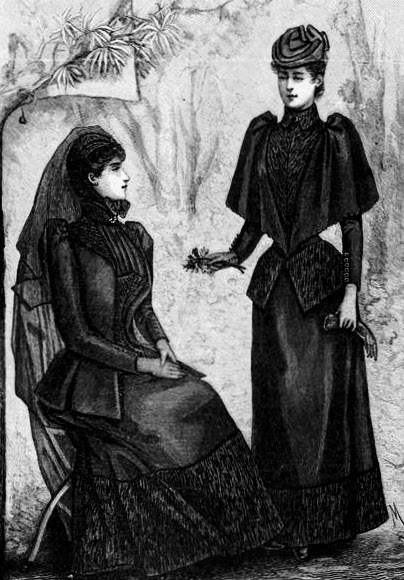
An 1891 advertisement for mourning dresses. — The etiquette of funerals in Mexico does not permit the female relations of deceased to attend. Only men attend the departed to the church and the tomb. 


The etiquette of funerals in Mexico does not permit the female relations of deceased to attend. Only men attend the departed to the church and the tomb. Funerals are so expensive that they often ruin business men. All female relatives, even to cousins and children, must wear deep mourning for two years. During the mourning none of the ladies of the household must be seen in public. Bodies are buried encased in laces and decked with precious stones. 

In Mexico, as in Spain and other southern countries, a lady retains her maiden name after marriage, and though she annexes to it, that of her husband by means of a “de,” she is universally known by her own family name. It is considered more courteous to address even elderly married ladies SeƱorita (Miss), instead of SeƱora (Madame.) The lady of the house is always called by her servants and dependents La NiƱa (the little girl), though she may have attained the age of eighty. — From ‘Of General Interest,’ 1884


Etiquette Enthusiast, Maura J Graber, is the Site Editor for the Etiquipedia© Etiquette Encyclopedia

Wednesday, August 12, 2020

Etiquette and the King’s Car


A motoring Monarch was a grave crisis in the history of Spanish royal etiquette!


Spain’s Blithe Young King

There is a grave crisis in the history of Spanish etiquette, says the London Chronicle. King Alfonso XIII, who is described by a French Journal as “very impulsive and at the same time very ‘sporty,’” wishes to make a royal progress through his Kingdom in an automobile. Horror of the Prime Minister! Such a vehicle, he says, is beneath the dignity of a Monarch to whom the constitution has entrusted the “sumptuous car of the state.” 


The sumptuous car must not be driven by petroleum. Horses are still harnessed to the Chariot of the Sun. But Spanish etiquette does not prevent the Monarch from traveling by railway. Lady Currie tells a story of a young man who jumped into a compartment one day on the English train and started a conversation with an old lady who greatly admired his pleasant manners. When he was alighting site asked his name and he answered, blithely, “Alfonso.” He was Alfonso XII, then a cadet at Sandhurst. The anecdote will probably be read at Madrid with pain and incredulity. — King City Rustler, 1905


Etiquette Enthusiast, Maura J Graber, is the Site Editor for the Etiquipedia© Etiquette Encyclopedia

Saturday, May 16, 2020

A Royal Nursery in Spain

An engagement card featured Alfonso in uniform with his helmet and sword and his then fiancĆ©, Victoria Eugenie. The Spanish Royal Court was considered the most confining in the world concerning etiquette, far surpassing the French Royal Court’s strict etiquette at Versailles. Evidently, the Royal nursery was the only area not controlled by a detailed list of rules of Royal decorum.  — “People who know Spain from books will tell you with bated breath of the cast-iron etiquette that surrounds the royal personage of Spain, of dreadful dinners eaten in solemn silence, of bows to the left and curtsies to the right, of mace-bearers and cup-bearers and sword-bearers, of orders of precedence...”

A Royal Nursery

The little heir to the Spanish throne has begun his babyhood in a suite of rooms arranged entirely after the fancy of his royal mother. Spanish etiquette requires her to conform to ideas other than her own on most points, but in the fitting of the nursery her word is law. The furnishing, decorating and entire arrangement are English, and offer everything that could possibly conduce to a baby’s health and happiness. The suite, directly over the Queen’s apartments, on the sunny side of the palace, consists of living room, dining room, bedrooms for the baby and head nurse, bath and sewing room. The living room is decorated in green and white, with showers of pink rosettes. 

The vaulted celling is enamelled in white, and round the walls runs a frieze of animals in Noah’s Ark-like procession. Eight green shades temper the sunshine. The angles of furniture walls are all softly rounded; so the approved method of standing a naughty child in the corner face to the wall could hardly be adopted in this case. With the exception of the rose colored English carpets, everything in the suite is washable. The wide window sills are coziily cushioned; an iron lattice, light and lacelike, but very strong, secures the windows from without. In the bedroom, three large paintings represent “Morning.” “Noon” and “Night.” The first is a sunshiny picture of a baby awakening in his little bed. "Noon” shows him busy with porringer and spoon: and in “Night” he has folded his chubby hands in prayer before going to sleep. The woodwork is white enamelled, and round the celling a frieze of dancing children charms the eye, as do the exquisite tint and design of the blue and white tiling of the fireplace. 

The little Prince sleeps in the cradle that rocked father and grandfather before him. It is a stately affair, resting on four Corinthian supports. It was formerly curtained in the richest lace, flowing from beneath a Spanish crown, but the young Queen mother had the crown removed, lest it fall and injure the royal sleeper below; and the lace curtains were, suppressed to allow freer access of air. The cradle linen shows embroidery of fairy like fineness, the other coverlets being sewn with butterflies and roses in white silk. The dining room furniture is white mahogany, with the royal arms of Spain skillfully inlaid in each piece. Throughout simplicity and good taste distinguish this ideal dwelling for a young child. The rooms are considered the best ventilated in all Madrid, for the young Queen inherits her love of fresh air from her illustrious grandmother, the late Queen Victoria of England.—Youth’s Companion, 1907


Etiquette Enthusiast, Maura J Graber, is the Site Editor for the Etiquipedia©️ Etiquette Encyclopedia 

Wednesday, December 27, 2017

Etiquette and Spanish Brides

Traditional Spanish brides wear black dresses and lace mantillas.  Originally, worn for Catholic church services, mantillas are ornate veils worn for wedding ceremonies. Many times, these are passed down from one generation to the next.

There are no bridesmaids at a Spanish wedding, but instead a “madrina” (literally “godmother”) is present with the witnesses. There is no bride cake, but there is a reception and very often a feast after the ceremony. Before the wedding takes place, the bride’s new home is made ready for her reception, for the honeymooners do not start on their travels until the day after their marriage.

Before their departure they pay a polite visit to their respective parents. On their return, dainty sweetmeats in pretty boxes are sent round to their friends. No visits are paid until little cards have been sent, “offering their house.” – Amador Ledger, 1903


Etiquette Enthusiast, Maura J. Graber, is the Site Editor for the Etiquipedia© Etiquette Encyclopedia 
Thursday, August 18, 2016

Etiquette Creates a Pretty Picture

The little Princess asks for a drink of water; a maid of honor hands it to her with the elaborate etiquette prescribed by the formalities of the most rigidly ceremonious Court in Europe. 

The Story of “Las Meninas”

How One of VelĆ”zquez's Notable Pictures Came To Be Painted 


The story of “Las Meninas” is that Velasquez was painting a portrait of the Spanish King and Queen (who sat where the spectator is when he looks at the picture). Their little daughter, the Infanta Margarita, came in with her maids of honor, her dog and her dwarfs, accompanied by her duena and a courtier. The little Princess asks for a drink of water; a maid of honor hands it to her with the elaborate etiquette prescribed by the formalities of the most rigidly ceremonious Court in Europe. 

The scene presented so charming a picture, that the King desired Velasquez to paint it. The artist has included himself in the group at work upon a large canvas on which it is supposed he was painting a portrait of the King and Queen when the interruption occurred. The reflection of the King and Queen appears in the mirror at the end of the room, and the Chamberlain, Don Jose Nieto, stands outside the door drawing the curtain. The scene is, indeed, represented with such wonderful realism that a famous French critic said of it, “So complete is the illusion that, standing in front of ‘Las Meninas’ one is tempted to ask, ‘Where is the picture?’” —St. Nicholas, Madera Mercury, 1905


Etiquette Enthusiast, Maura J Graber, is the Site Editor for the Etiquipedia© Etiquette Encyclopedia

Saturday, February 27, 2016

Lovers' Tech Skirt's Etiquette

How the newest technological marvel aided in elminating the Spanish royal court etiquette of the era, and romance flourished...
The modern, 19th century technology allowed a Spanish King to get the better of the traditional and implacable etiquette of a court where he couldn't get an egg boiled without 6 successive messengers and 10 pairs of hands.

The Telephone for Love Making

“The King,” writes a correspondent from Madrid, “spends with his bride all the time allowed him by etiquette and public affairs. He hastens to Aranjuez, where she is staying, and during the journey the royal Leander will sometimes look out at the carriage window to see on the horizon the bare trees under which Philip II conspired against the conscience of the world.”

When he returns from Aranjuez, his impatience leads him to a part of the palace where modern science has placed its latest discovery at the service of the royal lover, and annihilates the space which for two days longer separates him from his bride. A telephone, in fact, has been fitted up, connecting one of the King’s rooms with that of Princess Mercedes, and enabling them to converse together, free from indiscreet eyes and ears.

Strange to think that the telephone should thus get the better of the traditional and implacable etiquette of a court where the King cannot get an egg boiled without 6 successive messengers and 10 pairs of hands. Yet more strange is a love so rarely found in the loftiest stations, and which could only spring up and gain strength because two hearts met in the solitude of exile, far from the factitious pomp of courtly constraint. — The Daily Alta, 1878


Etiquette Enthusiast, Maura J Graber, is the Site Editor for the Etiquipedia© Etiquette Encyclopedia

Sunday, October 25, 2015

Etiquette Extremes of Spain

"The court etiquette of Spain was elaborate and complex to the extreme."
"It was in Spain that etiquette attained those extremes which are to-day so difficult to understand. Men and women ceased to be human beings with a will: Frederic Marshall says, 'They became machines of reverence, everybody had his place marked out and was kept mercilessly in it. The number of steps and the depths of bows which each person was to make on entering the royal presence, the width of cloaks, the length of ribbons, and perhaps more than all, the elaborate division of offices and functions, we're fixed with a precision of which examples exist nowhere else.'
                                                             
"Spanish nobles are classified either as Grandes de EspaƱa (also called in English grandees), or as titled nobles. Formerly, grandees were divided into the first, second and third classes, but now, all grandees enjoy the same privileges. An individual may hold a grandeeship, whether in possession of a title of nobility or not. Normally, however, each grandeeship is attached to a title, though this was not always the case. Furthermore, a grandeeship is always awarded along with every ducal title, just as most dukes in France gradually obtained a peerage under its ancien rĆ©gime. A grandee of any rank outranks a non-grandee, even if that non-grandee's title is of a higher degree. Thus, a baron-grandee enjoys higher precedence than a marquis who is not a grandee. Except for dukes and some very ancient titles of marquesses and counts, most Spanish titles of nobility are not attached to grandeeships." –From www.almanachdegotha.org

The people of Spain took up ceremony and reverential courtesy as a duty. Even the beggars asked each morning of their colleague: 'SeƱor, has your Courtesy taken his chocolate?' As for the grandees, they considered themselves above the universe and all the men within it.
It was Maria Anna of Neuburg, the wife of Charles II of Spain, 1690, who fell off her horse, caught her foot in the stirrup, and was thus indecorously suspended in the presence of forty-three courtiers, who gazed in anguish, but stood still, as it was against etiquette for them to aid in such a case. The grand equerry, whose particular and peculiar privilege it was to unhook the Queen's royal ankle, on such occasion, was absent that day!


The court etiquette of Spain was elaborate and complex to the extreme. It is related that on one occasion the Queen fell from her horse, caught her foot and hung by the stirrup, unable to extricate herself. This happened in the presence of a number of attendants who made no move whatever to assist her. They couldn't, you see, because the grand equerry whose particular and peculiar privilege it was to unhook the royal ankle on such occasion was absent!

A passerby, noticing the Queen's plight, released her. Whereupon he received several doubloons for his service, but was condemned to banishment because of his indiscretion! Such were the extremes etiquette had reached in the Spanish court." –Lillian Eichler 


Etiquette Enthusiast, Maura J. Graber, is the Site Editor for Etiquipedia© Etiquette Encyclopedia 

Thursday, May 14, 2015

Spain's Royal Etiquette Past

                                         
Maria Christina Henriette Desideria Felicitas Raineria of Austria, was Queen of Spain as the second wife of King Alfonso XII. She was regent during the minority of their son, Alfonso XIII, and the vacancy of the throne between her husband's death and her son's birth, from 1885 until 1902. 


Tobacco at the Court of Spain

The Queen Regent of Spain is simple in her manners and is slowly relaxing the rigid etiquette of the Spanish court. Formerly it was impossible to smoke before the Queen. At a recent court dinner, however, she ordered cigars to be produced. Everybody was astonished and no one seemed inclined to take the first step. The officer of state next the Queen held the silver basket containing the cigars, but did not know what to do with them." Finally the Queen took one, lighted it, and said : "Pass around the cigars, gentlemen." –From the Daily Alta California, November 1889

                                                     
Spain's young King with his mother, the Regent Queen ~ "one requires very little stimulating to "enthuse" over the ruler of Spain. Partly because he is the sort of youth that an ordinary citizen—were he, too, an ordinary citizen—would be very friendly with, and would speak about behind his back as a very decent fellow indeed, and partly because he is a monarch, isolated from the contact of common men, surrounded by what seemed insurmountable walls of etiquette and tradition, and apparently at the mercy of wire-pullers and courtiers, and yet has broken through the steel girdle and proved himself a wise ruler and a very human being."
šŸ‘‘ šŸ‘‘ šŸ‘‘ šŸ‘‘ šŸ‘‘ šŸ‘‘ šŸ‘‘ šŸ‘‘ šŸ‘‘ šŸ‘‘ šŸ‘‘

The New Spain — And Some Stories of 
King Alfonso in 1906 

        
An engagement card features Alfonso in uniform with his helmet and sword and his fiancĆ©, Victoria Eugenie, wearing a fashionable, squared necked, evening dress. “People who know Spain from books will tell you with bated breath of the cast-iron etiquette that surrounds the royal personage of Spain, of dreadful dinners eaten in solemn silence, of bows to the left and curtsies to the right, of mace-bearers and cup-bearers and sword-bearers, of orders of precedence; such as that between the Infanta who was born at 7.25 and the Infanta who entered this wicked world at 7.29.”

There came to meet me at the North Station at Madrid a cheerful boy—a boy who had obviously come straight from a tennis court, who was dressed "slack" as only the English can dress "slack" and remain respectable. In the carriage that drove us through the uneven streets of Madrid he told me about a "rotter" of our acquaintance, used twelve different school-slang phrases in as many minutes.

That night he came to the Fornos to dinner, and I asked him why his friends called him by a Spanish name.

"Because I am Spanish," was the reply, and the answer staggered me.

"But you are unique?"

"Not a bit of it. Dozens of fellows in Madrid like myself have been educated in England."

And this boy, I discovered, was the son of a noble house that goes back to the year 1, and that he was by no means alone in his Anglicisation I soon discovered.

The royal marriage and the enthusiasm it has aroused through Spain are only symptomatic of the extraordinary respect in which Great Britain is held throughout Spain. The word "Inglesi" has a meaning outside the narrow limits of appellation, and the young Spain that is growing up with the boy-King has possibilities which the boldest may speculate upon and fall short of the mark.

A LITTLE MAD

Remember that old Spain does not quite understand Alfonso. It loves him; he is the darling of the people, and your ultra-Republicans, exceedingly voluble on all pertaining to kingship, have a pleasant word for the slim youth with the everlasting smile.

But none the less old Spain does not quite take him in. To be perfectly frank, old Spain, watching in wonderment as the young man sweeps away the cobwebs that hamper his administration, confesses sadly that the King is a little mad. This same old Spain, be it noted, has for generations regarded the "Inglesi" as a nation of amiable lunatics, and for very much the same reason as England has deserved the stigma, King Alfonso bears it.

People who know Spain from books will tell you with bated breath of the cast-iron etiquette that surrounds the royal personage of Spain, of dreadful dinners eaten in solemn silence, of bows to the left and curtsies to the right, of mace-bearers and cup-bearers and sword-bearers, of orders of precedence; such as that between the Infanta who was born at 7.25 and the Infanta who entered this wicked world at 7.29.

There have been customs handed down from the days of the gloomy builder of the Escurial. They have been handed down from king to king—even Joseph Bonaparte "carried on"—and they were handed over, heirlooms of procedure, to the patient little boy whose unceasing education earned for him the sympathy of all the little boys in the world.

Where are those customs now?

If we are to believe the aged masters of ceremonies, who—so it is said—go moaning about the Corridors of the Palacio Real, weeping for glories gone, they have vanished. Pruned here and omitted there, remodelled, improved, renovated, the irreverent youth (he has just streaked past my window in a motor-car) has, in the language of the soap advertiser, "made home comfortable."

THE IRON HAND BENEATH

And his influence is felt throughout Spain. Not because he has led the Spanish gentry to wearing English clothes, English collars, and English cravats (I saw a "smoking jacket" ticketed in the window of a cheap tailor to-day), nor because he has infused into a languid people something of that restless energy which is peculiarly his, but because you see his hand in the great acts of administration.

There was a Minister in Spain who had a friend. The friend's past was not exactly blameless: there was a sort, of "war stores scandal" in the background, but the Minister was anxious to put his friend into the Cabinet. And the Minister, who was sufficiently powerful to he blind to his own weakness had not the slightest doubt that his nomination would be accepted. It is unfortunately true that corruption in the public service has been by no means rare in Spain, and is not regarded in a very serious light, and the Minister was perhaps justified in his belief that the unfortunate affair bad been conveniently forgotten.

But the King's memory, like the King's digestion, is remarkably good, and without a word he struck his pen through his name. The Minister was thunderstruck.

"I shall place my resignation in your Majesty's hands," he said stiffly; but the awful threat did not alarm the young man.

"That is my wish," he said gravely.

Again. The present marriage is by no means regarded with approval in Germany. You are aware that there are great German Princes whose "military duties" will prevent their attending the ceremony.

It is an unfortunate fact that one cannot show preference without offending the unpreferred. The attachment of the King has drawn him closer to Great Britain; but King Alfonso is a shrewd youth, and he has certainly no desire to antagonise a powerful State like Germany. The spirit of "manana," which is at once the joy and curse of Spain, extends to every class of Spaniard—even to the Spaniard ambassadorial—and there are to be celebrations this year in Germany at which the crowned heads of Europe are to be represented. Somehow the Spanish Ambassador at Berlin failed to notify the King of these celebrations, with the result that there was no time for the fitting representation of Spain. Alfonso's hand fell on the Ambassador. A prompt Gazette announced his recall and the reason.

ALL THE TO-MORROWS SHALL BE AS TO-DAY

This is how Alfonso XIII. is creating a new Spain. By substituting promptitude for procrastination; by replacing "manana" by "to-day"; by refusing to recognise the plea of custom; and lastly, and most important of all, by doing himself the things that he asks his people to do.

The story that best illustrates the sane, practical spirit that underlies most of his acts is the story of the reservoir disaster. In the course of constructing a reservoir near Madrid, part of the works collapsed, and hundreds of workmen were buried beneath tons of earth. The boy King was at the royal palace when the news was telephoned through, and he ordered his car and drove through to the scene of the catastrophe. Crowds had gathered in the vicinity, and the King was recognised as he drove up. Accident or royal procession, all's one to the Spaniard, so long as it be in the nature of sight- seeing, and "Viva el Rey!" was roared by a thousand throats. It was an indignant young monarch who stood up in his car and harangued the crowd. "If you were helping to dig these poor fellows out, instead of shouting, 'Viva,' you would be doing a far better thing." he said—and the crowd took the hint.

It is customary at such a time as this for the writer to say the nicest things he can remember about his royal subject. Kings, with two notable exceptions, are very uninteresting people, who do a great deal of work and listen patiently to a great number of national anthems. But one requires very little stimulating to "enthuse" over the ruler of Spain. Partly because he is the sort of youth that an ordinary citizen—were he, too, an ordinary citizen—would be very friendly with, and would speak about behind his back as a very decent fellow indeed, and partly because he is a monarch, isolated from the contact of common men, surrounded by what seemed insurmountable walls of etiquette and tradition, and apparently at the mercy of wire-pullers and courtiers, and yet has broken through the steel girdle and proved himself a wise ruler and a very human being.
–Reproduced from The Star (New Zealand), August 11, 1906


šŸ½️Etiquette Enthusiast, Maura J. Graber of The RSVP Institute of Etiquette, is the Site Editor for the Etiquipedia© Etiquette Encyclopedia

Friday, October 24, 2014

Etiquette and Spain's Coronation of the "Little King"

Alfonso XIII., the Boy King of Spain, whose coronation took place on May 17, 1902 ~ "A Royal reception was held in the Throne-room, where the special Ambassadors from the different European and America States offered their congratulations to the new King. He also, for the first time received the homage of his subjects. The procession to and from the Coronation-room, was of a magnificent mediaeval character, recalling the ancient glories of Spain." From The Northern Star (Lismore, NSW)
The coronation of Alfonso XIII, the boy King of Spain, which is been arranged for his birthday, will mark the majority of the youngest monarch in Europe, sixteen being in the ordinances and Royal etiquette of Spain, the prescribed age majeur. Notable as has ever been such pageantry in Spain, the preparations at Madrid suggest that this event will in all probability exceed in splendor many that have gone before it. 
"The wildest enthusiasm was shown by the people along the route and the King was obliged continually to thrust his head and arms out of the window and acknowledge the applause of his subjects. His naturally pale face was flushed, and it was plain that he was deeply touched by these manifestations of loyalty. Regardless of etiquette, which is nowhere so rigid as in the Spanish court, the members of the Cortes, as he entered, sprang to their feet and broke out into cries of "Long live the King!" The cheering continued for fully ten minutes, during which Alfonso stood calm and cool, unmoved by the excitement which swayed everyone else..." from "The Story of the Greatest Nations," by Charles F. Horne
To realize the surroundings, the pomp, the Oriental splendor characteristic of Spain's Royal ceremonial even into ordinary state functions, climate must be taken into account; and it must not be forgotten that in old days Spain's monarchs -- whatever may have been their shortcomings -- garnered into the Peninsula all that was most precious in the kingdom of art throughout Europe.  
The stately etiquette always rigorously enforced at the Court of Madrid has in nothing degenerated during the Regency of Queen Christina whose Austrian birth and proclivities carried out to the letter the established precedent. Within the palace, the finest residence royalty possesses in Europe, suites of apartments are being prepared, where will be lodged the many princes who come to honor the "Little King". 
On May 17, 1902, young Alfonso XIII, having attained his legal royal majority, was crowned King of Spain, taking the oath as sovereign in the Chamber of Deputies at Madrid under circumstances of mediaeval magnificence. He was King from his birth, having been born after his father's death; but his mother had ruled in his name as regent from his birth. He did not assume his royal functions under the most promising conditions, as revolutionary disturbances and labor troubles continued to keep the public mind in a state of ferment and apprehension. In 1906, Alfonso married Victoria Eugenie of Battenberg (Victoria Eugenie Julia Ena) She was a granddaughter of Great Britain's Queen Victoria and the first cousin of King George V of the United Kingdom, Queen Maud of Norway, Empress Alexandra Feodorovna of Russia, Queen Marie of Romania, Emperor Wilhelm II of Germany, Queen Louise of Sweden, and Queen Sophia of Greece. Felipe VI of Spain is her great-grandson. 


From the Saturday Review of Politics, Literature, Science and Art, Volume 93

 šŸ‘‘Etiquette Enthusiast, Maura J. Graber, is the Site Editor for the Etiquipedia© Etiquette Encyclopedia