Showing posts with label Ladies Home Journal. Show all posts

Thursday, April 2, 2026

Etiquette Humor from 1909

Ladies should precede in the theater, but follow the gentleman in church…?


Editor Bok of the Ladies’ Home Journal, who instructs his readers in etiquette, says that a lady entering a theatre should precede her escort down the aisle, but in entering a church she should follow him. 
Possibly Editor Bok can give another reason for this, but it looks as though he were afraid the escort would get away from church if the lady were not between him and the door. -The Press Democrat, 1909

🍽️Etiquette Enthusiast, Maura J. Graber of  The RSVP Institute of Etiquette, is the Site Editor of the Etiquipedia© Etiquette Encyclopedia 

Thursday, August 28, 2025

Gilded Age Etiquette for New Couples

You have a little band around the third finger of your left hand in which is set a turquois, and when it was put there you remembered that the ‘Hindoo’ said: “He who hath a turquois hath a friend.” 
When Girls Are Engaged

You have a little band around the third finger of your left hand in which is set a turquois, and when it was put there you remembered that the ‘Hindoo’ said: “He who hath a turquois hath a friend.” 
Now, that’s what you have in the man you love best, and whose wife you are going to become — a friend. He is your sweetheart, your lover, it is true, but because to you his heart seems best worth having, his love the richest gift you can possess, you will not vulgarize, as many girls do, the tie that binds you. 
It is true you go with him alone to hear some wonderful music, or look at some fine pictures, but I hope it is not true that when you are at a party or in your own home you two pair-off and make yourselves the objects for silly. chatter and idiotic jesting.—Ladies’ Home Journal, 1892


🍽Etiquette Enthusiast, Maura J. Graber, is the Site Editor for the Etiquipedia© Etiquette Encyclopedia

Sunday, April 14, 2024

Gilded Age Etiquette for Everyday

When a lady is out with a gentleman, either walking or driving, it is her privilege to suggest the time to return.
A lady should thank a gentleman for any courtesy shown her, no matter how slight it may be.

If the only guest at the family dinner table is a gentleman, he should not be served until all the ladies of the family have been attended to.

Writing on the first, then on the third, then crosswise on the second and fourth pages of a letter facilities the reading and is in perfectly good form.

When a lady is out with a gentleman, either walking or driving, it is her privilege to suggest the time to return.

When a lady is walking with two gentlemen, she may with propriety have one on either side of her.

When entertaining a friend, it is quite proper to ask all the members of one's social world to call upon her.

When someone expresses pleasure at meeting you, a smile and a bow are sufficient acknowledgment.– Ruth Ashmore in Ladies' Home Journal, 1897

🍽Etiquette Enthusiast, Maura J. Graber, is the Site Editor for the Etiquipedia© Etiquette Encyclopedia

Wednesday, April 1, 2020

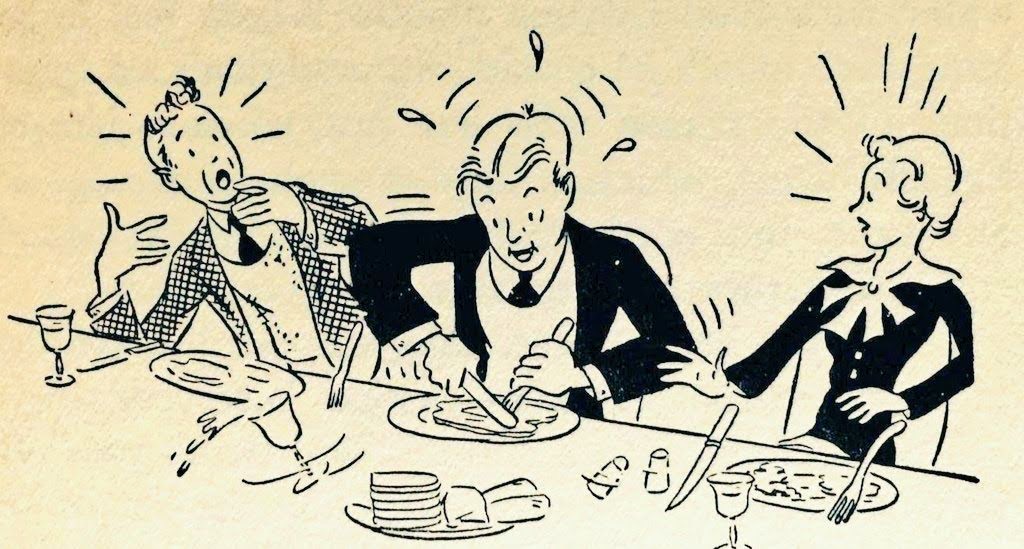
Company Table Manners

As soon as a child is old enough to come to the table he should be taught by precept and example what good table manners are... Let it be understood that good manners are not the acquiring of every new wrinkle that fashionable society may prescribe. There is a great difference between good manners and good form. What is good form to-day may be very bad form tomorrow, but good manners are not changeable.

There seems to be an idea among many people that there must be a different set of manners for company from what is observed in everyday life. While it is the proper thing to have for an invited company a more elaborate dinner and a little more ceremony in the service than at the family table, it must be remembered that one should not put on and take off good manners as one would a garment. They are a part of one's self, and whether the family meal consist of many courses, or only a cup of tea and a slice of toast, it should always be served decently and in order, and the manners of the members of the household should be such that one need not blush for them, even in the finest company. As soon as a child is old enough to come to the table he should be taught by precept and example what good table manners are. If the father and mother be so unfortunate as not to have had proper training themselves, they should study to correct any bad habits they may have, for the sake of their children. 


Let it be understood that good manners are not the acquiring of every new wrinkle that fashionable society may prescribe. There is a great difference between good manners and good form. What is good form to-day may be very bad form tomorrow, but good manners are not changeable. Unselfishness, kindly feelings and politeness are the foundation of good manners. Good table manners demand that one shall take soup from the side of a spoon; shall eat with a fork, rather than a knife; shall take small mouthfuls of food and masticate quietly, making no unpleasent sound; shall take in the fingers no food except fruit, confectionary, olives, bread, cake,celery, etc., and that the members of the family shali be as polite to each other as to any guest. Where people rush through their meals there is not much chance fo: table maners or good digestion. If properly managed, the table can be made one of the most refining influences of the home. —Ladies Home Journal, 1892


Etiquette Enthusiast, Maura J Graber, is the Site Editor for the Etiquipedia©️ Etiquette Encyclopedia 

Monday, August 31, 2015


"Ruth Ashmore," was the brainchild of Edward Bok, or the Ladies Home Journal. It was also the "nom de plume" of writer, Isabel A. Mallon (1857 - 1898), who also wrote under that name. After Bok had taken over the Ladies Home Journal in 1889, he sought a motherly columnist who could provide useful advice to young girls. Unable to find one, he wrote a sample of "Side Talk with Girls" under the name "Ruth Ashmead" to demonstrate exactly what he was looking for in a column.

After he mislaid the draft copy, his staff read it and convinced him to run it in the magazine, as it was the "best stuff for girls they have ever read." After the first column appeared, Ashmead was soon changed to Ashmore, and in January 1890, hundreds of letters poured in to "Ruth Ashmore." Bok convinced Isabel Mallon to take over the popular column, and she later went on to write two books for girls and young women.


🍽Etiquette Enthusiast, Maura J. Graber, is the Site Editor for the Etiquipedia© Etiquette Encyclopedia