Showing posts with label Spanish Etiquette History. Show all posts

Monday, July 12, 2021

Etiquette and the Restive King

“He loves horses, and every moment that he can contrive to escape from the confining duties of his position as King he spends on the race track, or in the company of jockeys, bookmakers and the general run of race-goers. Then, he is like a boy, free from the straint of home or school, a man among men, a good fellow…” Alphonso “would hie him with his family to some South American republic, to raise horses and forget Madrid. He would flee from his Queen mother, a strict follower of the Royal Code of the House of Hapsburg and a stickler for the letter of the rule and every word of tradition in regard to court functions.” 


Uneasy rests the head that wears the crown of Spain. Alfonso, harassed by politics and bored by the formalities and limitations of Court etiquette, longs to doff the glittering symbol of authority and become a private gentleman. He could be a horse breeder and trainer. He loves horses, and every moment that he can contrive to escape from the confining duties of his position as King he spends on the race track, or in the company of jockeys, bookmakers and the general run of race-goers. Then, he is like a boy, free from the straint of home or school, a man among men, a good fellow. 

He knows whereof he speaks when horses form the subject of his discourse, whereas, alas, even the wisest wearer of the purple cannot always be sure that he knows what he is talking about when he gives oracular utterance to his decisions upon affairs of state. So he would hie him with his family to some South American republic, to raise horses and forget Madrid. He would flee from his Queen mother, a strict follower of the Royal Code of the House of Hapsburg and a stickler for the letter of the rule and every word of tradition in regard to court functions. 

But the addition of a real Spanish King to a South American republic is something not to be contemplated lightly. No place in South America that we know of could be trusted to maintain its republican equilibrium a day after he had taken up his abode there. A Monarchist party would be formed on the night of his arrival, and a revolution would be afoot the following morning. The United States, in the interest of peace, would have to ship poor, weary Alfonso back to Spain and its surfeit of pomp and ceremony. – Chico Record, 1920


Etiquette Enthusiast, Maura J. Graber, is the Site Editor for the Etiquipedia© Etiquette Encyclopedia

Saturday, October 10, 2020

Strict Spanish Etiquette was Deadly

The strictest etiquette in Spain would prevent a young man from ever being left alone with his fiancée.


Courtship in Spain is regulated by the strictest etiquette. As is well known, a young man is never left alone with his fiancée. Near Malaga, a beautiful young girl of twenty, committed suicide by drinking a cup of coffee in which phosphorus had been dissolved. It appears that the girl had been driven to the deed by the adverse comments of neighbors who became aware that she had given her sweetheart a kiss.—London Mail, 1906


Etiquette Enthusiast, Maura J Graber, is the Site Editor for the Etiquipedia© Etiquette Encyclopedia

Thursday, August 27, 2020

Spanish Business Etiquette

Who sits where at a dining table? — Students are taught how to arrange seating (Anglo-Saxon protocol has guests of honor at the head, Latin protocol has them in the middle), how to sit correctly (elbows off the table), when to smoke (not until the coffee arrives) and which knife and fork to use (start from the outside).


Minding Manners Abroad : A Finishing Touch for Businessmen in Spain


At Spain’s newest business school, young executives are learning how to peel oranges, choose French wines and greet Arab princes.

Management, marketing and accounting are out: The Academy of Manners, Customs and Behavior is strictly concerned with the social side of doing business abroad.

The academy is the brainchild of three young entrepreneurs in the northeastern region of Catalonia, who saw their foreign ventures stumble on non-commercial obstacles.

Jose Ramon Tobia, for example, could not understand why his Arab workers in Abu Dhabi would take a break every three hours and refused to work at his pace. Then someone explained about Moslem prayer schedules.

200 Students

“I knew nothing about their religion,” he said.

“I talked to my friends and we realized that there were lots of people in Spain who were not equipped to deal with the rest of the world.”

Since the businessman’s finishing school opened in May, about 200 people have taken classes. The basic course is 75,000 pesetas ($550) for 12 two-hour sessions, while specially tailored programs for executives visiting specific countries cost two or three times as much.

“Of course, joining the Common Market helped,” co-founder Mario Gargallo said. Spain entered the European Community at the start of the year.

“People are traveling more and receiving more foreign visitors, and they want to improve themselves,” he said.

The Catalans have considered themselves Spain’s most urbane citizens, drawn by culture and tradition to emulate French and Italian sophistication.

They are also Spain’s most successful and innovative business executives, and the combination has made the academy an instant hit.

The Business Lunch

“In Madrid, they do their business and then go out to celebrate,” said Gargallo. “But in Barcelona, a business lunch is for doing business.”

So the business lunch is at the heart of the syllabus.

Students are taught how to arrange seating (Anglo-Saxon protocol has guests of honor at the head, Latin protocol has them in the middle), how to sit correctly (elbows off the table), when to smoke (not until the coffee arrives) and which knife and fork to use (start from the outside).

Then they progress to trickier subjects: peeling unshelled prawns and choosing the right wines.

The academy’s wine instructor, writer and restaurateur Jose Maria Gotarda, spends much of his time correcting misconceptions.

“The most common mistake is thinking that because a wine is older, it must be better,” he said.

“In fact, a Rioja from 1981, which was one of the great years, is far superior to a 1973, which was very bad.”

Gargallo said the restaurants and hotels where they hold their courses confirmed that Spanish table manners leave a lot to be desired.

“Head waiters always tell us that at a reception, the English and the Germans wait to be offered hors d’oeuvres while the Spaniards throw themselves on the food,” he said.

Pupils also have to be prepared for different eating habits abroad. The prospective traveler to Britain, for instance, is told not to be surprised by a cooked breakfast and to eat it, or risk hunger later.

Punctuality

The academy has specialists on all major foreign countries and some companies have sent along groups of employees. One Japanese multinational firm this month ordered lessons for five of its Spanish staff members who will travel to Japan soon.

But can the academy succeed in making Spaniards what they evidently are not?

“We don’t want Spaniards to be punctual like the English,” said Tobia. “But when they go to a business meeting with an Englishman, we want them to get there on time.”

He and his partners now have ambitious plans for expansion. They intend to open branches next year in Madrid, Valencia, Seville and Oviedo, and are looking at buying their own restaurant in Barcelona to serve as a venue for classes.

They have even been approached by parents who would like courses in manners and etiquette for their children.

“Twenty years ago, we had to study manners at school,” said the academy’s Fernando Lizcano de la Rosa, head of protocol at the Barcelona town hall.

“People no longer know how to shake hands with the king and they want to learn how to do things properly,” he said. — 
From Reuter’s, Barcelona, Spain 1986


Etiquette Enthusiast, Maura J Graber, is the Site Editor for the Etiquipedia© Etiquette Encyclopedia 

Wednesday, August 19, 2020

19th C. Wives‘ Etiquette of Mexico and Spain

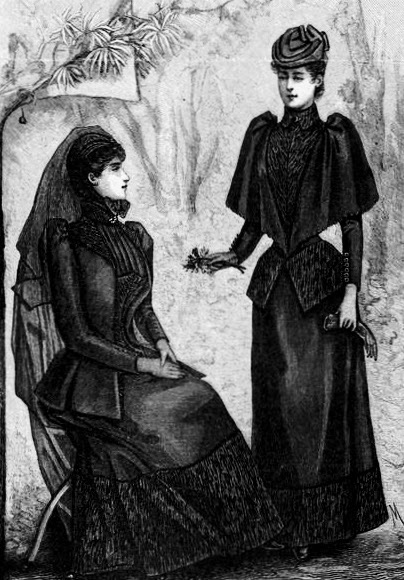
An 1891 advertisement for mourning dresses. — The etiquette of funerals in Mexico does not permit the female relations of deceased to attend. Only men attend the departed to the church and the tomb. 


The etiquette of funerals in Mexico does not permit the female relations of deceased to attend. Only men attend the departed to the church and the tomb. Funerals are so expensive that they often ruin business men. All female relatives, even to cousins and children, must wear deep mourning for two years. During the mourning none of the ladies of the household must be seen in public. Bodies are buried encased in laces and decked with precious stones. 

In Mexico, as in Spain and other southern countries, a lady retains her maiden name after marriage, and though she annexes to it, that of her husband by means of a “de,” she is universally known by her own family name. It is considered more courteous to address even elderly married ladies Señorita (Miss), instead of Señora (Madame.) The lady of the house is always called by her servants and dependents La Niña (the little girl), though she may have attained the age of eighty. — From ‘Of General Interest,’ 1884


Etiquette Enthusiast, Maura J Graber, is the Site Editor for the Etiquipedia© Etiquette Encyclopedia

Wednesday, August 12, 2020

Etiquette and the King’s Car


A motoring Monarch was a grave crisis in the history of Spanish royal etiquette!


Spain’s Blithe Young King

There is a grave crisis in the history of Spanish etiquette, says the London Chronicle. King Alfonso XIII, who is described by a French Journal as “very impulsive and at the same time very ‘sporty,’” wishes to make a royal progress through his Kingdom in an automobile. Horror of the Prime Minister! Such a vehicle, he says, is beneath the dignity of a Monarch to whom the constitution has entrusted the “sumptuous car of the state.” 


The sumptuous car must not be driven by petroleum. Horses are still harnessed to the Chariot of the Sun. But Spanish etiquette does not prevent the Monarch from traveling by railway. Lady Currie tells a story of a young man who jumped into a compartment one day on the English train and started a conversation with an old lady who greatly admired his pleasant manners. When he was alighting site asked his name and he answered, blithely, “Alfonso.” He was Alfonso XII, then a cadet at Sandhurst. The anecdote will probably be read at Madrid with pain and incredulity. — King City Rustler, 1905


Etiquette Enthusiast, Maura J Graber, is the Site Editor for the Etiquipedia© Etiquette Encyclopedia

Saturday, May 16, 2020

A Royal Nursery in Spain

An engagement card featured Alfonso in uniform with his helmet and sword and his then fiancé, Victoria Eugenie. The Spanish Royal Court was considered the most confining in the world concerning etiquette, far surpassing the French Royal Court’s strict etiquette at Versailles. Evidently, the Royal nursery was the only area not controlled by a detailed list of rules of Royal decorum.  — “People who know Spain from books will tell you with bated breath of the cast-iron etiquette that surrounds the royal personage of Spain, of dreadful dinners eaten in solemn silence, of bows to the left and curtsies to the right, of mace-bearers and cup-bearers and sword-bearers, of orders of precedence...”

A Royal Nursery

The little heir to the Spanish throne has begun his babyhood in a suite of rooms arranged entirely after the fancy of his royal mother. Spanish etiquette requires her to conform to ideas other than her own on most points, but in the fitting of the nursery her word is law. The furnishing, decorating and entire arrangement are English, and offer everything that could possibly conduce to a baby’s health and happiness. The suite, directly over the Queen’s apartments, on the sunny side of the palace, consists of living room, dining room, bedrooms for the baby and head nurse, bath and sewing room. The living room is decorated in green and white, with showers of pink rosettes. 

The vaulted celling is enamelled in white, and round the walls runs a frieze of animals in Noah’s Ark-like procession. Eight green shades temper the sunshine. The angles of furniture walls are all softly rounded; so the approved method of standing a naughty child in the corner face to the wall could hardly be adopted in this case. With the exception of the rose colored English carpets, everything in the suite is washable. The wide window sills are coziily cushioned; an iron lattice, light and lacelike, but very strong, secures the windows from without. In the bedroom, three large paintings represent “Morning.” “Noon” and “Night.” The first is a sunshiny picture of a baby awakening in his little bed. "Noon” shows him busy with porringer and spoon: and in “Night” he has folded his chubby hands in prayer before going to sleep. The woodwork is white enamelled, and round the celling a frieze of dancing children charms the eye, as do the exquisite tint and design of the blue and white tiling of the fireplace. 

The little Prince sleeps in the cradle that rocked father and grandfather before him. It is a stately affair, resting on four Corinthian supports. It was formerly curtained in the richest lace, flowing from beneath a Spanish crown, but the young Queen mother had the crown removed, lest it fall and injure the royal sleeper below; and the lace curtains were, suppressed to allow freer access of air. The cradle linen shows embroidery of fairy like fineness, the other coverlets being sewn with butterflies and roses in white silk. The dining room furniture is white mahogany, with the royal arms of Spain skillfully inlaid in each piece. Throughout simplicity and good taste distinguish this ideal dwelling for a young child. The rooms are considered the best ventilated in all Madrid, for the young Queen inherits her love of fresh air from her illustrious grandmother, the late Queen Victoria of England.—Youth’s Companion, 1907


Etiquette Enthusiast, Maura J Graber, is the Site Editor for the Etiquipedia©️ Etiquette Encyclopedia 

Sunday, September 1, 2019

Etiquette Observations in Spain

Artwork depicting clashes between the working classes and the Spanish elite – 1909 may not have been the best of years to travel to Spain. By late-July, a series of violent confrontations between members of the working classes of Barcelona and other cities of Catalonia (Spain) and the  Spanish army, during the last week of July 1909, is known as the “Tragic Week.” The clashes were the result of the calling-up of reserve troops by Premier Antonio Maura to be sent as reinforcements when Spain renewed military-colonial activity in Morocco on the 9th of July. Many of these reservists were the only breadwinners for their families, while the wealthy were able to hire substitutes. –image source, Pinterest


An Etiquette Travel Journal

From what we saw, and from what happened to us, I made up a page of Spanish etiquette. It is probably not correct, but I offer it as the result of our experiences. If you are of the female sex, never wear a short shirt, a sailor or English walking-hat unless yon are willing to have people stare at you and sometimes call after you. If you have red hair, dye it or be prepared to be saluted as “Rubia.” Never bow to a man unless he lifts his hat first. 

If you are a man, you may dress as an Englishman, an operatic tenor or a chorus singer from Carmen, without exciting remark. Never wear glasses if you are blind, take to a dog on a string. When you sit down at the table, or arise, always bow and say, “Buenas,” this is imperative. You may jostle people without apology, but never speak to any one without saying “your grace” be he noble, friend or beggar. “Will your grace do me the favor to bring me my coffee at nine o'clock tomorrow,” would strike an American bellboy with dismay. But it is the literal translation of the Spanish request. 

Never tell a beggar to clear out, but say that you have left your purse at home, and that you will remember him tomorrow; or, gently murmur that God will reward him, whereas he will smile, thank you and depart. These same beggars, which spring up on every side, seem to have a code of etiquette we could not fathom. After two or three days, there were a few who besought Jean. Evidently, we were understood to be the patrons of certain beggars who, out of a crowd of mendicants, were the only ones to approach us, who would take their dole with thanks, or if we said “tomorrow,” would smilingly back away at once. 

A trip into Spain ought to mean more than sketches of life, as we saw it in a single city. Yet it was our pleasure to linger on in Madrid—with the exception of three days spent in Toledo and the Escorial for the whole of our two months’ holiday, and to return direct to Paris without seeing any of the southern country so beloved by other tourism. So can any one wonder that, to us Spain means Madrid, the city of marvelous contrasts. – From “A Second-Class Trip into Spain.” in The Outing Magazine for February, 1909


Etiquette Enthusiast, Maura J Graber, is the Site Editor for the Etiquipedia© Etiquette Encyclopedia 

Tuesday, January 16, 2018

Royal Spanish Etiquette Traditions

From the birth of a Spanish King until his death, the Spanish Monarch is never free from the bonds of an etiquette which has survived from time immemorial, and, up to date as he is, young Alfonso XIII cannot wholly shake himself free.

The Court of Spain

In almost every court in Europe the strictness of old-fashioned etiquette has of late, been greatly relaxed. The Hapsburgs, however, cling to their ancient customs, and at the Courts of Austria and Spain much of the quaint old ceremonial survives. From the birth of a Spanish King until his death, the Spanish Monarch is never free from the bonds of an etiquette which has survived from time immemorial, and, up to date as he is, young Alfonso XIII cannot wholly shake himself free. 

When a baby Prince is born at the Court of Spain, the Prime Minister must be present, or is hastily sent for; also the Presidents of the Congress and the Senate; the Commander of the Royal Halberdiers, to whom is entrusted the guarding of the Royal family within the Palace. The chief doctor then dresses the baby, and, placing the poor little atom upon an enormous silver salver, bears him in state to the father, who is waiting in the ante-chamber. “Sir, it is an infante (Prince),” he says gravely. The father, with equal gravity, takes the salver, raises it, and shows it to all present, then kisses the baby, and the odd little ceremony is over.

“DON'T TOUCH THE KING!”

No one beneath the rank of a Noble may personally attend the King of Spain, nor by any means, touch his sacred person. About twelve years ago, little Alfonso, running carelessly downstairs, stumbled, and took a regular dive towards the bottom. A footman, with great presence of mind, opened wide his arms and caught the child unhurt. He had saved the little Prince's bones, but had broken the rules of Court etiquette. Therefore, he lost his place. But it is satisfactory to learn that the Queen-Mother saw that the poor fellow did not suffer. She thanked him, and pensioned him handsomely.

All his life through the King is guarded by a special body of picked men. Tradition requires that these shall be drawn from the town of Espinosa. All night, they patrol the corridor outside his room, and at certain intervals the officer in charge glances through a secret panel to see that his youthful Majesty is well and safe. The men wear full armor, and— curious contrast! —felt slippers.

By right of birth, the King of Spain is a canon of Leon Cathedral, and, by a curious old unwritten law originating no one knows how, each member of the chapter must, on his first visit to the cathedral, jump over a small gate in one of the cloisters. As may be imagined, this was one of the few points of custom which thoroughly appealed to young Alfonso. He carried out the very letter of the law by a really splendid jump, for slight and delicate as he looks, the King is very athletic.

GOOD FOR THE SERVANTS

In old days nothing that had appeared on the Royal table was ever seen a second time. From the wax candles to the unopened bottles of wine, all was the perquisite of the underlings. The Queen-Mother has changed all this, and waste is at an end. To such an extreme has economy been carried that during his minority, the young King's allowance was but five pounds a month. A Spanish Coronation is a more simple ceremony than might be imagined. An odd point about it is that just behind the head of the procession, are led twelve riderless horses in full Royal trappings. There is no crown used in Spanish Coronations. The ceremonial attending the funeral of a Spanish King is the strangest of its kind, in existence. 

The Royal tomb is situated in the Escurial— that strange old place which lies some distance, away from Madrid, and fully 8000 feet above sea level. The procession movea on foot out of Madrid, and rests one night upon the way. In the morning, the Lord Chamberlain stands by the coffin and cries, “Is your Majesty pleased to proceed upon your journey?” A short silence, and then they move on. When the casket is at last placed in the vault, its final destination, the same official unlocks it, kneels down, and calls loudly: “Señor! Señor! Señor! ” Again a solemn pause. “His Majesty does not reply,” says the Chamberlain. “Then it is true. The King is dead!” He locks the coffin, breaks his staff of office in pieces, and all is over. – Los Angeles Herald, 1906 


Etiquette Enthusiast, Maura J. Graber, is the Site Editor for the Etiquipedia© Etiquette Encyclopedia

Monday, January 15, 2018

Hat Etiquette of Spain’s Nobility

The young Spanish King presenting the heir to the throne, to the Grandees and other dignitaries assembled.

Grandees of Spain...
Curious Hat Etiquette That Mark Their Three Classes 

A Grandee of Spain enjoys the privilege, granted him many hundreds of years ago, of remaining “covered” in the presence of his Sovereign. This custom dates from the period when, according to the theory then held, the King was “the first among equals.” The ancient formula, always at the Coronation of the Kings of old Spain was, “We, your equals, choose you to reign over us.” And the King assented in this declaration of his Nobles. 

There was a time when all Grandees of Spain wore their hats in the presence of the King, but in time, the idea of caste began to prevail even among the Grandees, with the result that they were eventually divided into three classes, and these classes were distinguished by the hat etiquette. The first class entered the Royal presence covered; the second class entered uncovered, and, after an advance of a few steps, put on their hats, unbidden by the King, and the third class also entered uncovered, but did not “cover” until requested to do so by the King. Then, according to the etiquette, “all were equal.”

There have been Grandees who were not Spaniards, notably the Duke of Wellington, upon whom the Cortes conferred the honor in recognition of his services to the State. – Mariposa Gazette, 1918

Etiquette Enthusiast, Maura J Graber, is the Site Editor for the Etiquipedia© Etiquette Encyclopedia 

Wednesday, December 27, 2017

Etiquette and Spanish Brides

Traditional Spanish brides wear black dresses and lace mantillas.  Originally, worn for Catholic church services, mantillas are ornate veils worn for wedding ceremonies. Many times, these are passed down from one generation to the next.

There are no bridesmaids at a Spanish wedding, but instead a “madrina” (literally “godmother”) is present with the witnesses. There is no bride cake, but there is a reception and very often a feast after the ceremony. Before the wedding takes place, the bride’s new home is made ready for her reception, for the honeymooners do not start on their travels until the day after their marriage.

Before their departure they pay a polite visit to their respective parents. On their return, dainty sweetmeats in pretty boxes are sent round to their friends. No visits are paid until little cards have been sent, “offering their house.” – Amador Ledger, 1903


Etiquette Enthusiast, Maura J. Graber, is the Site Editor for the Etiquipedia© Etiquette Encyclopedia 
Tuesday, May 23, 2017

Etiquette and Carreño's Manual

    Manuel Antonio Carreño Muñoz was a Venezuelan musician, teacher and diplomat, was well known in the Spanish speaking world, during the 19th century— “Etiquette Book to Be Given Governor : University students today raised a fund to buy Gov. Gen. Robert H. Gore a copy of ‘Carreño's Manual,’ written by the ‘Spanish Emily Post.’ The students held the governor needed a course in Spanish courtesy because he refused to receive a delegation which wanted to protest the appointment of a trustee. Contributions were limited to four cents. The book is used widely in Spanish countries.” — United Press, San Juan, Puerto Rico, Sept. 30. 1933

In 1853, Manuel Antonio Carreño Muñoz wrote the Manual of Urbanity and Good Manners, for which he received great recognition and fame. This manual had a great repercussion on a global level, to the point that it was approved to be taught in elementary schools in Spain. So this 1853 work was used as a text since the beginning, not only in Spain but in other Spanish-speaking countries as well. 

An important book, it was directed towards children of both sexes in a time where education was almost exclusively for boys and the more powerful social classes. The book elaborates on the moral and religious standards that were so important in the 19th century, that, evidently, had already been lost due to the long period of time that had passed. 

In referring to courtesy and good manners, one has to remember that, even though it may appear an exaggeration, this book exercised an enormous influence in educated Venezuelan society for many generations and even today, some of these standards are easily identifiable to foreigners who have recently arrived to the country, all from a European origin.


🍽️Etiquette Enthusiast, Maura J Graber, is the Site Editor for the Etiquipedia© Etiquette Encyclopedia

Monday, September 12, 2016

Etiquette Above the Salt

A royal salt holder — In medieval times, due to its scarcity, salt was extremely expensive and only affordable by those in the higher ranks of society. At that time, royalty and nobility sat at the 'high table' while the commoner servants sat at lower, trestle tables. Salt was placed in the center of the high table. Only those of rank had access to the salt. Those less favored, and of lesser rank on the lower tables, were below, or beneath, the salt.

The proposed visit of the Infanta Eulalia of Spain to this country has given rise to a pretty exhibition of Court etiquette. She and her husband, Prince Antony, were to be the guests of the United States government
, but in proffering hospitality, the mistake was made of intimating that the Duke of Veragua would be included in the company. This was quite too much for Spanish notions of propriety. 

A person of royal blood to sit with a mere nobleman, and have the salt between them on equal terms — never! A Monarchical guest must take separate treatment to sustain her dignity; to hobnob with an inferior is tantamount to insult. So the Infanta gets out of this disparaging predicament by undertaking to pay her own expenses, an independent course which may grieve this country the less inasmuch as Congress has not appropriated a dime for her august entertainment. — New York Herald, 1883


Etiquette Enthusiast, Maura J Graber, is the Site Editor for the Etiquipedia© Etiquette Encyclopedia

Tuesday, September 6, 2016

Etiquette for Infanta Eulalia

New York society women now brushing up!
“Dorothy Q” fills her readers in on the efforts of the Gilded Age society women to brush up on rigid Spanish etiquette for an Infanta’s visit.

The Spanish Royal’s Visit was Supposed to be Incognito 


The ball that the society women of New York are contemplating giving in honor of the Infanta Eulalia, is just now under animated discussion. The etiquette that “doth hedge” a royal representative of Spain, is appallingly rigid, and as no one in the exclusive set of New York wishes to commit a breach of propriety, more studying is being done of pedigree and Court etiquette than ever before in the world of form and convention. 

As the Infanta is supposed to travel incognito, she could not accept the cordial invitation of Mrs. Hearst, who offered her mansion at Washington for the Infanta’s use while there, and also extended to the Infanta the freedom of the yacht, “Vamoose.” If the coterie of ladies who inspired the idea of giving this entertainment for the Infanta can carry out their plans, the ball will be a notable social event of Wednesday, May 17. —Dorothy Q., New York, May 8, 1893


Etiquette Enthusiast, Maura J Graber, is the Site Editor for the Etiquipedia© Etiquette Encyclopedia

Tuesday, August 30, 2016

Rigid Royal Spanish Etiquette


Victoria Eugenie of Battenberg was Queen of Spain as the wife of King Alfonso XIII

A Nurse for the Baby Prince

Many say the etiquette of the Royal Spanish Court rivaled that of the French Court of Versailles. They may be correct, but then again they may have been on par for Royal Courts of the day. The January 19th report from a London newspaper tells us, “The Madrid correspondent of the Standard says that Spain's Queen Victoria wants to nurse her coming baby herself, but will not be allowed to do so, because it is contrary to Spanish etiquette. An English nurse has been engaged.” – 1907


Etiquette Enthusiast, Maura J Graber, is the Site Editor for the Etiquipedia© Etiquette Encyclopedia

Thursday, August 18, 2016

Etiquette Creates a Pretty Picture

The little Princess asks for a drink of water; a maid of honor hands it to her with the elaborate etiquette prescribed by the formalities of the most rigidly ceremonious Court in Europe. 

The Story of “Las Meninas”

How One of Velázquez's Notable Pictures Came To Be Painted 


The story of “Las Meninas” is that Velasquez was painting a portrait of the Spanish King and Queen (who sat where the spectator is when he looks at the picture). Their little daughter, the Infanta Margarita, came in with her maids of honor, her dog and her dwarfs, accompanied by her duena and a courtier. The little Princess asks for a drink of water; a maid of honor hands it to her with the elaborate etiquette prescribed by the formalities of the most rigidly ceremonious Court in Europe. 

The scene presented so charming a picture, that the King desired Velasquez to paint it. The artist has included himself in the group at work upon a large canvas on which it is supposed he was painting a portrait of the King and Queen when the interruption occurred. The reflection of the King and Queen appears in the mirror at the end of the room, and the Chamberlain, Don Jose Nieto, stands outside the door drawing the curtain. The scene is, indeed, represented with such wonderful realism that a famous French critic said of it, “So complete is the illusion that, standing in front of ‘Las Meninas’ one is tempted to ask, ‘Where is the picture?’” —St. Nicholas, Madera Mercury, 1905


Etiquette Enthusiast, Maura J Graber, is the Site Editor for the Etiquipedia© Etiquette Encyclopedia

Sunday, October 25, 2015

Etiquette Extremes of Spain

"The court etiquette of Spain was elaborate and complex to the extreme."
"It was in Spain that etiquette attained those extremes which are to-day so difficult to understand. Men and women ceased to be human beings with a will: Frederic Marshall says, 'They became machines of reverence, everybody had his place marked out and was kept mercilessly in it. The number of steps and the depths of bows which each person was to make on entering the royal presence, the width of cloaks, the length of ribbons, and perhaps more than all, the elaborate division of offices and functions, we're fixed with a precision of which examples exist nowhere else.'
                                                             
"Spanish nobles are classified either as Grandes de España (also called in English grandees), or as titled nobles. Formerly, grandees were divided into the first, second and third classes, but now, all grandees enjoy the same privileges. An individual may hold a grandeeship, whether in possession of a title of nobility or not. Normally, however, each grandeeship is attached to a title, though this was not always the case. Furthermore, a grandeeship is always awarded along with every ducal title, just as most dukes in France gradually obtained a peerage under its ancien régime. A grandee of any rank outranks a non-grandee, even if that non-grandee's title is of a higher degree. Thus, a baron-grandee enjoys higher precedence than a marquis who is not a grandee. Except for dukes and some very ancient titles of marquesses and counts, most Spanish titles of nobility are not attached to grandeeships." –From www.almanachdegotha.org

The people of Spain took up ceremony and reverential courtesy as a duty. Even the beggars asked each morning of their colleague: 'Señor, has your Courtesy taken his chocolate?' As for the grandees, they considered themselves above the universe and all the men within it.
It was Maria Anna of Neuburg, the wife of Charles II of Spain, 1690, who fell off her horse, caught her foot in the stirrup, and was thus indecorously suspended in the presence of forty-three courtiers, who gazed in anguish, but stood still, as it was against etiquette for them to aid in such a case. The grand equerry, whose particular and peculiar privilege it was to unhook the Queen's royal ankle, on such occasion, was absent that day!


The court etiquette of Spain was elaborate and complex to the extreme. It is related that on one occasion the Queen fell from her horse, caught her foot and hung by the stirrup, unable to extricate herself. This happened in the presence of a number of attendants who made no move whatever to assist her. They couldn't, you see, because the grand equerry whose particular and peculiar privilege it was to unhook the royal ankle on such occasion was absent!

A passerby, noticing the Queen's plight, released her. Whereupon he received several doubloons for his service, but was condemned to banishment because of his indiscretion! Such were the extremes etiquette had reached in the Spanish court." –Lillian Eichler 


Etiquette Enthusiast, Maura J. Graber, is the Site Editor for Etiquipedia© Etiquette Encyclopedia 

Friday, June 5, 2015

19th C. Spanish Royal Court Etiquette

We find in a late number of Noah's Sunday Times an editorial upon the manners of the Court of Spain, and the particular code of morals of the present day. There is undoubtedly more licentiousness in that Court than in those of all the other foreign potentates put together. Yet Spain seems, at the present time, to remain comparatively tranquil under the reign of the youthful Queen, and be perfectly satisfied with the present regime. We copy a portion of the article:
                                                    
Queen Isabella II of Spain. She ruled from 1833 to 1868. Isabella's reign was a troubled and chaotic chapter in Spain's history. It was marked by coups, scandals and civil wars, which ended with a successful revolution against the Spanish monarchy.

There is probably no monarchy in Europe which keeps up the stiff, antiquated etiquette of royalty equal to the Spanish Court. Everything is done by rule, by usanca, as it is called, and it unites the sober dignity of the Moors with the imperial pride which distinguished the reign of Charles V., and Ferdinand and Isabella. Poverty has not abated an inch in the steady etiquette of that court, but it is now in great danger of being overturned, if not utterly destroyed, by that hoyden, the young Queen of Spain. She cannot possibly carry out old forms, and therefore discards them altogether. They say of the young Queen, that, although she likes gossip herself, she is indifferent to all gossip about herself. She gives herself up to the noisiest pleasures with childish ardor, and seems to take delight in teasing the solemn nullity of a husband whom she was required to marry. 


When her ministers wish to talk to her about public affairs, she bids them, with girlish petulence, to consult her mother, and that it is she who manages those kind of things. She orders dancing every night in the gardens, prohibits all kinds of illumination, and the moment she arrives gives herself up to laughter and dancing of the most energetic character. She tires out the strongest limbed, and then looks round with the most reckless merriment. Half an hour afterward she seats herself, and eats and drinks with the same vigor as she dances, and that at some rustic table under the trees. From these balls ancient Spanish etiquette has fled affrighted.

Cravats à la Lord Byron, replaced the stiff uniform, or formal black coat, white cravat, and white vest of “Spanishdom”

A young girl and her duenna, or chaperon         

Nankeen gabines, summer frock coats, cravats a la Byron, replace the stiff uniform, or formal black coat, white cravat, and white vest of Spanishdom. With utter contempt for all etiquette, her youthful majesty, whenever her partner is young, handsome, and amusing, does not scruple to walk off alone with him in the sylvan solitudes. Paquo, (Frank,) for so she calls her husband, used to fret and worry at first, but has got used to it, and is become plethoric and indifferent. She laughs at the remonstrances of her elderly friends, even when they hint that her crown is in danger; and it is this fact which induces people to speak of abdication.
                                               
Isabella's Royal Coat of Arms

The little queen is no doubt a jolly rollocking girl, full of buoyancy of spirits and happiness, as all Spanish girls are who are not kept down by priests and duennas. She is, however, in danger, for if she had the ability to assist in conducting public affairs, she might romp with impunity after business hours; but she is like one of our school girls at 3 o'clock, rushing out of the school room into the candy shop, with shouts of ringing laughter. If it is said that this dynasty of sovereigns that is, mother and daughter — with no special regard for morality, cannot long be sustained in Spain, we answer that the people, who are loyal, are exceedingly indifferent about the conduct of royalty and nobility at court.


They never meddle with interdicted subjects. There are no single females more virtuous than those of Spain, and none married who are so indifferent to its solemn obligations. In every respectable house there is a fat, jolly padre, who takes the head of the table, and all the children look like him. The husband, a kind, affectionate, good, indifferent fellow, in too sensible to take any notice of an event so very common and domestic in Spain — a kind of common law or usanca. The common, uneducated people, however, are more vigilant in this respect than the higher orders and do not generally submit to these matrimonial innovations.- From The Daily Alta California, 1849


Etiquette Enthusiast, Maura J. Graber, is the Site Editor for Etiquipedia© Etiquette Encyclopedia