Showing posts with label Janet McKenzie Hill. Show all posts

Thursday, April 9, 2026

Etiquette for Serving an Edwardian Tea

The basket-tray (“curate”) consists of a tripod to which three hoops are fastened one above another, and some distance apart; into each of the hoops is set a plate holding the articles to be served. The framework is of mahogany, bamboo, or other light wood, and the whole is carried about the room by a handle at the top.

For carrying out the hospitality expressed in this custom, a nest of tea-tables and a “curate” or English basket-tray are of great convenience. These articles are very light and sometimes exceptionally pretty; the tables are often of highly polished mahogany and inlaid with pearl. The basket-tray (“curate”) consists of a tripod to which three hoops are fastened one above another, and some distance apart; into each of the hoops is set a plate holding the articles to be served. The framework is of mahogany, bamboo, or other light wood, and the whole is carried about the room by a handle at the top.

The other accessories to afternoon tea are:

1. Tea cloths for the tables.

2. Small fringed napkins for the guests.

3. Doilies for the bread and cake trays or baskets.

4. A small tray covered with a doily for the waitress.

5. A tray holding two or three small tea cups and saucers, teaspoons of small size, small sugar bowl with sugar and tongs, small cream pitcher of cream, and a pretty dish holding thin slices of lemon.

6. A teapot of fresh-made tea, or a tea-pot of boiling water, a tea caddy with tea, spoon for the caddy, a silver tea ball or a china percolater, and a teakettle filled with fresh boiling water.

7. A bouillon urn.

8. Bouillon cups.

9. Bouillon spoons.

Shortly after three o'clock the ever prompt waitress has the tea-tray with its glistening china and silver and the basket-tray of edibles in readiness; the teakettle is singing over the low-turned jet of the gas range and the waitress herself is in immaculate trim from the tiny cap on her neatly brushed hair to the soft-soled shoes on her feet.

She may or may not answer the bell and admit such callers as come; this depends upon the number of employees.

After the hostess has greeted one or more guests, the waitress sets a pot of tea to brew, noiselessly brings in one of the larger tables from the “nest,” and sets it in an inconspicuous place in the drawing-room. Upon this she disposes such articles as will crowd the table of her mistress. Here also she sets the bouillon urn, with cups and spoons, when bouillon is provided. The outer and handsomest table of the nest she now sets before the hostess, spreads a cloth over it, and brings in the tea-tray to set down upon it. She now returns for the pot of tea, which was set to brew, and her tray. 

After a cup of tea is poured, she passes it on her tray, with two or three napkins beside the cup, to the one for whom it is prepared, then brings in the basket-tray of edibles, and passes this and other cups of tea or bouillon as desired. In the meantime she keeps a sharp lookout and removes cups or replenishes them with tea as is needed. Or, she passes cream and sugar or slices of lemon, takes out the spent teapot, and brings in a fresh supply of tea or slices of lemon, etc… 

All this sounds arduous, but in reality, in houses where the maids are limited in number the callers of an afternoon are not numerically strong, and a sister, daughter, or friend of the hostess is usually present to help out. — From “A Guide for Edwardian Servants,” by Janet McKenzie Hill,” 1908


🍽️Etiquette Enthusiast, Maura J. Graber of The RSVP Institute of Etiquette, is the Site Editor of the Etiquipedia© Etiquette Encyclopedia

Saturday, March 28, 2026

Etiquette and an Edwardian Waitress


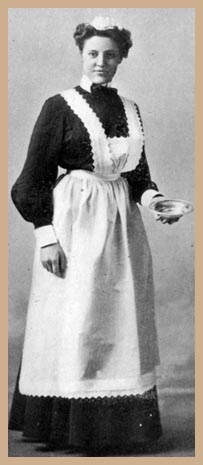
Afternoon dress for a maid: In the morning the waitress may wear a light print dress, a plain, full-skirted white apron, white collar and cuffs. Before serving luncheon the print dress is changed for a light-weight black wool dress and a more dressy apron, and a black bow is added to the cap. Boots or slippers with soft soles and low flat heels, if any, enable the waitress to move about noiselessly.— Image from “A Guide for Edwardian Servants,” by Janet McKenzie Hill,” 1908

PERSONAL QUALIFICATIONS AND DRESS OF A WAITRESS

The up-to-date waitress needs an eye quick to see and a hand deft to execute. She needs to be able to tell at a glance whether the window shades exclude the right quantity of sunlight or the open window admits the proper quantity of air. She needs to have an eye that never fails when an object is to be disposed in the centre of anything or two or more objects in exactly straight lines. Her first duty in regard to everything she touches is to “keep it straight.” On all occasions she is to be neatly dressed and manicured, calm and unruffled; no matter how many duties claim her attention at one and the same time, she needs to be absolutely deliberate, self-poised, and unhurried.

A waitress needs to be quick and light of foot; thus youth and a trim figure, not too large, are the first requisites in one who wishes to make a success of the calling. It is needless to add that a quiet, unobtrusive manner – is absolutely essential. A waitress needs to possess a mind unwearied by detail and a willingness to cultivate nice ways of doing work.

In the morning the waitress may wear a light print dress, a plain, full-skirted white apron, white collar and cuffs. Before serving luncheon the print dress is changed for a light-weight black wool dress and a more dressy apron, and a black bow is added to the cap. Boots or slippers with soft soles and low flat heels, if any, enable the waitress to move about noiselessly.
maid.

The up-to-date waitress is not superficial; she knows full well that daintiness secured by cleanliness must be part and parcel of her own person as well as of the inanimate things which she handles. She will no more think of omitting her full morning bath than of sending the butter to the table on an unwashed dish.

She is surrounded with choice articles often of great value, of which she is the caretaker. She comes in close contact with people who are ultra-fastidious. Her position is a responsible one, and calls for dignified bearing. She needs to maintain her own self-respect and claim that of those whom she serves. To do this, she can ill afford to neglect any of the personal niceties classed as “minor moralities.”

The daily bath and immaculate undergarments are at the foundation of these moralities. Cleanliness is next to godliness, and opportunity for cleanliness should be freely given and freely accepted. 
— From “A Guide for Edwardian Servants,” by Janet McKenzie Hill,” 1908


🍽️Etiquette Enthusiast, Maura J. Graber of The RSVP Institute of Etiquette, is the Site Editor of the Etiquipedia© Etiquette Encyclopedia
Monday, March 23, 2026

Different Serving Styles for Dinners


Styles of Serving Meals

Perhaps the best way to give directions for serving a meal is to present a representative menu, and tell how to get it before those who are seated at table. In "Practical Cooking and Serving," mention is made of two distinct styles of serving meals, the English and the Russian, also of a third style, " the compromise," which emphasizes the best points of the other two.

RUSSIAN SERVICE

When a meal is served after the Russian fashion, all the responsibility of supplying food to those at table falls upon the attendants. It follows, then, that, where this fashion is adopted, a full staff of trained household employees is needed, if the wants of those at table are to be properly supplied. Dinner is the meal for which this formal service is best adapted, and even at dinner it should not be carried out

in its entirety unless there be more than one waitress for each eight covers at table, since nothing appears upon the table save the centrepiece (at dinner, a bonbon dish or two is allowable) and the articles that compose the individual covers. All food is served "from the side"; by attendants who pass the food, separated into portions, to the left of those at table, for each to help himself; or, made ready on individual plates, it is set down before each individual from the right.

ENGLISH SERVICE

The English style of service breathes hospitality rather than formality. It allows of personal attention, on the part of those sitting at the head and foot of the table, to the needs of those about them. The food is served "from the table." The meat or fish just as it is taken from the oven or kettle, except for its garnish, is set down before the "head of the house," who carves it and selects the portion desired by each. Place also is found upon the table for one or two vegetables, which are served by some one at the table. Bread and butter, pickles and relishes, are also given a place on the table.But, save relishes, etc…, only one course appears at a time upon the table.

COMPROMISE STYLE OF SERVICE

The compromise style of service is, as its name implies, a "let down" from the formality of the Russian service and a "let up" to the arduous duties expected of the head of the house at a table served after the English fashion. This style of service is largely practised at luncheons and "little dinners," and should be the favorite style, where one has a cook proficient in giving those final touches to a dish that remove it at once from the realm of the commonplace to that of the artistic world. It is also the style of service usually 
employed in houses where but one or at most two maids are kept. — From “A Guide for Edwardian Servants,” by Janet McKenzie Hill,” 1908


🍽️Etiquette Enthusiast, Maura J. Graber of  The RSVP Institute of Etiquette, is the Site Editor of the Etiquipedia© Etiquette Encyclopedia 

Friday, March 20, 2026

After Luncheon Gilded Age Favorite

Popular in the Gilded Age, by 1908, crème de menthe over ice was still a popular after luncheon drink for women. — At a luncheon party, when coffee is served at the table, creme de menthe is occasionally passed after the guests are seated in the library.

CREME DE MENTHE SERVED IN LIBRARY

At a luncheon party, when coffee is served at the table, creme de menthe is occasionally passed after the guests are seated in the library. Tiny cordial glasses are partially filled with fine-shaved ice and over this is poured a tablespoon full of sugar syrup mixed with creme de menthe cordial. These are set on very small doily-covered plates, an after-dinner coffee spoon beside each glass. The plates are passed, two at a time, on a tray.

In English and compromise style of service the waitress stands at the left of the host or hostess when serving down a plate or taking up a plate or other article prepared for serving.

Wheter the host (or hostess) or the waitress set the plate or cup (coffee or tea) made ready for serving upon the tray is a matter to be decided by each individual host. We are however inclined to think that it should be done by the waitress. When no tray is used the waitress lifts the plate.Why change because a small tray is in one hand? — From “A Guide for Edwardian Servants by Janet McKenzie Hill,” 1908


🍽️Etiquette Enthusiast, Maura J. Graber of  The RSVP Institute of Etiquette, is the Site Editor of the Etiquipedia© Etiquette Encyclopedia