Showing posts with label Public Transit Etiquette. Show all posts

Thursday, April 25, 2024

Japanese Mid-C. Railway Etiquette

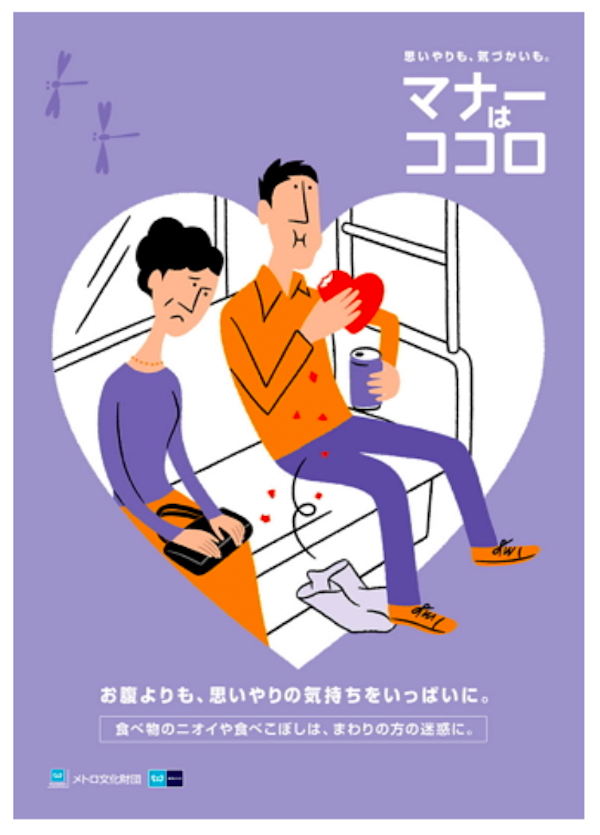
Long known for their exceptional mass transit manners, this is on of many images from the Japanese, “Please do it at home” campaign of the past 10 to 15 years. Many successful campaigns using eye-catching images and art have been used over the past decades. You can see many from the past here in a previous Etiquipedia post.
Japanese Railroad Launches Passenger Etiquette Program 

TOKYO, July, 21—(UPI)—The Japan National Railways Corporation, which runs one of the most efficient train systems in the world, launched an “etiquette training” program Monday to make its passengers the neatest and best-mannered as well. 
A spokesman for the corporation said special officers will be assigned to 24 trains to tell passengers how to behave. They will tell passengers not to: —
  • Walk around Railway cars in their underwear.
  • Enter the dining car in nightgowns.
  • Throw refuse all over the floors.
  • Play their radios too loud.
– Shin Nichibei, 1959


 🍽️Etiquette Enthusiast, Maura J. Graber, is the Site Editor for the Etiquipedia© Etiquette Encyclopedia 

Monday, October 30, 2017

A Street Car Etiquette Fail

“Street Car etiquette is developing in so many directions just now, that one must be prepared for anything... It occurred to me that this was probably the very latest development.” 1899 – (Above) A horse drawn street car, from 20 years earlier than this article. By 1899, most street cars were motorized in the US, but few had any heat in them during cold weather, so hay or carpets were put down on the floors to make riders more comfortable, but the drivers continued to have no protection from the elements.

Before Chivalry Died, It Was Obviously Ailing

“An Unexpected Courtesy”

“I was returning home with a small traveling bag in my hands,” says the woman, “and as it chanced to be just at the rush hours and the cars crowded, of course, I did not have a seat. But I was standing beside a gentlemanly young man who had a seat, and who, I soon saw, was also possessed of a kind heart.” ‘Can’t I hold your bag for you?’ he asked, politely, raising his hat. “I own I was a little surprised at first, but Street Car etiquette is developing in so many directions just now, that one must be prepared for anything. For a moment, I hardly knew what to say, and then, as it occurred to me that this was probably the very latest development, and it would not be well to check any one
s courteous inclinations, I thanked the young man, handed him my bag, which he held and sat until I reached my destination, while I stood in front of him.”—New York Times, 1899


Etiquette Enthusiast, Maura J Graber, is the Site Editor for the Etiquipedia© Etiquette Encyclopedia 

Wednesday, December 18, 2013

Japanese Transit Etiquette

Japanese Etiquette for the Train

“The Japanese adopt rules and mannerisms different from other cultures. Some rules are the same as other countries, such as eating on subways is not allowed; however, there are others—such as talking on your phone—that are considered rude in Japan. To help foreigners avoid public transport faux pas on its trains—and as a reminder to locals—the Tokyo Metro creates a series of courtesy posters each year to display in its stations and platforms. For 2013, a series of vibrantly colored posters were unveiled—one poster was created for each month, inspired by the months’ activities and season.

Presented in illustrations that accurately and easily get the message across, the posters depict various scenes to help you know how to behave on the subways—and the perils you could cause for behaving in ways that you should not. Even if you don’t read or speak Japanese, you’d know what is considered discourteous, and what you should or should not do, just by looking at the illustrated posters.”
 

Please "do it at home" campaign-


Vintage Tokyo subway manners posters from Pink Tentacle: Here are a few manner posters that appeared in the Tokyo subways between 1976 and 1982.


I'll stand up (July 1979)

Uesugi Teppei, a character from the popular manga "Ore wa Teppei," offers to give up his seat to the elderly and infirm.


Space Invader (March 1979)

This 1979 poster pays tribute to the extremely popular Space Invaders video arcade game and encourages passengers to read their newspapers without invading the space of other passengers.
Don't forget your umbrella (October 1981)

The text at the top of this poster -- which shows Jesus overwhelmed with umbrellas at the Last Supper -- reads "Kasane-gasane no kami-danomi" (lit. "Wishing to God again and again"). The poster makes a play on the words "kasa" (umbrella) and "kasane-gasane" (again and again).
Coughing on the platform (January 1979)

Modeled after the paintings of Henri de Toulouse-Lautrec, this poster -- titled "Hōmu de Concon" (coughing on the platform) -- urges people not to smoke on the train platforms during the designated non-smoking hours (7:00-9:30 AM and 5:00-7:00 PM). The poster makes a play on the words "concon" (coughing sound) and "cancan" (French chorus line dance).


Umbrellas left behind in the subway (June 1976)

This Marilyn Monroe poster aims to remind passengers to take their umbrellas with them when they leave the train. The text in the top right corner -- "Kaerazaru kasa" (umbrella of no return) -- is a play on "Kaerazaru Kawa," the Japanese title for "River of No Return," the 1954 movie starring Monroe.
Directly above and below- From Vibrant Posters For Tokyo Subway, Teach Tourists Manners With Fun Illustrations, By Anthea Quay


Etiquette Enthusiast, Maura J. Graber, is the Site Editor for the Etiquipedia© Etiquette Encyclopedia