Showing posts with label Place Setting Contest Winner 2022. Show all posts

Sunday, November 6, 2022

An Interview with Stephen Hanson

The Best in Show Winner for the Amateur category in our 2nd Annual Etiquipedia Place Setting Competition is Stephen Hanson. He is shown above with his 
Christmas Dinner for Four table setting entry.
🍽 🍽 🍽 🍽
When asked about himself, Stephen wrote, “ I am Australian by birth and nationality, but Japan has been my home for the last thirty years. I became enchanted with the place when I first came here as a high school exchange student in the mid-1980s. I am a translator by profession. For the past twenty-odd years, I have been lucky to live in a leafy area in the western outskirts of Tokyo. My passions are cooking, gardening, and reading.”

This formal Christmas Dinner setting was our Best in Show for the Amateur entries. Stephen’s inspired choices of his crystal, dinnerware and flatware impressed us. It is a mix of Australian, British and Irish elements which harmonize well together. We love the Art Deco, antique and vintage touches. They are a delightful complement to the menu and wines.  The non-traditional color scheme is perfect for celebrating Christmas, in a country where Christmas is not traditionally celebrated nation-wide. The table, which only needed to be set for 2 persons but was set for 4, is inviting and very well done. Congratulations!


🎄Christmas Dinner Menu🎄

Country-style terrine with assorted pickles and green salad
Crab bisque
Roast sirloin beef, with roast potatoes, peas and gravy
Assorted cheeses and dried persimmons
Christmas pudding, with custard, yuzu butter, and crème Chantilly
Champagne Taittinger Brut Reserve
Champagne Boizel Rosé Tradition
E. Guigal Condrieu 2017
Domaine Bertagna Vougeot Premier Cru Clos de la Perritère Monopole 2016
Château Pichon Longueville Comtesse de LalandePauillac 2015
Dow’s 10-year old Tawny Port
Stephen’s menu is imaginative in both the foods and wines chosen. Stephen has been able to cleverly meld the availability of traditional Christmastime foods in Japan with traditional Christmas family menus which he grew up with in Australia. Elizabeth and I would love to be invited to this dinner and to dine at Stephen’s table.


1. How did you choose the menu and various elements you used in your setting and why? Please explain each of the utensils at your setting… For which of the foods on your menu (or course) was each different item intended?

When I am in Japan at Christmas time, I serve roast beef and a Christmas pudding. (Interestingly, the Japanese idea of Christmas dinner is roast chicken and strawberry shortcake, served on Christmas Eve.)

The Christmas pudding has some Japanese touches. It has rum from Okinawa (the southernmost part of Japan)in it, and the juice and zest of a yuzu (Japanese citron). The latter has a great fragrance, which means it goes into the rum butter as well. Seafood is plentiful in this country, so it appears in this menu in the form of a crab bisque. Dried persimmons are available in Japan from the late autumn, and are a lovely accompaniment to cheese.

The Art Deco-style plates, produced by John Maddock & Sons, were part of my paternal grandmother’s wedding china. My grandmother married in January 1939 and built up a set for eight people. These plates were always brought out at Christmas time in Australia. The pattern, I believe, is called Sundown.

The dessert spoons and forks also belonged to my grandmother – the Josephine pattern produced in the 1960s by the Australian silverware firm Rodd.

The other cutlery is English sterling silver dating from the late 18th to the 20th centuries. The pattern is Old English. The faux-bone handled knives are also English, dating from the 1930s.

The champagne flutes are Stuart Crystal (Glengarry pattern), the wine glasses are Riedel, while the water goblets are Waterford Crystal (Lismore pattern).

The table linen is antique Irish damask linen sourced from eBay, where it can often be bought in mint condition for a song. The sterling silver hurricane lamps, produced by the US-based Preisner, were also acquired from eBay at a bargain-basement price.

The meal of roast beef and Christmas pudding is my own tradition, which I have developed since living in the northern hemisphere. (It took me years to get accustomed to spending Christmas and New Year in the middle of winter!)

Christmas fare in Australia usually consists of roast turkey, ham, and Christmas pudding, which are eaten at lunchtime. My late mother could never see the point of a heavy baked dinner in the middle of the day in the middle of an Australian summer. Our Christmas meal was at nighttime, and featured a roast leg of pork, an apple and celery salad, and a cucumber salad, with a fruit salad for dessert. My mother decorated the table with flowers and candles, a touch I have inherited from her.

2. Why did you choose this particular period in time to set your table? Please go into as much detail as you can.

There is no one particular period or style, as I prefer to mix them. Growing up with and subsequently inheriting a number of family heirlooms, I try to use them where possible. Why just look at them or stash them away in a cupboard? I am a great fan of Art Deco, so much of the silver is in that style and from that period.

3. How, if at all, did Covid-related social restrictions affect your choice of setting? Were you ready to celebrate? Feeling in the mood to do something different? Etc…

Covid hasn’t had any impact on this setting, except in one minor area. Salt mills have been used instead of the usual open salt cellars. The pandemic has unfortunately curtailed the amount of entertaining my partner and I do.

4. Have you always enjoyed a properly set table? Or, if not, was the table setting something you learned to enjoy through your social life and/or business later on in life?

Yes, I have. My late mother loved to entertain, and I learned the basics of setting a table from her. If nothing else, my mother felt there should be flowers on the table.

I also owe much to of an elderly lady of my acquaintance in the small country town where I grew up. She was part of that generation of women who set out a tablecloth at every meal.

There are, I believe, four key elements to any proper meal. Good cooking, of course, is paramount. Second is good wines (or other suitable beverages) to partner the food. Third is a properly set table and pleasant surroundings to complement the food and the wine. And fourth, family and friends to share it.

It grieves me to see so many people these days hunched over disposable containers of takeaway food, eyes glued to the smartphone screen, and oblivious to their surroundings and other people.

5. Did you do any research on table setting etiquette before setting your elements at the table?

Not really. It just seems to have developed organically. Having said that, all of the years spent in Japan have undoubtedly been a major influence. Japanese cuisine puts emphasis on using the ingredients of each season, and ideally a Japanese meal should feature a range of different flavours, colours, and textures. Presentation is all important – the food and the dishes in which it is served should be pleasing to the eye.

6. Do you plan on entering again next year?

Yes, if there is an Art Deco category. 


Elizabeth Soos and I would both like to congratulate Stephen on his award winning setting. We are honored that he entered our contest and love meeting others who are so willing to share their talents, enthusiasm for etiquette, and their wealth of knowledge. Bravo!
 

🍽Etiquette Enthusiast, Maura J. Graber, is the Site Editor for the Etiquipedia© Etiquette Encyclopedia


Wednesday, October 12, 2022

An Interview with Amy Willcock

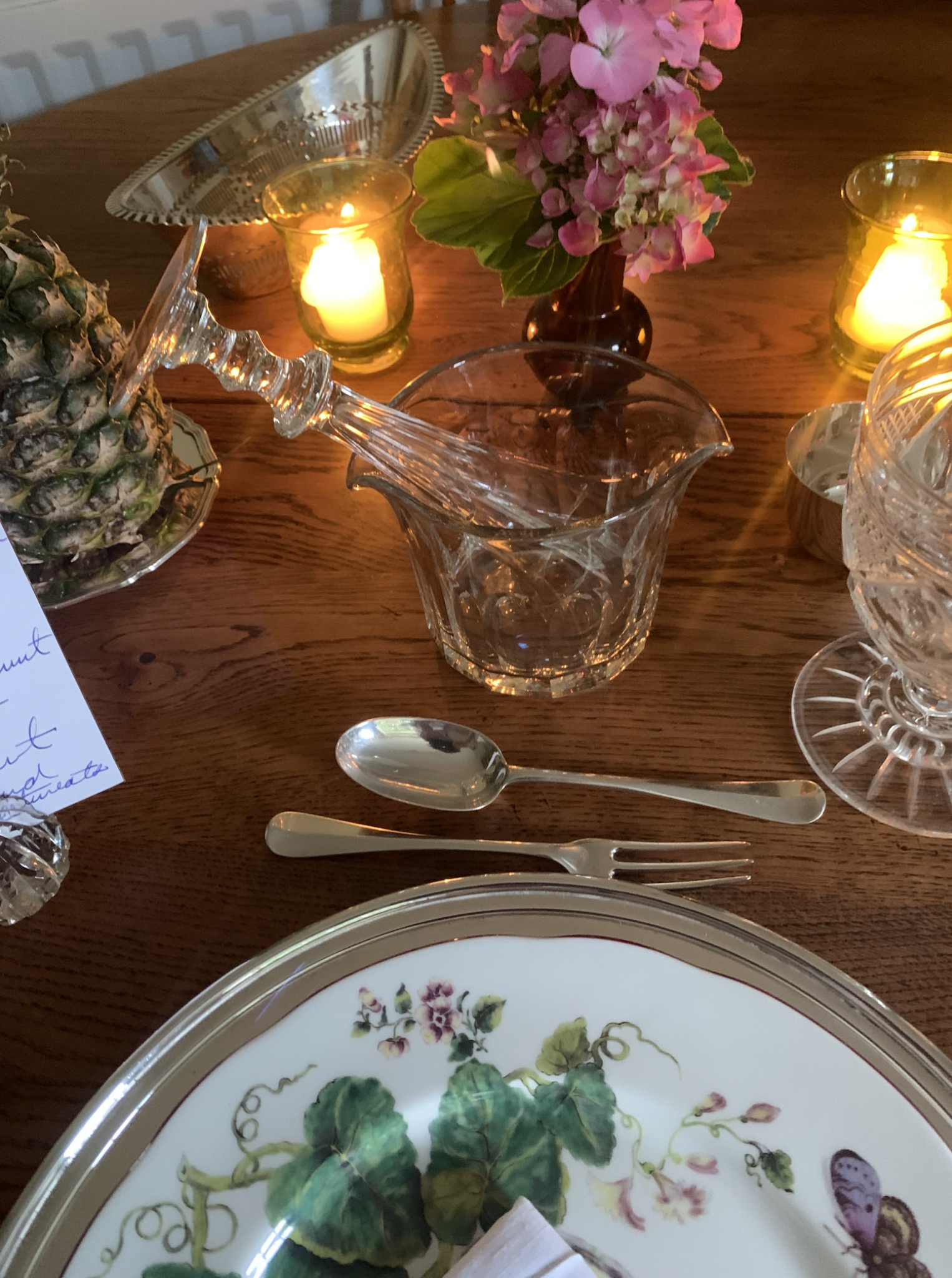
The Best in Show Winner for the Etiquette Community in our 2nd Annual Etiquipedia Place Setting Competition is Amy Willcock of the United Kingdom. Amy is shown above with her Georgian Era dinner place setting.
🍽 🍽 🍽 🍽
Amy Willcock is a successful writer of nine cookery and entertainment books. Born in Chicago, she moved to the UK in 1980. Specialising in country living and game recipes, Amy wrote a regular monthly column for The Shooting Gazette for over 19 years writing about food, country lifestyle and gundogs. During the Covid lockdown in Spring 2020, Amy started a new venture, KBO Cakes. The only way she could “send a slice of home” to her children serving in the forces and at university, was to send them a cake. “Nothing says “I’m thinking about you” more than a homemade cake. Everyone needs a little morale booster every now and then” says Amy. www.kbocakes.co.uk Amy was previously in the hotel business - one of which, The George on the Isle of Wight, had a Michelin starred restaurant. Amy held Lifestyle, Cookery and Aga Workshops teaching people to cook, arrange flowers and set beautiful tables along with how to run a house. Her lifestyle and Aga workshops have been described as ‘finishing schools for people in their 30’s’ and Nigella Lawson wrote in Vogue, “Amy Willcock, hand holder to Aga owners everywhere”. She is a founder member of Yarmouth Women’s Institute, the subject of a BBC 4 documentary, and is a WI Cookery and Preserves judge. Amy has appeared on Market Kitchen, Kirstie’s Homemade home, Celebrity Masterchef, and judged the perfect Sunday Lunch with John Torode and Gregg Wallace on Masterchef and is a regular Food and Lifestyle contributor to local radio. Amy lives in Yorkshire where she manages Warter Priory Shoot office, trains her gundogs, endlessly entertaining friends and family.
Amy’s formal Georgian setting was our Best in Show for the Professional and Etiquette Community entries. It is a mix of 18th century elements  that work beautifully together to create a real feel for the era. Starting with the candle light reflecting off of the silver and warm wood, the table is set with the pistol grip handled flatware so common to the time period. The pineapple is the quintessential Georgian fruit to accompany a fine, formal meal... all of these elements, along with the colors chosen, work seamlessly together. We’d love to dine at this table!

A few etiquette notes on Amy’s setting: 

Amy’s place setting and the overall look  and feeling it evoked was absolutely charming. She went into great detail in her description, so we only sent a follow-up request for explanations on each piece of flatware. You will find her explanation below the photo of Amy’s menu,


Six questions for Amy: 

1. How did you choose the menu and various elements you used in your setting and why? Please explain each of the utensils at your setting… For which of the foods on your menu (or course) was each different item intended? 
Amy’s menu is a perfect melange of Georgian fare and suits the setting to a T. The utensils are for the foods as follows: On the far right the small knife is a bread knife and the tablespoon is for soup. The small forks on either side are for fish (fish used to be eaten with two forks before fish knife and fork sets were created in the 19th century.) The joint knife and fork are for the lamb. The pudding-fork and spoon are for Cambridge burnt cream (“they slide down when main course is cleared”) and the small knife closest to the plate is for the dessert course.
“I always cook according to the seasons and what is easy to prepare and serve when you are the cook, hostess and bottlewasher! I collect silver it is a passion of mine along with old glass but I do love William Yeoward glasses.

“Soup spoons didn’t exist in the Georgian era, table spoons were used,which is so sensible – I do not possess a soup spoon!
In the late 17th and early 18th century knives were made of carbon steel and would taint delicate foods such as fish so two silver forks would be used. Much later in Victorian times silver fish knives and forks were used, although some are very beautiful, I use small silver forks and pistol handled knives with stainless steel blades and set two forks at dinner parties and it’s always fun to watch you guests try and figure out what is going on.

“I am rather fond of three pronged forks as you can see and my pistol handled knives do have very old blades so they need a bit of TLC every now and then. Rack of Lamb is so tender it should cut like butter and of course it is quite correct to pick up the bones and eat, just remember to give everyone a finger bowl after the main course!

“Cambridge Burnt cream is a delicious thick cold custard topped with a layer of crispy caramelised burnt sugar so a good whack with a sliver spoon will do the trick in England, apart from ice cream we always serve “pudding” as we call the sweet course, with a fork and spoon. 

The dessert course is always fruit, nuts, and sweetmeats – little candied bon bons made of marzipan and dates. That’s also where the pineapple comes in and you will see form the photo that the pineapple is taken out of it’s skin and then reassembled back inside, rather cleverly acting as a table decoration and fruit course.”

2. Why did you choose this particular period in time to set your table? Please go into as much detail as you can.


“I love everything about the Georgian period – the silver, the architecture, the china etc… that is when the dining room came into it’s own.”
Later this month we will be posting an extract from a book Amy wrote for English Heritage.
3. How, if at all, did Covid-related social restrictions affect your choice of setting? Were you ready to celebrate? Feeling in the mood to do something different? Etc…

I live in the middle of the country and covid had very little effect really except entertaining was out, but I still set a beautiful table every day.

4. Have you always enjoyed a properly set table? Or, if not, was the table setting something you learned to enjoy through your social life and/or business later on in life?

My mother always insisted on a properly laid table at every meal – breakfast lunch and dinner–  and never put a milk bottle on the table! I have always loved setting fun, beautiful tables. In the UK Tea is served around 4-5 pm and was usually served in the drawing room or sitting room, delicious little sandwiches, and cake- FYI cake would not be served with cake forks! High tea would be things like cottage pie or boiled egg and soldiers for children around 5pm. A properly laid table transforms whatever you are eating, even if it is just bread and cheese. My biggest tip is use everything all the time, don’t save anything for “best”, enjoy everything. I love Joan Didion’s reply when she was asked why she used the good silver every day, Didion replied, “Well every day is all there is.”

5. Did you do any research on table setting etiquette before setting your elements at the table? 

I entered the professional section as I have written, lectured and worked on tables in stately houses such as Castle Howard in Yorkshire extensively.


6. Do you plan on entering again next year? 

Definitely!

More on AmyWillcock–

Nigella Lawson wrote in Vogue, “Amy Willcock, hand holder to Aga owners everywhere”

Books published by Ebury Press

Amy Willcock’s Aga Bible

Troubleshooting tips for your Aga

Cooking for One

At home with Amy Willcock

Amy Willcock’s B&B Know How

Amy Willcock’s Aga Seasons

Amy Willcock’s Aga Know How

Amy Willcock’s Aga Baking

Aga Cooking

Magazines– Amy is a contributor to The Shooting Gazette, Country Life, The Lady, Aga Living, Homes and Garden, Country Kitchen, Waitrose.   

Elizabeth Soos and I would both like to congratulate Amy on her award winning setting. We are honored that she entered our contest and love meeting others who are so willing to share their talents, enthusiasm for etiquette, and their wealth of knowledge. Congratulations!


🍽Etiquette Enthusiast, Maura J. Graber, is the Site Editor for the Etiquipedia© Etiquette Encyclopedia