Showing posts with label Gilded Age Etiquette for Dinner Guests. Show all posts

Monday, July 22, 2024

Gilded Age Dinner Giving

In an age of questionable kitchen appliances it was often difficult to time meals, thus the best cooks and chefs were in high demand. — “It is very rude to keep other guests waiting for you, and to disturb the serenity of the hostess by delaying her dinner, thereby impairing the quality of the cooked viands.” 
In giving a dinner party it is very essential to know how many guests one is going to entertain. It is a serious inconvenience to have any doubt on the subject. Invitations are usually sent out in the following form:
The four capital letters constitute the initials of four French words, meaning "Answer if you please" (Respondez S'il vous plait). The person thus invited must not fail to reply at once, sending a messenger to the door with the note. It is considered impolite to send it by post, and then you are never certain that it will be received. 

If the person invited has any doubt about being able to attend the dinner at the time stated, he should decline the invitation at once. He should be positive one way or the other, not delaying sending the answer more than one day.

A prompt and decided answer declining, enables Mrs. Jones to supply the place with some other person, thereby preventing a vacant chair at the table. The same rule is applicable to a "German," as a well-bred hostess will not invite more than her house will comfort ably accommodate, and it is important for her to know at once if you intend to accept or decline her invitation.

On the appointed day of the dinner, the guest should arrive at the house ten or fifteen minutes before the appointed hour for dinner; avoid arriving too early, but never be too late. It is very rude to keep other guests waiting for you, and to disturb the serenity of the hostess by delaying her dinner, thereby impairing the quality of the cooked viands. 

She should not be expected to wait more than ten of fifteen minutes for any one. If an engagement makes a very early departure from a dinner party or other entertainment imperative, a guest should mention the fact to the hostess beforehand, and make his departure without leave taking, and unobserved. if possible, so as not to suggest the departure of others.

When the guests are assembled in the drawing room, the host or hostess can quietly intimate to each gentleman the lady he will take to the dining room, and how to find his place at the table. When the dinner is announced, the host should lead the way with the lady guest of honor, the hostess being the last to leave the drawing room.— From “Housekeeping and Dinner Giving in Kansas City,” Mrs. Willis, 1887


  🍽Etiquette Enthusiast, Maura J. Graber, is the Site Editor for the Etiquipedia© Etiquette Encyclopedia

Friday, July 8, 2022

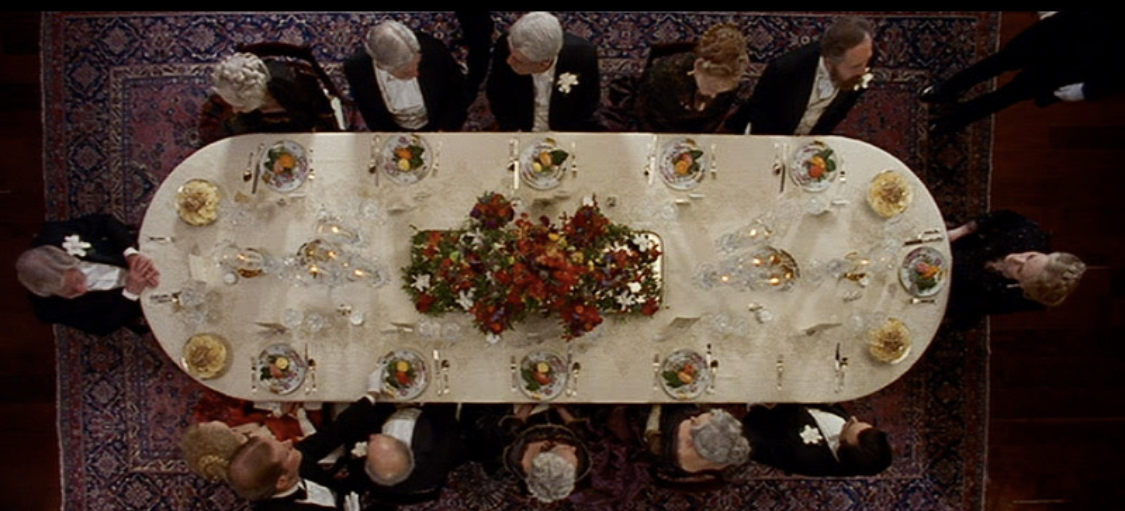
Enjoying a Gilded Age Dinner Party

Fleeting as is time, there is enough of it for all things, and when conversation is in order, let eating be suspended. Exciting topics may be banished without excluding those which have an exhilarating interest.

Primus, a dinner party pre-supposes enjoyment of the viands; secundus, it does not require that a guest shall express his pleasure by waving his napkin, gesticulating with his knife, fork, or spoon, or talking while his mouth is full of food. Fleeting as is time, there is enough of it for all things, and when conversation is in order, let eating be suspended. Exciting topics may be banished without excluding those which have an exhilarating interest.

Long stories are to be avoided, and so is the habit of asking questions; but there is a subtle way of wishing, or, at least, of being willing to hear more that gives the inflection without being too interrogative; and if it be not expedient to tell all we know in response to its gentle insinuation, it does not compel an ungracious refusal or a chilling reticence. A lady is entitled to special attention from her escort, but she should not monopolize his time. 

Not merely the pairing but the grouping of guests is considered by an accomplished hostess, and a lady may exercise her conversational graces impartially to right and left and likewise across the table, provided its width and adornments do not interfere; but neither in front of nor behind an intervening guest should anybody attempt to converse. When a word or sentence to one so separated suggests itself, the intervening person should be included in the conversation. In other words, the conversation becomes general to a lesser or greater extent, according as the subject under discussion may interest those present. 

Architecture may be frozen music to you in the most rigid sense, and you may be seated next to someone who draws out its harmonies in grand and classic shapes, and to whose latest triumphs the company may allude in brief, but pleasing terms. You feel called upon to add something to the general tribute, but can think of nothing apt. Said a young girl who was thus placed, “I could not think of anything to say that would indicate an intelligent knowledge of the subject and I did not feel privileged to lead the conversation from the channel in which it had been directed, so I could only speak of a mite of a country house which always comes to mind because of the beautiful roses that grow all about it and seem intent upon surmounting its diminutive height. I scarcely know how it happened, but in a very short time he was telling me how artistically the rose works into decorative purposes, and from that passed to other things until I felt the subject to be more interesting than I ever supposed it could become to one who knows next to nothing about architecture, and who cannot become familiar with it.” 

Such a frank avowal is not discreditable to one who has tact enough to make up for it, and tact quite often takes the place of many qualities commonly supposed to belong to the mental equipments of bright women. It made a good listener in the instance referred to, and it gave a good talker the opportunity to air his gifts agreeably. Worries and all disquieting subjects should not be mentioned outside the circle they affect, and even though in taking leave of your entertainers, be gracious but not effusive in expressing your pleasure. 

It is to your hostess that you will make acknowledgment in a few words. Just what they shall be, no pen can write and few people need be told; but they will give the impression that you have enjoyed your evening. Beware—this to the young — that your words do not savor of the fact that your enjoyment has been a surprise to yourself. To youth is also addressed this injunction: do not attempt to compliment your hostess upon her ménage. 

Verbally expressed compliments of any kind are rarely the prerogative of the young. If the hostess be your dearest school-friend, tell her privately, when you are admitted to a boudoir chat, how much you admire her qualities as housewife and hostess; but do not allow your appreciation to effervesce when she is doing her best to bear her blushing honors with meekness and dignity, for it is a hard combination for a young hostess to sustain. “Although I have remained late, the evening has seemed very short,” says one; “Time is very unkind, and so I must say good evening,” says another. A matron who has enjoyed years of complete social success extends her hand to a younger entertainer and says, “Before saying adieu, let me thank you for a most delightful evening;” but she does not prolong her leave-taking further than to add a brief good-night.

There was a time when appreciation of the dinner was expressed in the leave-taking, but the custom does not prevail among men and women of the younger generation. It was a pleasing and proper acknowledgment when an invitation to one’s table signified the most sacred form of social hospitality, but though an invitation to dine still suggests a desire for some degree of social intimacy, the giving of dinners has grown to be more of a formality since that time. — Eliza Lavin in “Good Manners,” 1889


🍽Etiquette Enthusiast, Maura J. Graber, is the Site Editor for the Etiquipedia© Etiquette Encyclopedia