Showing posts with label Dance Etiquette. Show all posts

Monday, February 3, 2025

How a Young Girl Should Behave

Manners and Modes: A young girl has the temerity to bring a chaperone to a dance — From “Punch” or the “London Charivari” Vol. 158, February 25th, 1920 ~ Chaperons were seen less often in society after World War I 

Etiquette for Girls

After a young girl has greeted her hostess, she ean, if accompanied by an escort, stand talking with him for a few moments while he introduces his friends. Her escort must always dance the first dance with her and take her out to supper. 

A girl who comes to a dance accompanied by a chaperon, which is considered the proper thing in very fashionable society, follows her protector to a seat and remains beside her until she is invited to dance. After this she need not return to her chaperon at the end of every dance if her program is happily filled, but may walk about with her escort, accept a glass of lemonade, or sit and talk with him until claimed for the next dance. 

It is the girl's place to stop dancing first, and she can, if she wishes, dance uninterruptedly through the entire number or cease waltzing at any time she pleases, and her partner should at once acquiesce.

No well-bred girl ever refuses a dance to one man and gives it to another. She can, however, plead fatigue and sit out the dance with some one if she prefers to do so. But she must not sit on the stairs or in secluded corners, or dance more than three or four times with the same man, or she will be criticized or gossiped about. 

When a man asks her for a dance she should reply. "With pleasure," or "Yes, I shall be delighted," or something of that sort, or it is permissible to say, "Thank you very mucir, but I am really too tired to dance this number."

It is etiquette for the masculine guest to ask his hostess for at least one dance, if she is a young woman; if not, be must ask her daughter, niece, or what- ever young girl the ball is given for. He must claim each partner immediately the music begins, and conduct her to a seat when the dance is over, and beg to be excused when he leaves her.

For all dances, whether ceremonious balls or the most informal of evening parties, the etiquette for the guests is the same. except that at the smalle
r affairs the hostess is considered a sufficient chaperon for all her young guests. – By Eleanor B. Clapp, San Francisco Call, 1905


🍽️Etiquette Enthusiast, Maura J. Graber, is the Site Editor for the Etiquipedia© Etiquette Encyclopedia

Saturday, November 18, 2023

Etiquette Blunders Spoil Vacation

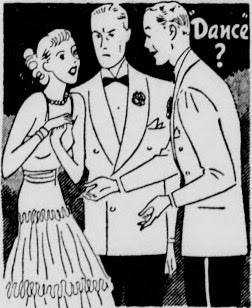
Miss Careless haven't you forgotten something?
You’re the guest, you know, of the frowning young man. How delighted you were when he invited you to this “Saturday night” at the resort’s nicest hotel. But now, when another asks for a dance, you float off without a word!
Here Are Tips for Vacation


Before you dance away, Miss Careless haven't you forgotten something? Your etiquette?

You're the guest, you know, of the frowning young man. How delighted you were when he invited you to this “Saturday night” at the resort’s nicest hotel. But now, when another asks for a dance, you float off without a word.

Mend your manners if you want to be invited again! Introduce the two men graciously. If the newcomer doesn’t say to your escort, “Do you mind” you say it. Then your escort waits with a smile instead of a frown

Indeed you can’t be too careful when you meet a new crowdJust the way you enter the supper room counts. Precede your escort if there's a headwaiter, follow him if there isn't. And it’s up to you – not your escort –to say when to leave any party.

Simple but so important!— Santa Ana Journal Home Service, 1937


🍽Etiquette Enthusiast, Maura J. Graber, is the Site Editor for the Etiquipedia© Etiquette Encyclopedia

Tuesday, December 28, 2021

Politely Asking for a Dance

To use elaborate and formal phrases, such as. "Will you be so kind as to grant me the honor of this dance?" would seem, in our American society, rather stilted and forced. 

What Readers Ask… “What is the correct way for a young man to ask lady of his acquaintance for a dance at a ball or other dancing party?”
Simply say: “May I have this dance, Miss Smith?” is all one need to say. To use elaborate and formal phrases, such as. "Will you be so kind as to grant me the honor of this dance?" would seem, in our American society, rather stilted and forced. – By Mary Marshall Duffee, 1917

Etiquette Enthusiast, Maura J Graber, is the Site Editor for the Etiquipedia© Etiquette Encyclopedia

Monday, November 2, 2020

An Idea of French Etiquette

It is hard to understand here, however, just how the French hostess will be able to insist that “all young people shall join energetically in every dance.”  
—Photo source, Pinterest, from from tenement.org
This immigration museum tells the story of families who immigrated to Manhattan.


Here is an idea of French etiquette which will delight every hostess in America: This year, sitting out, never a formally recognized practice at French parties, but occasionally winked at, will not be countenanced at all. Fashion has decreed, and hostesses will insist, that all the young people shall join energetically in every dance.

It is hard to understand here, however, just how the French hostess will be able to insist that “all young people shall join energetically in every dance.” It is a secret our hostesses would be glad to learn. They would have applied the methods, if they had known them, long ago to the young men who will not dance, and who oblige the young women who delight in the art of Terpsichore to remain wall-flowers.

It recalls that story of Frank Stockton, trying to drag Prof. John Fiske home on Storytellers’ Night at the Author’s Club, as told in one of the recent numbers of THE TIME'S SATURDAY REVIEW. “Isn't there some way which I can drag him forcefully away and still be polite?” quoth Mr. Stockton. Is there any way in which any hostess can drag and obdurate young man upon the ballroom floor and still be polite? — The New York Times, 1902


Etiquette Enthusiast, Maura J. Graber, is the Site Editor for Etiquipedia© Etiquette Encyclopedia

Wednesday, September 9, 2020

Country Dance Club Etiquette

“In Texas and Denver they have signs up: ‘If you’re slow, move to the inside or leave the floor.’ And if you don’t know you’re slow, they have bouncers who will tell you.”
—
photo source, Pinterest 


Rules of Road Important on the Dance Floor: 

Observing correct etiquette helps to ensure that everyone, including you, has a good time.


True or false dance floor etiquette quiz:

1. A gentleman should dance with his right hand clutching his partner’s bottom.

2. Cigarette ashes or beer are great ways to make the dance floor slicker.

3. Two-step and East Coast swing are indoor contact sports.

4. During fast line dances you have the right to steam roll anyone in your way.

5. If a couple strays too close to another couple on the dance floor, it’s OK for the man to jab the other guy in the back with his elbow.

6. To learn a line dance, shadow someone’s moves while bouncing off fellow dancers until you get it, the same way you’d play a pinball machine.

If you answered ‘true‘ to any of the above, you’re guilty of poor dance floor etiquette. 


Despite what you see in many country dance clubs these days, the floor should not resemble Times Square on New Year’s Eve. And practitioners of line dances, two-step and swing should not swarm the floor at one time.

In this respect, folks could learn a lot from Chuck, my plumber. “In Texas and Denver they have signs up: ‘If you’re slow, move to the inside or leave the floor.’ And if you don’t know you’re slow, they have bouncers who will tell you.”

The concept may not seem important. But wait until you’re part of a crowd packed front to back. Each line of dancers has linked arms, the whole crowd is traveling around to a fast 10-step, and someone gets out of sync. Or watch the crowd during a fast walking wazzi or Kentucky chug. You can tell the novice by the way he swims upstream— and up the heels of fellow dancers— every time the herd suddenly changes direction.

Most new country dancers aren’t aggressive, boorish knotheads. Chances are, they just don’t know the rules. And rules are especially important because most floors in area clubs are small— so small that if you cussed the cat, you’d get fur in your mouth. And nothing puts a burr under my saddle quicker than playing bumper cars on the dance floor; if my legs get tangled with somebody else, we’d better be engaged.

Everybody has different opinions and expectations. But most people agree dance floor etiquette begins with common sense and courtesy. Before each lesson, instructor Cliff Cox used to tell his students, “If you’re not havin’ fun— go bowling.” But there’s more to it than the right attitude. And a few clubs, like Denim and Diamonds in Woodland Hills, even distribute flyers that explain their dance floor etiquette.

During group or line dances such as the tush push, dancers must make room for people who know the steps. When the floor is shared by people doing different dances, swingers and line dancers belong in the center--but not usually at the same time. And partners engaged in progressive dances, including two-step, waltz, schottische and polka, should travel counterclockwise around the dance floor with the fastest couples using the outermost lane. In addition, couples doing such country dances have the right of way on that outside track. And nothing or no one should impede the flow.

To keep things moving, deejay Rick Borja, “beat mixes” up to five two-steps in a row at the Borderline Bar and Grill in Thousand Oaks. “Mixing the CDs provides smooth transitions between songs without a drop in energy. But I start slow and increase the speed of each two-step. That discourages the tendency for dancers to want off the floor when a song is done,” said Borja.

But if couples start to disperse as the pace picks up, Borja quickly reminds them to clear the dance floor or claim the inside track of the “Borderline” painted on the floor.

Indeed, couples are expected to dance at the speed of traffic so they aren’t weaving through people recklessly. And the man— who always leads— progresses clockwise in line of dance even as he and his partner are spinning. He never risks trampling the couple behind him by stopping or dancing backward.

And you should never take a cigarette or drink on the floor.

You will see several types of dancers coexisting on some local dance floors. But Borja said their club policy doesn’t generally permit line dancers on the floor when couples are two-stepping or when they might be sitting ducks.

“Just a couple weeks ago the floor was filled with line dancers doing tumble weed,” Borja said. “And I had to ask a couple doing West Coast swing at the edge to come off the floor. Otherwise, when the line dancers turn, run and slide, the couple was right in the impact area against the railed wall.”

“As a dancer myself, I remind the crowd of dance floor etiquette. And the security guards enforce it for the safety and dancing pleasure of everyone.” — By Robyn Lowenthal, Special to Los Angeles Times, 1994


Etiquette Enthusiast, Maura J Graber, is the Site Editor for the Etiquipedia© Etiquette Encyclopedia 

Wednesday, December 19, 2018

Courtesies for Campus Co-Eds

“The modern co-eds spend much time and efforts making themselves attractive, but one wonders if they do not often unconsciously forget a few courtesies. Nothing is so disgusting to a masculine escort as a twisted rearview mirror where a co-ed has thought only of her face and not of the disagreeable impression it makes upon her companion.” – Photo Pinterest


Campus Courtesies

It is not the girls’ place to trade dances at a dance, so why do they do it? The fault probably started with formal courtesy dances where girls did the inviting, but let’s not forget that all formal dances aren’t courtesy dances. It is easy to see that it is very annoying for boys to ask a girl to a formal only to find that all his dances are arranged without his even knowing anything about it. 


After an evening’s entertainment, girls often forget to say something like “thank you, I had a perfect time,’’ and many times they really intend to, but they probably don’t remember it until the next day. This column is donated to the co-eds, so let’s remember these few little courtesies. The modern co-eds spend much time and efforts making themselves attractive, but one wonders if they do not often unconsciously forget a few courtesies. 

Nothing is so disgusting to a masculine escort as a twisted rearview mirror where a co-ed has thought only of her face and not of the disagreeable impression it makes upon her companion. When men open doors for women, all they expect is a pleasant “thank you,” but it is often neglected and forgotten. – Santa Rosa Oak Leaf, 1938


Etiquette Enthusiast, Maura J Graber, is the Site Editor for the Etiquipedia© Etiquette Encyclopedia

Thursday, September 20, 2018

Fashionable Etiquette and Hypnosis

Was she hypnotized? “Kitty” dances the tango on television’s Mr. Selfridge — Argentine tango is a musical genre and accompanying social dance originating at the end of the 19th century in the suburbs of Buenos Aires and Montevideo. 
Tango Dance Etiquette 101: Respect ... the person you are dancing with, Respect ... the culture and heritage of Tango, Respect ... the music and the band, Respect ... the people around you. 
Photo credit Pinterest, Etiquette tips from “Tango Dance Concepts”


Society Takes Up Hypnotic Dancing
PARIS, Feb. 19. —Hypnotism applied to dancing is the latest Parisian fad. It was launched last night at a fashionable ball by Mrs. Caro Campbell and Senorlta Umbra Luigini, two of the most beautiful leaders of fashionable society this season. The intricacies of the tango and the complications of the fox trot will no longer be unapproachable by the uninitiated If the new "art” proves what its patronesses claim it to be. All that is needed, they say, is a few minutes of hypnotism practiced upon a willing devotee. — International News Service, 1920
Etiquette Enthusiast, Maura J. Graber, is the Site Editor for the Etiquipedia@ Etiquette Encyclopedia 

The Etiquette of Dance, 1860

The greatest familiarity between persons of opposite sexes, is, a gentleman placing one hand on a lady’s waist, while she rests one hand on his shoulder and holds his disengaged hand in the other. 


Mrs. Swisshelm on Dancing – It is worthy of note, that those churches and people who most strenuously oppose dancing, have already encouraged and practiced it under other names. Like the temperance man who would not drink cider, but had no objection to a glass of apple juice, our opponents of dancing have their children taught the art under the name of Calisthenics, and practice it when it is called Plays. For it is a remarkable fact, that those old time favorites of religious communities, ‘Dear Sister Phoebe,’ ‘Ring Round Rosy,’ ‘All a Marching to Quebec,’ ‘The White Cockade,’ ‘Copenhagen,’ etc., etc., are, every one of them, cotillions and contra dances, performed to vocal and instrumental music. 

The difference between the religious dance, is that in the former, every man in the room is compelled, on pain of breach of etiquette, to kiss every woman in the room; and, vice versa, that it is quite in order for married women to sit down on the knees of young gentlemen, put their arms around their necks, bring two pair of lips together with a smack, and do any amount of hugging. While, in a profane dance, even those of most doubtful propriety, the greatest familiarity between persons of opposite sexes, is, a gentleman placing one hand on a lady’s waist, while she rests one hand on his shoulder and holds his disengaged hand in the other. The churches, therefore, who set up rules against dancing, are fairly and squarely committed to the doctrine that promiscuous dancing is all right, and pious, and innocent, provided it is accompanied by promiscuous kissing, with a suitable amount of hugging and general rough and tumble. While, without these refining and elevating additions it is an evil on evil, and that continually. 

There is no escaping this conclusion, for the anti-dancing churches and Christians are too openly committed in favor of these vulgar plays for an intelligent man to deny, that either they have acted blindly, or that the kissing and hugging sanctifies the dancing. Now, since all the experience of the past proves that people will dance, even grave and reverend deacons, we are in favor of the dancing without the etceteras. But, apart from all comparisons, we regard dancing as a positive good, as something which requires no apology, but is inherently right in itself, and efficient means of perfecting, refining and cultivating the crowning work of God’s creation, a means appointed and directly approved by the Creator himself! It is liable to abuse, and the object of reformers should be to regulate, not to abolish it. – St. Cloud Democrat, 1860


Etiquette Enthusiast, Maura J. Graber, is the Site Editor for the Etiquipedia© Etiquette Encyclopedia

Monday, December 18, 2017

Naval Dance Etiquette

Dancing Etiquette Ordained for Gobs

Newport, Rhode Island, March 18 – Dancing etiquette must be maintained at the Saturday afternoon dances at the Naval Training station for the enlisted men. An official bulletin just issued reads: "It has been noticed that a number attending these dances do not ‘request’ the young women, their guests, to dance. The men must realize that these young ladies are pleased to dance with them and, therefore, they should do their part, If they desire to meet any of the ladies, they should ask the chaperon for an introduction. The uniform of the enlisted men of this section for these dances will be dress blue, shoes neatly shined, neat haircut, clean shave and clean white undershirt.” – Los Angeles Herald, 1919


Etiquette Enthusiast, Maura J. Graber, is the Site Editor for the Etiquipedia© Etiquette Encyclopedia 

Monday, August 1, 2016

Russian Dance Master on Etiquette

Vestoff is quoted as saying that the American gentleman "clasps his partner in his arms like a life preserver and then drops her in a heap in the middle of the floor to dance with some one else."


Ballroom Etiquette of America in Primitive State, Declares Russian Master
Los Angeles knights of the ballroom rally to a man in a sweeping denunciation of the statement made in San Francisco by Veronine Vestoff, a Master of the Imperial School of Dancing in Moscow, that American men do not know how to conduct themselves.

“Idiotic,” “absurd,” “childish,” “the essence of ignorance” are a few of the most delicate replies to the statement. Vestoff is quoted as saying that the American gentleman clasps his partner in his arms like a life preserver and then drops her in a heap in the middle of the floor to dance with someone else."

“Primitive,” he says... 
“Ballroom etiquette,” continued Vestoff, “in America is in a primitive state.” “Let me state that what I feel like saying in reply to Vestoff’s statement certainly would not be suitable for a ballroom function,” said Leo Youngworth today. “He knows absolutely nothing of what he is talking about. American etiquette, while not so superfluous and over-done as the European custom, is nothing that Americans should be ashamed of.

“In America we have been brought up with the idea of utmost respect for women and, although we do not bow and scrape in jewel-bedecked uniforms, we are gentlemen to the core.” “Tell our friend to put his vest back on again,” said W. K. Crawford, “his statements are utterly absurd. I think he is going a little too far when he tells us how to hold hands.”

Not Stiff and Cold
“The American people are themselves at a social function not stiff, cold figures bound by trifling rules of conventionality. Such an attitude does not prove a man is a gentleman.” “I have had the pleasure to attend quite a number of ballroom functions in my time,” said G. H. Ennis, “but never have I witnessed any of the actions that Vestoff says occur in America. “I cannot imagine where he got the idea of the dancing. When he says the gentleman drops his partner to waltz off with another, he probably refers to the old colonial custom so in vogue now of ‘breaking in,’ which means that when there is so large a number of men they are allowed to select their partners without introduction.” — Los Angeles Herald, 1914


 🍽Etiquette Enthusiast, Maura J. Graber of The RSVP Institute of Etiquette, is the Site Editor for the Etiquipedia© Etiquette Encyclopedia

Monday, February 15, 2016

Kaiser's New Dance Etiquette


The city palace in Berlin was the Prussian royal palace 


Emperor Wilhelm's New Dance Rules


At the court ball in Berlin lately the Kaiser brought in two innovations —first, that the court quadrille is to return as much as possible to the old French quadrille, instead of the modernized dance which has lately taken its place; also that the Kaiser's new ruling as to etiquette in round dance is an improvement.

The Kaiser gave out that in future at court balls, what is known as visiting will be given up.


"Visiting," to explain to those who do not know what it means, is a German practice of one man, having several partners in the same dance. This is an easy way for a man to get through a deal of formal civility, but is a death blow to sociability, and the ladies are pleased.


The visiting card of Kaiser Wilhelm. The German text reads, "Wilhelm, Deutscher Kaiser u. König von Preußen" (translation: "William, German Emperor and King of Prussia"). — Visiting or calling cards, were small paper cards with one's name printed on them, and often bearing an artistic design. In 18th C. Europe, the footmen of aristocrats and royalty would deliver these first European visiting cards to the servants of their prospective hosts solemnly introducing the arrival of their owners. They were the forerunners of today's business cards.


The scene around the throne was brilliant. The ball opened with the valse "La Gitanella," by Morena, the band of the Fusilier guards playing. The dancing card was a very pretty thing in old French style, with Watteau figures and the imperial arms on top. The dancing took place in front of the throne. Count Baudessen of the Life guards was leader of the ball, opening it with the chief lady of the court Countess Stolberg Werigerode.


Next came Count Bernstoff, with Countess Irma Kanitz. In a lovely toilet of white with silver embroidery. One of the toilettes much remarked on was that of Countess Stolberg. It was a ball dress of white satin, with pink roses, very simple but beautifully made.

A feature of the evening was the favorite dance of the Kaiser's, a dance which he has sought very hard to popularize, and what is known as "The Queen's Minuet." Six pairs were in each. set. In the set nearest the throne were Count Bernstoff. Countess Stolberg, Count Baudessen and Countess Kanitz. 

The partners of the ladies were solely officers of the guard regiments. Princess Frederick Karli looked well in chamois satin. Princess- Adolph Schaumburg-Lippe wore light blue, many pearls and much lovely lace; Countess von Wedel, one of the best dressed ladies at court, wore salmon satin; Frau von Bulow, yellow silk, trimmed with fur; Countess Schaffgotsch and Baroness Engelbert Furstenburg, pale pink; Baroness von Kreselbeck wore a very beautiful toilet over a white and gold embroidered skirt (she had a brilliant red broad train of dark red roses about her figure); Countess von Groben wore a silver embroidered toilet.—Berlin Letter, 1899


Etiquette Enthusiast, Maura J. Graber, is the Site Editor for the Etiquipedia© Etiquette Encyclopedia

Saturday, February 6, 2016

19th C. Ballroom Etiquette for Gents

Never dance without gloves. This is an imperative rule. It is best to carry two pair, as in the contact with dark dresses, or in handing refreshments, you may soil the pair you wear on entering the room, and will thus be under the necessity of offering your hand covered by a soiled glove, to some fair partner. 

Of all the amusements open for young people, none is more delightful and more popular than dancing. Lord Chesterfield, in his letters to his son, says: “Dancing is, in itself, a very trifling and silly thing; but it is one of those established follies to which people of sense are sometimes obliged to conform; and then they should be able to do it well. And, though I would not have you a dancer, yet, when you do dance, I would have you dance well, as I would have you do everything you do well.”

In another letter, he writes: “Do you mind your dancing while your dancing master is with you? As you will be often under the necessity of dancing a minuet, I would have you dance it very well. Remember that the graceful motion of the arms, the giving of your hand, and the putting off and putting on of your hat genteelly, are the material parts of a gentleman’s dancing. But the greatest advantage of dancing well is, that it necessarily teaches you to present yourself, to sit, stand, and walk genteelly; all of which are of real importance to a “man of fashion.”

Although the days are over when gentlemen carried their hats into ball rooms and danced minuets, there are useful hints in the quotations given above. Nothing will give ease of manner and a graceful carriage to a gentleman more surely than the knowledge of dancing. He will, in its practice, acquire easy motion, a light step, and learn to use both hands and feet well. What can be more awkward than a man who continually finds his hands and feet in his way, and, by his fussy movements, betrays his trouble?

A good dancer never feels this embarrassment, consequently he never appears aware of the existence of his feet, and carries his hands and arms gracefully. Some people being bashful and afraid of attracting attention in a ball room or evening party, do not take lessons in dancing, overlooking the fact that it is those who do not partake of the amusement on such occasions, not those who do, that attract attention. To all such gentlemen I would say; Learn to dance. You will find it one of the very best plans for correcting bashfulness. Unless you possess the accomplishments that are common in polite society, you can neither give nor receive all the benefits that can be derived from social intercourse.

When you receive an invitation to a ball, answer it immediately.

If you go alone, go from the dressing-room to the ball room, find your host and hostess, and speak first to them; if there are several ladies in the house, take the earliest opportunity of paying your respects to each of them, and invite one of them to dance with you the first dance. If she is already engaged, you should endeavor to engage her for a dance later in the evening, and are then at liberty to seek a partner amongst the guests.

When you have engaged a partner for a dance, you should go to her a few moments before the set for which you have engaged her will be formed, that you may not be hurried in taking your places upon the floor. Enquire whether she prefers the head or side place in the set, and take the position she names.

In inviting a lady to dance with you, the words, “Will you honor me with your hand for a quadrille?” or, “Shall I have the honor of dancing this set with you?” are more used now than “Shall I have the pleasure?” or, “Will you give me the pleasure of dancing with you?”

Offer a lady your arm to lead her to the quadrille, and in the pauses between the figures endeavor to make the duty of standing still less tiresome by pleasant conversation. Let the subjects be light, as you will be constantly interrupted by the figures in the dance. There is no occasion upon which a pleasant flow of small talk is more àpropos, and agreeable than in a ball room.

When the dance is over, offer your arm to your partner, and enquire whether she prefers to go immediately to her seat, or wishes to promenade. If she chooses the former, conduct her to her seat, stand near her a few moments, chatting, then bow, and give other gentlemen an opportunity of addressing her. If she prefers to promenade, walk with her until she expresses a wish to sit down. Enquire, before you leave her, whether you can be of any service, and, if the supper-room is open, invite her to go in there with you.

You will pay a delicate compliment and one that will certainly be appreciated, if, when a lady declines your invitation to dance on the plea of fatigue or fear of fatigue, you do not seek another partner, but remain with the lady you have just invited, and thus imply that the pleasure of talking with, and being near, her, is greater than that of dancing with another.

Let your hostess understand that you are at her service for the evening, that she may have a prospect of giving her wall flowers a partner, and, however unattractive these may prove, endeavor to make yourself as agreeable to them as possible.

Your conduct will differ if you escort a lady to a ball. Then your principal attentions must be paid to her. You must call for her punctually at the hour she has appointed, and it is your duty to provide the carriage. You may carry her a bouquet if you will, this is optional. A more elegant way of presenting it is to send it in the afternoon with your card, as, if you wait until evening, she may think you do not mean to present one, and provide one for herself.

When you arrive at your destination, leave the carriage, and assist her in alighting; then escort her to the lady’s dressing-room, leave her at the door, and go to the gentlemen’s dressing-room. As soon as you have arranged your own dress, go again to the door of the lady’s room, and wait until your companion comes out. Give her your left arm and escort her to the ball room; find the hostess and lead your companion to her. When they have exchanged greetings, lead your lady to a seat, and then engage her for the first dance.

Tell her that while you will not deprive others of the pleasure of dancing with her, you are desirous of dancing with her whenever she is not more pleasantly engaged, and before seeking a partner for any other set, see whether your lady is engaged or is ready to dance again with you. You must watch during the evening, and, while you do not force your attentions upon her, or prevent others from paying her attention, you must never allow her to be alone, but join her whenever others are not speaking to her. You must take her in to supper, and be ready to leave the party, whenever she wishes to do so.

If the ball is given in your own house, or at that of a near relative, it becomes your duty to see that every lady, young or old, handsome or ugly, is provided with a partner, though the oldest and ugliest may fall to your own share.

Never stand up to dance unless you are perfect master of the step, figure, and time of that dance. If you make a mistake you not only render yourself ridiculous, but you annoy your partner and the others in the set.

If you have come alone to a ball, do not devote yourself entirely to any one lady. Divide your attentions amongst several, and never dance twice in succession with the same partner.

To affect an air of secrecy or mystery when conversing in a ball-room is a piece of impertinence for which no lady of delicacy will thank you.

When you conduct your partner to her seat, thank her for the pleasure she has conferred upon you, and do not remain too long conversing with her.

Give your partner your whole attention when dancing with her. To let your eyes wander round the room, or to make remarks betraying your interest in others, is not flattering, as she will not be unobservant of your want of taste.

Be very careful not to forget an engagement. It is an unpardonable breach of politeness to ask a lady to dance with you, and neglect to remind her of her promise when the time to redeem it comes.

A dress coat, dress boots, full suit of black, and white or very light kid gloves must be worn in a ball room. A white waistcoat and cravat are sometimes worn, but this is a matter of taste.

Never wait until the music commences before inviting a lady to dance with you.

If one lady refuses you, do not ask another who is seated near her to dance the same set. Do not go immediately to another lady, but chat a few moments with the one whom you first invited, and then join a group or gentlemen friends for a few moments, before seeking another partner.

Never dance without gloves. This is an imperative rule. It is best to carry two pair, as in the contact with dark dresses, or in handing refreshments, you may soil the pair you wear on entering the room, and will thus be under the necessity of offering your hand covered by a soiled glove, to some fair partner. You can slip unperceived from the room, change the soiled for a fresh pair, and then avoid that mortification.

If your partner has a bouquet, handkerchief, or fan in her hand, do not offer to carry them for her. If she finds they embarrass her, she will request you to hold them for her, but etiquette requires you not to notice them, unless she speaks of them first.

Do not be the last to leave the ball room. It is more elegant to leave early, as staying too late gives others the impression that you do not often have an invitation to a ball, and must “make the most of it.”

Some gentlemen linger at a private ball until all the ladies have left, and then congregate in the supper-room, where they remain for hours, totally regardless of the fact that they are keeping the wearied host and his servants from their rest. Never, as you value your reputation as a gentleman of refinement, be among the number of these “hangers on.” –From Cecil B. Hartley's. “The Gentlemen's Book of Etiquette and Manual of Politeness”


Etiquette Enthusiast, Maura J. Graber, is the Site Editor for the Etiquipedia© Etiquette Encyclopedia

Sunday, October 4, 2015

Etiquette and Social Custom

The only exception to the old and present day rule is in the case of husband and wife. In such cases the husband gives his left arm to his wife. The origin of this is to show the domination of man over woman. 

"It's a Matter of Etiquette"


Should a man offer the right or left arm to a woman?  In social circles just now there is going on quite a discussion regarding this question.  To one’s wife, one gives the left arm.  To all other women, the right arm.  It is now being urged that the social custom be changed, and that man be considered quite correct should he offer his left arm to all women.  This question of etiquette, like so many others, originated in France centuries ago.


Shakespeare writes of a man “as polite as a French courtier." The "grand Maitres de maintien" decreed some ages ago that a man must give his right arm to members of the fair sex because one always places on the right hand those whom one wishes to honor.  French gallants, just like the American men of today, held the daughters of Eve in high honor.  At a ball when inviting a woman to dance you must give her the right arm, and after the dance, in promenading, you do not change the arm. It is the same rule at all functions, or even when walking in the street.


The only exception to the old and present day rule is in the case of husband and wife.  In such cases the husband gives his left arm to his wife.  The origin of this is to show the domination of man over woman.  It is now being urged that the right be dethroned in favor of the universal use of the left.  The argument is that in such case the man has the use of his good right arm for the defense of his fair companion, and to assist her the better if slipping or falling.  The coming season ought to definitely settle the question. 
–Sacramento Union, 1908


Etiquette Enthusiast, Maura J. Graber is the Site Moderator for Etiquipedia© Etiquette Encyclopedia

Tuesday, March 17, 2015

Etiquette of 19th C. Balls and Assembly Rooms


“Dance only from the hips downwards” was the guiding etiquette rule.

Dancing has been defined as a "graceful movement of the body, adjusted by art to the measures or tunes of instruments, or of voice;" and again, "agreeable to the true genius of the art, dancing is the art of expressing the sentiments of the mind, or the passions, by measured steps or bounds made in cadence, by regulated motions of the figure and by graceful gestures; all performed to the sound of musical instruments or the voice."


Lord Chesterfield, in his letters to his son, says: "Dancing is, in itself, a very trifling and silly thing: but it is one of those established follies to which people of sense are sometimes obliged to conform; and then they should be able to do it well. And though I would not have you a dancer, yet, when you do dance, I would have you dance well, as I would have you do everything you do well." 

In another letter, he writes: "Do you mind your dancing while your dancing master is with you? As you will be often under the necessity of dancing a minuet, I would have you dance it very well. Remember that the graceful motion of the arms, the giving of your hand, and the putting off and putting on of your hat genteelly, are the material parts of a gentleman's dancing. But the greatest advantage of dancing well is, that it necessarily teaches you to present yourself, to sit, stand, and walk genteelly; all of which are of real importance to a man of fashion."

When a gentleman accompanies a lady to a ball he will at once proceed with her to the door of the ladies' dressing-room, there leaving her; and then repair to the gentlemen's dressing-room. In the mean time, the lady, after adjusting her toilet, will retire to the ladies' sitting-room or wait at the door of the dressing-room, according as the apartments may be arranged. After the gentleman has divested himself of hat, etc., and placed the same in the care of the man having charge of the hat-room, receiving therefor a check, and after arranging his toilet, he will proceed to the ladies' sitting-room, or wait at the entrance to the ladies' dressing-room for the lady whom he accompanies, and with her enter the ball-room. The ladies' dressing-room is a sacred precinct, into which no gentleman should ever presume to look; to enter it would be an outrage not to be overlooked or forgiven.
                                      
A gentleman introduced to a lady by a floor manager, or the Master of Ceremonies, should not be refused by the lady if she be not already engaged, for her refusal would be a breach of good manners, regardless of his height.


With the etiquette of a ball-room, so far as it goes, there are but few people unacquainted. Certain persons are appointed to act as floor managers, or there will be a "Master of the Ceremonies," whose office it is to see that everything be conducted in a proper manner: if you are entirely a stranger, it is to them you must apply for a partner, and point out (quietly) any young lady with whom you should like to dance, when, if there be no obvious inequality of position, they will present you for that purpose; should there be an objection, they will probably select some one they consider more suitable; but do not, on any account, go to a strange lady by yourself, and request her to dance, as she will unhesitatingly "decline the honor," and think you an impertinent fellow for your presumption.


A gentleman introduced to a lady by a floor manager, or the Master of Ceremonies, should not be refused by the lady if she be not already engaged, for her refusal would be a breach of good manners: as the Master of Ceremonies is supposed to be careful to introduce only gentlemen who are unexceptionable. But a gentleman who is unqualified as a dancer should never seek an introduction.


At a private party, a gentleman may offer to dance with a lady without an introduction, but at balls the rule is different. The gentleman should respectfully offer his arm to the lady who consents to dance with him, and lead her to her place. At the conclusion of the set he will conduct her to a seat, offer her any attention, or converse with her. A gentleman should not dance with his wife, and not too often with the lady to whom he is engaged.


Any presentation to a lady in a public ball-room, for the mere purpose of dancing, does not entitle you to claim her acquaintance afterwards; therefore, should you meet her, at most you may lift your hat; but even that is better avoided—unless, indeed, she first bows— as neither she nor her friends can know who or what you are.


In inviting a lady to dance with you, the words, "Will you honor me with your hand for a quadrille?" or, "Shall I have the honor of dancing this set with you?" are more used now than "Shall I have the pleasure?" or, "Will you give me the pleasure of dancing with you?" If she answers that she is engaged, merely request her to name the earliest dance for which she is not engaged, and when she will do you the honor of dancing with you.


When a young lady declines dancing with a gentleman, it is her duty to give him a reason why, although some thoughtless ones do not. No matter how frivolous it may be, it is simply an act of courtesy to offer him an excuse; while, on the other hand, no gentleman ought so far to compromise his self-respect as to take the slightest offence at seeing a lady by whom he has just been refused, dance immediately after with some one else.


Never wait until the signal is given to take a partner, for nothing is more impolite than to invite a lady hastily, and when the dancers are already in their places; it can be allowed only when the set is incomplete.


Be very careful not to forget an engagement. It is an unpardonable breach of politeness to ask a lady to dance with you, and neglect to remind her of her promise when the time to redeem it comes.


If a friend be engaged when you request her to dance, and she promises to be your partner for the next or any of the following dances, do not neglect her when the time comes, but be in readiness to fulfill your office as her cavalier, or she may think that you have studiously slighted her, besides preventing her obliging some one else. 
Even inattention and forgetfulness, by showing how little you care for a lady, form in themselves a tacit insult.

In a quadrille, or other dance, while awaiting the music, or while unengaged, a lady and gentleman should avoid long conversations, as they are apt to interfere with the progress of the dance; while, on the other hand, a gentleman should not stand like an automaton, as though he were afraid of his partner, but endeavor to render himself agreeable by those "airy nothings" which amuse for the moment, and are in harmony with the occasion. The customary honors of a bow and courtesy should be given at the commencement and conclusion of each dance.

               
Unless a man has a very graceful figure, and can use it with great elegance, it is better for him to walk through the quadrilles, or invent some gliding movement for the occasion.

Lead the lady through the quadrille; do not drag her, nor clasp her hand as if it were made of wood, lest she, not unjustly, think you a bear. You will not, if you are wise, stand up in a quadrille without knowing something of “the figure; and if you are master of a few of the steps, so much the better. But dance quietly; do not kick and caper about, nor sway your body to and fro; dance only from the hips downwards; and lead the lady as lightly as you would tread a measure with a spirit of gossamer.

Do not pride yourself on doing the "steps neatly," unless you are ambitious of being taken for a dancing-master; between whose motions and those of a gentleman there is a great difference. 
Unless a man has a very graceful figure, and can use it with great elegance, it is better for him to walk through the quadrilles, or invent some gliding movement for the occasion.

When a lady is standing in a quadrille, though not engaged in dancing, a gentleman not acquainted with her partner should not converse with her. When an unpracticed dancer makes a mistake, we may apprise him of his error; but it would be very impolite to have the air of giving him a lesson.

Immediate attention should be paid to any request made by the Master of Ceremonies, and all misunderstandings respecting the dance should be referred to him, his decision being deemed final. Otherwise his superintendence of the ball will be attended with great inconvenience.

When forming for quadrilles, if by any oversight you should accidentally occupy another couple's place, on being informed of the intrusion, you should immediately apologize to the incommoded party, and secure another position. Contending for a position in quadrilles, at either head or sides, indicates an irritable and quarrelsome disposition altogether unsuited for an occasion where all should meet with kindly feelings.


When a company is divided into different sets, persons should not attempt to change their places without permission from the Master of Ceremonies. No persons engaged in a quadrille or other dance that requires their assistance to complete the set, should leave the room or sit down before the dance is finished, unless on a very urgent occasion, and not even then without previously informing the Master of Ceremonies, that he may find substitutes. If a lady waltz with you, beware not to press her waist; you must only lightly touch it with the palm of your hand, lest you leave a disagreeable impression not only on her ceinture, but on her mind.


Above all, do not be prone to quarrel in a ball-room; it disturbs the harmony of the company, and should be avoided if possible. Recollect that a thousand little derelictions from strict propriety may occur through the ignorance or stupidity of the aggressor, and not from any intention to annoy; remember, also, that the really well-bred women will not thank you for making them conspicuous by over-officiousness in their defence, unless, indeed, there be some serious or glaring violation of decorum. In small matters, ladies are both able and willing to take care of themselves, and would prefer being allowed to overwhelm the unlucky offender in their own way.

When a gentleman has occasion to pass through an assemblage of ladies, where it is absolutely impossible to make his way without disturbing them; or when he is obliged to go in front, because he cannot get behind them, it is but common courtesy for him to express his regret at being compelled to annoy them. A gentleman having two ladies in charge may, in the absence of friends, address a stranger, and offer him a partner, asking his name previous to an introduction, and mentioning that of the lady to him or not, as he may think proper.

It is improper to engage or reëngage a lady to dance without the permission of her partner. Never forget that ladies are to be first cared for, to have the best seats, the places of distinction, and are entitled in all cases to your courteous protection. Young ladies should avoid sauntering through an assembly-room alone; they should either be accompanied by their guardian or a gentleman. Neither married nor young ladies should leave a ball-room assemblage, or other party, unattended. The former should be accompanied by other married ladies, and the latter by their mother or guardian. Of course, a gentleman is a sufficient companion for either.

Young ladies should avoid attempting to take part in a dance, particularly a quadrille, unless they are familiar with the figures. Besides rendering themselves awkward and confused, they are apt to create ill-feeling, by interfering with, and annoying others. It were better for them to forego the gratification of dancing than to risk the chances of making themselves conspicuous, and the subject of animadversion. 

As we have elsewhere said, modesty of deportment should be the shining and preëminent characteristic of woman. She should be modest in her attire, in language, in manners and general demeanor. Beauty becomes irresistible when allied to this lodestone of attraction; plainness of features is overlooked by it; even positive homeliness is rendered agreeable by its influence.

When a gentleman escorts a lady to a ball, he should dance with her first, or offer so to do; and it should be his care to see that she is provided with a partner whenever she desires to dance. After dancing, a gentleman should invariably conduct a lady to a seat, unless she otherwise desires; and, in fact, a lady should not be unattended, at any time, in a public assembly.

When you conduct your partner to her seat, thank her for the pleasure she has conferred upon you, and do not remain too long conversing with her. When that long and anxiously desiderated hour, the hour of supper, has arrived, you hand the lady you attend up or down to the supper-table. You remain with her while she is at the table, seeing that she has all that she desires, and then conduct her back to the dancing-rooms.

If, while walking up and down a public promenade, you should meet friends or acquaintances whom you don't intend to join, it is only necessary to salute them the first time of passing; to bow or nod to them at every round would be tiresome and therefore improper; have no fear that they will deem you odd or unfriendly, as, if they have any sense at all, they can appreciate your reasons. If you have anything to say to them, join them at once.

We have already alluded to the necessity of discarding all cant terms and phrases from conversation, not only in assembly-rooms, but on all occasions; and we would particularly caution our young lady friends against even the recognition of those équivoques and double entendre which the other sex sometimes inconsiderately, but oftener determinedly, introduce.

Neither by smiles nor blushes should they betray any knowledge of the hidden meaning that lurks within a phrase of doubtful import, nor seem to recognize anything which they could not with propriety openly make a subject of discourse. All indelicate expressions should be to them as the Sanscrit language is to most people, incomprehensible. All wanton glances and grimaces, which are by libertines considered as but so many invitations to lewdness, should be strictly shunned.

No lady can be too fastidious in her conduct, or too guarded in her actions. A bad reputation is almost as destructive of happiness to her as absolute guilt; and of her character we may say with the poet: “A breath can make them, or a breath unmake."

In dancing, generally, the performers of both sexes should endeavor to wear a pleasant countenance; and in presenting hands, a slight inclination of the head, in the manner of a salutation, is appropriate and becoming. Dancing is certainly supposed to be an enjoyment, but the sombre countenance of some who engage in it, might almost lead to the belief that it were a solemn duty being performed. If those who laugh in church would transfer their merriment to the assembly-room, and those who are sad in the assembly-room would carry their gravity to the church, they both might discover the appositeness of Solomon's declaration, that "there is a time to be merry and a time to be sad."
                         
The "Father of English Grammar,” Lindley Murray

We have already alluded to the importance of a correct use of language in conversation, and though we are aware that it is absolutely impossible to practice it without a certain degree of education, yet we would urge that the habit which many acquire, more through carelessness than ignorance, of disregarding it, is worthy of consideration. Many a young lady has lost a future husband by a wanton contempt for the rules of Lindley Murray.

Though hardly a case in point, we cannot forego the opportunity of recording an incident in the career of a young man "about town," who, anxious to see life in all its phases, was induced to attend a public ball, the patrons of which were characterized more for their peculiarity of manners than their extraordinary refinement. 

On being solicited by an acquaintance, whom he respected for his kindness of heart and integrity rather than for his mental accomplishments, to dance with his daughter, he consented, and was accordingly introduced to a very beautiful young lady. Ere the dance commenced, and while the musicians were performing the "Anvil Chorus," from "Trovatore," the young lady asked: "Do you know what that 'ere is?" Supposing that she meant air, and wishing to give her an opportunity of making herself happy in the thought of imparting a valuable piece of information, in utter disregard of the principles of Mrs. Opie, he replied, "No." "Why," said she, "that's the Anvel Core-ri-ous." With an expletive more profane than polite, he suddenly found his admiration for the lady as much diminished by her ignorance, as it had before been exalted by her beauty.

At private assemblies, it should be the effort of both ladies and gentlemen to render themselves as agreeable as possible to all parties. With this purpose in view, the latter should, therefore, avoid showing marked preferences to particular ladies, either by devoting their undivided attentions or dancing exclusively with them. Too often, the belle of the evening, with no other charms than beauty of form and feature, monopolizes the regards of a circle of admirers, while modest merit, of less personal attraction, is both overlooked and neglected. 

We honor the generous conduct of those, particularly the "well-favored," who bestow their attentions on ladies who, from conscious lack of beauty, least expect them. “On the other hand, no lady, however numerous the solicitations of her admirers, should consent to dance repeatedly, when, by so doing, she excludes other ladies from participating in the same amusement; still less, as we have elsewhere hinted, should she dance exclusively with the same gentleman, to the disadvantage of others.

Both ladies and gentlemen should be careful about introducing persons to each other without being first satisfied that such a course will be mutually agreeable. The custom, in this country, particularly among gentlemen, of indiscriminate introductions, is carried to such a ridiculous extent, that it has often been made the subject of comment by foreigners, who can discover no possible advantage in being made acquainted with others with whom they are not likely to associate for three minutes, in whom they take not the slightest interest, and whom they probably will never again encounter, nor recognize if they should. Besides, every one has a right to exercise his own judgment and taste in the selection of acquaintances, and it is clearly a breach of politeness to thrust them upon your friend or associate, without knowing whether it will be agreeable to either party.


From “Martine's Hand-book of Etiquette, and Guide to True Politeness”

Etiquette Enthusiast, Maura J. Graber, is the Site Editor for the Etiquipedia© Etiquette Encyclopedia