Showing posts with label Bicycling Fashion Etiquette. Show all posts

Monday, September 25, 2023

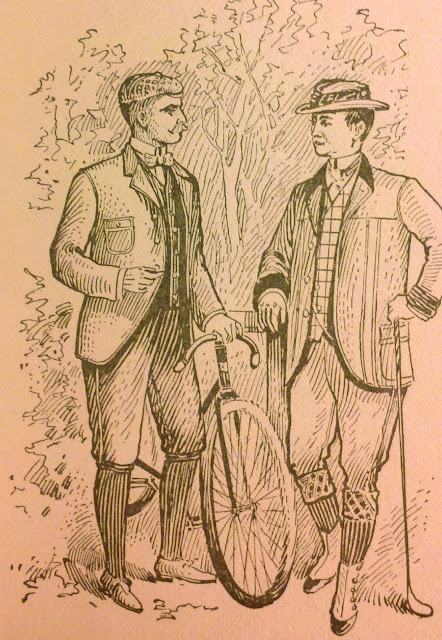
Correct Dress for Cycling Men of 1918

Gray golf stockings, tastefully variegated with touches of black, white and sober blue, or brown hose with very fine crisscrossing lines in yellow and red, now predominate.

Bicycling Attire for Men

THOSE still faithful to the bicycle wear in cool spring and autumn weather, a complete suit-coat, waistcoat, and knickerbockers-of serviceable gray or brown tweed, the coat cut very like an English pea-jacket, or what we prefer in America to call a "lounging coat." Gray golf stockings, tastefully variegated with touches of black, white and sober blue, or brown hose with very fine crisscrossing lines in yellow and red, now predominate. High or half-high laced shoes of black or brown leather dress the feet in good taste. But as this is too heavy an attire for mid-summer weather, it gives place, in June, July, August, and September, to a suit of Russian crash, heavy brown linen, khaki serge, or light-weight flannel. – From Emily Holt’s “Encyclopaedia of Etiquette,” 1918

 🍽Etiquette Enthusiast, Maura J. Graber, is the Site Editor for the Etiquipedia© Etiquette Encyclopedia

Wednesday, July 3, 2019

Etiquette of the Bicycle Costume

The bicycle has done more for the cause of legitimate dress reform than any other single agent. – By Rose Talbot Bullard, M.D., 1895

There is no more difficult task presented to the physician and hygienist than that of providing a pleasant, convenient and healthful outdoor exercise for women. The bicycle pre-eminently fulfills all requirements. It is the duty of every wheel-woman to so attire and conduct herself, as to make this invaluable exercise all that the most modest could wish. Costumes may be classed as follows: Knickerbockers, bloomers, short skirts and divided skirts. The essentials are comfort, appropriateness, inconspicuousness and gracefulness. The appearance when off the wheel must be considered, as well as when mounted. The first essential of comfort lies in the underwear. The union suits are especially desirable. Corsets should never be worn. The accessories — hats, shoes, gloves and leggings, should harmonize with the costume.

The knickerbocker allows greatest freedom, but is entirely too conspicuous to receive our endorsement. The bloomer fulfills the indication of comfort and is appropriate; for an exercise involving free motion may be best carried out if the legs are so clothed as to be independent of each other. However, they are conspicuous and very ungraceful. We may, in time, arrived at a modified bloomer, but are not yet ready to adopt them for city riding. The short skirt, coming just below the knee, is open to like objection. But there are costumes which comprise all our qualifications. They are the three-quarter skirt and the divided skirt with the division concealed. They should clear the ground from four to seven inches.

The divided skirt offers some advantages; under this the equestrian skirts or knickerbockers should be worn. The division is concealed in front by the front width which is fastened to each leg in the back by the way, the plaits are arranged. On the wheel, the skirt is always evenly divided; the leg need only lift its half of the weight of the skirt, and, finally, when off the wheel it looks like any other skirt. It is an ideal business or rainy day dress, and, in fact, is very suitable for ordinary street wear as it is lighter, does not serve as a street-cleaner and precludes the necessity of in discriminate lifting of skirts. The bicycle has done more for the cause of legitimate dress reform than any other single agent. – By Rose Talbot Bullard, M.D. Los Angeles, California – Extracts from a paper read before the Woman's Parliament, October 8, 1895


Etiquette Enthusiast, Maura J Graber, is the Site Editor for the Etiquipedia© Etiquette Encyclopedia

Saturday, December 5, 2015

Etiquette and French Calves

According to all rules of precedent and etiquette, if knee breeches must be donned, and nature has been unkind to the wearer he must call in artificial aid.
Coronation Calves to Order
A Parisian Industry Being Boomed by Thin British Shanks

Parisians must and will be amused. When there is nothing to occupy their attention they upset ministries and raise barricades. Consequently one must not begrudge them their joke, even if it is a “false calf.” 

It would appear, or at least Parisian news-sheets tell us so, that a certain quantity of artificial calves are being manufactured in Paris in view of the Coronation festivities. We are not all Pickwicks, with a well-filled gaiter, and when, according to all rules of precedent and etiquette, knee breeches must be donned, if nature has been unkind to the wearer he must call in artificial aid. Consequently the trade in artificial calves is very brisk. 

It has been found, however, that even without such an incentive as the coronation fetes the artlficial-calf industry is regularly occupied in manufacturing such articles for home consumption. Frenchmen must not chaff England in this respect, for every year numerous French cyclists, society men—yes, and society women —invest thirty francs in padding for their nether limbs. 

We must therefore add another article to the list of adulterated and imitated goods mentioned above, for even legs are not always what they seem. —From the Los Angeles Herald, as printed in the Paris Messenger, 1902


Etiquette Enthusiast, Maura J. Graber, is the Site Editor for Etiquipedia© Etiquette Encyclopedia