Showing posts with label Seating Etiquette for Guests. Show all posts

Monday, March 14, 2022

Graceful Dinner Seating Etiquette

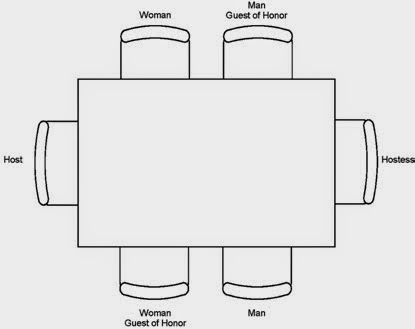
Formal Table Seating For Groups Divisible By Four, without Host and Hostess at opposite ends of the table— 
Images courtesy Bernadette Petrotta
 

“In seating one's self at table a comfortable posture is not incompatible with a dignified attitude. The shoulders should not be thrown back too far, nor should they drop forward. It is the latter pose which produces the inclination of the arms suggestive of the 'all elbows' idea which some people give of themselves.”
– Eliza M. Lavin, 1888

A 2020 Instagram query from Happy Soul —How do you take a seat the dining table i.e from the left of the chair or right of the chair or either way is correct? Then how do you leave the chair ie from left or right or either way is fine?
Reply from Maura J. Graber, Etiquipedia Site Editor: It is dependent on several factors, so common sense and some quick thought comes into play, just as it does with most other etiquette. Is it a formal dinner party in someone’s home? How many others are seating themselves at the same time? How is the table set up? Will seating yourself from the left side of the chair interfere with someone serving food? 
In the U.S., food and drinks are served on different sides — food from the left, drinks from the right. In Europe, everything is served from the right — food and drinks. Silently, ask the same question to yourself as you are walking toward the table on the right side. If one is in a restaurant, is everyone being seated at the same time? Are you joining a party already seated. Does someone have a walker, cane or other aid, sitting next to their chair that will impede your seating yourself? 

As a rule, I personally tend to “enter” the seat from the left and “exit” from the seat on my right. However, I always take a look around me before making those choices, and ask myself it it will work effortlessly, or if I will be causing discomfort or a challenge for anyone near me. Either way is fine, as long as no one else will be put out by the choice made.

Traditional Formal Table Seating For Six, Ten, Fourteen, Or Eighteen People, with Host and Hostess at Opposite Ends


 🍽Etiquette Enthusiast, Maura J. Graber of The RSVP Institute of Etiquette, is the Site Editor for the Etiquipedia© Etiquette Encyclopedia

Thursday, August 12, 2021

Etiquette of Meeting and Seating Royals


Original seating chart for the State Dinner held on November 23, 1934 in honor of a royal visit by Prince Henry, The Duke of Gloucester


This is a fun and wonderful piece of history that I found on Ebay several years ago. It had evidently been folded up and stuck in an Australian drawer for over 60 years. I was actually looking for vintage Australian etiquette books on Ebay Australia when I stumbled upon the listing.

It is the original seating chart for the State Dinner held on November 23, 1934 in honour of a royal visit by Prince Henry, The Duke of Gloucester. He was in Australia from October 4th until December 11th of that year, and when I researched it later, I found it had been an important state visit by the Duke at the time. I was the only bidder on the item and won it for about $4.50 total. I had it framed and it hangs in my dining room.


Prince Henry, the Duke of Gloucester ~ “Generally, the people found him, as they found his brother the Duke of York, a little shy and somewhat embarrassed at the overwhelming nature of his reception.”

You may be wondering, "Who is Prince Henry?" or, "Huh?" if you are here with me in the United States. He was the Queen’s uncle, and his son, the late Prince William of Gloucester, who died young in 1972, is who the Duke of Cambridge (aka the current Prince William) was named.

The Aussies know very well who he is however, so over the years I have been tempted to send this interesting historic document back to them. It should possibly be in a museum or with a historical group in Australia. Or, maybe mine is one of several copies they made for the 1934 event. Either way, I enjoy it and find it fascinating. Like I wrote in my book on mango forks, the Australians are the nicest people to do business with on Ebay, so I keep thinking I may just pop on over to visit there myself some day.


Note the "Capt. S.S. Bonham Carter" at Seat 2, a distant relative of actress Helena Bonham Carter. He was later "Admiral Sir Stuart Bonham Carter", and had served in the Royal Navy in both World Wars and rose to the rank of Vice Admiral. 


I find it interesting who sat where at this dinner. Of course the Duke was seated in the center at the head table, labeled "A", along with local Australian dignitaries flanking him on either side. The Consul-General from Germany was at Seat 8 at Table B, and fairly far from the center of Table A, where the Duke sat. But he was 4 seats away to his left from the Consul from Poland and 4 seats away to his right from Captain S.S. Bonham Carter. Behind him, to his left just 2 seats away, seated at Table C was the Consul-General to France. In just 5 years time, Great Britain and France would be declaring war on Germany, due to its invasion of Poland.

Seated at tables C, D, E, F & G, were Consul-Generals from China, Spain, Norway, The Netherlands, Finland, Brazil, Paraguay, Czecho-Slovakia, Italy and Denmark, along with the U.S. and other assorted countries. Representatives from the church, Reuters, The Telegraph, The Sun, Labor Daily, and others were also seated throughout the mix. Some printed names had been crossed out, with new names written in by hand. Others were just listed as "Official." Notably absent? Women!

I love this photo of a young Prince Henry at Eton. What a charming looking young chap!

Now back to the Duke... In 1934, the Duke of Gloucester was Prince Henry. Born on March 31, 1900, he was "Henry William Frederick Albert". He was the third son of George V and Queen Mary, thus he was the uncle of Queen Elizabeth II.


The Australian National Archives has a wonderful page devoted to him and his 1934 visit. The following are a few passages I found interesting...

Prime Minister Lyons first announced news of the tour in Parliament:

“I have great pleasure in intimating that since the last meeting of this Parliament His Majesty the King has graciously given his consent to the visit to Australia of a member of the royal family on the occasion of the centenary of the state of Victoria. As honourable members are probably aware, His Majesty in the first instance approved of his son, Prince George [the Duke of Kent], visiting Australia. Later however, advice was received to the effect that His Majesty felt that Prince George, after a strenuous tour of South Africa, should not, in the same year, undertake another tour. Consequently, His Majesty approved of the substitution of His Royal Highness the Duke of Gloucester.”

From the Courier-Mail’s reporting of the event, it would appear that the Duke’s visit to Queensland at least was a wild success:

“A dignified figure in a cavalcade of pomp and pageantry that struck an Imperial note, the Duke, his face browned with Queensland’s sunshine, made a truly Royal progress through bannered streets that echoed with the crash of band music and the skirl of bagpipes, and in which cheering thousands formed living colonnades, so densely packed that they seemed a solidified mass, vital and vivid with its pulsating loyalty, pouring forth with mighty voice its affection for the King’s son.”

I was especially amused by this passage:

It would seem that the only negative incident of the Duke’s tour took place during his visit to Toowoomba:

A remarkable incident was associated with the Duke of Gloucester’s final hour in Toowoomba, when, at supper at the Citizen’s Ball, he was requested by a fireman to cease smoking a cigarette! The Duke was momentarily dismayed by the unusual nature of the request…The incident, which was witnessed by a number of people near the principal table, was exceedingly regretted, as it was the only unfortunate happening in what was regarded as the most brilliant social gathering ever held in Toowoomba...When seen later, the Mayor said it was the most monstrous incident of which he had ever heard.

Under the heading of "General Correspondence relating to the Royal Visit, Canberra 1934-1935" you will find this recollection: 

"In Queensland, the Courier Mail compiled a list of hints for citizens planning to celebrate the Duke’s arrival in the city. The newspaper stated, ‘Police and ambulance officers, remembering incidents of other royal visits and experiences in southern capitals, have issued these “Don’ts” to Brisbane citizens who will be in the city to welcome the Duke today.’

The list of ‘Don’ts’ include the following suggestions:

• Don’t let your pet dog follow you to town where he may be hurt or lost in the crowd
• Don’t let your youngsters wander away from you – if you can help it
• Don’t go out without your hat
• Don’t expect the conductors to change a pound note.


When Prince Henry's brother, George VI, came to the throne in 1936, Henry was required to stay in the United Kingdom. He had been appointed a potential regent for his niece, so until she came of age, in case her father died, Henry was needed there if she ascended the throne as a minor.

He was also the 11th Governor-General of Australia, from 1945 to 1947 and when he died in 1974, he was the last surviving Knight of the “Order of St. Patrick” and the longest surviving child of George V and Mary of Teck.


In 1934, the Duke and Australian Prime Minister Lyons, and Mrs. Lyons
The Current Duke of Gloucester is a grandson of George V and a first cousin to The Queen. He became heir to his father's titles following the death of his elder brother, Prince William of Gloucester, in a flying accident on 28 August 1972. He succeeded his father in June 1974.

Born Prince Richard of Gloucester on 26 August 1944 at Northampton, he was christened Richard Alexander Walter George. When he was four months old he was taken by his parents to Australia, where for two years (1945-47) his father was Governor-General.


The current Duke – HRH Prince Richard, Duke of Gloucester


Modern Etiquette for Meeting Royalty-
  • There are no obligatory codes of behaviour when meeting The Queen or a member of the Royal Family, but many people wish to observe the traditional forms.
  • For men this is a neck bow (from the head only) whilst women do a small curtsy. Other people prefer simply to shake hands in the usual way.
  • On presentation to The Queen, the correct formal address is 'Your Majesty' and subsequently 'Ma'am'.
  • For male members of the Royal Family the same rules apply, with the title used in the first instance being 'Your Royal Highness' and subsequently 'Sir'.
  • For other female members of the Royal Family the first address is conventionally 'Your Royal Highness' followed by 'Ma'am' in later conversation.


Portions of this post were first published in 2012 by Site Editor, Maura J. Graber, on her personal blog site, https://theetiquettesleuth.blogspot.com/


Etiquette Enthusiast, Maura J. Graber of The RSVP Institute of Etiquette, is the Site Editor for the Etiquipedia© Etiquette Encyclopedia

Tuesday, March 16, 2021

Formal Dinner Seating Arrangements

This diagram shows what was, in the Gilded Age, a reportedly popular French-style, dinner party seating arrangement. This savvy seating arrangement places the host and hostess in seats across from one another, midway to the center of the table on each side. The couple, seated in such close proximity to one another, can direct or control the conversation with their guests, and help the dinner party flow along more easily throughout the evening.
These diagrams above show a popular dinner party seating arrangement for rectangular tables, at which the host sits at one end and the next male “of importance” is seated at the opposite end. At these tables, the hostess sits on that guest’s left, while the woman next in importance sits on his right. Note that “importance” is a relative term. It can refer to rank, seniority, age or even to which guest traveled the furthest distance or who will next be celebrating a birthday.
“When the party numbers 6, 10, 14 and so forth, the more modern way of dispensing with end places entirely, and seating the host and hostess directly in the center of each side, is increasingly used. To make this come out right, the number along each side, as you can see, must be an uneven one such as three, five, seven. This places the host and hostess opposite in the midst of their party, allows them to direct and control the conversation as necessary and look after the general welfare of their guests. At the usual friendly dinner party, there is seldom a special “guest of honor.” If, however, you were giving the dinner party in honor of a particular woman guest, you would seat her at the right of the host. If a man were the one to be so distinguished, you would see him at the right of the hostess.”— From Helen Sprackling, 1960


Etiquette Enthusiast, Maura J. Graber, is the Site Editor for the Etiquipedia© Etiquette Encyclopedia

Tuesday, March 26, 2019

Seating Arrangement Etiquette

Separate husbands and wives. They should never be seated side by side at a dinner or luncheon table. 
“Ring Around a Rosy” ...  and they all had a seat!
 Have hostess and host at foot and head of table respectively. Alternate men and women about the table.

Nancy and Lois were eating in a down town tea room and began to comment on the way in which people grouped themselves at the tables. They finally drew diagrams of the way folks should seat themselves. They saw two gentlemen come in with two ladles. The waitress showed them to a round table. The two men sat side by side and the two women side by side. True, this gave each lady a gentleman on one side of her but the table could better have been arranged so that each lady had a gentleman on each side. 

The top arrangement shows the diagram which Nancy drew. Then they watched another group of six who were seated at an oblong table. Evidently it was a party and the lady and gentleman who were entertaining had two husbands and wives as their guests. By seating them as shown in the lower diagram it was possible to do all these things which are socially correct: Have hostess and host at foot and head of table respectively. Alternate men and women about the table.

Separate husbands and wives. They should never be seated side by side at a dinner or luncheon table. The lady who was hostess has a gentleman at either side of her and the host has a lady on either side of him. The lady who sits on his right is the wife of the man who sits on the hostess’ right, and the lady on his left is the wife of the man who sits on the hostess’ left. – Florence LaGanke as “Nancy Page” for the San Pedro Pilot, 1929


Etiquette Enthusiast, Maura J Graber, is the Site Editor for the Etiquipedia© Etiquette Encyclopedia

Saturday, September 6, 2014

Basic Dinner Seating Etiquette

“In seating one's self at table a comfortable posture is not incompatible with a dignified attitude. The shoulders should not be thrown back too far, nor should they drop forward. It is the latter pose which produces the inclination of the arms suggestive of the 'all elbows' idea which some people give of themselves.” – Eliza M. Lavin, 1888

Formal Table Seating For Six, Ten, Fourteen, Or Eighteen People  
Traditionally at a formal dinner, the Host sits at the head of the table with the Hostess at the other end. This works whenever there are six, ten, fourteen, or eighteen people. Husbands and wives are never seated next to each other.
If the Guest of Honor is a woman, she is seated at the Host's right and her husband at the Hostess' right. The second most important woman is seated across from the Guest of Honor, on the Host's left, and her husband is seated accordingly on the Hostess' left. The remaining guests are seated in between, alternating between male and female guests.
To be fair, the word "important" can be relative to many differing situations and varying cultures. Age may play a factor, especially if there is no Guest of Honor. Giving the eldest member of a group, or the persons who have traveled the farthest distance to the dinner, special places in the seating arrangement, would be an honor. Special accommodations may be also be made for those in wheelchairs, or those using a walker or cane. Guests take note of such matters and will undoubtedly appreciate the kind gestures on a Hosts and Hostess' parts.
Formal Table Seating For Groups Divisible By Four 
When the group of people is divisible by four, it is not possible for the Hostess to sit at the end of the table. In this case, the Hostess moves one place to the left, with the man on her right sitting at the end of the table, opposite the Host. This will keep the tradition of seating guests alternately, male, female, male, female, etc... Again, husbands and wives are never seated next to each other.
For informal dining, the easiest system is to alternate between male and female guests, with the Host and Hostess on either end of the table. 


Contributor Bernadette Petrotta is the Founder and Director of the Polite Society School of Etiquette in Washington State.  She has been teaching etiquette for nearly 20 years and has written The Art of Social Graces and The Art and Proper Etiquette of Afternoon Tea.  She is currently working on her third book and continues to teach and lecture on the art and pleasures of proper etiquette and tea. 


  🍽Etiquette Enthusiast, Maura J. Graber of The RSVP Institute of Etiquette, is the Site Editor for the Etiquipedia© Etiquette Encyclopedia