Showing posts with label Dessert Course Etiquette. Show all posts

Monday, August 14, 2023

Etiquette and Dessert Nut Picks

When the fruit knives and nut picks are brought in with the finger bowl, the knife, pick and finger bowl are placed in their proper spots at the place setting before the course is served. The fruit knife goes to the right, the nut pick above the plate and the finger bowl goes to the upper left, above where forks are generally placed.


Correct Placement of the Nut Pick at the Setting

Properly speaking, the pudding, pie, ice cream, etc…, is not the dessert, it is the sweet course, and the dessert is the course of fruit, nuts, or both, which is the last course of the dinner or luncheon. A little cheese and crackers may or may not be offered with this course. The dessert plate is used for the fruit or nuts, and the dessert spoon for the sweet course; and such a confusion of terms gives sanction to the common usage of calling a pudding, or the like dish, a dessert — whereas in most of our homes we have no dessert at dinner, but we have a sweet course.

Coffee is sometimes brought on with the dessert, sometimes it is served in the drawing-room. After the dessert is served the servants withdraw, and the guests may linger for a little while in conversation, though this lingering is best done over coffee in the drawing-room, when the company may break up into congenial groups. — Mary Davoren Chambers, Boston Cooking School Magazine, 1920


🍽️Etiquette Enthusiast, Maura J. Graber, is the Site Editor for Etiquipedia© Etiquette Encyclopedia

Monday, December 19, 2022

Etiquette of Sporks

A silver ice cream fork used with a ramekin dish and matching under plate. Ice cream forks are in the spoon-fork combo family. They are also known as “sporks.” Other similar combination antiques were for eating terrapin and eating from ramekins.

“Ice cream forks are not the only table implements that combine a bowl with prongs. You could pass these off as terrapin forks.

What’s that? Your guests don’t want to eat a gelatinous mass embedded with turtle parts? Miss Manners will try again.

They could be used as ramekin forks. And you don’t even have to catch a ramekin. That can consist of anything baked into an individual dish, such as eggs with breadcrumbs, cheese, bits of meat, whatever you choose. A souffle, if you wish. Or you could enjoy your ice cream, and set out in pursuit of specialized terrapin and ramekin forks. Miss Manners would understand.” – Judith Martin, aka Miss Manners, on ramekin forks and other ‘sporks’ in 2013

🍽️Etiquette Enthusiast, Maura J. Graber, is the Site Editor for the  Etiquipedia© Etiquette Encyclopedia

Tuesday, May 3, 2022

Gilded Age Savories and Desserts

 It has always been poor manners for a guest to take more than his or her share of the foods offered.– “One American young woman, given the honor of dining at the Tsar’s table, was very embarrassed when she clipped off a grape stem with some ten or twelve grapes. Everyone else was careful to take only two or three. She received many hard looks from the other ladies for her greed.” -Above is shown an 1880’s butterfly design pair of grape shears. These were also marketed as “flower shears.” 


The Savory Course

The savory was seen as the last chance to whip up the jaded appetite for the end of the meal. It consisted of some extremely tasty food served as a sort of appetizer before the last course of the meal— the dessert course.

This course was normally dropped from American Victorian meals, which instead featured two types of sweet foods. The sweet course was often a pudding or cake. Then ice cream was served as the savory. The English moved this course to the end of the meal, following the dessert. They often served anchovies, which seems very odd to Americans today who are used to ending a meal on a sweet note. The French often served cheese as their savory course, or would combine the cheese with the fruit of the dessert course.

The Dessert Course

Dessert in the French tradition meant “fruit.” Fruit for many years was one of the few sources of a sweet taste. By the seventeenth century sugar from sugarcane was available, although at a high price, but the tradition of serving fruit at the end of the meal remained common.

With fruit becoming more common and less important as a source of sugar, the method of showing status in the dessert course changed. Upper-class Victorians gloried in serving fruit in winter. This serving of fruit out of season showed that the host had gone to the expense of buying fruit shipped in from southern areas (which in the early days before refrigerated box cars and ships bespoke expense because of the large waste due to spoilage) or grown in local hot houses. 

To serve grapes, oranges, and so on while the snow laid high on the ground outside was a sign of wealth and taste. The Tsars often showed their wealth and power in this way. But, even the wealth of the tsars had limits. One American young woman, given the honor of dining at the Tsar’s table, was very embarrassed when she clipped off a grape stem with some ten or twelve grapes. Everyone else was careful to take only two or three. She received many hard looks from the other ladies for her greed. – From Forgotten Elegance, 2002


Etiquette Enthusiast, Maura J. Graber, is the Site Editor for the Etiquipedia© Etiquette Encyclopedia

Wednesday, November 18, 2020

Gilded Age Stupidity and Etiquette


The objectionable features of the after-dinner finger-bowl arise principally in the stupid idea that they add to the elegance of the table, as much as does an épergne, and from the other fact that those using them, in order to do homage to the host, who has provided them with much récherché utensils, deem it incumbent on themselves to perform an elaborate after-dinner toilet. —The New York Times, February 1880


FINGER-BOWLS

The objectionable features of an after-dinner toilet

The subjects of finger-bowls, and mouth-cleansers are apparently again agitating the minds of the diners-out. Quite a long time ago, in the Household columns, an opinion was advanced in regard to after-dinner ablutions. Considered as a matter of dinner etiquette, it may be roundly asserted that finger washing after dinner is really an over refinement, and rather disagreeably suggestive than otherwise. If this system of cleansing the hands were pushed a l’outrance, we might require that the servants between the different courses, should go through the same operation, for a good many doubtful thumbs concealed under dingy cotton gloves might be the better for it. Practically considered, however, finger-bowls after dinner are rather useful than ornamental. 

Possibly it is too much for the latter cause that they are used. There are certain fruits which cannot be eaten without sticking the fingers. Confectionery — marron glacé and such things — when partaking of, does make the fingers feel uncomfortably. It is, then, perfectly legitimate to use a finger-bowl and small napkin; even further use may be made of the bowl by dipping the end of the napkin in the water and applying it to the lips. Such as are masculine, with mustaches, find such use of the finger-bowl is comforting to a degree.

All the trouble about it is in the display. Why do people who give dinners, insist on having such highly decorative small-sized hand basins at their tables? The simpler, the less obtrusive they are, the better. In fact, when introduced, they should be brought in last, just as the curtain falls on the dinner, not advanced while the play is going on. Those who use these finger-bowls are often at fault in the way they employ them. They make too much of a business of it. They repeat, on a minor scale, the tubbing process. 

The best table manners are those which are the most quiet. If there is any one thing more uncomfortable than any other, it is to hear your neighbor at the table swishing away, scrubbing his hands, and flicking his napkin around as if it were a jack-towel on a kitchen door. All you have to do is dip your fingers in the water, but you must be a very clumsy feeder if the palms of your hand are sullied; then the business is over. You may, before you begin, dip your napkin in the water and wipe your mouth. But the use of that extra cup inside of the bowl is to be inveighed against as a disgusting thing. No screen made with the hands avails to hide this repulsive act. 

There is something horrible in the idea of one’s rinsing out their mouth at dinner, which recalls the toothbrush or the dentist’s chair. The act of gurgling, and the final expulsion of the fluid, is simply nauseating. This filthiness was never intended, as the usage of the smaller glass. What it was put there for was to wash the outside of the mouth only. The nasty use of it may be called one of the false developments of civilization, and should be held up to scorn. As it is a temptation in the way of the ignorant, it would be wiser to abandon the small glass entirely, and then no mistakes could be made. 

Unusual things at a dinner table are not to be recommended to be recommended; nevertheless there is an Eastern custom, sometimes used in the south of France and in Spain, derived undoubtedly, from the Moors, which is not so much out of the way. At the conclusion of a dinner a servant presents to each guest a large copper basin, which he holds in one hand while with the other he pours from a large metal vessel, which has a spout with a small aperture, a thin stream of water. A very little water, without splashing falls on the fingers of the guest, who then uses his napkin, or takes one from another servant who follows. It is the parade of the thing, however, which renders it objectionable, though it is sensible enough. 

The objectionable features of the after-dinner finger-bowl arise principally in the stupid idea that they add to the elegance of the table, as much as does an épergne, and from the other fact that those using them, in order to do homage to the host, who has provided them with much récherché utensils, deem it incumbent on themselves to perform an elaborate after-dinner toilet. —The New York Times, February 1880


Etiquette Enthusiast, Maura J. Graber, is the Site Editor for Etiquipedia© Etiquette Encyclopedia

Monday, September 7, 2020

Proper Etiquette of the Fork

“In eating, the fork should be used in the right hand, with the tines up—the only time it is used in the left is when it is assisting the knife in the cutting of meat.” — Unless, of course, you have a rare, left-handed fork!
(shown above, placed beside a regular fork)
— Photo, Etiquipedia’s private library

The Use of the Fork

Almost all foods are eaten with the fork, even including peas, and other dishes of semi-liquid consistency. In eating, the fork should be used in the right hand, with the tines up—the only time it is used in the left is when it is assisting the knife in the cutting of meat. Use the fork for the cutting of salad and pie or pudding. The knife is only used for meat or the spreading of butter on bread.— Pacific Rural Press, 1916


Etiquette Enthusiast, Maura J. Graber, is the Site Editor for the Etiquipedia© Etiquette Encyclopedia

Friday, August 28, 2020

Etiquette After “Sweets Course”

The French ‘Sweets Course’ is known as the ‘Dessert Course’ in the USA, and the ‘Pudding Course’ in the U.K. Above is a vintage British, double-layered, boxed set of silver plated, pudding forks, pudding spoons and a serving fork and spoon.
——————————————
“Just at the close of dinner, after ice cream, pie or pudding has been disposed of and when fruit is about to be served, a dessert plate, with doily and finger bowl upon it is placed before each guest ...”


The Embroidered Doily and Finger Bowl 

That fashionable little embroidered doily is not meant for use. It is laid over the fruit dessert plate and serves as a mat for the finger bowl, which is placed upon it. Just at the close of dinner, after ice cream, pie or pudding has been disposed of and when fruit is about to be served, a dessert plate, with doily and finger bowl upon it is placed before each guest, who removes the finger bowl and the doily and places them at the left of the plate. The finger bowl contains a little water and a bit of lemon. After dipping the fingers in the bowl, they are dried on the dinner napkin, or a regular fruit napkin, provided for that purpose. —San Diego Bee, 1887


Etiquette Enthusiast, Maura J Graber, is the Site Editor for the Etiquipedia© Etiquette Encyclopedia 

Saturday, August 15, 2020

Don’t Argue with Miss Manners

It’s not true that “high tea” is a fancy little British business, featuring witty people eating cucumber sandwiches and tiny cakes. No, no. no! That is just called tea. The “high” doesn’t make it fancier. Quite the opposite. High tea features potted meat and soft-cooked eggs, and is what you have when you don't want to bother with a real dinner. 


Your etiquette blunders are upsetting Miss Manners!

Why don’t people pay strict attention to Miss Manners instead of trying to argue with her? There is a body of etiquette beliefs, firmly held in this society that is wrong, wrong, wrong. If you only knew how weary Miss Manners gets of repeating the same things, in a never-ending crusade to separate gentle people from this misinformation, you would use your energy to fetch her a cool drink, instead. 


Here, for positively (or possibly) the last time, is a list of common errors. It's not true: 

That spaghetti properly is eaten by twirling the strands on a fork held in the one hand, into the bowl of a large spoon held in the other hand; that this method, if not correct here, is at least dashingly continental. No, no, no! Here and in Italy, this is peasant or family manners (like eating chicken from the fingers) and not proper table manners under remotely formal circumstance.

That a bride in a white dress is either a virgin, or a brazen hussy, trying to pass herself off as one, when everyone in town knows better. No. no, no. The white wedding dress symbolize a first marriage, not a first consummation later in the day’s schedule, after all the guests have gone home. 

That dessert is correctly eaten with a teaspoon. No, no, no. Teaspoons are for stirring tea, and a dessert spoon is a larger oval spoon. Miss Manners blames the manufacturer of silverware, with their “basic place settings” of dinner fork, knife and teaspoon, for this one. Fork, knife and dessert spoon would be much more basic, as the large oval spoon can also pass itself off as a soup spoon. 

That “high tea” is a fancy little British business, featuring witty people eating cucumber sandwiches and tiny cakes. No, no. no. That is just called tea. The “high” doesn’t make it fancier. Quite the opposite. High tea features potted meat and soft-cooked eggs, and is what you have when you don't want to bother with a real dinner. 

That Miss Manners is willing to debate these matters further. — Judith Martin, aka Miss Manners, 1984


Etiquette Enthusiast, Maura J Graber, is the Site Editor for the Etiquipedia© Etiquette Encyclopedia

Tuesday, June 2, 2020

Gilded Age Swell Dinner Etiquette

Two different Victorian silver orange servers. One holds a half of an orange with two silver “pins” on chains. The other has silver “spikes” with which to twist the half of the orange onto to hold in place — “Pears and apples are peeled with a silver knife, cut in quarters and eaten with the fingers. Grapes should be eaten from behind the half-closed hand, the stones and skins falling into the fingers unobserved and thence to the plate. Oranges are eaten with a spoon. Salad is eaten with a fork, but needs a knife to cut large leaves that have not been divided before serving. Cheese is eaten with a fork, though soft cheeses are spread on a bit of cracker or bread and conveyed to the mouth by the fingers.”


One may be refined and elegant, yet unless continually given over to a round of social entertaining, may find one’s self at a loss when invited to some swell dinner where the latest fads are observed and more ceremonious etiquette required than for informal affairs just among the family. On elegant tables each plate is accompanied by two large silver knives, a small silver knife and fork for fish, a small fork for oysters, a tablespoon for soup and three large forks.

The napkin is folded in the center with a piece of bread upon it. As the courses are served, the knives and forks and spoons that have been used, are removed with the plate. Fish should be eaten with a silver fork, and if full of bones, needs the use of the knife, as well. For sweet breads, cutlets, roast beef, etc., the knife is also necessary, but for croquettes, rissoles, bondies à la Reine, timbales and dishes of that class, the fork is required.

When dessert is reached, everything save the tablecloth and floral decorations, is removed. A dessert plate with a small silver spoon, a dessert spoon and fork and sometimes a combination fork and spoon for ices, are placed before each guest. Pears and apples are peeled with a silver knife, cut in quarters and eaten with the fingers. Grapes should be eaten from behind the half-closed hand, the stones and skins falling into the fingers unobserved and thence to the plate. Oranges are eaten with a spoon. Salad is eaten with a fork, but needs a knife to cut large leaves that have not been divided before serving. Cheese is eaten with a fork, though soft cheeses are spread on a bit of cracker or bread and conveyed to the mouth by the fingers.

Salt-cellars are now placed at each plate, and it is not improper to take salt with the knife. If sorbets are served before the game, a dessert spoon accompanies them, but it is not among the original number placed on the table The small after dinner coffee spoon is used with the tiny cups of the black beverage that concludes all dinners. The spoon is the most dangerous implement of the dinner, so far as its correct usage is concerned. Soup is always taken taken from the side and is eaten noiselessly. To push the spoon into the mouth either end first or otherwise, is decidedly vulgar. — Philadelphia Times, 1894


Several different Victorian silver orange servers Were patented in the Gilded Age. This one from 1895 holds a half of an orange with two silver “pins” on chains.


🍽Etiquette Enthusiast, Maura J Graber, is the Site Editor for the Etiquipedia Etiquette Encyclopedia

Tuesday, October 29, 2019

Etiquette for the Dessert Course

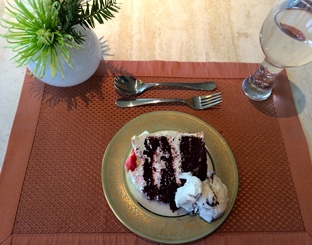
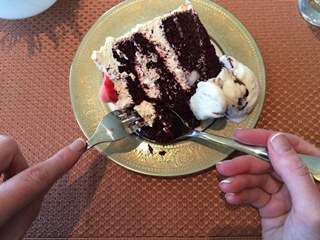
When your dessert consists of both harder and softer textures, a fork and spoon will be included and both will be used. (Tip: The spoon is not for your coffee or tea.)

How to Eat Dessert Gracefully and Properly

For many of us, dessert is the favorite course of the meal. There's always something to love about dessert!

The dessert utensils are at the top of your place setting.

When your dessert consists of both harder and softer textures, a fork and spoon will be included and both will be used.
(Tip: The spoon is not for your coffee or tea.) 


Here's how it's done.

The meal has ended, and dessert has been served.


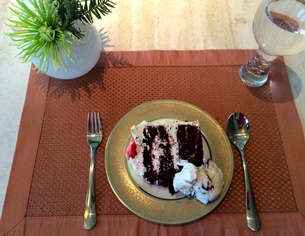
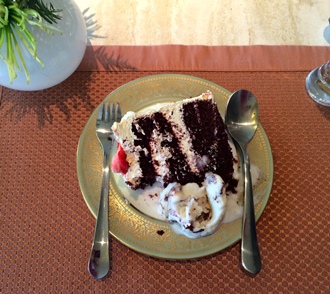
Once dessert is served, move the spoon and fork down to either side of the plate - fork on the left and spoon on the right.
(Sometimes, a server will do this for you.)


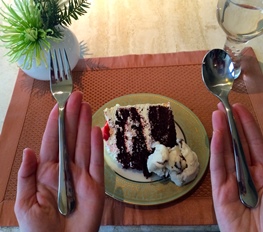
The fork is placed in the palm of the left hand and the spoon is placed in the palm of the right hand.


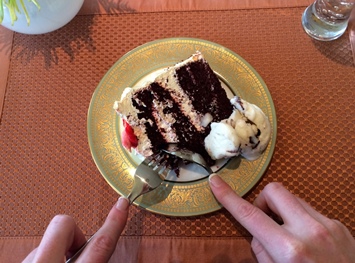
The spoon first serves as a knife and the fork is used to steady the solid portion of the dessert.


The spoon is then re-positioned in the right hand, holding in ‘pencil’ position. The fork becomes a ‘mover’ assisting in positioning both the cake and the ice cream on the spoon.


The fork as a helper tool will remain steady in the left hand, and the spoon is loaded with a delicious bite.   (In other words, only the spoon will come to your mouth. The fork remains in your left hand.)

As with other courses, there are resting and close-out positions for your utensils.

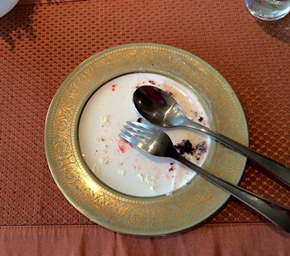
The dessert resting position is your fork on the left side of the plate, and your spoon on the right as shown here.


The close-out position is the same as other courses, with fork and spoon diagonal on the plate, or in the 6 o'clock position.


Serve cake and ice cream or pie a la mode at your next family meal, and practice using both a fork and a spoon to enjoy your dessert.

Other times, if your dessert is solid, you only need a fork. If your dessert is liquid or soft, you only need a spoon.

If you are setting the table, include only the utensils that are needed to eat the particular dessert that is to be served.


A retired, national award-winning secondary school educator, Candace Smith teaches university students and professionals the soft skills of etiquette and protocol. She found these skills necessary in her own life after her husband received international recognition in 2002. Plunged into a new “normal” of travel and formal social gatherings with global leaders, she discovered how uncomfortable she was in many important social situations. After extensive training in etiquette and protocol, Candace realized a markedly increased confidence level in meeting and greeting and dining skills and was inspired to share these skills that will help others gain comfort and confidence in dining and networking situations. Learn more at http://www.candacesmithetiquette.com/


Etiquette Enthusiast, Maura J Graber, is the Site Editor for the Etiquipedia Etiquette Encyclopedia