Showing posts with label Etiquette for Presentation at Court. Show all posts

Sunday, April 9, 2023

U.S. Debutantes in England of 1932

The moment of glory will be the climax of weeks of excitement and preparation—hours spent at dressmakers, the trip from America, long lessons in Court etiquette and hours spent in a queue of limousines in the Mall awaiting their turn to enter the palace. 


LONDON, May 11 (AP). Twelve American women will stand for one brief moment before Britain’s King and Queen tonight and hear the softly spoken words of presentation to Royalty. They will then curtsey in solemn “Thank you” for the regal favor and depart, tired and perhaps wondering a bit, to their hotels. The moment of glory will be the climax of weeks of excitement and preparation—hours spent at dressmakers, the trip from America, long lessons in Court etiquette and hours spent in a queue of limousines in the Mall awaiting their turn to enter the palace. 
The American women who will meet King George and Queen Mary will be just individuals in a crowd of hundreds of presentees of all nations tonight and tomorrow night. They will receive no more Royal attention than the presentee of a minister of the smallest and most remote principality. The gathering of men, resplendent in decorations and knee breeches and women in their white gowns and crowned by ribbon bandeaux holding three spotless white plumes, make a never to be forgotten sight.— San Pedro News Pilot, 1932


 🍽Etiquette Enthusiast, Maura J. Graber, is the Site Editor for the Etiquipedia© Etiquette Encyclopedia

Thursday, August 29, 2019

Princess Enjoys Kittens and Cash

When royalty descends openly to business of this sort for what can be made out of it, aristocratic folk of the humbler variety surely need not feel that they lose caste by engaging in trade of any kind. Yet when a woman of title gets hard up and goes in for millinery, dressmaking, or any form of shopkeeping, she thereby loses her right to presentation at court... Some day, quite likely, we shall have a radical parliament proposing to dock the allowance made to Princes and Princesses who engage in money making schemes in which their rank gives them such a tremendous advantage.” – Princess Victoria was the fourth child and second daughter of King Edward VII and Alexandra of Denmark, and the younger sister of King George V. – photo source, Pinterest  


Princess Finds Profit in Cats!
Victoria breeds pets for income, advertises them for sale 

Special Cable to The Herald. LONDON, Sept. 16.— Every one knows by this time that Queen Alexandra is a cat lover, but it has come as a surprise to a number of English women that her daughter, Princess Victoria, is not only a lover of cats, but an energetic and enthusiastic breeder as well. The Princess does not breed cats, it appears, merely to increase the number of her feline pets. Her “catteries” are worked on a solid commercial basis, and apparently with considerable profit to her private pocketbook. That her enterprise is conducted on thorough business lines may be seen from the following announcement which appears in a weekly paper whose space is mainly devoted to sales and exchanges of miscellaneous articles:

“Her royal highness, Princess Victoria, has for sale several handsome chinchilla kittens. Sire, Puck 111., ex-Chela, also Chela, splendid mother, lovely green eyes; blue Persian female; cheap to good homes; must sell. Mrs. Amor, Cumberland Lodge, Windsor Great Park.”
Picture of Princess Victoria ("Toria"), daughter of Edward VII & Queen Alexandra (1868-1935) holding a cat on the royal yacht. The picture was taken in about 1914 –Pinterest

A hint for plebeians: Mrs. Amor, I am told, occupies an important position in the household staff at Cumberland Lodge. “Cheap” is always a relative term, but in this instance it stands for anything between $25 and $100. When royalty descends openly to business of this sort for what can be made out of it, aristocratic folk of the humbler variety surely need not feel that they lose caste by engaging in trade of any kind. Yet when a woman of title gets hard up and goes in for millinery, dressmaking, or any form of shopkeeping, she thereby loses her right to presentation at court. In view of the fact that his Majesty does not even draw the line at making money out of cats in his own exalted family circle, it would seem that he ought, in justice, to rescind this rule. 

Of course there are lot of folks here— and not a few, I imagine, in the land of triumphant democracy— who would consider a cat bred by royalty worth many times more than a cat from a plebeian home. Such competition seems hardly fair to those who are compelled to sell cats solely on their merits. Some day, quite likely, we shall have a radical parliament proposing to dock the allowance made to Princes and Princesses who engage in money making schemes in which their rank gives them such a tremendous advantage. – Los Angeles Herald, 1905


Etiquette Enthusiast, Maura J Graber, is the Site Editor for the Etiquipedia© Etiquette Encyclopedia

Tuesday, July 19, 2016

Wartime Etiquette and Nobility

From World War I - Nobility of England seen at their best (in a Lillian Gish film) as every woman of America will agree, not in court gowns and with stately airs, but—the glamour of material glory laid aside, offering an earnest, conscientious service in the world’s present great need.

Film Shows Nobility of England During Wartime 

Time was — the world glad in the sunshine of a long continued peace—that the ambition of every society bud, upon concluding her course in some fashionable finishing school, was to go abroad and be presented at the Court of St. James.

If family connections, wealth and opportunity made such an experience possible, she devoted many hours to the study of Court etiquette in order that her appearance at this momentous event should be a credit to herself and her relatives.

Afterward, throughout her lifetime, the occasion was recalled as one of which she had just cause to be proud. Yet she had only basked a few moments in the of smiles from England's Queen and seen the Court ladies stand decorously, robed in their stately Court gowns, and each wearing a smile that resembled very much that worn by every other lady of the group — a smile which was no real index to the character which lay beyond it.

Today any American woman, no matter what her family or financial standing, may have a much more satisfactory glimpse of the real personnel that goes to make up the feminine part of the Court of St. James, and this, too, without crossing the sea.

It is afforded in a fascinating new production, “The Great Love“ playing its second week at Clune’s auditorium, for which Queen Alexandra and other women of the nobility posed. They are seen at their best, as every woman of America will agree, not in court gowns and with stately airs, but—the glamour of material glory laid aside, offering an earnest, conscientious service in the world’s present great need. — Los Angeles Herald, 1918


Etiquette Enthusiast, Maura J Graber, is the Site Editor for the Etiquipedia© Etiquette Encyclopedia 

More Court Presentation Etiquette

When her Majesty does not hold the drawing-rooms, she usually commands the Princess of Wales or one of her daughters to take her place, and all presentations are considered the same as to the Queen herself.  

Charm of the Presentation 


Probably the greatest charm of the presentation lies in the fuss made over the debutante by the debutante's friends. It is talked of weeks before and weeks after, and the day itself is one of long and delirious excitement. 

Immediately after leaving the palace, everyone drives to the photographer's to immortalize the gown. It is difficult to imagine how the photographers get through such a day, for not only have they so many appointments, but they are all for nearly the same hour. Nearly every woman who is presented issues invitations for what is known as a "drawing-room tea," and immediately after her return from the studio and a short turn in the park she stands for a couple of hours while her friends flock in to admire her gown, talk over the presentation and congratulate her. 

If at no other time in her life she is queen of the assemblage, she is this once, and she enjoys it as fully as only her feminine nature is capable of doing. How differently the men take their presentation to the Prince of Wales when he holds a levee. They drive unconcernedly through town in hansoms, their brilliant uniforms or Court dress standing out against the dark background of the cabs. At 2 o'clock the whole thing is over, and except for the flash of a helmet or the glitter of gold braid from a passing cab London, would not know that a levee was being held. 


The Queen, even when she holds a drawing-room in person, which is rarely more than twice during the season, does not remain for all the presentations, as her advancing years make the fatigue too great for her to bear. She may receive half of the list, but usually leaves the Palace about half-past four, for a drive in Hyde Park. This is one of the few occasions which the Londoners have for demonstrating their loyalty, for the Queen dislikes London intensely and spends as little time there as possible.


Hyde Park corner and the park are crowded with people on this afternoon, who are eager to catch a glimpse of her Majesty, and, while her reception is an enthusiastic one for the English to give, it must appear cold to those who are accustomed to the demonstrations some of the popular Continental sovereigns receive. This being the year of the Queen's eightieth birthday, the number of applicants to the Lord Chamberlain for presentation has been very large, especially for those drawing-rooms the Queen has held in person. 


When her Majesty does not hold the drawing-rooms, she usually commands the Princess of Wales or one of her daughters to take her place, and all presentations are considered the same as to the Queen herself.  —San Francisco Call, 1899

Etiquette Enthusiast, Maura J Graber, is the Site Moderator and Editor for the Etiquipedia© Etiquette Encyclopedia 

Thursday, July 14, 2016

Etiquette for Court Presentation

John Randolph, (or as he was known “John Randolph of Roanoke”) was a late 18th and early 19th centuries Congressman from Virginia, who not only served in the House of Representatives, and the Senate, but also as the Minister to Russia in 1830.


John Randolph’s Court Presentation

John Randolph, of Roanoke, dressed very eccentrically while he was at home, and his dress during his mission to Russia was hardly more extravagant than what he wore at Roanoke. 


In writing of it he says: “My dress on presentation to their Imperial Majesties was a suit of the finest mack cloth that London could afford; and with the exception of a steel capped sword it was the dress of Mr. Madison during the late convention." It was ornamented with gold shoe and knee buckles, and Randolph says that he was as well dressed as Prince Talleyrand, who was presented at the same time. Josiah Quincy visited Russia some years after this, and in his life there is a story related concerning this presentation of John Randolph.

Says this authority: “When he was presented to the Empress she put out her hand and Randolph went down on his knees to take it. He wore, however, tight gauntlets and he did not attempt to get those off before he fell upon his knee. It was contrary to etiquette to touch the lady’s bare hand with a gloved hand, and it look him so long to get his tight glove off, that her Majesty smiled at his predicament and the courtiers laughed out aloud.” 

Randolph soon took his leave of Russia and returned to the United States. Before he did so, he had a pleasant interview with the Emperor, and he made a remark which it is said, made the Empress laugh most vociferously. He bowed himself out backward as he left, and “it was lucky” said he, “that I happened to be near the door.” —Frank O. Carpenter in American Magazine, 1887


Etiquette Enthusiast, Maura J Graber, is the Site Editor for the Etiquipedia© Etiquette Encyclopedia 

Thursday, January 22, 2015

Etiquette and the “London Season”

In 1957, LIFE Magazine readers were taken on "an intimate tour of this rich and various pageant, a magnificent relic of old world society." LIFE Magazine, August 5, 1957

"An elegant old society shows off its granduer... "

The Duke of Bedford's step-daughter, 18 year old Lorna Lyle, danced with Hon. Charles E. Cecil, at her debut in 1957

On the Queen Charlotte Ball

The ball has been running almost every year since 1780, when King George III first organised the Queen Charlotte’s Ball as a way to celebrate his wife’s birthday. 
The ceremony remained unchanged- with debutantes paying respects to a large iced cake at Buckingham Palace, overseen by the monarch- until 1958, when Prince Philip persuaded the Queen to stop receiving each year’s crop at Court.
Philip is said to have complained that the annual Ball, at which girls aged 17 and 18 were expected to meet their suitably-moneyed future husbands, was ‘bloody daft’. 
The Queen’s sister, Princess Margaret, was even more forthright, saying later ‘we had to put a stop to it . . . every tart in London was getting in!’ 
Since 1958 the ball was held sporadically at various exclusive venues in the capital to varying degrees of success before being relaunched in 2009 and held annually since, albeit without its royal seal of approval.  –From the Daily Mail, 2014
Henrietta Tiarks, a banker's daughter, was called by some London papers, the "Deb of the Year" in 1957
For a dozen generations, in and out of wars and austerity, the traditional elegance of British society has been concentrated in a unique institution known as the London season. The season, roughly embracing the months of May, June and July, is the time of debutantes: first their formal presentation at court, then the brilliant world of their coming-out parties.

But the season is even more than this, for it encompasses a series of splendor social functions possible only in England. These gorgeous affairs are climaxed by the Queen's garden party at Buckingham Palace and by the Royal Ascot race meeting, where it is a social must for everybody who is anybody to be bidden to the royal enclosure - or even to that social holy of holies, the Queen's lawn. Other hallowed events include the royal regatta at Henley on the Thames and the Eton- Harrow match at Lord's Cricket Ground.

This year the season has been even more brilliant -and more costly - than any with in recent memory. Well over 100 young ladies like the Duke of Bedford's stepdaughter, are being launched at debut parties costing an average of $4,000 each. In these times of inflation and ruinous taxes such openhanded spending is an expensive privilege reserved for Britain's wealthiest view, and even they must make hard sacrifices to preserve the tradition. - LIFE Magazine


Etiquette Enthusiast, Maura J. Graber, is the Site Editor for Etiquipedia© Etiquette Encyclopedia

Sunday, June 8, 2014

Etiquette for Royal Court Presentation and Foreign Titles


Elisabeth of Austria, was the wife of Emperor Franz Joseph I, and thus Empress of Austria and Queen of Hungary.– “Emperors and empresses rank higher than kings. The sons and daughters of the emperor of Austria are called archdukes and archduchesses, the names being handed down from the time when the ruler of that country claimed himself no higher title than that of archduke.”


Foreign Titles

We have no titles in this country, or rather we have so many, and they are so indiscriminately worn, that they are wellnigh worthless. We have, at least, no orders of nobility; nevertheless, as our citizens are constantly visiting foreign countries, it is well to understand something of titles and ranks and their contingent orders of precedence.


Royalty

In England, as is well known, the king and queen are placed at the apex of the social structure. The mode by which they are addressed is in the form "Your Majesty."


The Prince of Wales, the heir-apparent to the throne, stands second in dignity. The other children are all known during their minority as princes and princesses. The eldest princess is called the crown princess. Upon their majority the younger sons have the title of duke bestowed upon them and the daughters retain that of princesses, adding to that the title of their husbands. They are all designated as "Their Royal Highnesses."


Nobility

A duke who inherits the title from his father stands one grade below a royal duke. The wife of a duke is known as a duchess. They are both addressed as " Your Grace." The eldest son is a marquis until he inherits the higher title of his father. His wife is a marchioness. The younger sons are lords by courtesy, and the daughters are distinguished by having " Lady " prefixed to their Christian names.

Earls and barons are both spoken of as lords and their wives as ladies, though the latter are by right respectively countesses and baronesses. The daughters of the former are "ladies," the younger sons of both "honorables." The earl occupies the higher position of the two in the peerage.

These complete the list of nobility, unless we include bishops, who are lords in right of their ecclesiastical office, but whose title is not hereditary.


All These Below are Entitled to Seats in the Upper House of Parliament

Gentry, Baronets, who are known as " Sir," and whose wives, in common with those of a higher order, receive the title of lady, are only commoners of a higher degree, though there are families who have borne their title for many successive generations who would hot exchange it for a recently created peerage.

A clergyman, by right of his calling, stands on an equality with all commoners, a bishop with all peers.


Esquire

The title of esquire, which is brought into such general use in this country that it has come to mean nothing whatever save an empty compliment, has special significance in England. The following in that country have a legal right to the title:

The sons of peers, whether known in common conversation as lords or honorables.

The eldest sons of peers' sons, and their eldest sons in perpetual succession.

All the sons of baronets.

The esquires of the Knights of the Bath.

Lords of manors, chiefs of clans and other tenants of the crown in capite are esquires by prescription.

Esquires created to that rank by patent, and their eldest sons in perpetual succession.

Esquires by office, such as justices of the peace while on the roll, mayors of towns during mayoralty and sheriffs of counties (who retain the title for life).

Members of the House of Commons.

Barristers-at-law.

Bachelors of divinity, law and physic.

All who, in commissions signed by the sovereign, are ever styled esquires retain that designation for.


Depiction of Queen Victoria giving the Bible to an African Chief in her Audience Chamber, 1861- by Thomas Jones Barker. Not eligible to be presented at court, but... “Those of more democratic professions, such as solicitors, merchants and mechanics, have not, as a rule, that right, though wealth and connexion have recently proved an open sesame at the gates of St. James.” 

Imperial Rank

Emperors and empresses rank higher than kings. The sons and daughters of the emperor of Austria are called archdukes and archduchesses, the names being handed down from the time when the ruler of that country claimed himself no higher title than that of archduke. The emperor of Russia is known as the czar, the name being identical with the Roman caesar and the German kaiser. The heir apparent to the Russian throne is the czarowitch.


European Titles

Titles in continental Europe are so common and so frequently unsustained by landed and moneyed interests that they have not that significance which they hold in England. A count may be a penniless scamp, depending upon the gambling-table for a precarious subsistence, and looking out for the chance of making a wealthy marriage. It is sorrowful and humiliating to know that there are many American girls who are willing to forego the right of being republican queens and to sell themselves and their fortunes to a foreign adventurer for the privilege of being known as countesses or baronesses.

A German baron may be a good, substantial, unpretending man, something after the manner of an American farmer. A German prince or duke, since the absorption of the smaller principalities of Germany by Prussia, may have nothing left him but a barren title and a meagre rent-roll. The Italian prince is even of less account than the German one, since his rent-roll is too frequently lacking altogether, and his only inheritance may be a grand but decayed palace, without means sufficient to keep it in repair or furnish it properly.

Yet not all foreign titles are worthless and unmeaning, nor are all those bearing them swindlers or adventurers. There is only one rule to guide a stranger in these matters: let him look to the individual direct and judge of his character impartially, without allowing himself to be dazzled by the glitter of a fine-sounding title and a long-descended coat-of-arms. If the title is found to become him, so much the better.

PRESENTATION AT COURT
It is frequently a satisfaction to an American to be presented to the queen during a sojourn in England. It is at least something to talk about when one returns home; and as the queen is really a good woman, worthy of all honor, we, even as a born republican, can find no valid cause for objection.


Those Eligible To Presentation At Court

The nobility, with their wives and daughters, are eligible to presentation at court unless there be some grave moral objection, in which case, as it has ever been the aim of the good and virtuous queen to maintain a high standard of morality within her court, the objectionable parties are rigidly excluded.

The clergy, naval and military officers, physicians and barristers and the squirearchy, with their wives and daughters, have also a right to pay their personal respects to their queen.


Those Not Eligible

Those of more democratic professions, such as solicitors, merchants and mechanics, have not, as a rule, that right, though wealth and connexion have recently proved an open sesame at the gates of St. James.


Those Who May Present Others

Any person who has been presented at court may present a friend in his or her turn. A person wishing to be presented must beg the favor from the friend or relative of the highest rank he or she may possess.


Articles of Union being presented to Queen Anne in 1706, from Hutchinson's Story of the British Nation c.1923- by Johann Gerhard Huck 

Preliminaries To Presentation

Any nobleman or gentleman who proposes to be presented to the queen must leave at the lord chamberlain's office before twelve o'clock, two days before the levee, a card with his name written thereon, and with the name of the nobleman or gentleman by whom he is to be presented. In order to carry out the existing regulation that no presentation can be made at a levee excepting by a person actually attending that levee, it is also necessary that a letter from the nobleman or gentleman who is to make the presentation, stating it to be his intention to be present, should accompany the presentation card above referred to, which will be submitted to the queen for Her Majesty's approbation. These regulations of the lord chamberlain must be implicitly obeyed.

Directions at what gate to enter and where the carriages are to stop are always printed in the newspapers.

These directions apply with equal force to ladies and to gentlemen.


Presentation Costume

The person to be presented must provide himself or herself with a court costume, which need not be particularly described here, but which for men consists partly of knee-breeches and hose, for women of an ample court train. These costumes are indispensable, and can be hired for the occasion.


The Presentation

It is desirable to be early to escape the crowd. When the lady leaves her carriage, she must leave everything in the shape of a cloak or scarf behind her. Her train must be carefully folded over her left arm as she enters the long gallery of St. James, where she awaits her turn for presentation.

The lady is at length ushered into the presencechamber, which is entered by two doors. She goes in at the one indicated to her, dropping her train as she passes the threshold, which train is instantly spread out by the wands of the lords-in-waiting. The lady then walks forward toward the sovereign or the person who represents the sovereign. The card on which her name is inscribed is then handed to another lord-in-waiting, who reads the name aloud.

When she arrives just before His or Her Majesty, she should curtsey as low as possible, so as to almost kneel.

If the lady presented be a peeress or peer's daughter, the queen kisses her on her forehead. If only a commoner, then the queen extends her hand to be kissed by the lady presented, who, having done so, rises, curtseys to each of the other members of the royal family present, and then passes on. She must keep her face turned toward the sovereign as she goes to and through the door leading from the presence-chamber. Considerable dexterity is required in managing the train in this backward transit, and it is well to rehearse the scene beforehand.


Rights Of Peers And Peeresses

Peeresses in their own right, as well as peers, may demand a private audience of their sovereign.

From "The Ladies' and Gentlemen's Etiquette, A Complete Manual of the Manners and Dress of American Society" by E. B. Duffey ~ 1877 

Etiquette Enthusiast, Maura Graber, is the Site Editor for the Etiquipedia© Etiquette Encyclopedia 

Monday, November 18, 2013

Etiquette, Debuts, Debutantes and a "Texas Dip"

Texas debutantes practice the “Texas Dip”

Debutantes and Debuts

Although a debutante is a novice in that worldly wisdom which time imparts, it is presumed that she has been instructed in the best principles of society, and that she is prepared to fulfill its obligations. In the best society everywhere the appearance of an immature school-girl at a party of grown people is unusual, and the only celebrations which are considered of sufficient importance to distract her mind from studious pursuits are those domestic occasions when the immediate kins-people are present. A debut does not necessarily put an end to all grave and intellectual pursuits; but it opens the way for so much gayety that the barrier should not be removed until the mental development has reached a standard that cannot be lowered by the fascinations of the social world. A young girl, whose student life is broken in upon by social diversions that captivate her imagination and interfere with those processes which are indispensable to a well-balanced and active mentality, is not apt, when removed from the circle where her omissions and commissions are rated according to her immaturity, to reflect favorably upon the influences which have shaped her mind and manners; nor can it be expected that such an one will become the superior woman whose social graces are the evidence and the flower of a cultivated mind and a kindly heart. 

No argument in favor of postponing the entree of a girl into society, until she has acquired the requisite training in all ways, is necessary for those wise women who are in the best and fullest sense brilliant society-women. There are, however, localities where no barrier, or at most but a slight one, exists between the social and student life of a young girl whose stature has carried her out of short frocks; and there are matrons whose indulgence leads them to overrule their own sense of what is fitting in favor of their daughter's desire for enjoying before their season the delights of social festivities. It is to such that a protest may be addressed.

When Jacqueline Bouvier made her society debut in 1947, a Hearst columnist, Igor Cassini dubbed her the "debutante of the year." She would later reside in the White House, as the wife of President John F. Kennedy 

A girl's formal presentation to society is rarely made before she is eighteen and sometimes not until she is nineteen or twenty. Previous to the date decided upon for the celebration her mother calls upon those of her acquaintance whom she desires to be present at her daughter's debut, and leaves her husband's card and, if she has grown-up sons, their cards also. The invitations which follow this preliminary are sent out about ten days or two weeks in advance of the date. 

Young men usually decry for themselves the observances which mark the appearance of their sisters in the social world, and their status as members of society usually dates from their appearance at the semi-formal entertainments given by their parents, while their early popularity depends largely upon the effort they have made to be agreeable to the guests of their parents and the friends of their sisters. A young man who graciously does escort duty for his sisters needs no formal announcement of his eighteenth or twenty-first birthday to convince his acquaintance that he may with propriety be invited to participate in the social enjoyments suited to his kind. He may not desire them; indeed, he often shuns them, and it is this masculine shrinking from social intercourse with any but near friends or relatives, in connection with the demands of preparatory scholastic pursuits, college life or an early business training, which tend to defer his appearance in the capacity of a society-man considerably beyond the age when his sisters are launched upon the tide of social gayety. 

It is customary, when a young man has completed his studies away from home or has been traveling abroad, for the ladies of his family to leave his cards with their own upon the members of their social circle at the beginning of the season, and this simple ceremony entitles him to the same formal consideration as the other members of his family in the matter of invitations, and involves the observance of a courteous recognition on his part.

Young girls never wear a profusion of jewelry; debutantes often none at all, though a necklace or dog-collar of pearls is not inappropriate. 

The toilette of a debutante is never elaborate. White is the favorite tint, and when her presentation is made at a ball or party, a diaphanous material is selected, tulle, *grenadine, *lisse, *mull, etc., being suitable. For an afternoon reception or tea she may also wear white, but veiling, fine cashmere, soft *surah and similar fabrics are more suitable than gauzy textures. If she have elder sisters, they may mark the difference in their social ages by wearing somewhat heavier white goods or delicate colored materials. Young girls never wear a profusion of jewelry; debutantes often none at all, though a necklace or dog-collar of pearls is not inappropriate. The dress should be of dancing length and simply made up.

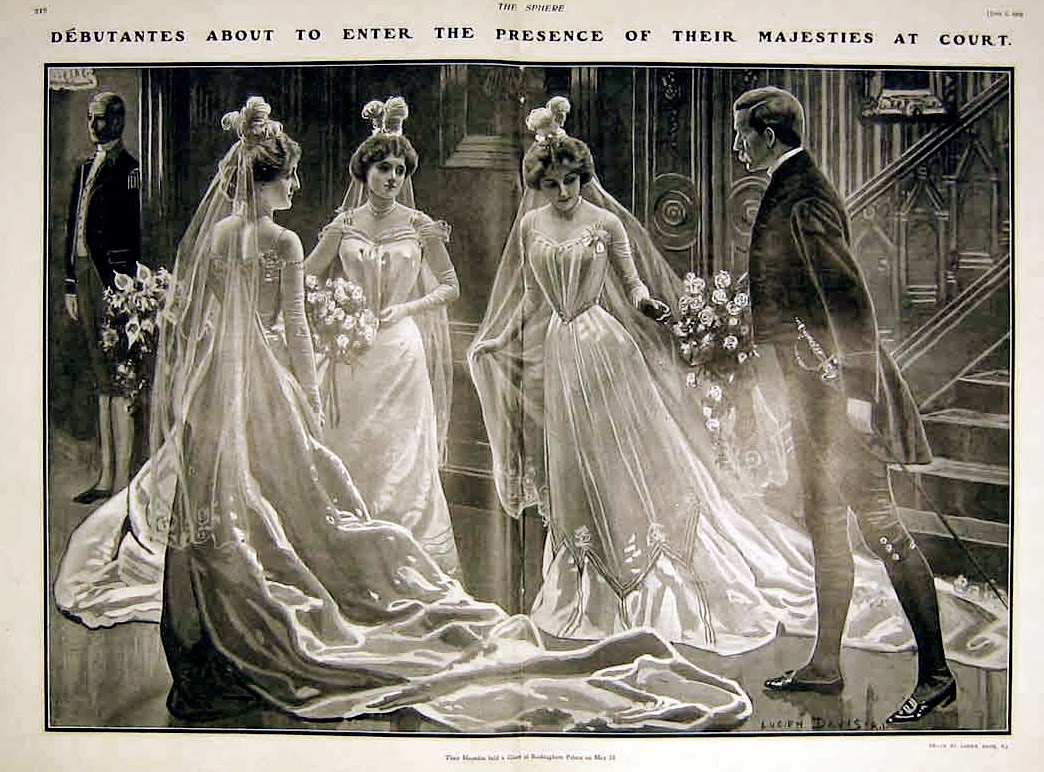
Debutantes Readying to Meet Royalty; To make one's “debut,” or to enter into society, has its roots in the Royal Court of France. By the reign of Britain's King George III (1760-1820), Queen Charlotte started a tradition of introducing and presenting the young aristocratic women of court to society. Known as "debutantes" from Queen Victoria's reign in 1837 and on, there was strict etiquette to follow regarding proper costume for court presentations; Fashionable evening dresses with head-dresses of veiling, feathers and a train trailing the dress from the waist. Long, white kid gloves, pretty fans or fragrant bouquets added to the look and offered a bit of diversity in look for the young debutantes.

THE TEXAS DIP

The "Texas Dip" is a most extreme curtsey. It is performed by Texan debutantes when formally introduced at the International Debutante Ball in the Waldorf-Astoria. Young women slowly lower their foreheads to the floor by crossing their ankles, then bending their knees and sinking. An escort's hand is held by a debutante during the dip. When a debutante's head nears the floor, she turns her head sideways, averting the risk of soiling her dress with her lipstick or make-up.

The International Debutante Ball is an invitation-only formal debutante ball to present young ladies to high society. Founded in 1954, the ball is considered the most prestigious and the most exclusive debutante ball in the world. It occurs every two years at the Waldorf Astoria Hotel in New York City. Young women from around the globe and all over the United States are brought together at the ball and the surrounding parties with daughters of prominent politicians, diplomats, nobility, ambassadors. 

Debutantes with their military escorts 

Over the years the International Debutante Ball has benefited numerous charities from the Ball's own foundation including the Soldiers’, Sailors’, Marines’, Coast Guard and Airmen’s Club of New York, which provides a home away from home for men and women of the United States Armed Services.

How to do the "Texas Dip" when being presented; 
1. Face the audience & hand your bouquet to your escort.
2. Bring your arms forward, level with the floor.
3. Cross your ankles, spread your arms, and bend at the knees.
4. Sink gracefully to the ground while maintaining eye contact with the audience.
5. Lower your forehead to the floor, but avoid soiling your dress with your make-up.

Executing a perfect Texas Dip 

*Surah: A light weight, lustrous twill weave constructed fabric with a silk-like hand

*Lisse: A fine, filmy, lightly crinkled gauze fabric used in strips for making ruching or for finishing garments

*Mull: A soft fine sheer fabric of cotton, silk, or rayon

*Grenadine: A weave characterized by its light, open, gauze-like feel. It is produced on jacquard looms 


 🍽Etiquette Enthusiast, Maura J. Graber of The RSVP Institute of Etiquette, is the Site Editor for the Etiquipedia© Etiquette Encyclopedia