Showing posts with label Cheek Kiss Etiquette. Show all posts

Friday, August 28, 2020

Kissing History and Etiquette

It may come as a surprise, but not all cultures think of kissing as romantic. In the 1400s, when Europeans first embarked on their path of conquest and exploration, kissing was unknown in many parts of the world. The Chinese found the whole idea of public kissing gross. And when members of an African tribe spotted two Europeans in a passionate kiss, they wondered what could be wrong with those people.


Historically Speaking, A Kiss Is Not Just a Kiss

You’ve seen it dozens of times. The camera gets close, the music soars, a hush falls over the audience, then, in a swirl of sound, the film hero kisses his sweetie.

Even in this era of more graphic movie lovemaking, the kiss still holds a special place, perhaps because it’s a sign of affection we all recognize. From the mother’s peck for an infant to children’s innocent busses for grandparents, kissing is with us always.

But how natural is the kiss?

Foreign to Some Cultures

It may come as a surprise, but not all cultures think of kissing as romantic. In the 1400s, when Europeans first embarked on their path of conquest and exploration, kissing was unknown in many parts of the world.

When confronted by puckering conquistadors, some natives showed no emotion at all, while others fled in terror, said Prof. Vaughn Bryant, chairman of the Texas A&M; anthropology department and an expert in the kiss’s history.

The Chinese found the whole idea of public kissing gross. And when members of an African tribe spotted two Europeans in a passionate kiss, they wondered what could be wrong with those people.

No one can say for sure how kissing started. Some say it dates to an infant’s basic desire for mother’s milk. Others think it might have begun as a way for the human male and female to show they were not going to bite each other. Then, there are those who suggest it began when people wanted to lick each other’s faces for salt.

Nose-Rubbing That Slipped

Bryant believes it’s possible that the romantic kiss grew out of an early lovemaking ritual, rubbing noses. “Somebody must have slipped and found that the lips were a lot more sensitive than the nose,” he said.

Kissing first emerged from the mists of pre-recorded history about 4,000 years ago. Bryant found the reference to romantic nose-rubbing leading to a kiss in the ancient East Indian book, the “Rig-Veda.” The practice spread west into Persia at some point.

The Greeks had the habit of throwing kisses at statues of the gods as a sign of respect. The story goes that Greek orator Demosthenes (384-322 BC) was being taken by guards to meet an enemy king. He asked his captors if they would take him to the nearest temple. The guards thought nothing amiss when Demosthenes raised his hands to his lips for the traditional sacred kiss. They could not see the poison in his hand that made this kiss his last.

It took the ancient Romans to raise kissing to an art. The race of soldiers saw no reason not to make both love and war. Bryant calls them “the kissingest culture that ever existed.” To make the kiss more potent, upper-class Romans took to perfuming their mouths with Oriental spices. The emperor got his hand kissed.

But all the heavy smooching soon was creating a scandal. Old-time Roman moralists were overwhelmed by it. And kissing was not without risk. Early in the 1st Century, the Emperor Tiberius felt that there was only one way to handle a herpes epidemic: He banned social kissing from Gaul to Egypt.
Faire la Bise Etiquette — According to Condé Nast Traveler, “A kiss, by name, has its charming differences—it's el beso in Spain, beijnhos in Portugal, beijos in Brazil, and beso-beso in the Philippines—but the logistics are fairly straightforward. You start by leaning in and placing right cheek to right cheek, before moving to the left side—and back and forth thereafter if additional pecks are required. The primary exception is Italy, which starts il bacio on the left.”
 
Former French First Lady, Carla Bruni-Sarkozy, mastered the art of the kiss. Photo: Sipa Press / Rex Features

Hems and Boots

Then, in the Middle Ages, kissing distinctions evolved: equals kissed on the lips; hem-of-garment and foot-kissing was for the lowest of the low. Kissing the ground next to a superior’s boot was for the ignominious, and from this arose phrases like kiss the dirt and boot licker .

The Christian church adopted some of the old Roman kissing rite in a religious ceremony. The kiss that the groom gives the bride at a wedding comes from that era.

At the Council of Vienna (1311-1312), the Catholic Church tried to regulate kissing, according it status as a mortal or venal sin depending on the degrees of lovers’ intent.

By the late 1600s, a period noteworthy for plagues sweeping the Continent, mouth kissing had faded from public practice. So, a whole etiquette of greeting grew up. Gentlemen would bow or doff their plumed hats. Ladies would curtsy. It was at this time, some experts say, that the handshake emerged, evolving from the obeisant kiss on the back of a superior’s hand.

The kiss from this time forward was regarded as something private, which should be given that way. As late as 1900, an American etiquette guide declared public kissing “a reprehensible custom and should not be tolerated in good society.” Emily Post, in statements in the 1920s, declared that when a couple meet in a restaurant, he should “on no account kiss her . . . in good society ladies (also) do not kiss each other when they meet either at parties or in public.”

But much changed in America since President Calvin Coolidge’s era. And now, trend-setters note, social kissing has even become a practice in certain business circles.— 
The Allentown Morning Call, 1989


🍽Etiquette Enthusiast, Maura J Graber of The RSVP Institute of Etiquette, is the Site Editor for the Etiquipedia© Etiquette Encyclopedia 

Friday, May 4, 2018

Differing Etiquette and Continents

Europeans hold the fork in the left hand and the knife in the right and, when food is cut, it is carried to the mouth by the left hand. The knife is always in use, not only for cutting, but also for pushing and for dabbing gravy onto the potatoes and other such useful functions. There are some differences between the English and the Continentals, for though both keep forks in the left hand, the English keep the tines turned over and pile food onto the back of the fork. Beginning with meat as a platform, they may smooth on potatoes into which they press peas and then transport the whole mouthful at once.

Why are American manners different?

Because most American customs and rules of etiquette are drawn from those of Europe, any that differ are of special interest. How did the differences come about and what do they represent, if anything? I have always wondered, for example, why Americans who greet one another by kissing do so with a single kiss on one cheek, while Europeans always buss both cheeks, and sometimes do so twice, for a total of four kisses. Are we less affectionate than Europeans, or merely busier and so anxious to cut our kissing time in half? Similarly and equally inexplicably, Americans differ from Europeans in their use of the knife and fork. 

Europeans hold the fork in the left hand and the knife in the right and, when food is cut, it is carried to the mouth by the left hand. The knife is always in use, not only for cutting, but also for pushing and for dabbing gravy onto the potatoes and other such useful functions. There are some differences between the English and the Continentals, for though both keep forks in the left hand, the English keep the tines turned over and pile food onto the back of the fork. Beginning with meat as a platform, they may smooth on potatoes into which they press peas and then transport the whole mouthful at once. Other Europeans turn the tines over after cutting and push food onto the fork with a knife. But for many years American etiquette dictated that the fork must be switched to the right hand after the food is cut, and that the knife should rest on the edge of the plate. During actual eating, the left hand was supposed to lie idle on the lap. 

This cumbersome and awkward switching of hands continues today even though it was declared out of date as far back as 1948 in “Vogue’s Book of Etiquette,” written by Millicent Fenwick, who was then an associate editor of Vogue and is now the United States representative to the United Nations Food and Agricultural Organization in Rome. After describing the old rule, Mrs. Fenwick wrote, “Today, it is reversed so commonly that the left-handed method is almost preferred to the other. Both are perfectly good usage, but it is now axiomatic that whenever food is cut with a knife, the left hand can quite naturally carry it up to the mouth.” Even though the European method is smoother and more efficient, as any time-motion study would prove, most Americans persist in this “zig-zag” method, as it is described in “The New Emily Post’s Etiquette” by Elizabeth L. Post. The author suggests that Americans are reluctant to follow the European method because they feel it would be “putting on airs to adopt a foreign way of eating.” Mrs. Post advises, “I can see nothing wrong in adopting a custom that seems more practical than your own.” 

Letitia Baldrige, who revised “The Amy Vanderbilt Complete Book of Etiquette,” also considers the Continental style more “sensible.” In preparing this book, which was published in 1978, Miss Baldrige tried in vain to discover how the zig-zag method developed in the United States. “I even called the Library of Congress but they could not come up with anything,” she said. “English nannies,” she continued, “always teach children to pile food up on the back of the fork because that is the quickest way to get the meal over with. Also, the food tastes delicious that way.” (Miss Baldrige also said she had been told that double kissing was meant to bless both sides of the brain.) 

Perhaps in the early days of our country, the change in rules was a populist protest against royalists. Or, as a European friend suggested, onehanded eating may be a holdover from frontier days, when it was necessary to keep one hand at the ready for self defense. Left-handed Americans have, perhaps, the best of both worlds. Those I know hold the fork in the right hand, cut with the knife in the left hand and eat without changing hands. – By Mimi Sheraton, N.Y. Times News Service, 1983


Etiquette Enthusiast, Maura J Graber,is the Site Editor for the Etiquipedia© Etiquette Encyclopedia

Wednesday, June 14, 2017

Faire la Bise Etiquette

French etiquette: “To kiss or not to kiss?” That is the question! 
                         

Former French First Lady, Carla Bruni-Sarkozy, mastered the art of the kiss 
Photo: Sipa Press / Rex Features


How to greet people can be bewildering for those new to French culture

My online dictionary gives two definitions of la bise – “the icy blast of winter” and “a kiss”. Evelyn Waugh wrote of two society ladies in London, “They kissed with cold detestation.” Maybe that happens in Paris, but here in the Morvan there is nothing wintry about la bise. 

Miss Graham, our headmistress in the 1950s, frowned upon what she called PDAs: public displays of affection. PDAs are ubiquitous here, in the form of kissing and vigorous handshaking and even hugging – in the street, in the doctor's waiting room, in the supermarket. Miss Graham would shudder, but when I meet Pierre and Nicole in Aldi, la bise as an expression of mutual respect and affection rules OK.

A little online research will lead you to items like To Kiss or Not to Kiss and Faire la Bise: The Art of the Parisian Double Air Kiss. All emphasize that la bise bears no relation to le baiser as immortalised by Rodin, or indeed to “French kissing”. In la bise, the kisses (for there should be at least two) are aimed at alternate cheeks. The online experts cannot seem to agree on which cheek gets the first bise. The thing they all agree about is that the lips doing the kissing remain closed. No slobbering – ça ne se fait pas. Strangely, nobody mentions the importance of holding one's breath while kissing – nobody wants your garlic fumes.

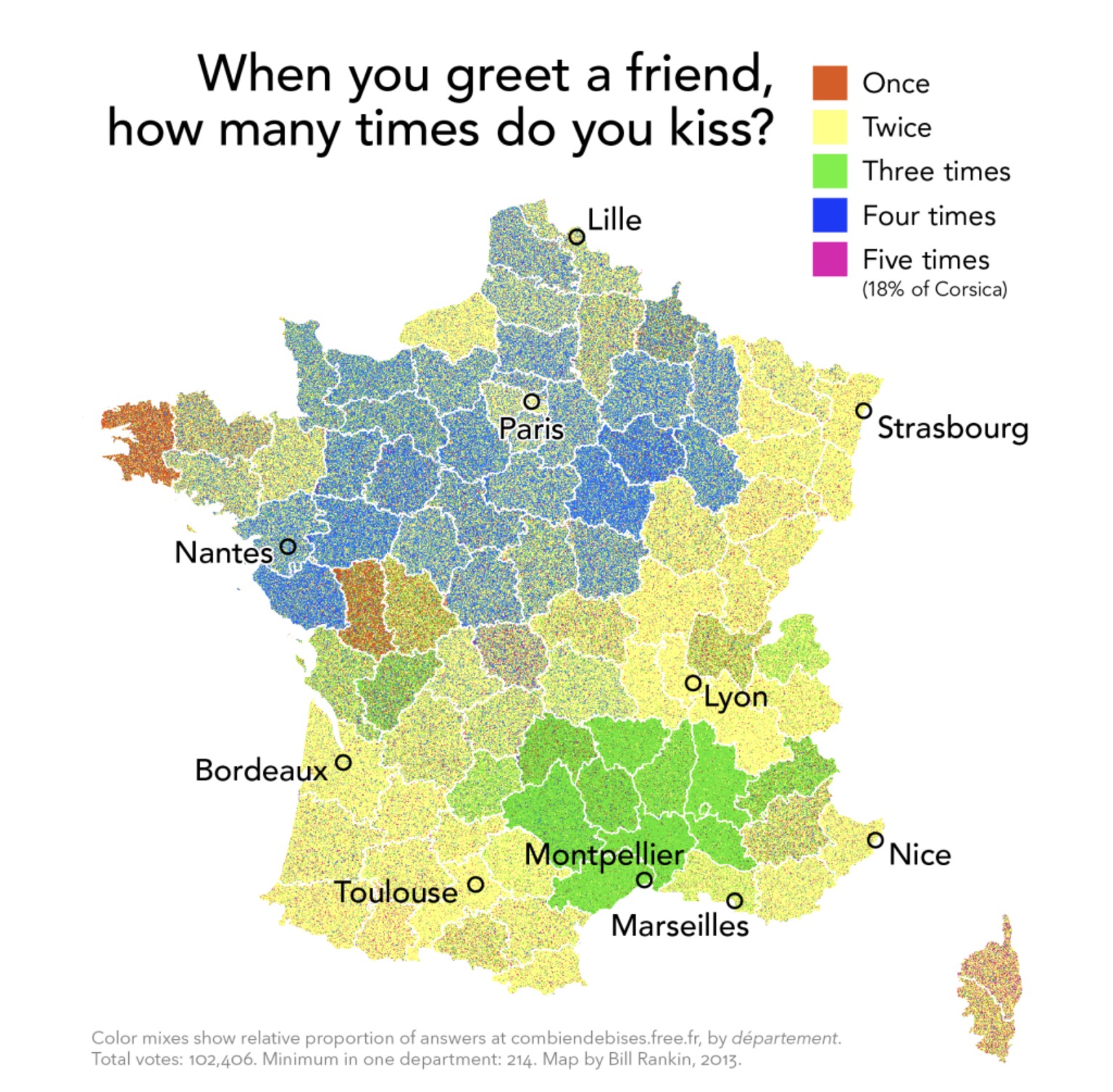
The number (from two to four or even, I am told, five in Corsica) depends less on the degree of affection or acquaintance than on the region. I even found a map of France on the web, showing the number of kisses current in each region. Someone probably got a Master's thesis out of that. 

“A popular French joke is that you may recognize the city you are in by counting the number of cheek kisses, as it is so varied across the country. An online map of France even shows the number of kisses currently claimed to be used in each region. It shows it's more common in the southern parts of France, even between males, whether they be relatives or friends. In the north however, it is less usual for two unrelated males to share 'la bise'. “In the Netherlands and Belgium cheek kissing is commonly used as a greeting between relatives and friends. But women will kiss both women and men, while men will kiss women and refrain from kissing other men. They prefer to shake hands, especially with strangers. Usually three kisses are exchanged in the Netherlands and the Dutch part of Belgium. The same is found to be true in Switzerland. In Francophone Belgium, the custom is usually one or three kisses. “On occasion, you may exchange bises with the same person three times: when you arrive, congratulating an achievement or thanking him or her for a gift, and then again when one is leaving.”


After almost eight years in the Morvan, I offer my own take on la bise. Here, men mostly shake hands with each other with optional back-slapping, but men kiss women. Women kiss women. Everyone kisses children: both sexes hold up their faces to be kissed. So our friend Alain from Auxerre shakes hands enthusiastically with my husband John, while I am treated to la bise. When you have known someone a while and exchanged handshakes, one of you will say, "On fait la bise?" and the kissing can begin.

My advice is go with the flow – and remember next time you meet that person. My extrovert friend Gigi delivers quadruple bises accompanied by a hug, whereas Simone, an equally dear friend but older and more reserved, does two, with no body contact. La bise says "hello" and "goodbye". My cleaning lady Yvonne and I exchange kisses when she arrives for work and again when she leaves.

Dionne Warwick sang: What do you get when you kiss a guy?
You get enough germs to catch pneumonia
After you do, he'll never phone ya
I'll never fall in love again.

In my experience, la bise does not spread contagion. To give an extreme example, the Bazolles oldies' club meets monthly and any woman with a birthday during that month faces what to many Brits would be Ordeal by Kissing. All 50 members claim their osculatory rights. If the lady is at all personable, several sprightly old buffers will queue up twice for the privilege. Amazingly, however, I have had just one cold since we arrived here in 2005. Maybe I had a natural immunity when we settled. My theory, however, is that the absence of mouth-to-mouth contact explains this. –By Rosy Rabson for Telegraph Weekly World, 2013 


Etiquette Enthusiast, Maura J Graber is the Site Editor for the Etiquipedia© Etiquette Encyclopedia