Showing posts with label Gilded Age Entertaining. Show all posts

Saturday, May 20, 2023

The Formal Dinner by Louis Sherry


The formal dinner setting for the first course of Oysters, by famed gilded age restauranteur and hotelier, Louis Sherry.
Oftentimes, hoteliers and restauranteurs get some aspects of the table setting wrong. It could be a matter of personal or establishment preference or possibly wanting to start a trend. — “At the left of the service plate are three forks — prongs up and perfectly aligned. Nearest the plate is the salad fork…”
Note that he has only one glass or goblet at the setting, he placed the napkin on the left and refers to the fork tines as “prongs.” These were unique choices in an age of definitive social rules.
 

THE one occasion of the day, perhaps, when we do not stiffen perceptibly at the idea of formality— when we do not mind a slight tightening of the bonds of acceptedly good procedure. Here the candle-sticks which all through the day have been frowned upon, come into their own-great high ones, for they are with- out shades and must be above the eye level. The question of bread and butter plates is an open one, but they are convenient. I like them and I use them.

The cloth is of white damask over a “felt.” The decorations are flowers, in a flower bowl of silver. Dinner napkins are either folded square and flat and laid on each place plate or they may be loosely folded and placed at the right of the oyster fork. Silver place plates are extremely desirable and are not removed until the soup course has been finished — the oyster and soup plates being placed on top of them.

At the left of the service plate are three forks — prongs up and perfectly aligned. Nearest the plate is the salad fork. Next to this comes the dinner fork, while the fish fork takes its place at the extreme left. At the right and nearest to the plate is the Mirrorstele-blade dinner knife— next the silver fish knife, both with edges turned toward the plate the soup spoon and last the oyster fork.

At a formal dinner no place is left uncovered by a plate at any time. The only dishes placed on the table are the small, decorative silver holders of sweets and nuts. The carving is done in the kitchen. — From “Silverware: The Autocrat of Every Table,” 1926


 🍽Etiquette Enthusiast, Maura J. Graber, is the Site Editor for the Etiquipedia© Etiquette Encyclopedia

Saturday, July 2, 2022

Gilded Age Fads… the Ring Toss Game

The childish game of tossing rings of different sizes over a small upright pole has been transferred to the drawing room, and ever since the advent of warm weather, these ring-toss parties have been given…
–Image source, Pinterest


The hostess of the moment seems to care only for an opportunity to bestow favors at her entertainments, searching constantly for new excuses to give prizes. The childish game of tossing rings of different sizes over a small upright pole has been transferred to the drawing room, and ever since the advent of warm weather, these ring-toss parties have been given. A jewel casket of silver for the Queen prize and a diamond scarf-pin for the King prize were the favors at a recent one.– “Her Point of View” in the New York Times, June 1892


💍Etiquette Enthusiast, Maura J. Graber, is the Site Editor for the Etiquipedia© Etiquette Encyclopedia

Monday, June 27, 2022

Gilded Age Horseback Dining

The guests were notified to arrive at Sherry's at eight o'clock the next day, their dress code jodhpurs, boots, and formal jackets.  
Public domain image of the famous stag party on horseback 


A BLACK-TIE DINNER ON HORSEBACK


Millionaire C. K. G. Billings, a New York sportsman and “regular fellow,” became president of the exclusive New York Riding Club in the autumn of 1900 and issued invitations to a stag dinner for members at his medieval castle on Riverside Drive. Alas, the newspapers published rumors of the upcoming dinner, and the irked Billings appealed to restaurateur Louis Sherry. “This notoriety is driving me mad!” he exclaimed. “Reporters are bothering the life out of me. . . . What can we do about it?”

“Leave it to me,” replied Sherry. “Give me carte blanche, and we'll fool the papers as they've never been fooled before.” The guests were notified to arrive at Sherry's at eight o'clock the next day, their dress code jodhpurs, boots, and formal jackets. 

On arrival at Sherry’s at Fifth Avenue and Forty-Fourth Street, they found Sherry’s ballroom converted to a twilight woodland garden where a circle of fine horses were hitched, each one saddled and ready to be mounted. (The horses were brought up earlier on a freight elevator.) The waiters, dressed as grooms in scarlet coats and white breeches, scurried about to serve each guest on a tray affixed to his saddle. 

Two saddle-bags hung from each horse’s flanks, the contents iced champagne to be sipped from rubber tubes. The guests feasted on trout with green sauce. Each horse was provided with a feedbag of oats to chomp on as well. Total cost: about $50,000 (or $1.28 million in today's dollars). — From “What Would Mrs. Astor Do?,” 2018


Etiquette Enthusiast, Maura J. Graber, is the Site Editor for the Etiquipedia© Etiquette Encyclopedia 

Tuesday, June 21, 2022

Luring a Lord in the Gilded Age

“The original hotel had modern conveniences such as a hydraulic elevator, central steam heat and gas lights. In addition, the property had a billiards room, music room, barber shop, Turkish Bath and children’s playroom. The hotel had 75 large guestrooms, some with balconies, and no two rooms were alike. The hotel welcomed many travelers from around the world and in fact was nicknamed ‘Little London’ because of the many English tourists who came to visit. The city attracted health-savvy individuals seeking the high altitude dry climate, nearby Pikes Peak and the amazing natural rock formations known as Garden of the Gods.” — antlers.com


The Duke’s Progress: The English Lord’s American Journey

Gallons of ice water. Great gusts of suffocating steam heat. The heiress-hunting Englishman was always being buffeted by extremes in America. Take, for instance, the hotels: so wonderfully luxurious, yet so deeply uncomfortable. The elaborate meals were poorly served, and wine was not a matter of course with dinner. The elegant bedrooms were heated to the point of boiling, the enormous, shiny bathrooms overrun with complex, unmanageable systems of faucets. There were bells, buttons and switches everywhere— but no one to look after His Lordship personally, to meet his own little idiosyncratic needs. And topping it all was the demeaning practice of signing the guest book, where any plebeian might thereafter finger his noble name.

No less confounding were the young American ladies. Never before had the English Lord found himself in such unrestricted contact with unmarried females, hurrying here and there, from one social or sporting activity to the next, with no evidence of adult supervision. It was not the least bit necessary for the Englishman to exercise any rituals of courtship formalities until the very last moment. Although he might perpetually expect the red-faced, indignant parent to appear on the horizon of his lovemaking, none ever materialized. The indignity was, in fact, all his own and from another quarter: he soon discovered that he was only one among many, that the girl in question had a veritable horde of equally favored “admirers.”

The question of the girls aside, the English Lord found that civilized America bored him. True, the famous American openness was preferable to the stilted formalities back home— no one was kept standing in the States, and everyone was free to speak his or her mind. But this very freedom produced a certain blandness. Only occasionally could one enjoy an excited discussion of corruption in government, and there was almost no gossip— no little scandalous stories, no intrigues to titillate and amuse. Of much greater interest was primitive America. “Though one can dine in New York,” wrote Oscar Wilde, “one could not dwell there. Better the far West with its grizzly bears and its untamed cowboys.” (Indeed, the West was so full of aristocratic Englishmen that the famous Antlers Hotel in Colorado Springs had be come known as “little London.”) Thus the wife-hunting English Lord, after a patient review of American heiress strongholds along the Atlantic coast (where he might or might not attend to the business at hand), would head happily west to points wild and unknown. — From “To Marry an English Lord,” 1989


🍽Etiquette Enthusiast, Maura J. Graber, is the Site Editor for the Etiquipedia© Etiquette Encyclopedia 

Thursday, June 2, 2022

Fascinating Details of an Astor Ball

A gilded age depiction of the fickle and oft-engaged, but only once married, Miss Van Alen. She was great granddaughter to Caroline Astor

NEW YORK, Jan. 18.-Mrs. Astor gave a ball last night and when Mrs. Astor gives a ball, society has something to talk about. In view of the splendor of the house the floral decorations were comparatively simple.

Scarcely more than the usual number of palms lined the foyers and tall vases filled with American beauty roses in the drawing rooms and clusters of orchids on the supper tables were the principal flowers used.

The guest of honor was Miss Van Alen, the eldest daughter of James J. Van Alen and a great granddaughter of the hostess. This is the second grand ball given by Mrs. Astor in honor of her young kinswoman. 

Another guest, who practically shared honors with Miss Van Alen was Mrs. George Haig of England, formerly Mrs. J. Coleman Brayton, the favorite daughter of Mrs. Astor, and who, to gether with Mr. Haig, will sail for England on Wednesday.

Nearly all the guests came from the opera, so that it was well on toward midnight when the carriages began to roll up to Mrs. Astor's door. The picture galleries of Mrs. Astor's house and John Jacob Astor's house, which are also the ballrooms, were thrown into one.

Supper was served at sixty tables in the dining room. Mrs Astor presided at a large table of ten of her intimates and Mrs. John Jacob Astor at another of twelve. The remaining tables were smaller. 

When the company returned to the ballroom a litttle before 2 o'clock this morning, it was bordered with gilded chairs for the cotillion which began at once. Elisha Dyer, Jr., was the leader, with Mrs. John Jacob Astor for a partner. But so vast was the assemblage that Craig Wadsworth was requested to lead at the old end of the double ball room. He danced with Mrs. Orme Wilson.— The Associated Press,1898 


🍽Etiquette Enthusiast, Maura J Graber, is the Site Editor for the Etiquipedia© Etiquette Encyclopedia

Tuesday, May 3, 2022

Gilded Age Savories and Desserts

 It has always been poor manners for a guest to take more than his or her share of the foods offered.– “One American young woman, given the honor of dining at the Tsar’s table, was very embarrassed when she clipped off a grape stem with some ten or twelve grapes. Everyone else was careful to take only two or three. She received many hard looks from the other ladies for her greed.” -Above is shown an 1880’s butterfly design pair of grape shears. These were also marketed as “flower shears.” 


The Savory Course

The savory was seen as the last chance to whip up the jaded appetite for the end of the meal. It consisted of some extremely tasty food served as a sort of appetizer before the last course of the meal— the dessert course.

This course was normally dropped from American Victorian meals, which instead featured two types of sweet foods. The sweet course was often a pudding or cake. Then ice cream was served as the savory. The English moved this course to the end of the meal, following the dessert. They often served anchovies, which seems very odd to Americans today who are used to ending a meal on a sweet note. The French often served cheese as their savory course, or would combine the cheese with the fruit of the dessert course.

The Dessert Course

Dessert in the French tradition meant “fruit.” Fruit for many years was one of the few sources of a sweet taste. By the seventeenth century sugar from sugarcane was available, although at a high price, but the tradition of serving fruit at the end of the meal remained common.

With fruit becoming more common and less important as a source of sugar, the method of showing status in the dessert course changed. Upper-class Victorians gloried in serving fruit in winter. This serving of fruit out of season showed that the host had gone to the expense of buying fruit shipped in from southern areas (which in the early days before refrigerated box cars and ships bespoke expense because of the large waste due to spoilage) or grown in local hot houses. 

To serve grapes, oranges, and so on while the snow laid high on the ground outside was a sign of wealth and taste. The Tsars often showed their wealth and power in this way. But, even the wealth of the tsars had limits. One American young woman, given the honor of dining at the Tsar’s table, was very embarrassed when she clipped off a grape stem with some ten or twelve grapes. Everyone else was careful to take only two or three. She received many hard looks from the other ladies for her greed. – From Forgotten Elegance, 2002


Etiquette Enthusiast, Maura J. Graber, is the Site Editor for the Etiquipedia© Etiquette Encyclopedia

Thursday, August 5, 2021

Gilded Age Dining Etiquette


In “The Age of Innocence,” Mrs. Mingott is shown selecting the correct flatware for a dinner party to welcome Countess Olenska.


For the Gilded Age Dinner Party

Etiquette advice from 1894 …

No gentleman will ever place his arms upon the table either before, during, or after a meal. Meats are to be cut with a single gliding movement of the knife, not by converting it into a saw. Keep the elbows always close to the side, no matter how ample may be the room between the guests.
 Iced oysters or clams are to be eaten with lemon juice dropped over —never with salt and pepper. Never play with knife or fork or other table utensils; do not touch them at all, except when about to use them. Do not forget that cheerfulness “suggests good health, a clear conscience and a soul at peace with all human nature.”
  Gilded Age dinners were multi-course, elaborate dinners
– Photo source, Pinterest


Formal dinner parties were an important part of the life of a well-to-do Gilded Age couple. The rules of etiquette and good taste dictated the dinner table’s look. Collectors can find many pieces of silver, serving dishes and large, carved furniture that were all made for a 19th century feast.

The dining room had large furniture. There was often a sideboard with carvings of dead game birds, animals and symbols of the food to be served. The sideboard held large pieces of silver that were to be used during dinner. Examples of fine silver, crystal or china were also on display.

The table was in the center of the room under a large, decorative chandelier. Ground-glass globes were preferred because they made the lighting more flattering.

The long table was surrounded by matching carved chairs. The table was covered with a white damask cloth that was large enough to fall 20 inches from the floor at both ends. The cloth was ironed and the crease was placed exactly in the middle, going the length of the table. The center of the table held a flower arrangement.

Dinners often had 12 courses, so many dishes were used. Silverware, dishes and napkins were put in place for each course. Sometimes the place setting included an individual salt dish and spoon, plus a place card and menu card.

Large, ornate serving pieces such as tureens and platters were used, and serving pieces were made for every type of food, from asparagus to tomatoes. Most of the utensils can still be used today. Never wash gold-trimmed dishes or hollow-handled silverware in the dishwasher. The heat can cause damage to them. — From a variety of sources and articles, including the Los Angeles Times, 2000


Etiquette Enthusiast, Maura J Graber, is the Site Editor for the Etiquipedia© Etiquette Encyclopedia

Monday, December 21, 2020

New Fashions Gilded Age Tableware

Other novelties mentioned are flower cups for individual salt-cellars. Liquor sets are prominent either in Russian enamel or repoussé work. The decanters are very low bodied. The glasses are set in perforated silver, enameled or raised. Coalport after dinner and tea sets decorated in representation of jewels such as turquoise and pearls on backgrounds of pale blue, pale pink, gold and ivory are among the many attractive things.— Above, an antique Coalport cup in a sterling silver holder graced with cherubs, atop its saucer.
— Photo source Etiquipedia private library


New for 1892

A bonbon dish of cut glass, with a sterling silver handle. The brightly chased silver beautifully enhances the brilliant stars and roses that form the cutting.


Among charming fashionable wares now to be seen is that combining cut glass with silver mountings in the accompanying illustration from Jewelers’ Circular is shown a bonbon dish of cut glass, with a sterling silver handle. The brightly chased silver beautifully enhances the brilliant stars and roses that form the cutting. Beautiful clear crystal vases are shaped like the cornucopias of a Christmas tree and wreathed with silver flowers which terminate in a standard. 

Other novelties mentioned are flower cups for individual salt-cellars. Liquor sets are prominent either in Russian enamel or repoussé work. The decanters are very low bodied. The glasses are set in perforated silver, enameled or raised. Coalport after dinner and tea sets decorated in representation of jewels such as turquoise and pearls on backgrounds of pale blue, pale pink, gold and ivory are among the many attractive things. 

Dresden handles are applied to gilt knives and spoons of every sort, and are among the things regarded as desirable by every woman who takes an interest in her table. The rival of Dresden china handles is Russian enamel. Silver vegetable dishes and their platters and salvers generally have plain surfaces, excepting the edges, that are in high rich raised work. The covers of vegetable dishes have on their highest curve a narrow band of this raised work. — Red Bluff Daily, 1892


Etiquette Enthusiast, Maura J. Graber, is the Site Editor for the Etiquipedia© Etiquette Encyclopedia

Thursday, November 12, 2020

Etiquette of Gilded Age Hired Guests


To be sure, the hired guest is probably allowed his or her dinner or supper without any deduction from the stipulated rental, but the temptation to carry off the spoons or to “prig” a stray bit of jewelry should be guarded against. — This is delicious. None but “parties” of culture and refinement would possibly consent to hire out at the rate of ten dollars a night to make anybody’s “events” pleasant and enjoyable. And none but refined and cultured “parties” we may add, would be willing to call in the aid of an employment bureau to meet and entertain their guests. It would be sad indeed if the hired guests should chance to be more refined and cultured than those who hired them.
Above, a gilded age, 1888, Gotham ‘Versailles’ pattern spoon - Photo source, Etiquipedia private library

Not long since there was printed in one of the New-York newspapers, was an entertaining account of an establishment at which evening costumes for gentlemen and ladies were hired out by the night at a stipulated price. It was said there were several such “magazines” in the City from which young gentlemen and ladies were supplied with elegant attire of faultless fit and warranted to be made in the latest fashion. The only puzzling feature of this novel business was the precise character of the persons who could possibly be the patrons of depots of fashionable clothing kept for rent. 

It seemed incredible that, in even and so crowded and heterogenous a society as that of New-York, there could be found persons— men or women — who would have the audacity to venture into private houses wearing borrowed clothing. Of course, there are persons who walk about in dress coats or in WORTH'S gowns who are incapable of refinement, or feeling any stings of mortification under any propagation short of being ignominiously kicked down the stairs. But how many people are who are willing to go into society with borrowed garments, could possibly get into society was a puzzle. There, however, were the two facts: the clothes were hired out and there were mysterious persons who hired them.


The missing link has been supplied. An alleged newspaper of this City has gone into the business of supplying what may be called a long-felt want—ladies and gentlemen to attend parties, receptions, and other entertainments. It must be very vexatious for a lady, when she has been at the trouble and expense providing a dinner, supper, or music for dancing, to find her table half-filled or rooms empty. There was once a lady who came hither from a western city bent on getting into “first-class society right away.” She had (or her husband had) a great deal of money. So she set out to give a magnificent entertainment. The evening came and with it the supper, wines, flowers, lights, silver, and everything but the guests. The richly decorated lady and her husband received nobody but the hired servants, who stood around and giggled at the sight. This has not been an uncommon experience in New-York, it is said. But it need not occur again. 

The “Employment Bureau” of our society newspaper, addressing itself to families “who are about giving receptions, dinner parties, or other entertainments,” proposes to furnish “persons who will make these events pleasant and enjoyable.” It is further said in the delightful circular published by the Bureau that “these persons will not be professionals, but parties of culture and refinement.” This is delicious. None but “parties” of culture and refinement would possibly consent to hire out at the rate of ten dollars a night to make anybody’s “events” pleasant and enjoyable. And none but refined and cultured “parties” we may add, would be willing to call in the aid of an employment bureau to meet and entertain their guests. It would be sad indeed if the hired guests should chance to be more refined and cultured than those who hired them.


The novice in New-York society, who finds some difficulty in the way of securing the attendance of nice-looking and agreeable people and entertainment, will hail the Employment Bureau as a sweet boon. For it is stipulated that these social supers shall dress elegantly and mingle with the guests, while able and willing to play, sing, and converse fluently, tell a good story, give a recitation, or anything to help to make the evening pass quickly and pleasantly. And all this for ten dollars! From what mine of intellect and refined culture does the Employment Bureau draw its supplies? The late lamented BROWN, it is well known, used to keep lists of eligible young men for evening parties, for which he furnished animated lay figures for dancing and for wall-flower purposes. But the Employment Bureau goes beyond BROWN, and guarantees persons who can sing play and converse well, tell good stories, give recitations, and do anything tolerable and desirable and polite society. 

Moreover, these persons will be furnished to order “young or old, male or female,”  and all for the moderate price of ten dollars per evening each. The compensation is too low. To be sure, the hired guest is probably allowed his or her dinner or supper without any deduction from the stipulated rental, but the temptation to carry off the spoons or to “prig” a stray bit of jewelry should be guarded against. The Employment Bureau, however, guarantees its employed guests to be “strictly honest and desirable persons.” We have sufficiently indicated the class of persons, male and female, for whose benefit the magazines of second-hand fashionable costumes, to be let, are maintained. On the one side is society famishing for entertaining guests; on the other are impecunious persons of culture and refinement. The Employment Bureau and the second-hand clothing depot furnished the connecting link.


Of course, like other beneficent institutions, the scheme of hiring out guests is liable to abuse. Even though they may be persons of culture and refinement, they might possibly take a glass of wine too much, and, in a moment of natural enjoyment, “give the whole thing away.” Then, again, their frequent appearances and reappearances in New-York society, provided the Employment Bureau should be extensively patronized, would eventually arouse suspicion. A very great lady, who never wears less than fifty thousand dollars worth of diamonds when she goes a-visiting, is continually accompanied by two elegant and “stylish” young fellows who appear to be basking in the sunshine of her smiles, but who are only hired detectives guarding her ladyship’s gems. It would be dreadful if the Bureau’s young men and women should eventually be rated as mere detectives. 

The same journal that offers to furnish elegantly dressed, refined, and cultured guests for parties, also invites attention to its facilities for informing patrons of art where art-works “can be purchased at reasonable figures, thus avoiding the extortion and prices charged by dealers.” Surely, talents like these will be able to protect society from the exposure of sham guests, as well as from the possibility of somebody's asking: Are you one of the Employment Bureau's young men? — New York Times, 1882


Etiquette Enthusiast, Maura J. Graber, is the Site Editor for Etiquipedia© Etiquette Encyclopedia

Sunday, December 1, 2019

Gilded Age Tabletops and Etiquette

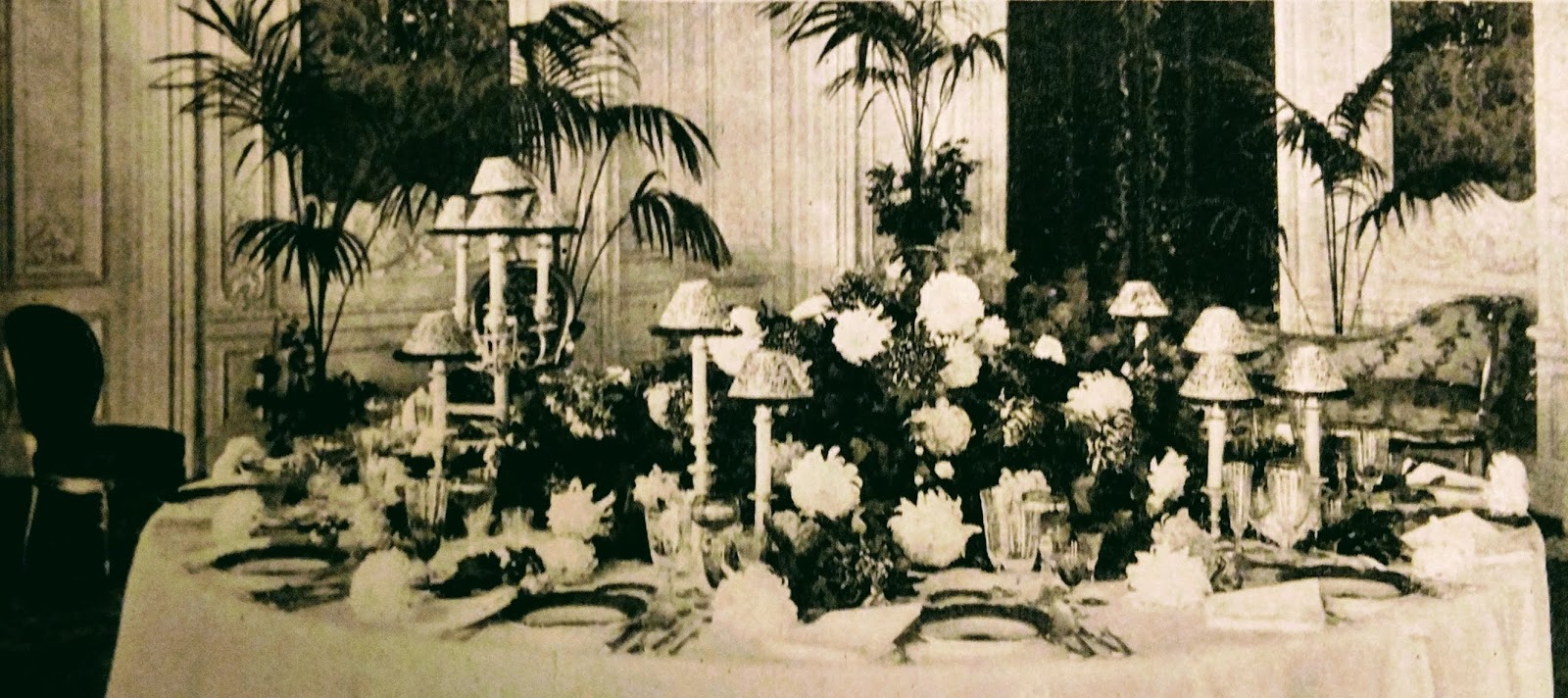
Those pretty candle shades, so much in use, were decorative to the furnishings of the table, but they prevented the most effective and becoming light at Victorian dinner parties.

Etiquette Notes for the Victorian Woman and the Home


A woman who has carefully studied the effects of light at her dinners says that unshaded candles in high, old fashioned candelabra that branch out in many directions, are absolutely the perfection of light for a table, and are, too a most becoming light to the faces of the guests gathered around it. The candelabra should be tall enough to carry the lights fairly high. The pretty candle shades so much in use are decorative to the furnishings of the table, but they prevent the most effective and becoming light.

A knitted table padding is being offered for use under table cloths. It is especially recommended because it does not grow hard after washing, as does the ordinary table pad. For a polished table, too, its protection is claimed to be more perfect. 


Cosmos and pansies are preferred for cloths intended for round tables. Sometimes entire plants are used to form a double border, with a plain linen center, and a plain strip between. The latest and most fashionable tablecloths have centers of plain linen, to which deep floral borders extend from the hem. Poppies, lilacs or goldenrod are favorite designs. Floral designs are preferred, the figures being larger and more pronounced than ever, this season.

Some damasks show the representations of whole plants or of a great branch bearing both flowers and foliage. Lace-trlmmed table linen is more fashionable than it was last season. Three new laces are used in ornamenting it. One is a French lace, resembling heavy linen torchon of elaborate patterns; another is a Russian lace of close meshes and clumsy figures.

Table linen that is not trimmed with lace, should be marked with embroidered initials. The accepted size for letters on tablecloths is two and one-half inches, and for napkins one and one-half inches. The initials should be intertwined, but the old-fashioned monogram style is no longer admissible.

In the serving of a pineapple:  Slice it, dip it in grated coconut, and pile high on a dish of fine white china.

A jelly sauce that is used for meats or the game course, requires that the jelly should be melted to the liquid state, and a tablespoonful of wine added just as it is sent around.
–Sacramento Daily Union, 1898


  🍽Etiquette Enthusiast, Maura J Graber, is the Site Editor for the Etiquipedia© Etiquette Encyclopedia