Showing posts with label Tiffany Silversmiths. Show all posts

Saturday, June 11, 2022

Egg Spoons and Egg Etiquette


Erasmus, in his treatise on manners, de civilitate morum puerilium (On the Civility of the Behavior of Boys), 1530, warned against cleaning out the shell's contents with the fingers or tongue.— Figure 74 from the Tiffany Silver Flatware book—A selection of egg spoons with gilded bowls in Tiffany full-line patterns. Left to right: Vine (iris), 4in.; Lap Over Edge, 4 in.; Persian, 4 in. The egg-shaped bowl of the Lap Over Edge specimen is standard. The shield-shaped bowl of the other two examples is unusual.


The soft-boiled egg has been a favorite food for a long time but before the appearance of egg cups and spoons presented problems as to how it should be eaten. Erasmus, in his treatise on manners, de civilitate morum puerilium (On the Civility of the Behavior of Boys), 1530, warned against cleaning out the shell's contents with the fingers or tongue. Apparently the use of a small knife was acceptable, as was dipping small pieces of bread into the egg. 

Italians at one time were given to drinking a barely heated egg right out of its shell. At first, egg spoons were used not to eat the egg directly but to transfer the semi-liquid contents to a plate, where it was mashed with butter, or to a glass, from which it was drunk.

Egg spoons have always been appropriately small, usually about 4 to 5in. in length, but the shape of the bowl has varied. Some bowls are very slightly oblong, others almost pear-shaped. Still others are shield shaped. 

The most commonly-observed Tiffany egg spoon bowl is egg-shaped, but the bowl of what we think is the egg spoon in some of the early patterns has a shield shape. Bowls of egg spoons are usually gilded to protect against discoloration from the sulfur in yolks. The handle on Tiffany's egg spoon is that of a large coffee spoon.

In the eighteenth and nineteenth centuries, egg spoons and cups were often part of an egg cruet, or egg stand, sometimes surmounted by a salt cellar. Tiffany made these, along with silver or silver-plated egg boilers, or coddlers.— Tiffany Silver Flatware- 1845-1905- When Dining Was an Art, 1999


🍽Etiquette Enthusiast, Maura J. Graber, is the Site Editor for the Etiquipedia© Etiquette Encyclopedia

Wednesday, June 8, 2022

Etiquette of a Romantic Repast

Table by Mrs. William Sarnoff from the 1981 book, “The New Tiffany Table Settings” — The gold and white setting has the gilded flatware turned upside down, in the French fashion. The stemware is in the American or British fashion, and not lined up above the dinner plate. It is in a small triangular cluster. Placement of the champagne saucer is is incorrect for this setting, unless the order is with a water glass first, then a champagne, then a red or possibly rosé, or white wine. It’s possible that the soup is being served with the champagne, but that is unlikely.


The monarchical decor of the Hapsburg Court, its red velvets, its white satins, its gold laces and embroideries, and its jewels, are recalled by Mrs. William Sarnoff in this intimate dinner whose multiple richness of elements burgeons with the romance of things past.

Mrs. Sarnoff's state portrait by the court painter Winterhalter of the beautiful young Princess Elizabeth of Hungary and the Two Sicilies sets the tone. Colors are restricted to the Hapsburgs’ red and white. An antique gold lace scarf from Mrs. Sarnoff’s family decorates the satin-covered table set with “Chrysanthemum” vermeil turned down in the European fashion, gold and white “Sheffield” bone china, “Antoinette” cut crystal, and Royal Berlin birds. 

A leaf-shaped vermeil ravier holds a ruby and diamond ring tied into pearl lariats, all by Tiffany jewelry designer Angela Cummings and all reminiscent of the jewels worn by the Princess Elizabeth in her portrait. Black lacquer side tables hold a bouquet of red silk flowers and a nineteenth-century black lacquer birdcage.— The New Tiffany Table Settings, 1981
There are wine and roses and candlelight, and Viennese waltzes in the background.


🍽Etiquette Enthusiast, Maura J. Graber, is the Site Moderator for the Etiquipedia© Etiquette Encyclopedia

Monday, June 6, 2022

A Gilded Age Tiffany Table

A gilded age luxury table by Mrs.William Randolph Hearst features a sterling flatware pattern accented with inlaid copper called ‘The Aztec,” designed exclusively for her by Tiffany's in the early twentieth century. Each handle has a different Indian motif sculptured on it. The excitement of the “Far West” permeated American design in this epoch. Note the dessert utensils of just a knife and spoon. Etiquipedia would love to know the planned menu!

“The Turn of the Century”
Mrs. William Randolph Hearst 
For the Tiffany Hostesses’ Show


Mrs. William Randolph Hearst has set a table to recall with nostalgia another era-the turn of the century. In the “Mauve Era” the most elaborate of centerpieces would dominate the dinner party (Mrs. Hearst's is a monumental arrangement of fruit, vegetables, lilies, gardenias, and orchids).

On a green satin cloth she has used richly-decorated service plates Tiffany made for her many years ago, as well as a sterling flatware pattern accented with inlaid copper called ‘The Aztec,” designed exclusively for her by Tiffany's in the early twentieth century. Each handle has a different Indian motif sculptured on it. The excitement of the “Far West” permeated American design in this epoch.

In the close-up we see the detail on the intereting flatware, as well as the rococo candlesticks and Charles II covered cups flanking the center piece. The stemware is all Tiffany glass–the translucent iridescent "favrile glass" invented by Louis Comfort Tiffany. It became one of the leading elements of the “art nouveau” movement.

This whole table represents imaginative design and elegance from another era, a period of rapid growth in America's history, as well as in her economic power and cultural sophistication. — Tiffany Table Settings, 1960


🍽 Etiquette Enthusiast, Maura J Graber, is the Site Editor for the Etiquipedia© Etiquette Encyclopedia


Saturday, June 4, 2022

Etiquette of Tiffany Hostesses' Show

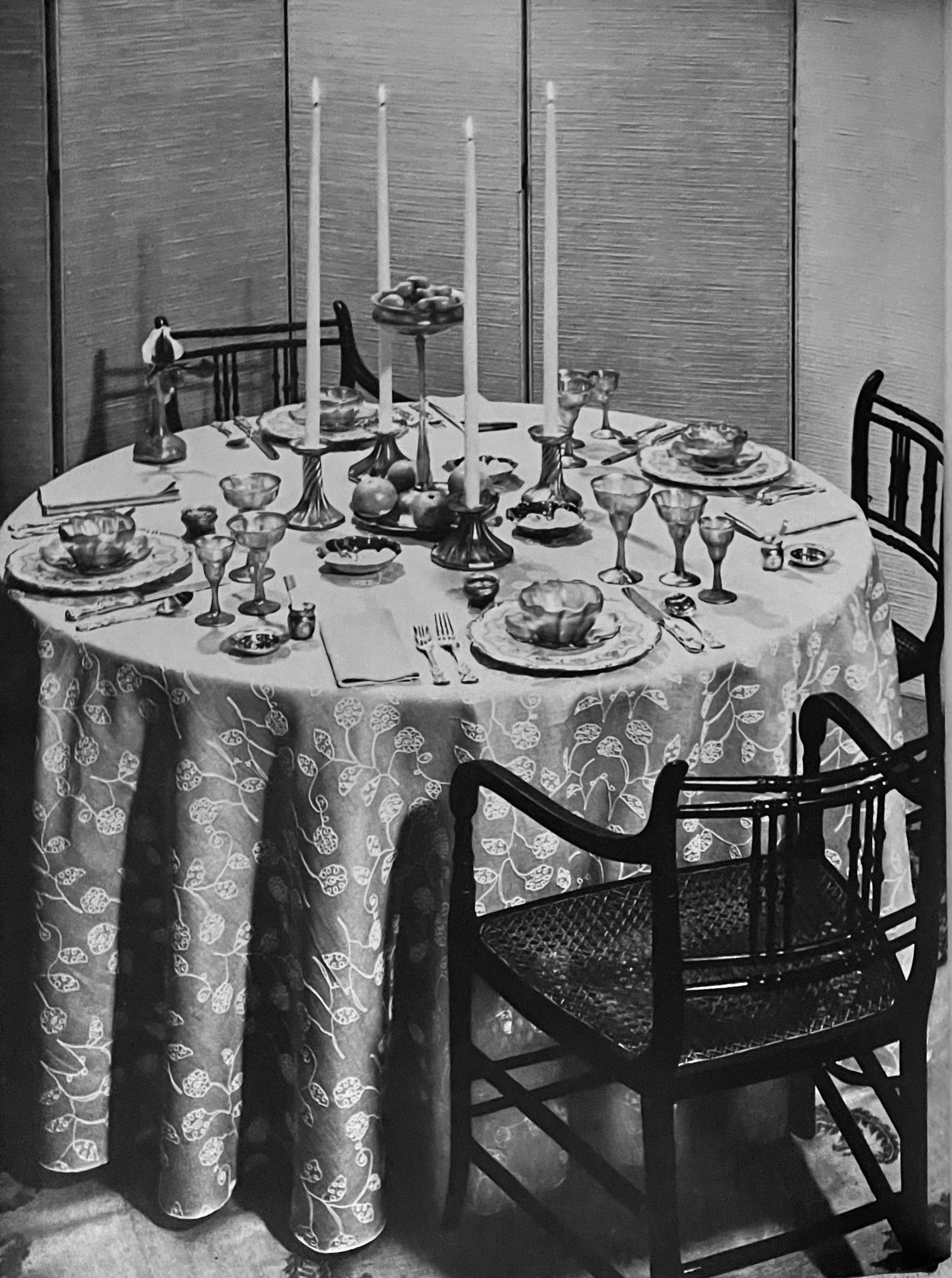
Etiquipedia’s initial thoughts: This is a strange order of courses for a formal, mid-century dinner. It appears to be a soup course, a fish course, a salad course and then a main course. Typical for the era would have been a soup, fish, a sorbet as palate cleanser, a main course, and then a salad. There are no dessert utensils, but at a formal dinner, these would be brought to the table with or without a finger bowl, but with the dessert plate. — Above is “A Dinner with Antique Silver, by Mrs. Charles Suydam Cutting, for Tiffany Hostesses' Show” 

Mrs. Charles Suydam Cutting has set a table that is a jewel of antique silver. She has used her own table ornaments: cigarette boxes for each place with hunting scenes sculptured in low relief; an Irish potato ring for the center of the table; columnar Irish candlesticks; cups, bowls, and all sorts of objects from the Charles II, Queen Anne, and early Georgian periods. 

She has made an unusual arrangement of pomegranates and grapes, red ampelopsis, and brown cypripedium from her greenhouses for the center decoration. Mrs. Cutting's écru fine linen cloth is embroidered with “Dixiana.” The finely monogrammed napkins are from France. She uses a simple English reproduction sterling flatware pattern, and a very plain stemware pattern. The dinner plates are white, with a subtle gold scratch-line decoration on the scalloped border.

Mrs. Cutting has grouped her antique silver objects on the table for decorative as well as for utilitarian purposes. The warm tone of the cream-colored cloth brings forth the glow of the old silver.— From Tiffany Table Settings, 1960


🍽Etiquette Enthusiast, Maura J. Graber, is the Site Moderator for the Etiquipedia© Etiquette Encyclopedia 

Friday, June 3, 2022

Etiquette and Tiffany’s Table Settings


This beautifully set dining table for four features elements from Tiffany’s. It is the first of the settings shown in the 1960 book, “Tiffany Table Settings.” The book was a companion offering to the women who not only participated in the yearly event, but notably to those who couldn’t attend the popular show of tabletop artistry. Etiquipedia will be featuring more from the book in the coming days, along with etiquette critiques of the late-1950’s to 1960 settings.

In 1956 Tiffany & Co., the famous Fifth Avenue jewelers and silver smiths, inaugurated an active program to present table settings of taste and imagination to the public. The purpose of this program a continual round of exhibitions-is to inspire and provoke greater interest in this area of design. When the exhibits are held, thousands of people visit Tiffany's weekly to view the settings by New York's leading hostesses and interior decorators. The store holds that a "per fect party" implies a beautiful table as well as a distinguished menu. Those who are chosen to design tables select Tiffany china, silver, and glass as accessories on their tables, combining these elements with their own furniture, linens, and antiques.

This collection of settings has not been compiled to instruct in the "book of etiquette" sense. Rather, it is hoped that the presentation of these settings will be a source of inspiration and a focus of ideas to any hostess.

There is infinite variety of design in these tables. Some of the set tings are based on the theory of switching objects created for one purpose to other uses, as well as juggling to make new combinations of color, fabric, and shape. Some of the settings are classic examples of subtle orthodox statement. Others are frankly based on fantasy.

The common denominator of good style, however, underlies all the designs, regardless of the occasion or spirit of formality or infor mality. A table set with inexpensive earthenware, for example, on a checked cotton cloth can be as enticing and appetizing as one of rare porcelain, crystal, and silver.

The editors believe that a woman is not using her own creative abilities unless she can turn her imagination to lending a fresh look to her table. It is hoped that this book will encourage a new point of view in this field of interior design. — Tiffany Table Settings, 1960


🍽Etiquette Enthusiast, Maura J. Graber, is the Site Moderator for the Etiquipedia© Etiquette Encyclopedia

Thursday, September 24, 2020

Dining Implements, Etiquette and More

Here’s something your mother probably never warned you about: sauce knives. Looking like a flattened-out spoon, this tricky little utensil— also called a sauce spoon— sits with other knives on the right side of the plate, in wait to help drizzle sauce on, say, a bite of salmon that you’ve secured on your fish fork.” — Photo, Etiquipedia’s private library


The Ware and Tear of Formal Dining


Here’s something your mother probably never warned you about: sauce knives. Looking like a flattened-out spoon, this tricky little utensil— also called a sauce spoon— sits with other knives on the right side of the plate, in wait to help drizzle sauce on, say, a bite of salmon that you’ve secured on your fish fork.

If you can’t tell a fish fork from a pitchfork, take comfort in the fact that even the most cultured among us occasionally get flummoxed by an elegant table setting.

“Escargot clamps can be very challenging,” says Sean Loeffel, director of food and beverage at the Four Seasons Hotel, recalling the scene in “Pretty Woman” in which Julia Roberts accidentally catapults a garlicky mollusk across the room.

“I haven’t used an escargot clamp in probably 15 years,” he admits, “and I suspect there are many diners who would not be familiar with how to use it.”

Fortunately, even if you’re sitting down to a nine-course meal, you’ll probably only have to negotiate three courses’ worth of knives, forks and spoons at a time.

“Nine courses of silverware would be frightening, even for the most educated,” says Loeffel. “It also wouldn’t fit on the table. As a general rule, in order not to confuse the guest, servers never put out more than three courses of tableware at a time.”

Even so, as you sit down for that nine-course fete for, say, the queen mother herself, prepare to work your way through some 19 pieces of silverware over the course of the evening— or afternoon, when, according to the Tiffany sterling flatware catalog, you might come upon the afternoon teaspoon, as distinct from the teaspoon, ice cream spoon or coffee spoon.

But wait, there’s more. Those 19 pieces don’t include all the serving silverware shined up to parade past your table. Tiffany lists knives (cheese, bread, butter, cake), spoons (berry, sugar, salt, jelly, vegetable) and forks (lemon, olive and cold meat). Also making an appearance: ladles (gravy, punch and sauce), tongs (sugar, ice, asparagus), servers (flat, cheese, cake and butter) and possibly scissors (for grapes).

“Some chefs have a cunning sense of humor,” says Loeffel, who learned forks and spoons from his parents, who’d take him and his nine siblings out to breakfast— the least expensive restaurant meal— in order to teach table manners. “You’ll have a course where normally you’d use a knife and fork, and now some chefs are starting to serve a spoon with it as well, so the guest doesn’t miss out on the leftover sauce.”

And how would you know to use a spoon with your sauce? When in doubt, watch your host, says Loeffel. “We just did a luncheon where we served a coupe dish [that’s a sort of football-shaped, high-sided bowl for foods with hot sauces] and a spoon with it,” he says. “Everyone had their eye on the host so they knew what to do.”

In addition to keeping an eye on your host, other rules of culinary propriety include:

Work from the outside in. What your mother did tell you about silverware still applies. Start with the outside utensil and work your way in. The most common mistake is for diners to get rattled by the number of pieces of flatware and reach instinctively for the utensil closest to the plate. Don’t worry about the forks and spoons placed above your plate. They’re for dessert.

Knives and forks dine together. Even those secure in the knowledge that one should work from the outside in may still find it disconcerting to see seven pieces of silverware at their command. Know that for every fork at your place setting, you’ll also have a corresponding knife to your right. The spoon with the round bowl is most likely for soup (there are, however, different kinds of spoons depending on whether you’re served a cream soup [larger spoon] or bouillon). Pasta is often served with a fork and spoon to work that angel hair into a manageable bite.

Although Loeffel was brought up in the American style of putting the knife down and switching the fork to the right hand after cutting a piece of food, he says it is more correct to hold the knife and fork at the same time, one in each hand, as the Europeans do. “It makes more sense,” he says.

When you’re done with a course, place the knife and fork, handles facing out, at the 3 o’clock position on your plate. This will tell the server that you have finished eating.

Covet not thy neighbor’s bread plate. Or water glass. Or coffee cup. The bread plate is always to the left of a place setting. Glassware— water, wine, coffee cups and saucers— is always to the right.

According to Jill Cross, director of catering for the Beverly Hilton Hotel, one of the most common mistakes is for diners at a round table to assume control of the bread plate to their right instead of their rightful bread plate to the left. What happens next might best be termed a dining domino effect as everyone else at the table is forced to take the bread plate to their right. Unless, of course, a diner on the other side of the table has already staked out one to the left, which leaves someone without a bread plate altogether.

Another common dilemma: how to get butter from point A, the butter dish, to point B, your bread. Use the butter knife to retrieve a pat of butter as the dish is passed around the table. Place the butter on your bread plate, return the butter knife to the dish, then use your own knife to spread butter on your bread.

And if you do find yourself drawn into the who’s-got-my-bread-plate controversy, “adjust,” says Loeffel. “It’s not worth anyone getting embarrassed over it. Also, any server worth his weight will notice what’s happening and will adjust for you by bringing new silverware or another bread plate.” At their best, rules of table etiquette are designed for clarity, not one-upmanship. Consider, for example, the story credited to Queen Victoria, who, upon seeing an unsuspecting dinner guest pick up his finger bowl and drink from it, raised her own finger bowl to her lips and also drank. Taking her lead, the rest of the guests joined her.

And they all lived happily, perhaps not ever after, but at least through the dessert course. — By Debra Hotaling, Special to the Times, 1998


Etiquette Enthusiast, Maura J Graber, is the Site Editor for the Etiquipedia© Etiquette Encyclopedia