Showing posts with label American vs Continental Dining. Show all posts

Tuesday, April 4, 2023

Setting a Table for the King

His Majesty's cover for dinner at the French Embassy in 1939 – French flatware is traditionally set facing down on the table and thus monogrammed on the backs of the handles.


This Table, Set For the King, Starts U.S. Experts Talking

Etiquette authorities, trying to determine how tables should be set for wining and and dining royalty when King George XI and Queen Elizabeth visit the United States in June, are interested in this picture. It shows the cover set for His Majesty at dinner given recently in the French embassy in London. Its especial interest is that it isn't exactly what American authorities had in mind.

The glasses, the turned-down-silver and an ash tray caused most comment. Eyebrows weren’t raised at the number of glasses– but at their placing. It’s an old American custom to put glasses above and to the right of the knife– not above the service plate.

At the dinner given by President M. Lebrun of France, and Mme. Lebrun, however, the water goblet was placed to the left front, near the entree fork. Behind it came the champagne glass. Right front was the first wine glass, on which His Majesty’s place card was laid– so he would not have to bend over to read it. Other glasses were two more for white wine, one for red wine, and another, in the center, for the Romanee-Conti, famed Burgundy vintage of which 200 bottles were sent from Paris especially for this dinner.

The turned-down silver was a surprise in this country. Never, said one authority, is silver turned down. Glasses, perhaps– they might collect a little dust. A waiter will turn them up before serving starts. But the choicely-patterned silver? It can’t happen here.

The ash tray is pointed out some-what gleefully. It’s a long-needed concession smokers, one authority explains. He points out that until a few years ago ash trays would have appeared only at the end of the meal.– By Joan Durham, AP Feature Service Writer, May 8, 1939


🍽Etiquette Enthusiast, Maura J. Graber, is the Site Editor for the Etiquipedia© Etiquette Encyclopedia

Monday, March 13, 2023

Etiquette for Cutting a Steak

Modern steak knives by Towle, without the customary, not to mention helpful, serrated edges. Earlier steak knife blades were made of steel.


What Readers Ask— “When you go to dinner with a gentleman and are served a steak, who should cut it and how should the knife and fork be held in cutting the meat.” 

The man who orders the steak may carve it, but it is more usual nowadays for him to ask the waiter to carve at a side table and then pass the steak. 

Needless to say, steel knives should be at each place when steak is served and a special carving knife should be supplied if it is to be cut at the table. In carving, the knife is held in the right hand and the fork in the left. The carver grasps the knife and fork firmly, but takes eare not to let his fingers touch anything bu!t the handle. 
In cutting it on the plate, one cuts off just a morsel at a time. To cut it all up at once is, of course, childish. The knife is held in the right hand and the fork in the left. The European way is to eat with the fork always in the left hand, but it is permitted in this country to take the fork in the right hand if for convenience sake.”— Mary Marshall Duffee, the Morning Union, 1918

 🍽️Etiquette Enthusiast, Maura J. Graber, is the Site Editor for the Etiquipedia© Etiquette Encyclopedia

Wednesday, August 24, 2022

The Art of Using a Knife with a Fork

Designed for teaching American children proper flatware usage and placement, this circa 1930’s-1940’s, three piece set of “Kindergarten” flatware has “hidden messaging” in the design on the handles. Upon close inspection, the fork handle reads, “For the Left Hand,” while the handle of the knife reads, “For the Right Hand,” and the spoon handle reads, “For the Saucer.” The handles can only be read at the table if the utensils are in their proper positions for “pausing,” “resting” or even “finished” (when the knife and fork are placed together at 11:00 and 5:00.)


American versus Continental Dining
Close-up of the knife handle

When dining with knives and forks, one should be aware of the two different and distinct styles of eating with these utensils. In the United States, most Americans eat using the American “flip-flop” or “zig-zag” method. The U.S. is the only country in the world that uses this method predominantly. Most of the rest of the world uses the European or “Continental” style.

Because you are obviously at your best when you feel comfortable in all social situations, use whichever method you are most comfortable with, regardless of how others are eating around you. The self confidence you feel knowing that you are using the proper utensils and table manners, as well as other proper forms of etiquette, will free you from worry over how you look to others and will enable you to concentrate on what you need to say and how to communicate your thoughts. 

You will find yourself more relaxed in many different social situations with this new confidence and you will also find that you are enjoying your social life more fully, even when your social life is an extension of yours, or your spouse's, business or professional life. Think of this new found knowledge as a valuable tool and use it to its fullest to enhance the quality of every aspect of your life.

The American Flip-Flop or Zig-Zag

For our example we will be using steak. Imagine the steak on your plate. Pick up the steak knife to your right of the plate with your right hand and the fork to the left with your left hand. Carefully spear the steak with your fork tines facing downward into the steak. Use your knife to cut the piece of steak with a gentle sawing motion, using only slight pressure on the blade of the knife. In this manner, the blade does the work, not you. Then, when the piece of meat has been cut, the knife is placed across the top of the plate with the tip of the knife pointing toward twelve o'clock and the handle pointing at three o'clock. Switch the fork from your left hand to your right hand, gently spear the cut piece of meat, turn the fork so that the tines are facing upward and bring the food to your mouth. Return the fork either to the left side of the plate, or to the steak if you will be cutting another piece, with your left hand, and pick the knife up with your right hand again. This is the “flip-flop” or “zig-zag” action.

The European or “Continental” Style

Imagine the same steak on your plate. Pick up the steak knife with your right hand and your fork with your left, just as in the American example. Carefully spear the meat with the fork tines facing downward and cut the piece of steak with the knife with a gentle sawing motion. When the piece of meat is cut, place the knife at the top of the plate, resting in the same manner as the American style calls for and bring the piece of meat to your mouth with the fork still in the left hand and with the tines facing downward. This action is then repeated, if another piece of steak is desired, by keeping the fork in the left hand and retrieving the knife with the right hand from its resting spot at the top of the plate. The fork in the Continental or European style of dining is never switched back and forth from one hand to another.— From The RSVP Institute of Etiquette’s “Social Graces Handbook”, 1993


🍽Etiquette Enthusiast, Maura J. Graber of The RSVP Institute of Etiquette, is the Site Editor for the Etiquipedia© Etiquette Encyclopedia

Saturday, July 18, 2020

A Question of Fork Etiquette

“Excuse me, waiter, but why do well bred Americans permit themselves and their children to use the fork in the right hand? And, if no bread and butter plates are used, where should bread be laid during the meal?”


Watching the Forks


One of the questions that foreigners, especially English-bred people, most frequently ask regarding American manners is this: “Why do well bred Americans permit themselves and their children to use the fork in the right hand?” The fact is that in England, good table etiquette demands that the fork should be kept in the left hand. The knife is used, of course, in the right hand and it is regarded as bad form to shift the fork over to the right hand when the knife is not needed. 

Even in eating desserts the fork is kept in the left hand, frequently being used with a dessert spoon, which is held in the right hand. And children here, unless they are children of Europeans or of parents who affect English manners, are not warned against shifting the fork to the right hand for convenience. However, it is bad form from our point of view, as well as the English, to use the fork shovelwise, scooping up large mouthfuls of vegetables or meat upon it.

Well-bred persons take care how they hold the fork until it becomes second nature to hold it well. Even if the fork is small and your hand is large, avoid placing the handle in the palm of your hand as you would handle a small screw driver, as if your object were to get the best possible grip upon it. Do not hold on too far down the handle, but on the other hand, do not affect the over-dainty manner of holding it uncertainly very far up. 

When you have finished eating leave the fork on the side of the plate, sometimes downward.

When passing a plate for a second helping, place your knife and fork on the side of the plate, blade in or tines downward.

What Readers Ask...

“If no bread and butter plates are used, where should bread be laid during the meal?”

Usually on the plate, but if there is hardly room there is no harm in allowing a roll or fairly dry bread to rest on the table cloth beside the butter-pat.— The Sun, 1921


Etiquette Enthusiast, Maura J Graber, is the Site Editor for the Etiquipedia© Etiquette Encyclopedia

Sunday, July 5, 2020

Differing Dining Styles — USA vs U.K.


Abigail Van Buren... “Letter on ‘manners’ stirs response.”

DEAR ABBY: My English husband and I howled with laughter when we read the letter from the Americans who had returned from England. Scotland and Wales and noticed the “strange” manner of eating. They said, “After cutting meat, they do not set the knife down and change the fork from the left hand to the right; they eat left-handed, which looks rather awkward.” Worse yet, these visiting Americans were not content to merely observe the “foreign” manner of eating, they attempted to instruct an Englishman in the “correct” way — theirs. What nerve! I’ll bet you get a ton of mail on this. — S and S in Menlo Park

DEAR S AND S: I did. Some samples;
DEAR ABBY: I married a man from Finland who always thought that European table manners were superior to ours because they never touch their food with their fingers as Americans so often do. However, after living in Indiana for six years, my husband has become slightly Americanized. Instead of using a knife and fork to eat a Big Mac or a piece of Kentucky Fried Chicken, he eats with his fingers. I'm so glad. It was getting a little embarrassing with company. And you should see him tackle an Ortego taco!— Susan M. Clarksville, Indiana

DEAR ABBY: Now I know where the phrase “Ugly American” originated. It was partly from people like your reader who had the nerve to visit a foreign country and criticize age-old eating habits. When I dined in England during World War II, my hosts were very charming; they must have been vastly amused as they watched me switch my fork from one hand to the other, but no one had the bad taste to call it to my attention. It’s like the American who asked the British sergeant why his stripes were upside down. Or Americans who ask foreigners, in their own country, why they drive on the “wrong” side of the street. —Jack Corzette, Houston

DEAR ABBY: I was born in England and now live in the United States While dining in an American restaurant, imagine my horror when I was asked to keep my fork from the main course to use for my dessert. This disgusted me no end At least we use clean utensils for each course. —Doreen in Pine Bluff, Arkansas

DEAR ABBY: Who do those Americans think they are to criticize the way the English use their eating utensils? I’m English, and one thing we do not do is struggle with the side of a fork to cut our meat. We use a knife. And we do not use our fingers to eat bacon regardless of how crisp it is, as I've seen countless Americans do. Have you ever chased the last few peas around your plate, trying to get them on a fork? Well, that’s where the knife comes in, to “rake” them, as you say, onto your fork. I offer this little rhyme a favorite with my countrymen,  ‘I eat my peas with honey, I've done it all my life, It may sound awfully funny, But it keeps them on my knife.’ — Born in England

DEAR ABBY: Please leave King Henry VIII at rest. The English learned their “strange eating habits” centuries before America was even born. So who is “wrong”? The American tourists who thought the English need eating lessons should visit China and “teach” the Chinese to use a knife and fork, and throw away those funny little sticks they’ve been eating with for 5,000 years! — Proud Canadian 

🍽Etiquette Enthusiast, Maura J. Graber of The RSVP Institute of Etiquette, is the Site Editor for the Etiquipedia© Etiquette Encyclopedia

Wednesday, January 24, 2018

Develop Etiquette with All 5 Senses

Airing first in 1970, and through most of the decade, T.V.’s “Queen Mary”, Mary Tyler Moore was the epitome of style and charm. The show’s characters, “Mary Richards” and “Rhoda Morgenstern,” were fashion forward, hard-working, always well-groomed and most always polite. They were single women, living on their own. They became positive, feminist role models for young career women everywhere. – “When Queen Mary was asked to name the most important subject in the education of a potential Monarch, she answered in one word “Manners!” Many a successful executive, homemaker and career girl would give the same answer if asked about his or her assets, but how do people develop the knack of saying and doing the right things?” 

Etiquette for Everyone       

New York (NAPS) – When Queen Mary was asked to name the most important subject in the education of a potential Monarch, she answered in one word “Manners!” Many a successful executive, homemaker and career girl would give the same answer if asked about his or her assets, but how do people develop  the knack of saying and doing the right things? 


Long a guide for etiquette, the noted author, Emily Post, said good manners come from the heart, and you’ll also recall, the Bible says of man, “As he thinketh in his heart, so he is.” Now it doesn’t necessarily mean you must undergo surgery for a heart transplant, in order to have a change of heart that makes you do and say what is right. But if you do care about people at work, or in a social situation, or even at home where all too often, unfortunately, the best foot forward is not put!... , you can learn the courteous thing to do and be kind. You can begin with five basic concerns: The senses!

In brief, if you are thoughtful about people’s five senses you will become more sensitive and perhaps in time a veritable sensation! Here are five sensible rules to remember; 

• Eyes– Be easy on the eyes and dress (including cosmetics) in a “manner” that shows you care for another person’s viewpoint, literally. 

• Ears– Is your voice shrill? Rough? Loud? Too soft? Speaking with a nicely modulated, melodious voice falls softly on the ears. Practice listening to yourself. 

• Nose– Personal hygiene, as important for men as for women, makes you kind to another’s nose. You’ll be snifty if in addition to daily showers you are also thoughtful enough to use something such as Man-Power aerosol. 

•  Taste– You’ll taste better when kissed if, in addition to regular dental appointments, you also keep on hand a refreshing mouthwash to use at home and at work. 

• Touch– A well-scrubbed skin made smooth and kept soft and moist with creams will keep you off the offensive fence, more fun off than on. 

Once you have carried through on being kind to the five senses, you’ll find it fun to use all your own five to contemplate the different customs in various parts of the world. In Japan, for instance, etiquette demands you remove “walking” shoes on entering a temple. Slippers are worn inside and floors are kept spotless. In yet other parts of the world, it’s considered ill-mannered to use the same handkerchief twice! 

In Europe, Amy Vanderbilt points out, it is quite proper to use a toothpick at dinner, with the table napkin held as a screen, but in America, one is supposed to remove themselves from the table, to dislodge the food. The American and Continental use of the knife and fork also vary. The American uses a knife only to cut with. In Europe, the knife can be used to pile food on the back of the fork and food is then transferred to the mouth with the left hand still holding the fork. Americans generally place their napkin in the lap, whereas in different regions of the world it’s proper to tuck the napkin in the collar. Americans are very quick to use first names, although Eastern and Southern communities are more conservative in this matter, but Europeans and especially Asians prefer introducing a relationship in a formal manner, with proper title and last name. 

Etiquette, it’s true, involves not only the heart and the senses, but also protocol which must be learned with the head. But don’t be discouraged! If your heart is in the right place, and you’re sensitive, you can get the facts for your head out of books. This is true even if you don’t have to think, as Queen Mary did, about the most important subject in the education of a King or Queen. –Coronado Eagle and Journal, 1970

Etiquette Enthusiast, Maura J. Graber, is the Site Editor for the Etiquipedia© Etiquette Encyclopedia 

Sunday, May 22, 2016

Dining Style Etiquette History

“For Americans, it is more proper to eat American-style and it looks silly to eat European-style if you were not born in Europe. I'm a firm believer, for which I get a great deal of hate mail, that the American style is more dignified, slower, more complicated, as opposed to a quick shove-it-in method. People who use the European style point out that it is more efficient. But I say efficiency is not a virtue when it comes to stuffing food in your face. It is not proper etiquette or good for your health. Doctors don't ever say: ‘You're not eating fast enough.’ I am a great believer in American etiquette for Americans on all counts. Our forefathers wanted an American etiquette that would reflect the egalitarianism of America and not Europe, that was based on court life. My feelings get stirred up when I hear people arguing vehemently for aping European ways when we have a much more sophisticated and aesthetically pleasing American standard of our own. I agree with Ben Franklin and Thomas Jefferson and George Washington, who wrote that Americans should have a dignified American etiquette.”– Miss Manners


Continental Dining  vs American Dining  


I admit, I am part of the American minority that refuses to juggle my eating utensils. I cut, hack and slash with the knife in my right hand and sling the food to my gaping mouth with the fork in my left hand. This makes me both a no-nonsense and continental kind of guy. Or so I've been told by no less an authority than myself. But what do the professional etiquette experts say about the conflicting techniques– the American way and the way the rest of us chow down? Before I get into that, I have learned that being a professional etiquette arbiter is a tougher job than it used to be.

Listen to Letitia Baldrige, the renowned author of eight etiquette books, who says: “Social manners have changed dramatically. Kids today and for the last 20 years have held the fork and knife in unbelievable ways. They hold the fork with a fist and the knife like a saw and they shovel it in. It doesn't matter to them which way they hold their knife
 and fork. They eat every which way. I'm amazed they get food into their mouths at all.” As for Ms. Baldrige's personal preference, she's on my side and prefers the labor-efficient continental approach.

“It is a much easier way to eat. It is much neater and there is no banging of flatware. Eating American-style, you put the knife down and clang. Continental is silent and efficient. But some people think it is faddish and elitist. We're the only people in the world who eat this way, putting the knife down and changing the fork from the left to the right hand.” Why do we do it? The custom of American eating was the way everyone ate until about 1840. In 1852 it came out in a French etiquette book that if you wanted to eat in a more fashionable manner, you would not switch the fork to the other hand. Before long, Europeans of all classes started using that style. In certain business sectors, if you don't eat continental-style, you look as if you just got off the cabbage truck. A strong believer in the American style is Judith Martin, who has written the Miss Manners column since 1978 and is author of four Miss Manners books.

“For Americans, it is more proper to eat American-style and it looks silly to eat European-style if you were not born in Europe. I'm a firm believer, for which I get a great deal of hate mail, that the American style is more dignified, slower, more complicated, as opposed to a quick shove-it-in method. People who use the European style point out that it is more efficient. But I say efficiency is not a virtue when it comes to stuffing food in your face. It is not proper etiquette or good for your health. Doctors don't ever say: ‘You're not eating fast enough.’ I am a great believer in American etiquette for Americans on all counts. Our forefathers wanted an American etiquette that would reflect the egalitarianism of America and not Europe, that was based on court life.

“My feelings get stirred up when I hear people arguing vehemently for aping European ways when we have a much more sophisticated and aesthetically pleasing American standard of our own. I agree with Ben Franklin and Thomas Jefferson and George Washington, who wrote that Americans should have a dignified American etiquette.” Well, thanks a lot, Ms. Martin. Here we are, talking about how to get grub from the plate to our chompers, and you make me feel like a subversive. 


The final comment I leave for Ms. Baldrige, who offered this nugget of indisputable wisdom: “It is most important to eat neatly. You are a dining success if you don't get food on your clothes.” The next time we consider etiquette, we will look into the question of the proper way to share table scraps with our dog. Do you let it get up on the table, as I prefer? Or do you just toss the tidbits over your shoulder and let the lively little creature make a leaping catch, as my wife enjoys doing? No, no, I meant that the dog makes a leaping catch, not my wife. See? I just can't avoid conflict. - From a 1996 article by Mike Royko for the Chicago Tribune


Etiquette Enthusiast, Maura J. Graber, is the Site Editor for the Etiquipedia© Etiquette Encyclopedia 

Saturday, October 17, 2015

Etiquette Tips for the Table

Hey... Cover that cough, please!

Coughing at the Table

Ordinary coughing at table is done behind the hand, without excuse, but a coughing fit, brought on by something being caught in the windpipe, indicates that you must leave the table immediately without excuse (you can't talk, anyhow). If necessary, your partner at table offers help in the next room a pat on the back or a glass of water. If there is a servant present he or she attends to this unless the hostess indicates to some member of the family or to a nearby guest that help might be better from that source.

And if you're sick, just stay home.
Blowing One's Nose at the Table


If the nose must be blown at table, it is done as quietly as possible, without excuse to draw attention to the fact.
Don't serve it to your guests!
"Foreign Matter" in Foods

Foreign bodies accidentally taken into the mouth with food gravel, stones, bird shot are removed with thumb and forefinger, as are fish bones and other tiny bones. If a gnat gets into a beverage or some other unappetizing creature turns up in or on a diner's food, he fishes it out, unobserved (so others won't see it and be upset), and then either proceeds or leaves the drink or dish untouched, depending on the degree of odiousness of the intruder. 

A gnat or a tiny inchworm on lettuce shouldn't bother anyone, but most fastidious people draw the line at a fly or worse. If the hostess notices an untouched dish, she may say, "Do let me serve you a fresh portion," and she has the dish or drink removed without remarking clinically as to the need for the move. Or if a servant notices, she asks if the guest would like a fresh serving. In a restaurant, if host or hostess does not notice (and both should be alert for this sort of thing) that something is amiss, the guest may tactfully murmur to the waiter that the dish or drink needs changing preferably when host or hostess's attention is directed else- where.
Use the serving utensils provided, not your own. If the serving utensils have been forgotten, pause long enough for the hostess to notice what's happened. 
When You Need Silverware

Your own wet spoon should never be placed in a sugar bowl, nor your butter knife in the jam or butter dish. If the serving utensils have been forgotten, pause long enough for the hostess to notice what's happened.   
This is informal but only permissible, if a fresh fork or spoon is used, with the possessor of the dish then handing the "taste" implement, handle first, to the other person. As this is an adult and child, Etiquipedia allows it!

Tasting Another's Food

Sometimes a couple dining in a restaurant wish to taste each other's food. This is informal but permissible, though only if a fresh fork or spoon is used, with the possessor of the dish then handing the "taste" implement, handle first, to the other person. The other must not reach
across the table and eat from a companion's plate, no matter how many years they have been married. If one of the two has had included some item say French fried potatoes in his order and doesn't wish them, he asks the waiter to serve them to the other, if desired he doesn't take them on his plate, then re-serve them.
Oh, to be a toddler again and have an actual food pusher to use!

Using Bread as a "Pusher"

A bit of bread, if available, is used to push food onto a fork never use the fingers. At formal dinners when bread is not served one may always switch to the Continental style, if one is adept, and chase the peas onto the back of the fork held in the left hand, pressing them down before conveying the fork, upside down, to the mouth. Or, holding the fork in the right or (French and Italian fashion) left hand, tines up, on plate, one may guide difficult food onto it with the side of the knife.   
Reaching at table is now preferred to asking neighbors to pass things ...
Reaching at Table

Reaching at table is now preferred to asking neighbors to pass things one can well take up himself, but one should not have to rise out of his seat. – Amy Vanderbilt


Etiquette Enthusiast, Maura J. Graber is the Site Editor for Etiquipedia© Etiquette Encyclopedia

Thursday, October 15, 2015

Gilded Age Etiquette for Men

“I had long wished that some capable person should challenge Mrs. “ Madge ” Humphrey on some of her statements in her letters in Truth and The World, or in her little booklets, Manners for Men and Manners for Women...” — One of the first woman journalists in England, C.E. Humphry (1843–1925), often worked under the pseudonym “Madge,” was a well-known writer and Agony Aunt in Victorian-era England who wrote about women’s issues of the day. She wrote, edited and published many works throughout her career and is perhaps best known for originating what was known as the “Lady’s Letter” style column she wrote for the publication “Truth,” which was widely read throughout the British Empire. 

“Madge” Propounds “More Manners for Men” – Rules for Everything, from Marriage to the Color of a Necktie, Are Given with Tabloid Wisdom in Mrs. Humphry's Book of Etiquette

The lady known as “Madge” in London — Truth- her real name, it appears, is Mrs. Humphry— who for years has told people just how to conduct themselves on all conceivable occasions, has written another book called “More Manners for Men.” Her “Manners for Men” was so successful, and provoked so many questions from men continually kept guessing as to whether they were “in right” on the color of neckties or the exact angle of salaams that “Madge” has once more graciously consented to be an authoress.

Right at the very start of her preface she points out one class to whom her new book should appeal in these words: “Marriages of mixed nationalities become more and more frequent. And besides all this, our American cousins visit us, to our great content, in greater numbers every year. Their etiquette differs essentially from ours in many points, and they are naturally desirous to acquaint themselves with ours, just as we should be to acquire a knowledge of theirs while we visiting their own great country.”

Does this bridegroom have pretensions to social position? He's wearing a frock coat in 1904! “In most of these letters I am asked if the frock coat is a necessary item of the bridegroom’s costume. Until the last couple of years I was obliged to reply that this garment was indispensable to any bridegroom with pretensions to social position.”
“Madge” tells us to bear in mind that “the most innately courteous and high minded of morals possesses no inward guide to the knowledge that a letter to the King must be written on thick white note paper, and enclosed in an envelope large enough to take it without being folded. And how could anyone possibly be aware from his or her inner consciousness only, that a Frenchman may eat with his fork, leaving his knife blade sideways on his plate, whereas an Englishman must not do so under penalty of showing himself ignorant of our table customs?”

“I receive a great number of letters from young men in all parts of the world,” remarks “Madge,” “with references to the etiquette of marriage, and containing many questions about the formalities of weddings. In most of these letters I am asked if the frock coat is a necessary item of the bridegroom’s costume. Until the last couple of years I was obliged to reply that this garment was indispensable to any bridegroom with pretensions to social position. Fortunately, however, fashion has now decided that the less ceremonious morning coat may replace the frock. At one of the smartest weddings of recent years the bridegroom, an officer of the First Life Guards, wore a simple gray suit, and had not even a buttonhole.”–The New York Times, 1897


Etiquette Enthusiast, Maura J. Graber, is the Site Editor for the Etiquipedia© Etiquette Encyclopedia


Thursday, October 9, 2014

Amy Vanderbilt on Dining Etiquette

Even when one uses the American zigzag method, it is sensible to convey food one has just cut to the mouth with the fork in the left hand, if one wishes. –  The traditional European style of dining was originally what was considered the American style. The dining style division was the result of British colonists sailing across the Atlantic, bringing their multi-step, or “zig-zag” method to the New World. The Continental (or European, as in the continent of Europe) style of dining became fashionable. A French etiquette book from that period read: “If you wish to eat in the latest mode favored by fashionable people, you will not change your fork to your right hand after you have cut your meat, but raise it to your mouth in your left hand.” 


The Use of the Knife and Fork

Knives and forks may be used American or Continental fashion, but a combination of the two systems is now often seen and is quite acceptable. Even when one uses the American zigzag method, it is sensible to convey food one has just cut to the mouth with the fork in the left hand, if one wishes. In other words, if you have cut off a bit of chop, it is not necessary, even conservative American style, to lay down the knife, place the fork, tines up, in the right hand and convey the meat to the mouth. Instead, one may use the fork in the left hand, with the tines of the fork down. 

Also, in eating a bit of bread and gravy by impaling the bread on the fork (in either hand), tines down, and sopping up the gravy it is now more usual than otherwise to convey the bit to the mouth with the fork tines down rather than up. Of course, nothing that would leak off the fork apple pie or other things needing a shoveling technique should be eaten this way. In the European fashion, food eaten with fork and knife is piled with the knife on the back of the fork, held in the left hand, and pressed down so it won't fall off or in the case of meat, impaled on the tines. The fork is then conveyed to the mouth, upside down, with the left hand.


Drinking Beverages at the Table

In drinking any beverage at table, a sip is never taken until the mouth is empty and has been wiped with the napkin. This keeps cup and glass rims free from food marks.


The Napkin

Napkins are placed on the lap entirely open if they are lunch-size or in half if they are dinner napkins. Guests wait until the hostess has taken up hers before placing their own. Napkins are tucked in only for children. They are never refolded; at the end of the meal, they are gathered and laid casually to the right of the place setting. Paper napkins are preferable to napkins to be used for more than one meal and placed in rings, but, if rings are used, they are given only to the family. A guest staying over should have a clean napkin each meal. Napkins reused are as incomprehensible to me as beds which have only one sheet changed. There are so many more sensible ways to economize.


Tipping of Dishes

The tipping of soup or dessert dishes is acceptable if the plate is tipped away from the spoon, not toward the eater.
          

The Soup or Bouillon Cup

Soup or bouillon served in a handled cup or even in a small cup-size bowl (Oriental fashion) is drunk. If there are dumplings or decorative vegetables or other garnish floating on top, these may be lifted out first with the spoon before the soup is drunk. Noodles or other things which may be in the bottom of the cup are spooned up after the liquid has been drunk.


Testing Liquids

Coffee or tea may be tested for heat or sweetening by one sip from the spoon, then drunk. If it is too hot, it must be allowed to stand until it is tolerable it may not be blown, spoonful by spoonful, until it is cool enough to drink.


“Stirring” Food

Nothing should ever be stirred up or mashed into a conglomerate heap on the plate. Gravy unless it is a gravy in which meat, fish or other protein is incorporated (rarebits, curries, blanquettes, chilis, etc.) is never poured or ladled onto rice, noodles, or other than meat on the plate. It is an insult to the cuisine to inundate everything on your plate with gravy or with that American favorite, catsup. If you want to eat your potatoes with gravy, you dip a forkful into the gravy that has escaped from the meat.


Conserves and Jellies

Conserves and jellies (jam and marmalade are for breakfast and tea) may be served at dinner or lunch with meat and are placed on the side of the plate, as are horse-radish, cranberry sauce, apple butter, relish. They are incorporated onto the fork as the food is taken into the mouth. Hard sauce is placed on the side of the dessert plate and incorporated with the pudding with dessert fork or spoon. Dessert sauces are ladled onto the dessert. Liquid sauces (mint, Chateaubriand, Worcestershire, etc...) meant for the meat are poured only onto it.


When Food is Too Hot

Too hot foods taken accidentally into the mouth are never hastily spit out in any way but are quenched with a drink of water before being swallowed (exception to rule against drinking with anything in the mouth).


“Spoiled” Food

Spoiled food, not even a bad clam, is ever spit, however surreptitiously, into a napkin. But it is sheer masochism to down, for the sake of manners, something really spoiled, once you have got a goodly mouthful. Anyone with experience in those foreign countries where such things are common knows it is better to seem unmannerly than to brave ptomaine or worse. Certainly, a partly chewed mouthful of food looks unappetizing to one's dinner partner if it has been necessary for you to deposit it from your fork on the side of the plate. It should be screened, if possible, with some celery leaves or, perhaps, a bit of bread. And, in taking it out of your mouth, try not to look as if anything were the matter. After all, if you were eating stewed or canned cherries, you would place the pits in the spoon with which you were eating, then place them on the side of your plate without anyone thinking the procedure disgusting.


Coughing at the Table

Ordinary coughing at table is done behind the hand, without excuse, but a coughing fit, brought on by something being caught in the windpipe, indicates that you must leave the table immediately without excuse (you can't talk, anyhow). If necessary, your partner at table offers help in the next room a pat on the back or a glass of water. If there is a servant present he or she attends to this unless the hostess indicates to some member of the family or to a nearby guest that help might be better from that source.


Blowing One’s Nose at the Table

If the nose must be blown at table, it is done as quietly as possible, without excuse to draw attention to the fact.


“Foreign Matter” in Foods

Foreign bodies accidentally taken into the mouth with food gravel, stones, bird shot are removed with thumb and forefinger, as are fish bones and other tiny bones. If a gnat gets into a beverage or some other unappetizing creature turns up in or on a diner's food, he fishes it out, unobserved (so others won't see it and be upset), and then either proceeds or leaves the drink or dish untouched, depending on the degree of odiousness of the intruder. A gnat or a tiny inchworm on lettuce shouldn't bother anyone, but most fastidious people draw the line at a fly or worse. If the hostess notices an untouched dish, she may say, "Do let me serve you a fresh portion," and she has the dish or drink removed without remarking clinically as to the need for the move. Or if a servant notices, she asks if the guest would like a fresh serving. In a restaurant, if host or hostess does not notice (and both should be alert for this sort of thing) that something is amiss, the guest may tactfully murmur to the waiter that the dish or drink needs changing preferably when host or hostess's attention is directed else-where.


When You Need Silverware

Your own wet spoon should never be placed in a sugar bowl, nor your butter knife in the jam or butter dish. If the serving utensils have been forgotten, pause long enough for the hostess to notice what's happened.


Tasting Another's Food

Sometimes a couple dining in a restaurant wish to taste each other's food. This is informal but permissible, though only if a fresh fork or spoon is used, with the possessor of the dish then handing the "taste" implement, handle first, to the other person. The other must not reach across the table and eat from a companion's plate, no matter how many years they have been married. If one of the two has had included some item say French fried potatoes in his order and doesn't wish them, he asks the waiter to serve them to the other, if desired he doesn't take them on his plate, then re-serve them.


Using Bread as a “Pusher”

A bit of bread, if available, is used to push food onto a fork never use the fingers. At formal dinners when bread is not served one may always switch to the Continental style, if one is adept, and chase the peas onto the back of the fork held in the left hand, pressing them down before conveying the fork, upside down, to the mouth. Or, holding the fork in the right or (French and Italian fashion) left hand, tines up, on plate, one may guide difficult food onto it with the side of the knife.


Reaching at Table

Reaching at table is now preferred to asking neighbors to pass things one can well take up himself, but one should not have to rise out of his seat.


From the original Amy Vanderbilt's Complete Book of Etiquette


Etiquette Enthusiast, Maura J Graber, is the Site Editor for the Etiquipedia© Etiquette Encyclopedia 

Monday, October 6, 2014

Etiquette for Dining in Ukraine

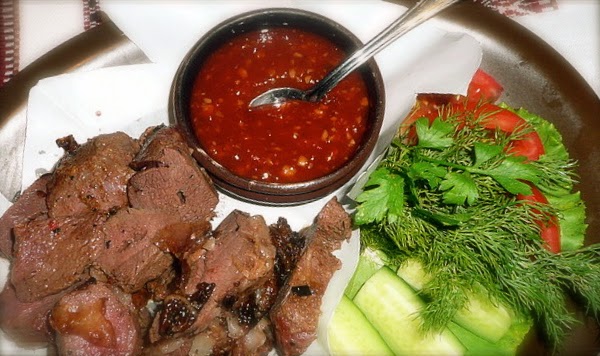
"Dining refinements are key because you never get a second chance to make a first impression, like after spilling shashlik sauce on your pants." A great secret to eating in Ukraine, if you are just visiting the country, is to not ask for a "restaurant," according to ukraine.pacsys.com  "The word restaurant has a different connotation in Ukraine. The Ukrainian word 'restaran' implies a high-class, elegant dining experience, often with live music. They are mostly used for weddings, banquets and big celebrations. For a delicious, inexpensive meal in Ukraine, ask for a cafe. These are the standard places for everyday dining in Ukraine."


Looking Fine, While Fine Dining in Ukraine


Table manners play an important part in making a favorable impression, and are essential to one's personal and professional success. Dining refinements are key because you never get a second chance to make a first impression, like after spilling shashlik sauce on your pants.

Obviously, there is a degree of flexibility involved. It can be hard to project success in certain Kyiv restaurants, where you have to get down on your knees and beg your waitress for a menu, or stand on your chair at the conclusion of your meal and wave your napkin semaphore-style in order to secure the bill. In other words, not every dinner calls for a complete working knowledge of table manners.

     
The goal is to behave with graciousness and poise at the table... Slouching is not approved of, regardless of how good you may look. Remember, your posture silently speaks volumes about you.

“The goal is not, after all, to demonstrate utter mastery of the most arcane details of etiquette,” says an article oncuisinenet.com. “[but] to behave with graciousness and poise at the table.”

Napkin Use


As soon as you are seated, place your napkin on your lap, and use it sparingly and gently throughout the meal. Leaving it loosely folded on your seat when standing up from the table signals you’ll be returning. Leaving it to the right of your dinner plate signals you have concluded your meal.

The Table Setting

Not every dinner calls for a complete working knowledge of table manners, but, again, watch that posture. Good manners means no slouching! And please keep your elbows off of the table too.

Faced with a baffling arsenal of cutlery and dishware, follow two basic rules: Imitate the actions of your host or fellow diners and typically eat from the outside in, proceeding with those forks and knives furthest from the center of your setting and working your way inwards.

On the far left is typically found the salad fork, followed by the fish fork and meat fork. On the far right you may find a small oyster fork, followed by the soup spoon, fish knife and meat knife. Spoons may also accompany a serving of dessert or coffee and tea. Once used, each should be returned to the saucer (but not bowl) on which it arrived, but never to your dinner plate.


Holding On

The guides describe the European style as less formal, since you can use your knife both to cut up your food and load up items like peas on your fork.
Etiquette guides define two styles for holding utensils: the American or “Zig-Zag” style, and the European or Continental style. The first system refers to the habit of cutting at most two bites of meat with the fork in the left hand and knife in the right, and then placing the knife on the rim of the plate and switching the fork to the right hand before taking a bite. The guides describe the European style as less formal, since you can use your knife both to cut up your food and load up items like peas on your fork. In general, however, food should be eaten off of the fork with the tines pointed downward. “The position of the knife and fork when not in use acts as a sort of semaphore,” cuisinenet.com adds.

Soiled utensils should never touch the table, but remain on the plates for which they were designed (salad fork on salad plate, meat/fish fork and meat/fish knife on dinner plate, etc...). Keep the blade of the knife pointed toward you and the fork tines preferably pointed up or down, but never facing another person. When taking a small break in eating, the fork and the knife should balance on the rim of the plate; when receiving a second helping, they should lie parallel on the right side of the plate; and when you’ve finished your meal, they should lie parallel either across the plate or on a diagonal.


Brushing Up

Eaten with the fingers ~ Foods which may be eaten with the fingers include artichokes (until you reach the heart), asparagus (when not covered in sauce), crisp bacon... 
There certainly is no shortage of dining rules. Foods which may be eaten with the fingers include artichokes (until you reach the heart), asparagus (when not covered in sauce), crisp bacon, bread and rolls (always broken, never cut), cookies, corn on the cob, hors d’oeuvres, sandwiches and fruit.

Inedible foods should come out of the mouth the way they went in – olive pits in the hand, chicken bones on the fork. But, to repeat, style and flexibility are all-important.

“When a piece of fat is too big to be removed with the fork, use a napkin discretely to discard the meat,” advises the askmen.com Web site, which clearly hasn’t heard of salo, and doesn’t know it should simply be swallowed.


Main article used was originally published in 2003 in the Kyiv Post

🍽Etiquette Enthusiast, Maura J. Graber of The RSVP Institute of Etiquette, is the Site Editor for the Etiquipedia© Etiquette Encyclopedia