Showing posts with label Seating Etiquette. Show all posts

Sunday, April 12, 2020

Medieval Seating and Dining

 The origins of modern day seating arrangements for dining. — “As a rule, one knife had to serve for two people, and often a bowl of soup was used by two persons. For this reason the party giving the dinner arranged his guests in couples, trying to place people together who would be congenial and not adverse to this common use of table appointments.”— Image source, Pinterest


A description of a dinner given in 1350 shows that there has been a vast improvement in table manners since then:
As a rule, one knife had to serve for two people, and often a bowl of soup was used by two persons. For this reason the party giving the dinner arranged his guests in couples, trying to place people together who would be congenial and not adverse to this common use of table appointments. Spoons were seldom supplied to the guests, and the soup was drunk directly from the bowl, the latter usually having side handles by which it was held. 
In less refined company, there were no separate soup bowls, only one large porringer, which was passed around to the guests in turn. The diners helped themselves to the pieces of meat they desired from the common dish with their fingers. Napkins were considered a luxury, and were only provided in very aristocratic and wealthy families.—Philadelphia Inquirer, 1903

Etiquette Enthusiast, Maura J Graber, is the Site Editor for the Etiquipedia© Etiquette Encyclopedia

Saturday, July 15, 2017

Table Seating Etiquette

The reason seating arrangements is worth thinking about in advance, is that you'll be asked the question, “Is there any place in particular you'd like us to sit?” and your mind will have a hard time switching gears. 


Diplomatic careers have foundered on bad decisions about who should sit where, but with six people you've got nothing to worry about. Because couples often go through life welded together at the hip, it might make for a more interesting dynamic not to have the same two people who breakfast together every morning of their mortal lives seated together at a dinner, as well. 


Convention likes to have a man seated next to a woman seated next to a man seated next to a woman. But since couples no longer come exclusively in those pairings and since your table might not conform to three of one, three of the other, best to seat people for conversational possibility rather than atavistic allegiance.

The reason it's worth thinking about in advance, is that you'll be asked the question, “Is there any place in particular you'd like us to sit?” just as you're draining the pasta or taking the muffins out of there tin, and your mind will have a hard time switching gears.

You want the talkers and the listeners fairly evenly distributed around the table. You probably don't want the three men who were college roommates absorbed in a tête to tête to tête, at one end of the table. Nor do you want the shy cousin who invited you to dinner when you first moved to town, to have only you to talk to throughout the meal, the cocktail hour having pretty much exhausted your news of the family. So say firmly, “Yes, I'd like Marjorie on my right, Fritz on my left, and if Betty would go to the other end of the table, the rest of you can sit where you like.” — From 1993's “Rising to the Occasion”


Etiquette Enthusiast, Maura J Graber, is the Site Editor for the Etiquipedia© Etiquette Encyclopedia

Sunday, May 15, 2016

Diplomatic Table Seating Etiquette

Original seating chart for State Dinner Honoring HRH The Duke of Gloucester, in 1934 — At diplomatic dinners, titles are abbreviated, “H. E. [for His Excellency] the Norwegian Ambassador,” “The Secretary of Defense.” Dinner partners refer to these gentlemen as “Mr. Ambassador” and “Mr. Secretary” in direct conversation, by the way. Note that there are absolutely no women at this dinner in 1934!

The seating at formal dinners is the same as that at informal ones at which guests are present. Host and hostess are seated more or less opposite each other, with the hostess preferably near the entrance through which the formal place card. Monogram, in this case, in gold with matching border. 

Name of guest is handwritten. To the right of the host is placed the honored woman guest. If a young engaged girl is to be feted, for example, she is given this place despite the fact that older women are present. If among the guests there is one woman who has come some distance and is rarely a visitor to the household, it is she who would be given this place of honor. 

Ordinarily, among people who see each other frequently, the hostess places to the host's right any woman who has obvious seniority over the rest or, if none has, any woman guest who will bring out her husband conversationally if he needs special incentive. 

To her own right the hostess places the husband of the guest of honor, if there is one, the man who has come the greatest distance and is an infrequent visitor to the household or a man who may be a little shy or difficult conversationally. To the host's left is placed the next most important woman guest and to the hostess' left, the next most important man guest.

At a long banquet table host and hostess need not sit at opposite ends but may sit across from each other at the center. The same seating of guests of honor maintains, however.

At each place will be a guest's name. The cards are usually plain white with beveled edges gilded, although in a household using a heraldic device the host's full coat of arms may be embossed in gold or the crest alone without the motto may be used. 


A widow or an unmarried woman may properly use only a lozenge for menu and place cards. Place card names are written “Mrs. Roberts,” “Miss Sweeney,” “Mr. Prudhomme” at formal dinners. 

At diplomatic dinners titles are abbreviated,  “H.E. [for His Excellency] the Norwegian Ambassador,” “The Secretary of Defense.” Dinner partners refer to these gentlemen as “Mr. Ambassador” and “Mr. Secretary” in direct conversation, by the way. Amy Vanderbilt, 1952


🍽️Etiquette Enthusiast, Maura J Graber of The RSVP Institute of Etiquette, is the Site Editor for the Etiquipedia© Etiquette Encyclopedia

Sunday, September 7, 2014

Savvy Business Seating Etiquette

One tip: If there will be an odd number of guests, request a round table, so that no one sits next to an empty seat. 
In the world of business, much energy goes into getting it right at the boardroom negotiating table. But even the smartest of business execs sometimes forget to play it smart and savvy at another equally important table: The dining table. And this is not just about knowing which fork to use, or silencing your mobile phone and leaving it off of the table.

Where you place your guests, especially those visiting international guests, conveys an instant, unspoken message about the level of esteem you hold them in. It also is a way for them to gauge your own understanding of seating protocol.

Always consider the seating chart as of the most important aspects of any form of business dining and entertaining. “Getting it right” means that everyone feels respected and you look like a pro. It is a clear win-win. Get it wrong, and it is an epic fail.
If multiple languages are to be spoken, include appropriately placed interpreters at the table. 

Below are a few of the finer points of business seating strategies:

■ Always choose a restaurant or venue that you are familiar with, and hopefully one that knows you as a customer. Book the table, or room, well in advance to secure the best.  Make certain your tables don't face a mirror, are nowhere near the kitchen, or the restrooms, for that matter. The fewer distractions, the better.
■ If you have an odd number of guests in your party, request a large, round table. That way, no one is left sitting next to an empty seat. 
■ When creating a seating chart, the position of honor is always to the right of the Host. If you have more than one honored guest then the second highest-ranking guest sits to your left. When there is a third honored guest they sit to the right of your first honored guest. Gender never plays a role in determining a seat of honor. Rank determines someone's level of importance. 
■ If multiple languages are to be spoken, include appropriately placed interpreters at the table. 
■ For larger groups you will find it helpful to use place cards.  Share your seating plan with the maitre'd, and let the waiter know early on of any particular requests, so that there will be no surprises. Let them know that you will be directing seating when your group arrives. 
■ As the host, or hostess, you should always arrive early to make certain that nothing has been overlooked. 
Share your seating plan with the maître d’ and let the waiter know early on of any particular requests.
 ■ Greet your guests at the entrance. If you and a guest arrive at the same time, walk in together, pause and allow the maître d’ to lead you to your table. The guest follows the maitre d' while you follow the guest. 
■ Once you are at your table/s, indicate to your guests where they should sit. 
■ If you must go to the table to await your guests, do not open your napkin, and do not order a drink. You don't want your guests to feel as if they are late, but do want to look as if you have just arrived. 
■ When your guests arrive, stand to greet them. Remain standing until they are all seated. 
■ Placing your napkin in your lap will signal to the wait staff that you are ready to order, or be served, so leave your napkin on the table until all your guests have been seated. If there are any business issues you'd need to address prior to the meal, leave your napkin on the table until those matters have been discussed and the discussions are concluded. 
Remember, that not every point mentioned will apply to every entertaining setting or event. However, using this as a basic guideline, and controlling the atmosphere around you, as much as the situation will allow, demonstrates respect and an understanding of business etiquette and seating etiquette strategies on your part. - Source Sydney Morning Herald, 2014 

Etiquette Enthusiast, Maura J. Graber, is the Site Editor for the Etiquipedia© Etiquette Encyclopedia 

Saturday, September 6, 2014

Basic Dinner Seating Etiquette

“In seating one's self at table a comfortable posture is not incompatible with a dignified attitude. The shoulders should not be thrown back too far, nor should they drop forward. It is the latter pose which produces the inclination of the arms suggestive of the 'all elbows' idea which some people give of themselves.” – Eliza M. Lavin, 1888

Formal Table Seating For Six, Ten, Fourteen, Or Eighteen People  
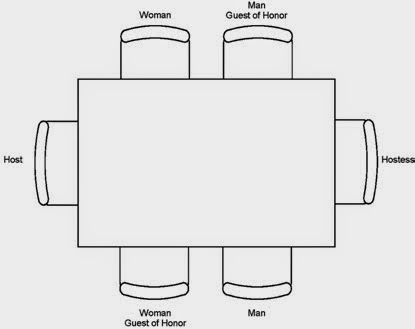
Traditionally at a formal dinner, the Host sits at the head of the table with the Hostess at the other end. This works whenever there are six, ten, fourteen, or eighteen people. Husbands and wives are never seated next to each other.
If the Guest of Honor is a woman, she is seated at the Host's right and her husband at the Hostess' right. The second most important woman is seated across from the Guest of Honor, on the Host's left, and her husband is seated accordingly on the Hostess' left. The remaining guests are seated in between, alternating between male and female guests.
To be fair, the word "important" can be relative to many differing situations and varying cultures. Age may play a factor, especially if there is no Guest of Honor. Giving the eldest member of a group, or the persons who have traveled the farthest distance to the dinner, special places in the seating arrangement, would be an honor. Special accommodations may be also be made for those in wheelchairs, or those using a walker or cane. Guests take note of such matters and will undoubtedly appreciate the kind gestures on a Hosts and Hostess' parts.
Formal Table Seating For Groups Divisible By Four 
When the group of people is divisible by four, it is not possible for the Hostess to sit at the end of the table. In this case, the Hostess moves one place to the left, with the man on her right sitting at the end of the table, opposite the Host. This will keep the tradition of seating guests alternately, male, female, male, female, etc... Again, husbands and wives are never seated next to each other.
For informal dining, the easiest system is to alternate between male and female guests, with the Host and Hostess on either end of the table. 


Contributor Bernadette Petrotta is the Founder and Director of the Polite Society School of Etiquette in Washington State.  She has been teaching etiquette for nearly 20 years and has written The Art of Social Graces and The Art and Proper Etiquette of Afternoon Tea.  She is currently working on her third book and continues to teach and lecture on the art and pleasures of proper etiquette and tea. 


  🍽Etiquette Enthusiast, Maura J. Graber of The RSVP Institute of Etiquette, is the Site Editor for the Etiquipedia© Etiquette Encyclopedia