Showing posts with label Formal Military Table Manners. Show all posts

Tuesday, March 3, 2015

Etiquette History of British Army Mess-Rooms

The mess in particular constituted a very great expense. This mess, which the Emperor Napoleon III established in the regiments of the Garde Impiriale, following the example of the English army, which he greatly admired, is not only a place where men meet for their meals, but a club, and very often a club of the most elegant description, maintaining the highest standard of excellence as to surroundings, cuisine, and personnel. The government pays a portion of the furnishings, but all the rest, — the silverware, the china, glass, etc. — is the property of the Mess, and is administered by a committee of three officers.
THE English army before the war was a very aristocratic institution. The law of 1871, passed after the Franco-Prussian War, had suppressed the purchase of officers' commissions — before that time the authorized price for com- missions varied from £450, for an Ensigncy in the Infantry, to £7,250 for a commission of Lieutenant-Colonel in the Life Guards — the Royal Warrant abolishing the system of purchase had substituted that of entrance examinations, but, as a general thing, the corps of officers was recruited from the same social class as in the day of Thackeray's novels, partly from the nobility, whose members generally remained but a short time; partly from old military families, true guardians of glorious traditions; and partly also from among the sons of rich parvenus of commerce and industry, who, as in the, day of Vanity Fair, rose, in wearing the King's uniform, many rounds of the social ladder.

The number of officers who had risen from the ranks was very few, and for the most part, were the sons of prominent families who upon their entrance were named for "special recommendation." Even in later years, when the standard for military studies was very high, officers led an expensive existence. The costliness of the mess, the up-keep of polo ponies and hunters, the luxury of the uniforms, the elegancies of the social life, obliged an officer to spend a great deal more than his pay, arid it was practically impossible for an officer to serve, especially in some of the crack regiments, who was not possessed of large personal resources.

The mess in particular constituted a very great expense. This mess, which the Emperor Napoleon III established in the regiments of the Garde Impiriale, following the example of the English army, which he greatly admired, is not only a place where men meet for their meals, but a club, and very often a club of the most elegant description, maintaining the highest standard of excellence as to surroundings, cuisine, and personnel. The establishment is furnished by the state, and comprises, at least, a dining-room, the "Mess Room," a reception-room, the "ante-room," a billiard-room, a wine-cellar, and all the official apartments necessary for service. The government pays a portion of the furnishings, but all the rest, — the silverware, the china, glass, etc. — is the property of the Mess, and is administered by a committee of three officers.

Each newly-admitted officer pays, as in a club, an entrance fee, and annual dues. The government provides a yearly amount for the upkeep of the Mess. The expenses of each officer are paid monthly. The fittings of the mess of certain regiments are magnificent, the furnishings very handsome, the silver superb, and the wine-cellars of the first quality.

The Mess of the Horse Guards and of the Life Guards, of the Foot Guards, and of many other corps that I could name, are in no way inferior in elegance and perfection of style to the most exclusive and expensive clubs of any country. The officers — I speak of times of peace — always at dinner are in " mess kit," the special uniform for Mess, very elegant, heavily braided with gold upon the" particular color of the regiment — a uniform entirely different from that worn for service, or for parade. Besides the " King's Rules," which prescribe the functioning and administration of the Mess, there exist customs peculiar to the different corps, to which not only members of the Mess, but their guests as well, must strictly conform.

There is a great deal of entertaining at Mess: there are "Inspection Nights," and "Regimental Guest Nights," when the visitors are guests of the regiment or corps, and also "Guest Nights" when individual members may entertain. This question of entertaining is considered very important. Dining in Mess "is a Parade." All officers must dine in Mess on "Guest Night," unless very excellent reasons are given for being absent, but on "Inspection Night," or "Regimental Guest Night," they are obliged to be present, and may not excuse themselves. 

The intimate relationship which the war has established between the French officers and their comrades of the English army is the cause of many invitations, which will become more and more frequent now that the establishment of peace, and the maintenance of British regiments on French soil for an indefinite period, permit closer friendships; civilians are already, and will in future be still more, in receipt of invitations to Mess from the English officers. Now the esprit de corps, the old customs, the usages and privileges of the different corps are carefully and jealously observed by our allies. The new army has inherited them, and is as exacting in regard to them as the old. 

The war has admitted to the various regiments a very considerable number of men who have received commissions, but who have had previously no idea of military traditions or customs. To assist newcomers — "Warts" as they call the latest- arrived Second-Lieutenants in military slang — Lieutenant-Colonel E. G. Mackenzie, Staff Officer, Royal Fusifiers, has written a little pamphlet called Notes on Mess Etiquette. It should be of interest to all prospective Mess guests. We will give a few short extracts from it. Certainly those who are to have the honour of being entertained by our brave allies and friends will be glad to know of usages and customs, the omission of which would render them conspicuous or ridiculous. They will be happy "to know the ropes," as General Sir Bindon Blood said in his introduction to the little book in question, and with its aid to avoid "a bad break" (or la faucheuse gaffe). 

To give an idea of the rules and customs of certain corps, we may cite the fashion in the Royal Marines of drinking the King's health. The Royal Marines, whose device is "Per mare, per terram," are divided into two corps: the Royal Marine Artillery, and the Royal Marine Light Infantry. These are the crack corps, proud of a glorious history. There are also certain other regiments of infantry which were raised originally as "marines." These corps insist upon every custom which may recall this fact, and among them all the King's health is drunk, as in the Royal Marines, that is to say the corps remaining seated, while, in all other army corps the men rise and drink standing. This custom goes back to the days of three-deck vessels, when the rooms of the middle deck, among which was the dining- hall, had very low ceilings, where it would be difficult to stand. 

Evil tongues pretend that the custom came also from the fact that after dinner the rolling and pitching caused certain convives to find themselves more comfortable seated. The guest who was ignorant of this custom, but only knew in a general way that in the army everybody arose when the vice-president said: "Gentlemen, the King!" would be embarrassed to discover that he was the only person standing. 

The King's health is not proposed at all dinners, it is proposed only on "Band Night," or "Guest Night," when the band of the regiment plays. The King's health is drunk in the following manner: when the repast is ended, the president — before whom the wine is usually placed until it is circulated and poured — rises and says: "Mr. Vice, the King." The wine then makes the circuit of the table and all the glasses are filled. 

Under no condition may any one drink or even raise his glass until the toast is proposed. When all the glasses are filled the vice-president rises in his turn and says: "Gentlemen, the King." The band then plays "God Save the King." All the company rises, holding in the right hand the full glass. In certain regiments the officers respond: "The King ! God bless him !" after which everyone is seated. : On ordinary evenings the men may leave the table after the wine has been once around, on others it is the custom to wait until the senior officer rises, but on "Guest Night" no one may rise before the senior officer. In some regiments it is the rule that no officer shall leave the Menu until all the guests have left. 

The president and vice-president of the Mess are not necessarily the two officers of highest rank. It is a weekly service, taken in turn. During the week the men are "in roster" they take the places respectively at the head and foot of the table. The president is responsible for the conduct of the officers at Mess, and gives the orders to bring the coffee, the cigars, and cigarettes. The vice-president is always the last to leave the table, at least unless he has received from the president special permission to rise, in which case the president himself will remain until the last. 

The officers must be in the ante-room — the room adjoining the Mess-Room, at least five minutes before the bugle sounds the last call to dinner. Smoking is not permitted in the ante-room for an entire half-hour before dinner. When dinner is announced the senior officer present, passes out first, followed by all the others. If there is a guest present, the officer who is his host passes out first with him, if there are several guests, the oldest officer present passes out first with his, and the others follow with theirs according to age. An officer arriving late must excuse himself to either the president or the vice-president, whichever is nearest to his place. It is not permitted to smoke in the Mess-Room before the end of dinner. In certain Mess-Rooms the president or the senior officer gives the permission to smoke. No one is ever allowed to smoke a pipe. 

Each man in his mess pays for what he drinks. "Treating" is considered very bad form, though of course the expenses of a guest are charged to his host. In each Mess there is a "wine book," in which is entered every day the charge of each officer for wines and liquors. If there is a claim through error, it must be addressed directly to the president of the Mess Commission. When a stranger enters the ante-room it is the custom for all officers present to rise and salute. He is usually offered a drink and a cigarette, this expense being carried by the general account under the heading "Mess Guests." 

Never may the name of a lady be mentioned at mess; never may a bet be made there, nor may one ever "talk shop." In time of peace officers dress for dinner in "Mess Kit," with the exception of the "Orderly Officer," who is usually in service undress blue. Today an officer of the Regular Army, or an officer coming from the Regulars, may wear the undress blue every day after six o'clock. In most Mess-Rooms officers wear long trousers for dinner. If, for any reason, an officer is in breeches, he must excuse himself to the senior officer present in the ante-room, before dinner, for not being in proper dress. If a guest is himself an officer, he should, of course, be in uniform, but if he is a civilian he should wear a dress coat and a white tie. It would be extremely bad form for a guest to present himself in a " dinner- jacket" (which they call in Paris "smoking-jacket," the English always asking "Why smoking?" the "smoking- jacket" being a dressing gown) with a black tie- With the exception of the Officer of the Day, officers dining at mess do not wear the belt. It is always worn on special guest nights, or on inspection nights, or other formal occasions, but when an officer comes to dine at a mess as guest, the custom is that he should wear the belt. 

It is quite usual for a Mess to nominate officers of other corps, and even civilians* honorary members. In this case the committee addresses to the one so honored a letter or a printed card, asking him to consider himself an honorary member of the Mess during his stay in the district. To this invitation the rule is to reply with a note, written in the third person, thanking the chief of the corps and his officers for their courtesy, and assuring them that the writer will be happy to avail himself of the privilege. But all this does not mean that the invited member shall use the mess as though he were a member in reality. It is a simple formal courtesy; any one taking the invitation literally, and coming regularly to dine at the mess would be considered very badly informed. When one speaks to an officer, or of an officer, one designates him by his, rank: Major X., Captain Z., but when it is a subaltern, that is, a Lieutenant, or a Second-Lieutenant, one calls him Mr. Y., and not Lieutenant Y. The same rule holds in addressing a letter. We write: Captain Z. and Y. Esq. 

It is forbidden to bring dogs to the Mess. In most regiments a fine of five shillings is imposed on the owner of a dog found within the precincts of the Mess. No matter if you have at your side the most magnificent sabre in the world, a precious "arm of honor," etc., never think of drawing it from its scabbard in the Mess, even to display it. You would be loaded with fines from every corner of the room. When the wine is passed around the table it is well to remember always to pass it "as the hands of the clock move," that is, from left to right. It would be a grave fault to fail in this matter. It is a good rule, when invited to dine at a Mess, always to ask one's host if his regiment has special customs, for, I repeat, most regiments are very jealous of their privileges and traditions, and it is a matter of simple courtesy to inform one's self, and observe them.


By Frank Levray , Le Correspondent. — Translation, Lotus Magazine.
Etiquette Enthusiast, Maura J. Graber, is the Site Editor for the Etiquipedia© Etiquette Encyclopedia 

Monday, July 28, 2014

More on U.S. Military Etiquette of the “Dining-In”

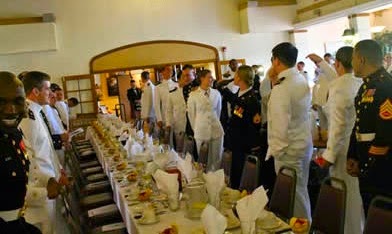
2013 San Diego Dining-In ~ "In November of 1964, the Chief of Naval Operations Naval History Division prepared an article on the mess night for the BUPERS Mess Newsletter. The article was aimed at Commissioned Officers Mess Managers and provided a synopsis of the Navy dining-in. This was the first official mention of the event. A renaissance of the dining-in can be linked to the 200th birthday of both the country and the Navy. During the bicentennial, officials were reviving virtually every traditional event to celebrate the occasion. The Chief of Naval Information (CHINFO) prepared a pamphlet entitled "How to Conduct a Dining-In." The guide was published as an article in the March 1975 issue of U.S. Navy Medicine. This is a most important document because it describes the basic format of the Navy dining-in." From Military Facts, History of the Navy 


Introduction To The Dining-In

1. The purpose of this booklet is to familiarize the junior officer with an old custom that has begun to experience a resurgence of popularity after a period of considerable decline.

This custom is known as the Dining-In. Simply stated, the Dining-In is the assemblage of all the officers of a particular unit for a formal dinner. There is of course much more involved in conducting the Dining-In than just sitting down to dinner. It is a rather complex affair that can and often does include a receiving line, cocktail hour, a ceremonial posting of the colors, a punch ceremony, ceremonial toasts, etc. All of these will be discussed in detail later in this booklet.

2. The formal Dining-In has several purposes. First, it brings together the unit officers on a social basis. Second, it fosters a spirit of team work in the unit as the officers get to know each other better. Finally, each officer has an opportunity to see his place in the unit history. He learns that many brave and capable men have gone before him and have left him a legacy of falor and efficiency. He also learns that his own day-to-day activities become a part of the unit’s history which encourages higher standards of performance from him. It is to this end that the Dining-In should be conducted.

3. The Dining-In should be compared to an officers’ call as far as its purpose and function are concerned. Therefore, when invited you should consider your attendance as obligatory and your absence should occur only for those reasons for which you would be excused from any military formation.


Background On The Dining-In


1. GENERAL. Conduct of the British Officers’ Mess over the years has had great influence on many of the procedures practiced today by US organizations in the formal Dining-In. The British mess was a source of solemn formality; a cause for living above one’s means; and a source of long-lasting customs and traditions.

2. THE OFFICERS’ BILLET


a. Today’s colorful British officers’ dinners continue a custom which arose in the eighteenth century. In those days there were no barracks. Consequently, officers and men were billeted wherever lodging was available. When a battalion entered a town the Quartermaster would select billets for the unit. Then the unit would hold a parade and group the colors at the officers’ billet. This billet became known as the officers’ mess and was the central meeting place for officers.

b. The custom of dining together was especially useful in large units where many officers did not normally come in contact with one another. However, during dinners they were brought together in a fraternal atmosphere. The mess, besides entertaining guests in the surroundings of traditions and customs of the regiment, served to make the officers aware of the social amenities. Young officers received training which enabled them to give formal entertainment later as senior officers.

c. While the mess served a functional purpose it also served as a constant source of satire and junior officer horseplay. Additionally, they served as a method of transmitting the histories and traditions of the Regiment to junior officers.


BACKGROUND ON US ARMY REGIMENTAL MESS


1. GENERAL:

a. US Army Dining-In traditions are related directly to those of the British Army prior to the American Revolution, and in many instances, more modern British Army Mess procedure has been incorporated into our unit social events. The oldest recorded American Dining-In occurred in September 1776.

b. In the regimental mess of the 1920’s the colonel or senior officer presided and sat at the head of the table with the lieutenant colonel to his right and the adjutant to his left. The other officers were seated on both sides of the table according to rank. Dinner was a formal meal with everyone wearing the uniform prescribed. The officers of the mess assembled and upon arrival of the presiding officer followed him into the mess and took seats when he had taken his. In general, the US Army Dining-In has been more formal and restrained than its
usual British Army counterpart.

c. The importance of the mess as related to the image of the officer corps was evidenced by the recommendation that all newly commissioned officers should carefully make arrangements for messing to enable them to “live with the quiet dignity becoming their station.” It was sufficient for expenses, and he owed it to the service to “dress and live, though simply, yet always like gentleman.”

2. TRADITION: As with the British Mess, the US Army Dining-In has served as a vehicle for transmitting the histories and traditions to junior officers. This is particularly true in our Army where rotation between units is quite frequent. As an example of this tradition, the punch bowl for 1st Battalion, 9th Infantry (MANCHU) reflects upon each of the major battles and wars in which that fine regiment fought.


ORGANIZATION AND SEQUENCE FOR THE DINING-IN


1. Principal officers of the mess are listed below. Their duties and responsibilities are also listed. 


a. PRESIDENT OF THE MESS. The Presiding Officer is the company commander. He is the President of the Mess. It is his responsibility to oversee the entire organization and operation of the Dining-In. His operational techniques will follow those of any formal dinner affair and will include appointment of a host and persons or committees to take care of the arrangements, food, and protocol. The President will appoint a Vice-President, Mr. Vice, who is one of the senior trainers of the company; open the mess and close the mess; and call upon Mr. Vice for performance of any duty deemed appropriate during the conduct of the affair.

b. MR. VICE. Mr. Vice opens the lounge at the appointed time. When the dinner chimes are to be used, he sounds them as appropriate. He may be called upon to provide items of unit history, poems, or witticisms in good taste relating to particular personalities present. He is seated at the opposite end of the dining room to permit the President of the Mess to face him easily during the dinner.

c. THE COMMANDER. The formal Dining-In is the one occasion when the battalion commander is a guest. Planning by the President and Mr. Vice should be so thorough that the commander may relax and enjoy a smooth, efficiently run dinner. He may participate actively or remain an observer. The option is and should be his.

d. THE ESCORT OFFICER. Escorts should be appointed for each guest attending the dinner to act as personal hosts.

(1) The Escort should welcome his guest upon his arrival and join his guest immediately after the receiving line.

(2) The Escort should familiarize himself with the guest’s background prior to the night of the Dining-In.

(3) It is the Escort’s job to make the guest feel at home explaning the different portions of the Dining-In and its history.

(4) He should introduce the guest to the members of the mess during the cocktail hour and be sure that the guest understands the Punch ceremony procedure.

(5) The Escort has a large responsibility. Many of the guest’s impressions of the unit will be formed due to the actions of the Escort.

(6) The Escort’s duties terminate when the guest leaves the Officers’ Club, or place of the Dining-In. 

2.  APPROPRIATE DRESS.  Black tie is the appropriate dress for a formal Dining-In and is the designation used on invitations.  Civilians wear the tuxedo while military personnel wear the black bow tie with one of four appropriate uniforms, Army Blue, Army Blue Mess, Army White, or Army White Mess.  The black tie designation also implies the wearing of miniature decorations on the Army Blue Mess or Army White Mess uniforms and the wearing of ribbons, miniature or full size, on the Army Blue or Army White uniforms.  The term military black tie may appear on invitations directed to a predominately military group, but the same uniform implications apply. 


 🍽️Etiquette Enthusiast, Maura J. Graber of The RSVP Institute of Etiquette, is the Site Editor of the Etiquipedia© Etiquette Encyclopedia 
Wednesday, July 23, 2014

Formal Dining Etiquette for U.S. Military

 FORMAL DINNER. As the name implies, the most complex of dinner parties, the formal dinner party, is to be conducted. During the cocktail or informal period each participant examines the seating chart to determine the location of his place at the table. When the serving of dinner is sounded and announced, the Presiding Officer and his most senior guest proceed to the dining room first, followed by other guests with no order of precedence. Each place will be marked by individual place cards. Seats will not be taken until permission to do so has been announced. 


PLACE SETTING.

a. The place setting will be set up by the Club. Only coordination is required—be sure to specify exactly what is required.

b. Once seated, engage in conversation with those individuals nearby. Each person will find before him a place setting similar to the one shown at Figure 1. Folded on top of the plate is a dinner napkin. On the left of your plate you will find, from left to right, a fish fork, meat fork, and salad fork. On the right side of the plate you will find, from right to left, an oyster fork, soup spoon, fish knife, meat knife, and salad knife. Located to the upper right wide of the setting will be the glasses. They are identified as follows, from left to right: water glass, white and red wine glass. Directly in front of the plate you may find either a menu card and/or name card. It is customary for the servants to remove each set of knives and forks, used or unused, and each glass as the course for which they were set is finished. A service plate will be part of the table setting, but it is not intended for use. A butter plate is provided when served bread, lay it on the butter plate.

c. No more than three forks (not counting the oyster fork) and three knives are placed on the table when it is set.

d. The type wine glass depends upon the menu, but their arrangement will be according to size so that the small ones are not hidden behind large ones. The water glass is placed directly above the knives or to the right of the plate; in front of this glass is the red wine glass and the white wine glass. The glasses are placed in a straight row slanting downward from the water glass at the upper left.

e. The waiter will always serve the dishes from your left and the beverages from your right. After the table is completely cleared, dessert will be served. At the conclusion of the dinner, coffee will be served.

TIPS ON TABLE MANNERS.

a. Selection of Silver. Silver is arranged to allow use of utensils farthest from the plate first, so take the next item in order with each succeeding course.

b. When to start eating. Do not start eating until the Presiding Officer has started.

c. Use of the Knife. Do not place the knife on the table once you have used it. When you have finished with the knife, never place the handle on the table with the blade resting on the plate, simply place it on the upper right rim of the plate with the blade resting on the plate. Use your knife for cutting salad only when iceberg lettuce has been served. (All other salads are cut with the fork only).

d. Use of the Spoon. When used to eat soup, dip the spoon away from you and then place the side of the spoon to your lips. When finished with the soup course, place the spoon in the soup plate with the bowl up, handle resting on the right rim of the plate. Do not place the soup spoon on the under plate unless a light soup or consommé has been served in a cup or bowl at which time the spoon bowl is placed up on the right side of the under plate. When you have used a spoon with coffee or tea, place the spoon bowl up on the right side of the saucer.

e. Chicken and Other Fowl. At a formal dinner no part of the bird is picked up with your fingers. Hold the meat on your plate with the fork and strip off the meat with your knife. (Frog lets are eaten in the same fashion.)

f. Olive Pits, Seeds, and Fishbones. Remove pits, seeds, or bones from the mouth with the thumb and forefinger and place them to one side of your dinner plate.

g. Long-Stemmed Glasses. Long-stemmed water glasses or wine glasses are held with the thumb and first two fingers of your right hand at the base of the bowl or on the stem. Do not hold the bowl of the glasses.

h. Fresh Fruits. Halve, quarter, stone the fruit with the knife and fork, but with the exception peaches do not skin it. The fruit is then eaten with a fork. Fresh grapes and cherries are eaten whole; pits removed with the fingers and inconspicuously placed on the side of the plate. Grapefruits and oranges are served in halves. They are never squeezed, but are eaten with a fruit spoon or teaspoon. –
 Military Field Circular for Dining In” Fort Benning, Georgia

Place Setting Image and Etiquette from the “Military Field Circular for Dining In” Fort Benning, Georgia 

"Why Are They Called 'Mess Halls' & 'Mess Kits' in the Military?" 


Three Paratroopers Messing Around with a Paper Airplane in 1957, at Fort Bragg, North Carolina 


When referencing food and the military, I am frequently asked the same questions by students. “Why does the military give out mess kits?”, and “Why is the place where soldiers eat called a mess hall?” I am a person who needs answers that add up. Inquisitive kids are that way too.

When I first started looking around for an answer back in the early 1990s, I found a few bits and pieces of information available, but not one source I read actually tied it all together to where it made sense to me.

From the outset “mess” obviously meant “food” and nothing more. The biblical Essau had a “mess of potage” which is believed to be a portion of lentil soup or beans. While growing up my brothers had G I Joe action figures that came with “mess kits” and watching the “Beverly Hillbillies” on television I heard the term “mess a’vittles” frequently used. While listening to former Presidential aide Dee Dee Meyers talking on late night t.v. she referred to her “mess bill” for something she had eaten on Air Force One. It was starting to drive me a bit nuts. If “mess” historically had meant food, how, why and when did it become the definitive term for a state of confusion and disorderliness?

It took me much sleuthing, but I finally found a very old book on word origins and voila… there was an answer that made sense. The change in the general public’s definition of the word apparently was in the 1590s, when a party game called “Muss” spread across Europe. Muss was a game in which trinkets were tossed around a room and the party guests would scramble to retrieve them (anyone for some 52 pickup?) As popularity of the game spread throughout Europe, with its various languages, the name of the game somehow was changed to “Mess”. The Bible, military handbooks, and all other writings had naturally been left with the original meaning of the word intact. But from that point on, “muss” has rarely been used as a common term for something in a state of disarray, other than regionally in a few parts of the world.

Many southern states here in the U.S. are one such regional area. The term "muss" is still used in the south, while I rarely hear it here in Southern California. The eyes of an octogenarian attending one of my seminars became misty as he recounted how his grandmother in Alabama would scold him for wearing his hat in her home. “I would say that my hair was a mess underneath my hat. She would then correct me by saying, ‘Your hair is mussed. It is not a mess!”

Now I always try to remember that my daughter’s room is not a mess. Her room is simply mussed up. It sounds better and somehow makes me feel a bit better about it.– From Maura Graber, The RSVP Institute of Etiquette 


🍽️Etiquette Enthusiast, Maura J. Graber, is the Site Editor for the Etiquipedia© Etiquette Encyclopedia