Showing posts with label Introduction Etiquette. Show all posts

Thursday, November 17, 2022

Social Graces from Mrs. Adams

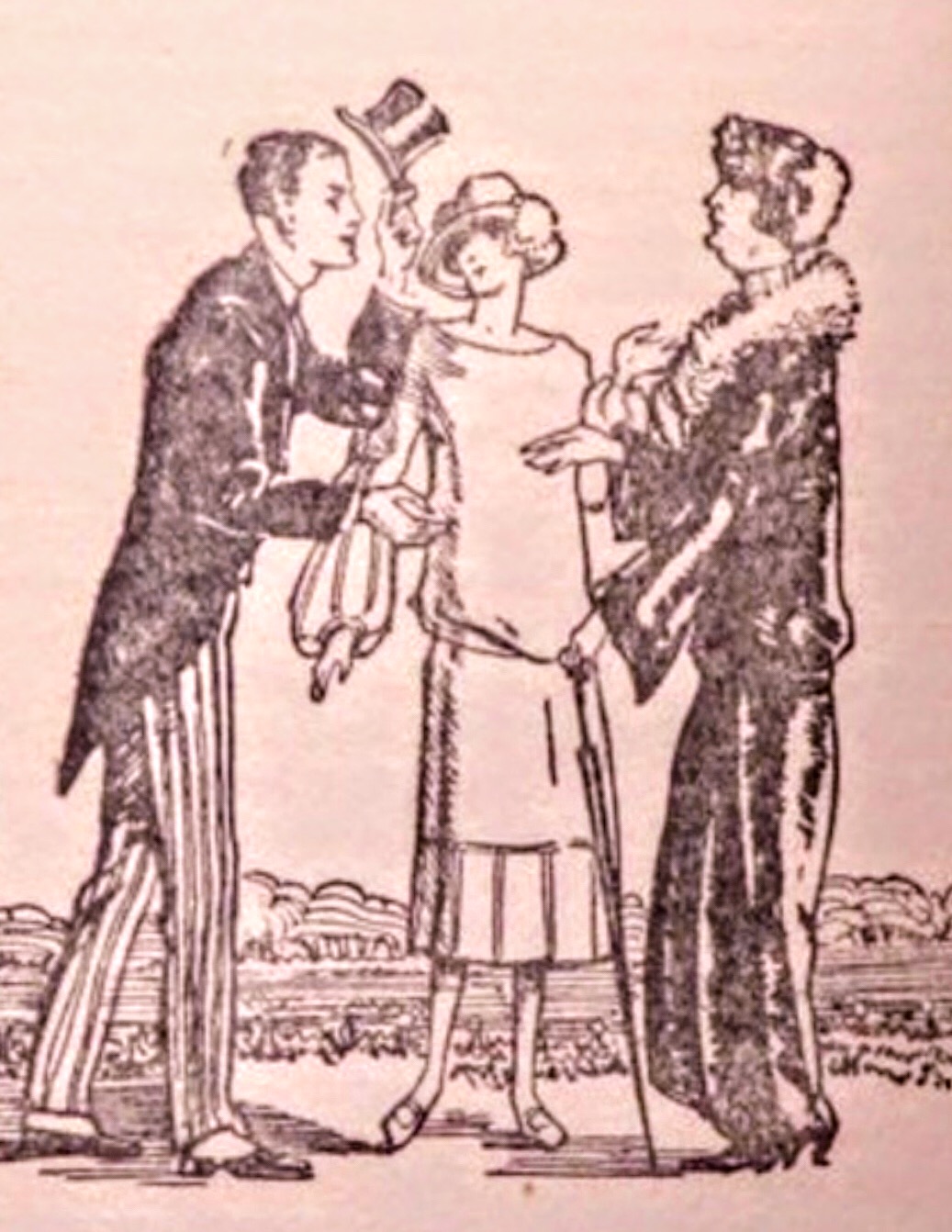
When making introductions one should remember that a man is always presented to a woman, a younger person to an older one and an unmarried woman to a matron. When introducing friends a good form to use is. “Miss Brown, let me present Mr. Jones.” If introducing a relative one should say, “Miss Black, may I present my cousin. Mr. White?”

Introducing Friend or Relative

Dear Mrs. Adams: 1. What is the proper way to introduce a friend or relative? 
2. In congratulating a bride or bride- groom-to-be, what must one say? 
3. What is an appropriate gift for a groom to present to his bride-to-be? 
4. On being invited to dine, how long before dinner should one arrange to arrive? When leaving, must one bid only the hostess or all the guests good-bye? –A Green One

1. When making introductions one should remember that a man is always presented to a woman, a younger person to an older one and an unmarried woman to a matron. When introducing friends a good form to use is. “Miss Brown, let me present Mr. Jones.” If introducing a relative one should say, “Miss Black, may I present my cousin. Mr. White?”
2. To the bride-to-be, one may say, “Let me offer hearty good wishes for your future happiness.” To the groom-to-be, one may say, “Accept my sincerest congratulations.” 
3. A piece of jewelry is the most appropriate gift. 
4. A dinner guest is to arrive at the hostess' home at the hour named in her invitation. When leaving, the guest politely thanks the hostess for the hospitality enjoyed. If there are few friends at the dinner, the person leaving may bid them all good evening; but if there are many guests present, she should bid a formal farewell to those friends nearest her.

Mother Insists

Dear Mrs. Adams: I am a girl of 15, and my mother insists that I shall go with a man of 26. I do not care for him. She compelled me to accept a gold watch from him as a Christmas present. What would you advise me to do in such a case? –Anxious 

While your mother may prove to be your best friend, I cannot help suggesting, in this case that you accept the young man's attentions, but treat him with indifference. He will soon understand that his company is not desired, and will not force his attentions on you. — San Francisco Call, 1910


🍽Etiquette Enthusiast, Maura J Graber, is the Site Editor for the Etiquipedia© Etiquette Encyclopedia

Saturday, October 23, 2021

More Introduction Etiquette

Make all your introductions simple. Say as few words as possible! Speak distinctly! 


HOW TO INTRODUCE

Make all your introductions simple. Say as few words as possible! Speak distinctly! 

As illustrations:
“Miss Brown, MAY I PRESENT Mr. Green?”
“Miss Brown, DO YOU KNOW Mr. Green?”

Or perhaps BEST OF ALL, simply their names:
“Miss Brown, Mr. Green.”

NEVER SAY:

“Miss Brown, I'D LIKE TO MAKE YOU ACQUAINTED WITH Mr. Green.”

“Mr. Jones, MEET Mr. Black.”

“Mr. Jones, SHAKE HANDS WITH Mr. Black.”

WHEN INTRODUCING A MAN TO A WOMAN always speak the woman's name FIRST!
 
You may say: “Mr. Green, HAVE YOU MET Miss Brown” – indicating that the introduction bestows a favor on the gentleman and on the woman the respect that all women receive from well-bred men.

NEVER SAY:
 
“Miss Brown, HAVE YOU MET Mr. Green?”
This conveys the impression that Mr. Green is more important than Miss Brown.

THERE ARE EXCEPTIONS HOWEVER:
Special distinction of office or advanced years may justify introducing a debutante to a famous author or scientist, a general or an admiral.

WHEN INTRODUCING MEN TO EACH OTHER, the best way is:
 
“Mr. Smith, Mr. Brown.” 


From “Good Manners: 
Reliable Advice on Etiquette – Clearly Told,” 1930


Etiquette Enthusiast, Maura J. Graber, is the Site Editor for the Etiquipedia© Etiquette Encyclopedia

Thursday, October 21, 2021

A Checklist of Introduction Etiquette

Always stand up to be introduced, or to make introductions.

Check-list on Introductions

1. Always introduce a man to a woman.

2. When introducing two men or two women, always introduce the younger to the older.

3. Say “May I present?” Or “I should like you to know.”

4. Always use proper titles such as Miss, Mr., Mrs., Captain, Doctor, Judge.

5. Shake hands like a man with a man. With a woman, only if she first offers her hand.

6. Always stand up to be introduced, or to make introductions.

7. Look squarely at the person you are meeting. Let your glance be firm but friendly.

8. Say “How do you do” after being introduced. Never say “Pleased to meetcha.”

9. Speak names clearly. Drop a hint if you want people to talk.

10. Catch the name if you can. Ask for it if you didn't. — From “Manners for Moderns”, 1938


Etiquette Enthusiast, Maura J Graber, is the Site Editor for the Etiquipedia© Etiquette Encyclopedia

Thursday, June 13, 2019

An Etiquettical Talk on Introductions

 “One other question—does a man rise every time a woman enters and leaves a room?” “Theoretically yes, practically no. He would look like a Jack in the box if there is much moving about.” – Nancy Page

Nancy Page has an “etiquettical” discussion regarding introductions.

Nancy found many old friends down in Florida. They were glad to see her and gave teas, receptions, bridge luncheons and affairs galore in her honor. At one sorority tea she noticed that one of the girls was watching her intently. Later she found the reason. It seems that the girls had been having an “etiquettical” discussion regarding introductions. They had been told to watch the guests at this particular tea. Later Nancy and the girls discussed the whole question. 


“Why did you remain seated when other folks were brought up to you and introduced, Mrs. Page?” “Because a woman never rises when being introduced unless the other person is elderly or very distinguished. Of course, if I were a young girl and were being introduced to—oh say, a person as old as I am—l would stand. That is youth's duty. But if I were a college girl being introduced to another, college girl X would not get up.” 

‘‘Would you rise if a man were brought up to be introduced?" “No indeed, unless he were most distinguished, say a Bishop, a President or a cabinet officer or foreign diplomat.” ‘‘Should the man rise if he is seated when a woman is brought up?” “Yes, surely. That motion of hospitality belongs unless he were aged.” 

“Should a man extend his hand in greeting to the woman?” “She should extend her hand first. Of course, if a man does reach out his hand she does not acknowledge it by extending her own, but the man made the error in putting his out first.” “One other question—does a man rise every time a woman enters and leaves a room?” “Theoretically yes, practically no. He would look like a Jack in the box if there is much moving about.” – “Nancy Page” by Florence La Ganke, 1929


Etiquette Enthusiast, Maura J Graber, is the Site Editor for the Etiquipedia© Etiquette Encyclopedia 

Thursday, March 22, 2018

Gilded Age Introduction Etiquette

Another bit of etiquette equally well defined is that a lady, after a gentleman has been introduced to her, should, on another meeting, recognize him first, it being her prerogative to drop the acquaintance if she sees fit. This bit of etiquette, however, is apt to be ignored, women instinctively falling into the habit of waiting for men to take the initiative in recognition, as everything else. Women frequently complain of the discourtesy of men in this matter, while the latter are merely observing the form of courtesy which etiquette has ordained.

Although it is an established rule of etiquette that persons meeting in society are at liberty to speak without an introduction when they know each other by sight, Americans are not very likely to do so; however familiar they may be with the rule. While it devolves on the host and hostess to introduce their guests, they cannot, of necessity, introduce more than a part of them; hence part of the duty falls upon the guest themselves. The awkwardness, even the anoyance of repeatedly meeting men and women with whose names and faces you are entirely familiar, but to whom you have not been introduced, is constantly observable in social circles. The presumption that members of the same calling, or of the same set, always know each other is entirely unwarranted. 

Even should they know each other, it can do no harm, if there be any doubt in the introducer’s mind, to represent them. It is easy to say: “ I suppose, Mrs. or Miss—, you are acquainted with Mr.—” or “No doubt, Mr.—, you have met Mr.—.” If the parties have been introduced, the offered courtesy will not be superfluous or embarrassing. If they have not been, the politeness is well-timed. The absence or neglect of this attention has a tendency to create a sort of antagonism between persons visually acquainted who have met again and again without recognition. Each is inclined to think: “He knows me very well, but he will not speak. If he feels so, I am sure I will not be the one to speak first.” 

We have known persons of prominence, men particularly; to encounter one another at parties and receptions through a whole season without an introduction. Having many friends in general, and being constantly thrown together, the mistake is naturally made that they are acquainted. Another bit of etiquette equally well defined is that a lady, after a gentleman has been introduced to her, should, on another meeting, recognize him first, it being her prerogative to drop the acquaintance if she sees fit. This bit of etiquette, however, is apt to be ignored, women instinctively falling into the habit of waiting for men to take the initiative in recognition, as everything else. Women frequently complain of the discourtesy of men in this matter, while the latter are merely observing the form of courtesy which etiquette has ordained. -Scribner's Monthly, 1875

Etiquette Enthusiast, Maura J. Graber, is the Site Editor for the Etiquipedia© Etiquette Encyclopedia

Saturday, October 15, 2016

Introduction Etiquette and Sisters

If the three should be together and there was a desire to introduce them, the form would be to present the elder as Miss Smith and the other two by their given names.

If there are three sisters in a family named Smith and a call is made at their home, if Miss Smith is asked for, it is supposed that the elder sister is desired; the others if desired, are called by their given names. If met individually it would be proper to address either as Miss Smith. 

If the three should be together and there was a desire to introduce them, the form would be to present the elder as Miss Smith and the other two by their given names, in addition to the family name. That is the rule if you follow etiquette, but if you do not follow that, then you may introduce the sisters each by her given as well as family name. – San Francisco Call, 1901

Etiquette Enthusiast, Maura J Graber, is the Site Editor for the Etiquipedia© Etiquette Encyclopedia

Saturday, November 28, 2015

Party Etiquette and Who to Invite

Avoid giving invitations to bores. They will come without.

Where the company is large, the ladies of the house should have tact enough to avoid introducing and placing together persons who cannot possibly assimilate, or take pleasure in each other's society. The dull, and the silly, will be far happier with their compeers. To a woman of talent, and a good conversationist, it is a cruelty to put her unnecessarily in contact with stupid, or unmeaning people. She is wasted and thrown away upon such as are neither amusing nor amusable. 

Neither is it well to bring together a gay, lively woman of the world, and a solemn, serious, repulsive dame, who is a contemner of the world and all its enjoyments. There can be no conversation that is mutually agreeable, between a real lady of true delicacy and refinement, and a so-called lady whose behaviour and talk are coarse and vulgar,—or between a woman of highly cultivated mind, and one who is grossly ignorant of every thing connected with books, and who boasts of that ignorance. We have heard a lady of fashion say, "Thank God, I never read." The answer might well have been, "You need not tell us that."

In inviting but a small company, it is indispensable to the pleasure of all, that you ask none who are strikingly unsuitable to the rest—or whose presence will throw a damp on conversation. Especially avoid bringing into the same room, persons who are at notorious enmity with each other, even if, unhappily, they should be members of the same family. Those who are known as adversaries should be invited on different evenings.

Avoid giving invitations to bores. They will come without. The word "bore" has an unpleasant and an inelegant sound. Still, we have not, as yet, found any substitute that so well expresses the meaning,—which, we opine, is a dull, tiresome man, or "a weariful woman," either inveterately silent, or inordinately talkative, but never saying any thing worth hearing, or worth remembering—people whom you receive unwillingly, and whom you take leave of with joy; and who, not having perception enough to know that their visits are always unwelcome, are the most sociable visiters imaginable, and the longest stayers.

In a conversation at Abbotsford, there chanced to be something said in reference to bores—those beings in whom "man delights not, nor woman neither." Sir Walter Scott asserted, humourously, that bores were always "good respectable people." "Otherwise," said he "there could be no bores. For if they were also scoundrels or brutes, we would keep no measures with them, but at once kick them out the house, and shut the door in their faces."

When you wish an introduction to a stranger lady, apply to your hostess, or to some of the family, or to one of the guests that is acquainted with that lady: you will then be led up and presented to her. Do not expect the stranger to be brought to you; it is your place to go to her. —
From The Ladies Guide to True Politeness and Perfect Manners, by Miss Leslie, 1864


Etiquette Enthusiast, Maura J. Graber, is the Site Editor for the Etiquipedia© Etiquette Encyclopedia