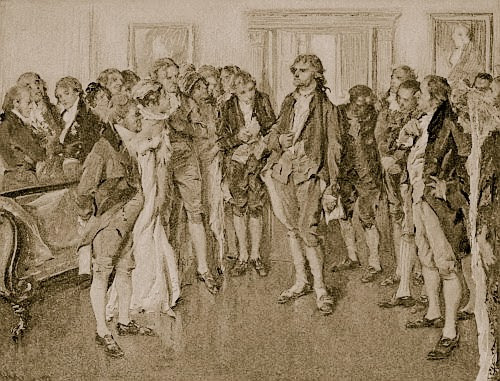
Jefferson had been told of what had taken place, and he quickly divined the object of this visit. Pulling on one boot, he took the other in his hand, and, in his velvet dressing-gown, proceeded to the drawing mom, and having half-opened the door, he turned to a servant behind him, and gave directions, in an easy manner, for the making ready of his horse. Then he entered the room, boot in hand, and smiled blandly upon his august visitors. “Really, my friends, this is an unexpected pleasure. Be seated, be seated, I beg. No ceremony here. I heard of your arrival and would not keep you waiting.” And then, with a gleesome laugh, he sat down, and pulled on his remaining boot, having done which he plunged offhand into a spirited conversation upon the pleasant relations then existing between their respective countries.
Another Anecdote of Thomas Jefferson’s Style
The story I am about to tell was first I told by an English woman. Mrs. Wright, who was cognizant of the circumstances. Those who know anything of Thomas Jefferson’s character know that he had a deep disrelish of all hollow forms and etiquette. When Jefferson came to the Presidential chair, he found considerable of these at the capital, and he at once determined, so far as lay in his power, to preserve that sterling, easy graceful, whole-hearted simplicity, which he deemed the appropriate characteristic of a republic.
One of the most annoying things that met him in the outset of his exalted career was the extreme, punctilious etiquette which the foreign ambassadors, and more especially their wives, introduced and sought to establish in its own drawing-rooms. Those who would not, or could not, copy them they treated with chilling hauteur. This evil he was resolved to nip in the bud, and deeming an example better than precept, he ordered his own carriage and conversed after a manner that must have been refreshing to the shade of Ben Franklin. When he rode, it was without servants or outriders, and when he visited tie announced his own name at the door.
At the Presidential mansion the utmost simplicity of manners prevailed. In his drawing-rooms he sought to make true and hearty sociality the rule, and at his tables, he made as little distinction of persons as possible. Of course, there had to be exceptions, but as a rule he placed those near him whom he deemed most worthy. The President was so pleasant, so cheerful, so kind, and so attentive to the wants and comforts of all who came near him, that no one could find a peg upon which to hang direct accusation. At length, however, the opportunity was offered, and was seized.
On a certain occasion, when the chief dignitaries of America and of all represented nations, were assembled at the Presidential mansion, the Ambassadors from abroad, seeming to feel that the dignity of their respective courts rested upon them, Jefferson received them all as nearly upon a social level us he could. The Spanish Minister was there blazing in gold and jewels, and his wife bore him company in a perfect bespanglement of diamonds, rubies, and emeralds.
Jefferson did not stop to consider —perhaps he did not know—the exact relative positions which court etiquette would have given to his foreign guests, and innocently enough he placed at the dinner-table the wife of the English Secretary of Legation above the wife of the Spanish Ambassador. The kind host had only thought of seating two dear friends together— the two wives of the British Minister and his secretary. But the wife of the Spanish Minister, as was natural, was deeply offended, and laid the case before the diplomatic corps. She was indignant, and eloquent, and she wielded an influence; and dually it was decided that on the morrow, the ministers of France and Spain should wait upon President Jefferson together, and demand of him that in future, proper respect should he paid to the rank of the Europeau potentates.
So, at a proper hour on the following day, the two ambassadors, in full court costume, with jeweled swords at their sides, culled at the President's mansion, and requested to see His Excellency, the President. They were shown into one of the drawing-rooms, and word was conveyed to Mr. Jefferson, who was engaged in the library. Now, Jefferson had been told of what had taken place, and he quickly divined the object of this visit. Pulling on one boot, he took the other in his hand, and, in his velvet dressing-gown, proceeded to the drawing mom, and having half-opened the door, he turned to a servant behind him, and gave directions, in an easy manner, for the making ready of his horse. Then he entered the room, boot in hand, and smiled blandly upon his august visitors.
“Really, my friends, this is an unexpected pleasure. Be seated, be seated, I beg. No ceremony here. I heard of your arrival and would not keep you waiting.” And then, with a gleesome laugh, he sat down, and pulled on his remaining boot, having done which he plunged offhand into a spirited conversation upon the pleasant relations then existing between their respective countries. No man living could talk more sensibly, more comprehensively, or more eloquently. By a graceful and adroit management of language he elevated the gentleman above the minister, and gave eminence to the Christian philosopher and humane heart above the frozen diplomatist.
The ambassadors were at first amazed and confounded, and then interested; and very quickly the combat between republican simplicity and truth, and autocrat pomp and hollowness, was decided. The representatives of Kings got away as soon as they could, and when they met their diplomatic companions and their wives, they reported : “It is of no use to contend. We might do it with some rulers, but not with this one. When we visit the President of the United Slates, we may as well make up our minds to leave the royal dignity of our masters behind us.”— S. C., Jr.,in the New York Ledger, 1878
Etiquette Enthusiast, Maura J. Graber, is the Site Editor for Etiquipedia© Etiquette Encyclopedia