Showing posts with label Making Societal Debut. Show all posts

Saturday, July 23, 2016

Etiquette and Presentation's Perks

 People pass up and down before the carriages, and criticise their occupants with the utmost freedom. The Prince and Princess of Wales are cheered as they go by in their gilded chariots; the Lord Mayor and High Sheriff must listen to comments on their gorgeousness, the Embassadors and public functionaries applauded or hooted, as fancy dictates.


The advantages of a presentation are somewhat visionary. It is supposed to give one a standing socially, for according to the theory the anyone presented at Court is entitled to be presented by the Embassador of his country, at any and every other Court. But, in fact, a presentation benefits only those who do not need it, and the great mass of those presented see nothing more of royalty. 


If they are never invited to the royal fetes or balls, they have little more interest in high society than they had before, and the chief benefit, so far as the masses of the presentees are concerned, is to see their names in the paper the next day, and so to be the envy of all the women who have not been presented. As a sort of social triumph it is worth striving for when that sort of distinction is deemed worth having, and for the sake of the honor women go through the tedious drill, the hours of weary waiting, the discomfort, and sometimes the humiliation, just to say they have been recognized by Majesty. 


In general, even this statement is not true. So far as England is concerned, the royal receptions are in the name of the Queen, but as a rule, after the Embassadors nave been received, the Queen retires and leaves her daughter-in-law, the Princess of Wales, to do the honors, which are thereby done quite as well, and the Queen is therefore saved the discomfort, to her no doubt very great of a tedious public audience. 

Those who have passed through it more than once generally concede thai a royal drawing-room is a misery to most of those concerned, and in particular to the ladies who receive the honor. It is not necessary to be among those presented, however, to share some of the benefits of a drawing-room. Persons of good character, having proper credentials and fortune enough to secure an introduction to the Lord Chamberlain, may receive tickets permitting them to stand in the corridors of the Palace and see the crowds of debutantes and their chaperones pass in and out on their way to and from the reception. 


Some people say this is really the most satisfactory way of "doing" a drawing-room, but good credentials are necessary and some influence to secure even so so slight a favor as that of being permitted to stand in the passage and see the nobility and gentry go by. It is not to be supposed, however, that there is no fun at a drawing-room. There is any quantity of it, but it is all for those who have neither part, nor lot, in the exercises within. The occasion is always announced in the papers some days before, and the order is given in which the carriages are to fall in line. 

The announcement never fails to attract the public, which gathers numerously, and bestows enthusiastic encouragement on the persons participating. For hours before the appointed time vehicles are slowly moving about the neighborhood in order to get ready to take a place, for the rule stands, first come first presented, and as the clock strikes there is a grand rush toward the Palace gate, and in the crush, carriages are often broken, sometimes overturned, and accidents to horses are quite frequent. The police lend their assistance to form the line, and after a carriage is in position, its occupants must wait from two to four hours until their turn comes at the Palace gate. 

Meantime, the people in groups pass up and down before the carriages, and criticise their occupants with the utmost freedom. The occasion is always available also for the display of patriotism. The Prince and Princess of Wales are cheered as they go by in their gilded chariots; the Lord Mayor and High Sheriff must listen to comments on their gorgeousness, the Embassadors and public functionaries applauded or hooted, as fancy dictates. In London it is not a statutuable offense to howl at anybody, from the Prince of Wales up or down, as you choose to count, and it frequently happens that unpopular public characters have, while waiting in the streets before Buckingham Palace, an excellent opportunity to ascertain what the public think of them. 

But nobody minds, and even the women who are stared at by the mob on the street, and commented upon, sometimes the reverse of respectful, take the matter very coolly. Their carriages are provided with curtains, but as a rule they seldom take the pains to draw them up. They are on exhibition, and if they do not object to the publicity, unwelcome though it sometimes is, no one else has it right to complain. — San Francisco, 1891

Etiquette Enthusiast, Maura J Graber, is the Site Moderator and Editor for the Etiquipedia© Etiquette Encyclopedia 

Tuesday, July 19, 2016

More Court Presentation Etiquette

When her Majesty does not hold the drawing-rooms, she usually commands the Princess of Wales or one of her daughters to take her place, and all presentations are considered the same as to the Queen herself.  

Charm of the Presentation 


Probably the greatest charm of the presentation lies in the fuss made over the debutante by the debutante's friends. It is talked of weeks before and weeks after, and the day itself is one of long and delirious excitement. 

Immediately after leaving the palace, everyone drives to the photographer's to immortalize the gown. It is difficult to imagine how the photographers get through such a day, for not only have they so many appointments, but they are all for nearly the same hour. Nearly every woman who is presented issues invitations for what is known as a "drawing-room tea," and immediately after her return from the studio and a short turn in the park she stands for a couple of hours while her friends flock in to admire her gown, talk over the presentation and congratulate her. 

If at no other time in her life she is queen of the assemblage, she is this once, and she enjoys it as fully as only her feminine nature is capable of doing. How differently the men take their presentation to the Prince of Wales when he holds a levee. They drive unconcernedly through town in hansoms, their brilliant uniforms or Court dress standing out against the dark background of the cabs. At 2 o'clock the whole thing is over, and except for the flash of a helmet or the glitter of gold braid from a passing cab London, would not know that a levee was being held. 


The Queen, even when she holds a drawing-room in person, which is rarely more than twice during the season, does not remain for all the presentations, as her advancing years make the fatigue too great for her to bear. She may receive half of the list, but usually leaves the Palace about half-past four, for a drive in Hyde Park. This is one of the few occasions which the Londoners have for demonstrating their loyalty, for the Queen dislikes London intensely and spends as little time there as possible.


Hyde Park corner and the park are crowded with people on this afternoon, who are eager to catch a glimpse of her Majesty, and, while her reception is an enthusiastic one for the English to give, it must appear cold to those who are accustomed to the demonstrations some of the popular Continental sovereigns receive. This being the year of the Queen's eightieth birthday, the number of applicants to the Lord Chamberlain for presentation has been very large, especially for those drawing-rooms the Queen has held in person. 


When her Majesty does not hold the drawing-rooms, she usually commands the Princess of Wales or one of her daughters to take her place, and all presentations are considered the same as to the Queen herself.  —San Francisco Call, 1899

Etiquette Enthusiast, Maura J Graber, is the Site Moderator and Editor for the Etiquipedia© Etiquette Encyclopedia 

Monday, November 18, 2013

Etiquette, Debuts, Debutantes and a "Texas Dip"

Texas debutantes practice the “Texas Dip”

Debutantes and Debuts

Although a debutante is a novice in that worldly wisdom which time imparts, it is presumed that she has been instructed in the best principles of society, and that she is prepared to fulfill its obligations. In the best society everywhere the appearance of an immature school-girl at a party of grown people is unusual, and the only celebrations which are considered of sufficient importance to distract her mind from studious pursuits are those domestic occasions when the immediate kins-people are present. A debut does not necessarily put an end to all grave and intellectual pursuits; but it opens the way for so much gayety that the barrier should not be removed until the mental development has reached a standard that cannot be lowered by the fascinations of the social world. A young girl, whose student life is broken in upon by social diversions that captivate her imagination and interfere with those processes which are indispensable to a well-balanced and active mentality, is not apt, when removed from the circle where her omissions and commissions are rated according to her immaturity, to reflect favorably upon the influences which have shaped her mind and manners; nor can it be expected that such an one will become the superior woman whose social graces are the evidence and the flower of a cultivated mind and a kindly heart. 

No argument in favor of postponing the entree of a girl into society, until she has acquired the requisite training in all ways, is necessary for those wise women who are in the best and fullest sense brilliant society-women. There are, however, localities where no barrier, or at most but a slight one, exists between the social and student life of a young girl whose stature has carried her out of short frocks; and there are matrons whose indulgence leads them to overrule their own sense of what is fitting in favor of their daughter's desire for enjoying before their season the delights of social festivities. It is to such that a protest may be addressed.

When Jacqueline Bouvier made her society debut in 1947, a Hearst columnist, Igor Cassini dubbed her the "debutante of the year." She would later reside in the White House, as the wife of President John F. Kennedy 

A girl's formal presentation to society is rarely made before she is eighteen and sometimes not until she is nineteen or twenty. Previous to the date decided upon for the celebration her mother calls upon those of her acquaintance whom she desires to be present at her daughter's debut, and leaves her husband's card and, if she has grown-up sons, their cards also. The invitations which follow this preliminary are sent out about ten days or two weeks in advance of the date. 

Young men usually decry for themselves the observances which mark the appearance of their sisters in the social world, and their status as members of society usually dates from their appearance at the semi-formal entertainments given by their parents, while their early popularity depends largely upon the effort they have made to be agreeable to the guests of their parents and the friends of their sisters. A young man who graciously does escort duty for his sisters needs no formal announcement of his eighteenth or twenty-first birthday to convince his acquaintance that he may with propriety be invited to participate in the social enjoyments suited to his kind. He may not desire them; indeed, he often shuns them, and it is this masculine shrinking from social intercourse with any but near friends or relatives, in connection with the demands of preparatory scholastic pursuits, college life or an early business training, which tend to defer his appearance in the capacity of a society-man considerably beyond the age when his sisters are launched upon the tide of social gayety. 

It is customary, when a young man has completed his studies away from home or has been traveling abroad, for the ladies of his family to leave his cards with their own upon the members of their social circle at the beginning of the season, and this simple ceremony entitles him to the same formal consideration as the other members of his family in the matter of invitations, and involves the observance of a courteous recognition on his part.

Young girls never wear a profusion of jewelry; debutantes often none at all, though a necklace or dog-collar of pearls is not inappropriate. 

The toilette of a debutante is never elaborate. White is the favorite tint, and when her presentation is made at a ball or party, a diaphanous material is selected, tulle, *grenadine, *lisse, *mull, etc., being suitable. For an afternoon reception or tea she may also wear white, but veiling, fine cashmere, soft *surah and similar fabrics are more suitable than gauzy textures. If she have elder sisters, they may mark the difference in their social ages by wearing somewhat heavier white goods or delicate colored materials. Young girls never wear a profusion of jewelry; debutantes often none at all, though a necklace or dog-collar of pearls is not inappropriate. The dress should be of dancing length and simply made up.

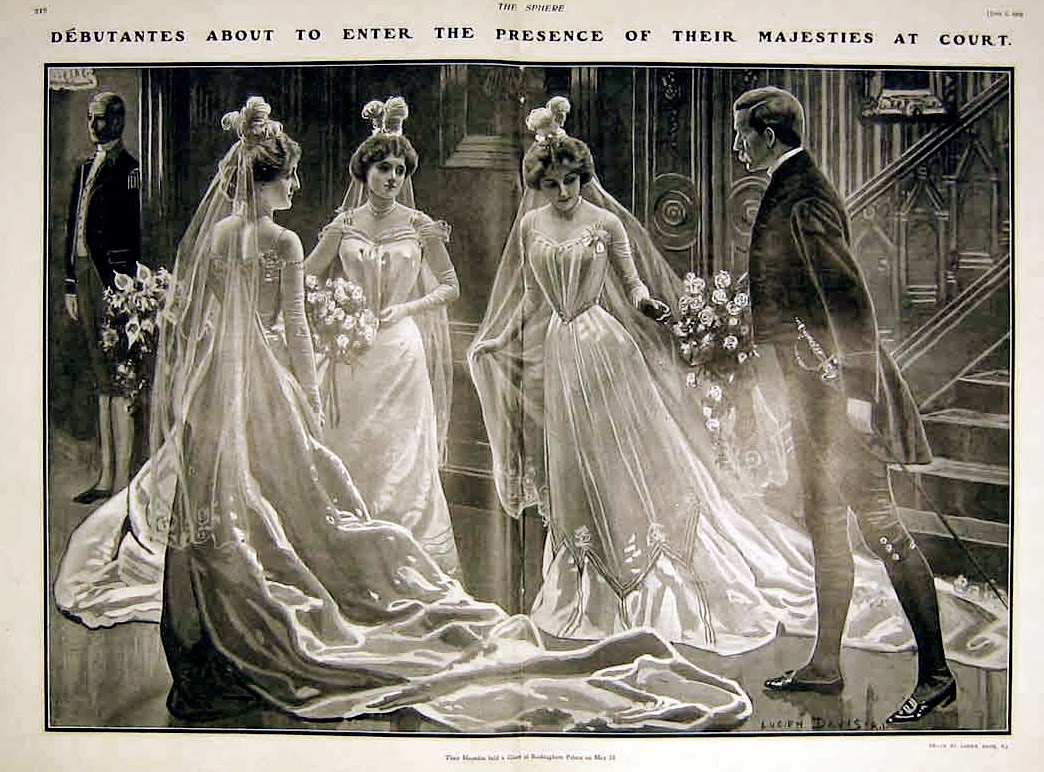
Debutantes Readying to Meet Royalty; To make one's “debut,” or to enter into society, has its roots in the Royal Court of France. By the reign of Britain's King George III (1760-1820), Queen Charlotte started a tradition of introducing and presenting the young aristocratic women of court to society. Known as "debutantes" from Queen Victoria's reign in 1837 and on, there was strict etiquette to follow regarding proper costume for court presentations; Fashionable evening dresses with head-dresses of veiling, feathers and a train trailing the dress from the waist. Long, white kid gloves, pretty fans or fragrant bouquets added to the look and offered a bit of diversity in look for the young debutantes.

THE TEXAS DIP

The "Texas Dip" is a most extreme curtsey. It is performed by Texan debutantes when formally introduced at the International Debutante Ball in the Waldorf-Astoria. Young women slowly lower their foreheads to the floor by crossing their ankles, then bending their knees and sinking. An escort's hand is held by a debutante during the dip. When a debutante's head nears the floor, she turns her head sideways, averting the risk of soiling her dress with her lipstick or make-up.

The International Debutante Ball is an invitation-only formal debutante ball to present young ladies to high society. Founded in 1954, the ball is considered the most prestigious and the most exclusive debutante ball in the world. It occurs every two years at the Waldorf Astoria Hotel in New York City. Young women from around the globe and all over the United States are brought together at the ball and the surrounding parties with daughters of prominent politicians, diplomats, nobility, ambassadors. 

Debutantes with their military escorts 

Over the years the International Debutante Ball has benefited numerous charities from the Ball's own foundation including the Soldiers’, Sailors’, Marines’, Coast Guard and Airmen’s Club of New York, which provides a home away from home for men and women of the United States Armed Services.

How to do the "Texas Dip" when being presented; 
1. Face the audience & hand your bouquet to your escort.
2. Bring your arms forward, level with the floor.
3. Cross your ankles, spread your arms, and bend at the knees.
4. Sink gracefully to the ground while maintaining eye contact with the audience.
5. Lower your forehead to the floor, but avoid soiling your dress with your make-up.

Executing a perfect Texas Dip 

*Surah: A light weight, lustrous twill weave constructed fabric with a silk-like hand

*Lisse: A fine, filmy, lightly crinkled gauze fabric used in strips for making ruching or for finishing garments

*Mull: A soft fine sheer fabric of cotton, silk, or rayon

*Grenadine: A weave characterized by its light, open, gauze-like feel. It is produced on jacquard looms 


 🍽Etiquette Enthusiast, Maura J. Graber of The RSVP Institute of Etiquette, is the Site Editor for the Etiquipedia© Etiquette Encyclopedia