Showing posts with label Gilded Age Servants. Show all posts

Thursday, May 28, 2026

A Tip Proves Politeness Pays

Taking pride in one’s position means that the goal is to always provide excellent service, not to merely gain tips. The tip is a bonus and should not be expected. Especially tips like the tip in this story… — A tip of $100.00 U.S. dollars in 1895 is equivalent in purchasing power to about $3,964.52 today. Almost $4000.00, reflecting an average annual inflation rate of 2.85%.

POLITENESS PAYS

Henry Cary, one of the very best of the many good servants employed by the Pennsylvania railroad, died about two years ago, lamented and respected by every officer of the road whom he came in contact with. Carey was one of those ideal servants who was never around except when he was wanted, and then he was sure to be in evidence. He had that happy faculty of knowing just what was the right thing to do at the right moment, and if he was not wanted you would think the earth had swallowed him up, and in the moment he was wanted he appeared to descend from the clouds. 

A little incident in his life is worth relating before he got into the employ of the railroad company. At that time he was porter of one of the Pullman cars, and one day just as they were leaving the station in Chicago he was going through the cars, when one of the passengers asked him for some slight information. He said be didn't know, but would find out and bring back the answer, which he did in a few minutes. The passenger then asked him to be good enough to hand him a drink of water. He said “certainly” in a most pelite way and brought him the glass of water. 

The passenger was quite taken with the kindly face of Carey, and said to him that he was not very well and might get worse on the journey and asked him if he wouldn’t be good enough to pay him some little attention on the way. Carey then told him that that was not his car, that his car was in front and that he could give him but very little attention there. He then asked if he might not be removed to the front car. Carey said that he would have to consult the conductor, which he did. The conductor agreed to the transfer and he was moved into Carey’s car. 

For the first eight or ten hours the man was rather under the weather, but Carey gave him every attention in his power, and from that on he rather improved, but Carey still kept on his kind attention, bringing him everything he thought he might like, and doing everything that he wanted. When he arrived in Philadelphia, Carey took his valise out to the platform. When the passenger, watching his opportunity, saw the porter of the other car that he had left come up to Carey, the passenger put his hand in his vest pocket, took out a hundred dollar note and banded it to Carey saying: “I want to thank you for your attention to me on the journey here, and I also want to reward you for your kindness to me. Good day, I hope you may have a prosperous time.” To say that the porter whose car the passenger had left dropped dead, is to modestly depict his feelings.- Philadelphia Times, 1895


🍽Etiquette Enthusiast, Maura J. Graber, of The RSVP Institute of Etiquette, is the Site Editor for the Etiquipedia© Etiquette Encyclopedia

Sunday, October 19, 2025

Gilded Age Etiquette Christian-Based

22. Leave your plate with the knife and fork lying parallel, the handles pointing to the right. – 
“The 12 o'clock and 6 o'clock or 5 and 11 are the official ‘Finished’ positions for one's knife and fork for American-style dining, but this Continental-style position seems to be universally recognized as the ‘Finished’ position for one's utensils. I recommend placing these as far to the right as possible on a plate. That way, when the server or waiter removes your plate, he or she can grasp the handles of the flatware at the same time as grasping the plate, and remove the three noiselessly from your right side. If sitting in a booth, and the only way that your plates can be removed is from your left side, a courtesy is to place the utensils together toward the left hand side of your plate. Etiquette rules can be flexible, especially when it comes to the consideration of others.” – Photo and text from the book, 
What Have We Here?: The Etiquette and Essentials of Lives Once Lived, from the Georgian Era through the Gilded Age and Beyond... by Etiquipedia Site Editor, Maura J. Graber

 RULES FOR TABLE ETIQUETTE

True politeness has its origin in Christian charity and kindness, and all standard rules of etiquette were founded for the greater convenience and happiness of all the members of society. Although the reasons may not be obvious at first sight, they exist, and will be apparent on a careful consideration.

1. Do not keep others waiting for you, either at the beginning or at the close of the meal.

2. Do not sip soup from the tip, but from the side of the spoon.

3. Be careful not to drop nor spill anything on the table cloth.

4. Keep your plate neat; do not heap all sorts of food on it at once.

5. In passing your plate to be re- helped, retain the knife and fork.

6. When asked for a dish, do not shove but hand it.

7. While drinking do not look around.

8. Instruct the servant to hand the cup at the left side, so that it may be received by the right hand.

9. Do not drink your tea or coffee without first removing the teaspoon from the cup to the saucer.

10. Use the knife for cutting only; never put it to the lips nor in the mouth.

11. Break your bread into small pieces and rest there on your plate while spreading.

12. Do not eat too fast. Besides giving one the appearance of greed, it is not healthy.

13. If you find anything disagreeable in your food put it aside as quietly as possible, without drawing the attention of any one to it.

14. Do not open the lips nor make any unnecessary noise in chewing.

15. Do not touch the head.

16. Do not rest the elbow on the table.

17. Do not speak with the mouth full.

18. Brush the table neatly before bringing on the dessert.

19. Be thoughtful and attentive to the wants of those about you.

20. Converse on pleasant subjects with those sitting near you.

21. Do not say anything not intended for all present to hear.

22. Leave your plate with the knife and fork lying parallel, the handles pointing to the right.

23. Never leave the table before others without asking the lady or gentleman who presides to excuse you. 

– Russian River Flag, 1871


🍽️Etiquette Enthusiast, Maura J. Graber of The RSVP Institute of Etiquette, is the Site Editor of the Etiquipedia© Etiquette Encyclopedia  

Sunday, January 7, 2024

Gilded Age Etiquette of “Not at Home”

  “Not at home” is all-sufficient explanation, provided always that a servant is able to give a direct answer at once of “Not at home” when the query is put to him… – Mr. Hefty was not pleased to see unexpected guests, when Mrs. Astor literally was, “Not at home.”
🎩 🎩 🎩 🎩 🎩 🎩 🎩 🎩
William Ryall as Mrs. Astor’s butler, “Mr. Hefty” with Nathan Lane’s “Ward Mc Allister,” in HBO’s The Gilded Age – Photo source HBO
A mistress of a house should inform her servant after or before luncheon, or before the hours for calling, whether she intends to be “at home” to visitors or not during the afternoon. 

“Not at home” is the understood formula expressive of not wishing to see visitors. “Not at home” is not intended to imply an untruth, but rather to signify that for some reason, or reasons, it is not desirable to see visitors; and as it would be impossible to explain to acquaintances, the why and the wherefore of its being inconvenient to receive visitors, the formula of “Not at home” is all-sufficient explanation, provided always that a servant is able to give a direct answer at once of “Not at home” when the query is put to him. 

If a servant is not sure as to whether his mistress wishes to see visitors or not, it is almost a direct offense to the lady calling if he hesitates as to his answer, and leaves her either sitting in her carriage or standing in the hall, while He will see if his mistress is “At home,” perhaps returning with the unsatisfactory answer that she is “Not at home;” in which case the intimation is almost received as a personal exclusion rather than as a general exclusion of visitors.

If a lady is dressing to go out when a visitor calls, the servant can mention that fact to a visitor calling, and offer to ascertain if his mistress will see the caller; and the caller should use her own discretion as to whether she will allow him to do so or not; but unless the visit is one of importance, it would be best in such a case only to leave. – From “Manners and Rules of Good Society,” 1873


🍽Etiquette Enthusiast, Maura J Graber, is the Site Editor for the Etiquipedia© Etiquette Encyclopedia


Thursday, December 8, 2022

Gilded Age Tabletops and Manners


The teaching of table manners cannot be begun too soon. But children should never be allowed to trouble guests. If not old enough to behave well at table, guests should not be invited to the meals at which they are present. It is very trying to parents, guests, and servants.

It is well in all households, if possible, for the children to breakfast and lunch with their parents. The teaching of table manners cannot be begun too soon. But children should never be allowed to trouble guests. If not old enough to behave well at table, guests should not be invited to the meals at which they are present. It is very trying to parents, guests, and servants.

When luncheon is to be an agreeable social repast, which guests are expected to share, then the children should dine elsewhere. No mother succeeds better in the rearing of her children than she who has a nursery dining-room, where, under her own eye, her bantlings are properly fed. It is not so much trouble, either, as one would think– and no matter if it is trouble.

Table mats are no longer used in stylish houses, either at luncheon or at dinner. The waiter should have a coarse towel in the butler’s pantry, and wipe each dish before he puts it on the table. Menu-cards are never used at luncheon. Salt-cellars and small water carafes may be placed up and down the luncheon-table.

In our country, where servants run away and leave their mistress when she is expecting guests, it is well to be able to improvise a dish from such materials as may be at hand. Nothing is better than a cod mayonnaise. A cod boiled in the morning is a friend in the afternoon.– From “Manners and Social Usages,” by Mrs. John Sherwood, 1884


 🍽️Etiquette Enthusiast, Maura J. Graber, is the Site Editor for the Etiquipedia© Etiquette Encyclopedia

Sunday, April 3, 2022

Etiquette and Finding “Good Help”


It has always been a ludicrous fiction that servants were deaf and blind to what was going on around them, and people who envy the household staff of bygone eras might reflect on what they did to privacy. There may have been fewer attempts to publish the family secrets then, although that was not unknown, but instances blackmail, from the gentle variety to the blatant, were plentiful. —Image of Douglas Sills, left, Michael Cerveris, Celia Keenan-Bolger and Kelley Curran in a scene from HBO's “The Gilded Age,” by Alison Cohen Rosa/HBO


DEAR MISS MANNERS - I have just been engaged as a maid in an exceedingly aristocratic household. I suspect it is true that “Good help is hard to find nowadays,” since I got the position without having had any previous experience. I think my false letters of recommendation may have assisted in this; at any rate, many uncomfortable moments have arisen from my lack of expertise. Most recently, my employer — who is rather eccentric, comme tout le Beau Monde, n'est pas? — insisted on introducing me to one of her visitors, a young woman who, according to the newspaper, is heir to $50 million. This heiress greeted me pleasantly, but didn't offer to shake my hand. I just smiled and clutched my dust-mop. Should I have offered my own hand? I would very much appreciate an answer to this and any suggestions you might have for my success in the domestic service. I want to stay hired at least until I have enough material for a novel entitled “The Dust-Mop May Eavesdrop.”
 
P.S. In all fairness, I think you should also include some advice for my employer. Thank you.

GENTLE READER - Miss Manners’ advice to your employer is: Watch out. You’re welcome. 

It has always been a ludicrous fiction that servants were deaf and blind to what was going on around them, and people who envy the household staff of bygone eras might reflect on what they did to privacy. There may have been fewer attempts to publish the family secrets then, although that was not unknown, but instances of blackmail, from the gentle variety to the blatant, were plentiful. Nevertheless, that fiction served the dignity of both employer and employee. If nothing is officially observed by the servant, then there is no need for commenting about what is going on —which always leads to trouble. — Judith Martin, aka “Miss Manners,” 1982


Etiquette Enthusiast, Maura J .Graber, is the Site Editor for the Etiquipedia© Etiquette Encyclopedia

Monday, January 10, 2022

Gilded Age Help “Without Beer”

They eat very little meat, most of it salt; the cheapest kind of fish, and then they have potatoes and greens and puddings with treacle; and they are provided with beer, unless in engaging servants it is stipulated that the engagement is “without beer.”

Keeping House In London

An American taking a house in London will learn that she will have to keep more servants in the old country than in the new. These servants are trained, and one who is willing to engage to do many things, is usually willing to take such a position because she is incompetent in everything. 

A small family there would keep a cook, a chambermaid and a waitress. The washing would be put out, and a charwoman would be called in once a week to help with the general cleaning and clearing up. A very good cook can be had for one hundred dollars a year, a chambermaid for sixty dollars, and a smart waitress for eighty dollars. The charwoman will be paid two shillings, or fifty cents a day, and given her beer and food. The washing for such a family will cost from three to four dollars a week. 

In America, such a family would have two women — one a cook, who would also wash and iron, and another as chambermaid and waitress. The servants we have here do more, but they do it more roughly, and are totally deficient in that silent subservience which makes the trained English domestic perform the usual household duties with automatic celerity. 

Generally, you have to have a greater number of servants there than here, but wages are less, and the feeding costs less. There, the servants do not expect to eat just what is provided for the family. Not at all. When the marketing is done special things are bought for the servants, and they have a table for their own, the meals being served at a different hour, and the quality of food very much less in cost. They eat very little meat, most of it salt; the cheapest kind of fish, and then they have potatoes and greens and puddings with treacle; and they are provided with beer, unless in engaging servants it is stipulated that the engagement is “without beer.”— John Gilmer Speed, 1892


Etiquette Enthusiast, Maura J. Graber, is the Site Editor for the Etiquipedia© Etiquette Encyclopedia


Saturday, October 2, 2021

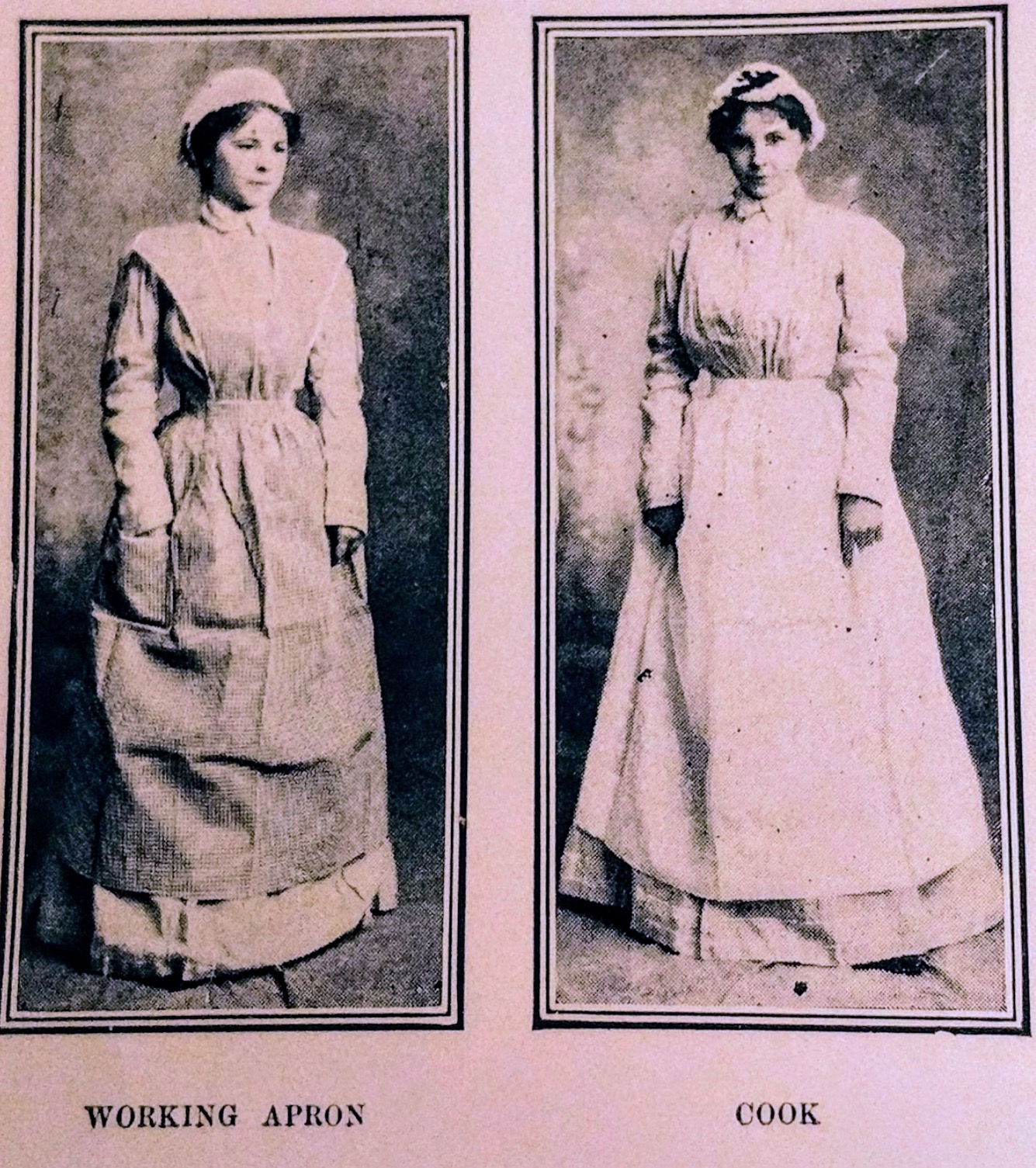
Dressing Gilded Age Cooks and Kitchen Help

“The dress was the final piece of clothing; it would still have had a high neckline in the 1890s-no low scoop-and long sleeves that had to be pushed up for cooking. Fabric colors were solid and muted: a light blue or gray, perhaps. The final touches were sensible shoes, perhaps boots, hair pushed into a mobcap or cook's cap, and a spotless apron. (Women almost never cut their hair and therefore a cap was necessary. In fact, a short-haired cook applying for a job would be regarded with suspicion. A woman had her hair cut for just two reasons: to remove lice or to sell hair for money.) According to a 1904 House Beautiful article, outfits were often changed mid-afternoon to provide a more formal appearance for the evening.”

In a large private household, the kitchen maid was always the first to rise, cleaning the stove, firing it, scrubbing the floor, making tea, and then bringing a cup to the cook, who might request help in getting dressed. The first article of clothing donned in the morning was a set of split drawers followed by a camisole: cotton in the summer, wool in the winter. The lady of the household, however, wore a one-piece version that was made of silk or extremely fine cotton, so thin that it could pass through her wedding ring, much like a handkerchief. This distinction in the quality of clothing between employer and cook was continued within the household hierar chy: kitchen and housemaids wore even coarser fabrics than the cook. The same inequality was also true between households of different social sta tus: a wealthy family provided better garments for its cook than did one of merely middle-class stature.

Next were the wool stockings, held up by ribbons or, toward the end of the nineteenth century, elasticized garters. The cook would then slip on a petticoat: red flannel in the winter, cotton in the summer. The corset was next, loosely laced and ending above the hips so that the cook would bend easily while working. (Her mistress wore a tightly laced corset to appear as narrow-waisted as possible; a thin cook was never a good sign. Corsets also provided bust support since brassieres were not invented until the 1920s.) The stays were made of a springlike steel, rather than whalebone, another contribution of the Industrial Revolution. One inevitably wonders how one tightened a corset when dressing alone. One clever solution was to install a metal ring on the wall of a servant's bedroom. The wearer would tie the corset strings to the ring and simply walk away to tighten it. A cook was likely to wear a corset made of coarse material and there fore a sleeveless corset cover was often slipped on next; this protected the petticoat or dress that rubbed up against it from chafing and wear. 

The dress was the final piece of clothing; it would still have had a high neckline in the 1890s-no low scoop-and long sleeves that had to be pushed up for cooking. Fabric colors were solid and muted: a light blue or gray, perhaps. The final touches were sensible shoes, perhaps boots, hair pushed into a mobcap or cook's cap, and a spotless apron. (Women almost never cut their hair and therefore a cap was necessary. In fact, a short-haired cook applying for a job would be regarded with suspicion. A woman had her hair cut for just two reasons: to remove lice or to sell hair for money.) According to a 1904 House Beautiful article, outfits were often changed mid-afternoon to provide a more formal appearance for the evening.

As the century progressed, however, social equality became the cry of the working class and so the workmen, maids, and cooks often chose clothing that mimicked that of their employers. Harper's Bazaar noted this trend in 1867, pointing out that crinoline and a flowing train of silk have no place next to a red hot stove or dirty kitchen floor. Instead, they promoted looser, more practical clothing, preferring the flowing blouse of the French workman to the tight-fitting coats and pants often worn by the lower classes in imitation of their masters. This smacked of putting the working class in their place, however, as in this printed admonition: "Let her take the advice of the tasteful, who will tell her that the rude freshness of natu ral appears to the greatest advantage in a plain setting."

The pay was modest-a few hundred dollars per year-although cooks in wealthy households were at the high end of the scale and were usually treated well, since a good cook was hard to come by: poaching within one's social circle was not uncommon. (Cooks had their own menu books collections of personal recipes and the mistress of the household would choose among them to create menus.) Life with a middle-class family, however, was often a nightmare; the mistress of the house often had little experience with managing servants, so they were often poorly treated and paid. To get by, then, the cook had her own bag of tricks. When interviewing for employment, she would ask if she could choose the tradesmen. This was crucial, since she often asked purveyors to mark up their prices, paying her the difference. She would also inquire as to the dispensation of the pan drippings and candle ends, both of which could be sold for ready money. On the other hand, servants, including cooks, had their quarterly pay docked if they broke a plate or burned the pudding. In some cases, the servant owed the household money at payday.

As for washing, undergarments, including petticoats, would be laundered either commercially or in-house, but dresses would only be spot cleaned, since they were usually made of finer, more expensive material and could not withstand constant soap and water. One could purchase "double-motion" hand-cranked washing machines, fashioned from galva nized iron and white cedar tubs. Also for sale were endless designs for racks to dry clothes outside (including one model that attached to a window frame), wash benches, ironing tables, ironing boards, and bosom boards, designed specifically for ironing shirts.

By the early 1900s, however, a private home was often no longer staffed by numerous household servants but reduced to employing just one all purpose maidservant. In the 1904 The Expert Maid-Servant, the mistress of the household is cautioned that cooking would be just one of the maid servant's many duties and therefore one had to inquire whether the potential employee understood plain cooking and could follow a simple recipe. “More elaborate accomplishments can rarely be looked for in a maid-of-all-work.” By 1920, after the devastation of the First World War and the influenza epidemic, and the increased availability of factory and other nondomestic jobs, the era of the well-staffed Victorian household was at an end both here and in England. – From Christopher Kimball’s book, “Fannie’s Last Supper”


Etiquette Enthusiast, Maura J. Graber, is the Site Editor for the Etiquipedia© Etiquette Encyclopedia

Wednesday, July 21, 2021

Etiquette and English Maids in America

The English maid’s cap has ceased to be sine qua non of the English maid which it is regarded on this side of the water.
 
– Photo Source Pinterest

The maid’s cap has got into the English courts. A servant sued her employer for wages after dismissal, because she would not wear caps. They learned Q.C. admitted that the subject was a very delicate one, and seemed to be ever a cause of complaint between mistresses and maids. It was finally decided that the refusal to wear caps per se was not sufficient ground to discharge a servant out of time. The particular case in question took on some other phases, but this part of the decision implies, by inference, that the cap has ceased to be sine qua non of the English maid which it is regarded on this side of the water.

It is certain, as many housekeepers will testify, that the English maid, supposedly admirably trained and accustomed to service, gives more trouble on American soil than servants of other nationalities. She exaggerates the freedom of America, and takes not only liberty but license without restraint. Such of them as serve in the houses of our very rich countrymen are not open to this criticism; they are clever enough to show a deference to the wealth about them, if they do not feel it, but those English maids that drift into the average American household are, for the most part, intolerable in speech and manner. —The New York Times, 1895


Etiquette Enthusiast, Maura J. Graber, is the Site Editor for the Etiquipedia© Etiquette Encyclopedia

Tuesday, June 22, 2021

Meeting Servants Outside the Home

American cooking expert and teacher, Fannie Farmer, was the first cookbook author to use strict standardized measurements. Called “the mother of level measurements,” Fannie helped popularize a more scientific approach to cooking and housekeeping, and inspired doctors and nurses with her innovative teachings on convalescent diet and nutrition. Her legacy is the renowned, late 19th century, “Fannie Farmer Cookbook.” – Photo source, Pinterest


“A suburban bachelor” writes to a London periodical begging to be informed on a question of etiquette — “How to greet one’s irreproachable maid servant on meeting her as occasionally happens on the highway.” “I smile suavely,” he confesses; “so does Ann or Ellen. But they no more than myself are reconciled to an incongruous position. How do you manage, my brethren?” This question seems absurdly simple. Why not smile and nod, with or without a civil, “How d’ye do?” or “Well, ‘Ann.’ or ‘Ellen.’” as one’s amiability or temperament dictates. That salutation ought not to be too friendly, not yet too incongruous.

The discussion gives point to a recent little experience of a New Yorker. He is a suburban householder from May to November, and the other day, a week’s unpleasantness on the part of the cook of his domain terminated in an intolerable impertinence one morning, just as he was leaving the house to catch a train for the city. He stopped long enough to interfere on his wife’s behalf, and sternly dismissed the delinquent maid coming in, telling her as a final word on no account to let him find her in his house when he should come home at night. Then he caught his train, and in the press of office affairs forgot all about the mornings moil. 

As he was leaving the car in the evening, however, he saw a woman of genteel appearance, whose face was strangely familiar, waiting at the station to board an inbound train which had just arrived. As their eyes met there came over her countenance the peculiar expression, which means, ‘I don’t believe you’re going to recognize me!’ and thinking it was someone whom he knew, but could not place, he hurried forward with a cordial salutation. 

He was about to take her satchel and assist her on the train when the curious familiarity of her appearance resolved itself into identity, and he saw that she was his late-cook. “Which gave me,” he said telling about it, “the comfortable sensation one has, to be left facing the onlookers after a run down a ferry bridge, to catch a retreating boat and finding the jump too wide.” — The New York Times, 1892


Etiquette Enthusiast, Maura J. Graber, is the Site Editor for the Etiquipedia© Etiquette Encyclopedia 

Wednesday, December 9, 2020

Giving One’s First Dinner in 1878

“In many families, the master and mistress sit opposite at the middle of the table, so that they can attend more especially to all their guests; and this is an excellent plan...” — This was a popular French method of seating for spouses, that was adopted by many in the U.S. at the time. Sitting across from one another, a host and hostess could signal one another silently, without guests being aware.


To young housekeepers, the first dinner given to their friends is fraught with terror. Yet, by observing a few rules, the matter can be made easy enough. First of all, do not crowd your dining-room. If possible, you should invite an equal number of gentlemen and ladies, unless the party is given wholly to gentlemen, when the lady of the house does not appear, but nearest gentleman friend of the family take her place. 

In many families, the master and mistress sit opposite at the middle of the table, so that they can attend more especially to all their guests; and this is an excellent plan. When the guests are seated, the soup is served by the servants, or if the dinner is an informal one, the tureen is placed in front of the hostess, and she sends the plates by the servants, first to the right, and then the left, until all at the table are served. No one asks for soup or fish twice, and the hostess does not offer to replenish your plate, because by so doing, part of the company are usually kept waiting for the next coure. 

Sometimes the plates of soup are put upon the table before the guests are seated and when only one servant is employed this is a good plan to adopt. Oysters and clams in the shells are served before the soup, if at all, and they can also be put in place before the guests are summoned. Beside the napkin should be placed a tiny braided roll, or a square of three inches of bread, a tumbler, and glasses. 

Two large knives and forks are needed, knives at the right and forks at the left of the plate, also a soup spoon, and when the dessert is served, a silver knife, fork, and spoon are placed upon the dessert plate, with a glass finger-bowl and doily. On taking this, the guest places the knife and spoon at the right side, and the fork at the left, and spreads the doily at the left, placing the finger-bowl upon it, and when the repast is finished he dips his fingers quietly into the bowl and dries them upon his napkin. 

At some dinners, the meats are not handed around until they have been carved, and the servants will pass them to the left of each person. The vegetables are then served in a similar manner, and the various sauces and pickles then follow.— The Placer Herald, 1878


Etiquette Enthusiast, Maura J Graber, is the Site Editor for the Etiquipedia© Etiquette Encyclopedia


Tuesday, November 17, 2020

A Gilded Age Servant Problem

The habit of calling servants “the girls” and “helps” has had not a little to do with the demoralization of domestics in this country. They insist there are no servants in the United States, and the deference due to superiors in the ‘old countries’ is not to be exacted here. Now, what we want are honest, efficient servants, with a sufficient quantity of neat dresses and undergarments to render them tidy and respectable looking. At many boarding schools, each girl is obliged to bring a stated number of good undergarments. Why not exact the same from servants? 


Understanding the Importance of Undergarments and Proper Training


To the Editor of the New-York Times: The excellent article in the TIMES on “Servants” has encouraged me to speak. I have been anxiously expecting to see it followed up by other hints, and thus prepare the way for action. Every household is suffering more or loss from the want of good, efficient servants, not “helps.” Farmers in the country employ these, when they get their equals, or the sons and daughters of their neighbors to assist them.


The habit of calling servants “the girls” and “helps” has had not a little to do with the demoralization of domestics in this country. They insist there are no servants in the United States, and the deference due to superiors in the ‘old countries’ is not to be exacted here. Now, what we want are honest, efficient servants, with a sufficient quantity of neat dresses and undergarments to render them tidy and respectable looking. At many boarding schools, each girl is obliged to bring a stated number of good undergarments. Why not exact the same from servants?


And in yesterday morning's TIMES we see by the address of Reverend H.W. Beecher, that there are 30,000 unfortunate women in the city of New York, many of them brought to that condition for want of proper employment or training for work. Again, we hear of thousands of thousands out of employment, and also that household after household is without its usual complement of servants, either because it cannot afford to pay the enormous wages required, or supply its domestics with the luxuries they require; or, what is often the case, the heads of households are in despair as to where to turn to look for honest women to do their work properly.


Answering advertisements, all can tell you who have tried it, no matter how much trouble one is put to to hunt them up, is almost always unsatisfactory for one reason or another. And intelligence offices, what are they but places where women congregate to gossip and insult ladies who come after them by their arrogance and exactions? If a good girl goes into one, she is soon spoiled by the rest, who dictate to her what she must do, and what she must not. The keepers of the offices are often, if not always, the fosters and encouragers of discontent, as it fills their pockets with money and the offices with women.


Cannot some enterprising person bring about a better state of things? Domestics themselves would certainly be benefited, for under the present state of affairs they are far from being a happy class of creatures; they drift from pillar to post, and finally die, never having reached any position of trust or esteem. - From a Subscriber — The New York Times, April 1870


Etiquette Enthusiast, Maura J Graber, is the Site Editor for the Etiquipedia© Etiquette Encyclopedia

Sunday, September 20, 2015

Etiquette and Gilded Age Servants

The “hired girl” is a phrase which has been banished from good society, and we say instead “the maids.” – Servants are very imitative, and if those who employ them are gentle, soft voiced and uniformly polite they become so too. 

It is of great importance that girls who wish to show perfect breeding at every turn should know how to properly treat servants. These dependents, either in one's own household or in the homes of one's friends, are entitled to courtesy and consideration, and there is a well defined etiquette in regard to them.

Some girls act as if their inferiors were not to be recognized except when service is required of them and then adopt a manner of haughty disdain, demanding everything and taking the attitude that the servant is a mere machine. There is, of course, the other extreme that of intimacy with a servant, and the latter attitude is as much to be as the former.

Every girl of wealth in these luxurious days has her own maid and this domestic naturally comes into close contact with her. It is the maid's business to be at the beck and call of her young mistress at all hours, but the mistress should remember that the maid is human and not make unreasonable demands on her. 

It is unreasonable to expect perfection, for none of us possess it in any capacity, and it is unreasonable to expect an intelligence equal to your own, for if the maid had it she would be something of a higher order than a menial. Politeness is an important part of good manners with servants, and you are not only served better when you are courteous but you present to them a model of manners.

Servants are very imitative, and if those who employ them are gentle, soft voiced and uniformly polite they become so too. One should always preface or end an order with “Please,” and one should say “Thank you” in acknowledgment of service. Do not say “Thanks,” even to a servant as the word is no longer considered good form. Always say “Good morning” to the servants of your household and, also to other people's servants when they are known to you, as in the homes of your intimate friends.

As a rule, young girls rarely give orders to servants with the exception of their own maids, but often give orders for their mothers. There is only one correct form in which to do this. You must not say, “Mary, mother wishes you to go up to her room.” But supposing your mother's name to be Mrs. Brown, you should say, “Mary, Mrs. Brown wishes you.” etc... The formal prefix applies not only to your mother, but to all the other members of your family. Never say “father,” “sister” or “brother” to a maid, but always “Mr. Brown,” “Mr. Harold,” if that is your brother's name, and “Miss Beatrice,” supposing that to be your sister's. 

Do not call or refer to the domestics in your mother's establishment as “girls.” The “hired girl” is a phrase which has been banished from good society, and we say instead “the maids” or “the women” when speaking of the servants if they are all of one sex. 

When you are staying in other people’s houses never give orders of any sort to the maids unless it be that one has been assigned to you for your own personal use, in which case, of course, you treat her as you would your own. Otherwise, when you wish things done, ask permission of the hostess to use a servant for this or that. And when at the table you must not request things directly of the maid, as etiquette requires, that you make your request to the hostess. –1909


Etiquette Enthusiast, Maura J. Graber, is the Site Editor for the Etiquipedia© Etiquette Encyclopedia