Showing posts with label Etiquette Advice. Show all posts

Wednesday, April 1, 2020

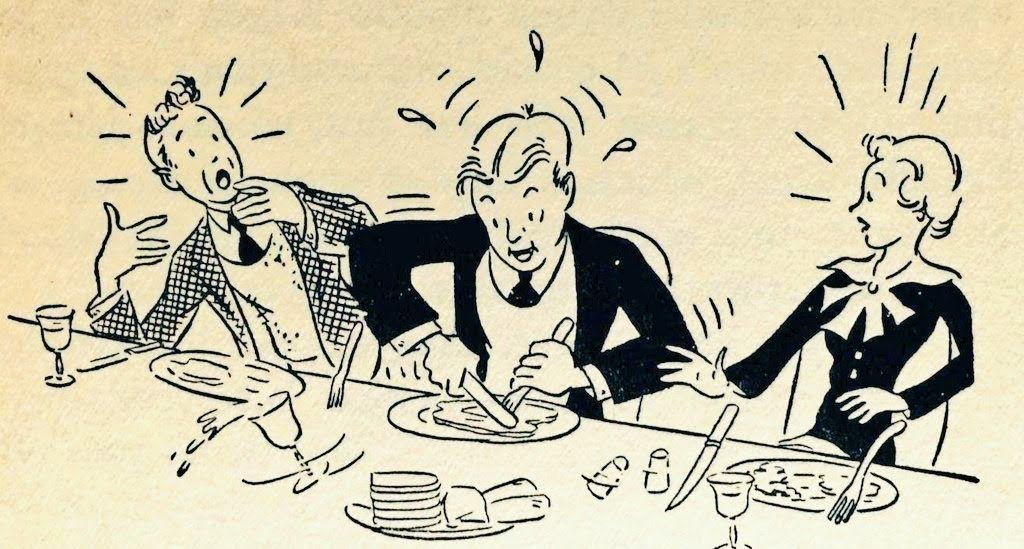
Company Table Manners

As soon as a child is old enough to come to the table he should be taught by precept and example what good table manners are... Let it be understood that good manners are not the acquiring of every new wrinkle that fashionable society may prescribe. There is a great difference between good manners and good form. What is good form to-day may be very bad form tomorrow, but good manners are not changeable.

There seems to be an idea among many people that there must be a different set of manners for company from what is observed in everyday life. While it is the proper thing to have for an invited company a more elaborate dinner and a little more ceremony in the service than at the family table, it must be remembered that one should not put on and take off good manners as one would a garment. They are a part of one's self, and whether the family meal consist of many courses, or only a cup of tea and a slice of toast, it should always be served decently and in order, and the manners of the members of the household should be such that one need not blush for them, even in the finest company. As soon as a child is old enough to come to the table he should be taught by precept and example what good table manners are. If the father and mother be so unfortunate as not to have had proper training themselves, they should study to correct any bad habits they may have, for the sake of their children. 


Let it be understood that good manners are not the acquiring of every new wrinkle that fashionable society may prescribe. There is a great difference between good manners and good form. What is good form to-day may be very bad form tomorrow, but good manners are not changeable. Unselfishness, kindly feelings and politeness are the foundation of good manners. Good table manners demand that one shall take soup from the side of a spoon; shall eat with a fork, rather than a knife; shall take small mouthfuls of food and masticate quietly, making no unpleasent sound; shall take in the fingers no food except fruit, confectionary, olives, bread, cake,celery, etc., and that the members of the family shali be as polite to each other as to any guest. Where people rush through their meals there is not much chance fo: table maners or good digestion. If properly managed, the table can be made one of the most refining influences of the home. —Ladies Home Journal, 1892


Etiquette Enthusiast, Maura J Graber, is the Site Editor for the Etiquipedia©️ Etiquette Encyclopedia 

Monday, January 11, 2016

Etiquette in Cultured Society

“So let me get this straight... If I work on my table manners, and I get a knowledge of dining room etiquette and stuff, then I'll get a passport to the most highly cultured society?”

 How many girls who dined out for the first time with their “best beau” fail to enjoy their food, because they do not know the proper table customs?

IT was not until many homes became afflicted with frozen gas that I realized what poor table manners exist in the average home. Many families betook themselves and their ill-mannered children to the nearby moderate priced restaurant. In a suburban restaurant, a mother with two children sat near me. 


There was a boy of 8 and a girl of 6. The unsuspecting waiter put down the usual glasses of water and a semi-sliced half loaf. In the grabbing which ensued the unoffending loaf was deluged with water. “Stop that, you two, or I’ll— I’ll...’’ and then catching my eye she apologetically said, “Isn’t this awful? You see, the children never ate away from home before; our gas is frozen and...” — But here her conversation was interrupted for it was necessary for her forcibly to separate both children from the celery. 

And these bad table manners were not limited to children by any means. Mothers and fathers and other home-bound relatives “forced into the open” by frozen gas or burst pipes, convincingly showed that they never had eaten away from home. Yet it is a simple matter to acquire good table manners, and good table manners are ever an asset. 

The earlier these are acquired, the more fortunate the child. I know a physician of prominence whose early training in this respect was neglected, and today his method of gripping his fork as if it were a cudgel, is a constant source of embarrassment to his highly cultured wife. How many girls who dined out for the first time with their “best beau” fail to enjoy their food because they do not know the proper table customs?

“She surely is a pretty girl.’’ said a young man to me recently, “but it would take me years to teach her table manners before I could let mother see her eat.” One mother of six young children whom I know, has exceptionally well mannered children. When her gas froze up, neighbors with the daintiest of table appointments were only too glad to have these little guests. In answer to my question, “How did you do it?” she told her secret. 

She said that as soon as each child was able to hold a spoon, he was taught to hold it “properly.” He was taught ‘‘respect” for food. The ethical side of eating was impressed upon him. To toy with food was wrong. She believes in one clean white tablecloth a week. And each child felt it his or her duty to keep this immaculate. The boys were taught consideration for ihe girls. The rest was easy. The children had a solid foundation upon which to build their table conduct. The rest came with practice. 

“Elbows close to the sides when eating.” was mother's gentle but constant suggestion. Only food too soft to be conveyed to the mouth with a fork should be eaten with a spoon. The children were taught how to cut or prepare the food on the plate before conveying it to the mouth. No child’s food was hashed up by the mother and then eaten with a spoon. Tlie children used their own muscular power and the food was chosen with an eye to their abilities and this direction. 

Only pleasant conversation was permitted. And crying, wailing, arguing or cave-man methods of obtaining one-share meant that the child had to leave the table before the meal was concluded. "So much trouble." I hear some one whisper. Well, everything worth while takes time and patience. 

This woman may not have much cold cash to leave these children when she passes on, but she will leave them with good table manners and a knowledge of dining room etiquette which is often a passport to the most highly cultured society. — Loretto C. Lynch in the Los Angeles Herald, 1918

Etiquette Enthusiast, Maura J. Graber, is the Site Editor for Etiquipedia© Etiquette Encyclopedia