Showing posts with label Etiquette in Japan. Show all posts

Tuesday, November 3, 2020

The Geisha: An Exquisite Hostess

                                                                                
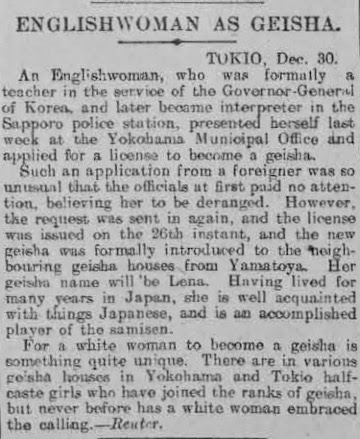
A geisha is a traditional entertainer trained in classical arts such as dance, tea ceremony, and music. In the modern era geisha are understood to be female, but historically there were male geisha as well. In 1913, an Englishwoman applied for a license to become a geisha. There were already many "half-caste" girls who were geisha in Japan, however "Lena" would be the first white woman to hold such a license.  The application was at first thought to be from someone who had to be "deranged," so it was ignored by Yokohama officials. A second application was sent in and she was granted the license on the 26th of December, 1913.


Like ghosts from another time, the real geisha seem to float silently along the streets at twilight, making their way to tea houses and restaurants where they will entertain elite, powerful men.

Trained to be exquisite hostesses, they are accomplished musicians, singers, dancers and most importantly conversationalists. To have a geisha in your company, to be in the presence of a beautiful, articulate, talented companion for the evening, is considered a status symbol. Their clients used to be samurai and shogun. Now it’s politicians, actors and corporate CEOs who hire the geisha by the hour for private dinners at ryotei (traditional Japanese restaurants) and ochaya (tea houses).

They are not courtesans or prostitutes. Before World War II, a geisha’s virginity was auctioned to the highest bidder, but sex is no longer part of the transaction. To be a geisha is to be part of a community, a vocation. They are career women. They are performance artists.

An endangered species, the numbers of real geisha in Japan are dwindling. From a reported 80,000 throughout Japan in the early 20th century, they now number only a few thousand. “In Kyoto, there are about 150 geiko geisha in the local dialect and maiko, geisha in training, left in Kyoto,” according to Anne Alene, an in-country guide for a recent trip to Japan arranged by the Carnegie Museums of Pittsburgh Travel Program.

The group toured the Gion district, one of several historically preserved neighborhoods in Kyoto and the place where the 2005 movie “Memoirs of a Geisha” was filmed. It was based on the novel of the same name by Arthur Golden.

In Kyoto, authentic geisha are not nearly as prevalent as faux geisha young women who dress in traditional Japanese kimono complete with obi, white tabi socks and wooden geta sandals. While they enjoy being stopped by tourists to have pictures taken, wearing traditional ensembles also appeals to the Japanese reverence for ritual and tradition.

“For many Japanese girls, it’s fun to dress up in something they would never ordinarily get to wear,” said Amy Boots, executive director of the Japan-America Society of Pennsylvania.

“I think it might be like doing a Renaissance or Old West-style photo shoot for us.”

Visitors can also give it a try. In Kyoto, there are several places that rent a kimono ensemble or the men’s version, a black kimono with montsuki haori, the short coat over top. 
                                                        
A hand-colored photo of a group of Geishas, 1890
—Photo source Pinterest


“Kimonos have many layers and are difficult to put on without a helper,” said Katsuko Shellhammer, education outreach coordinator for the Japan-America Society of Pennsylvania. “They are also very expensive, and seasonal patterns are important. It can be like wearing a piece of art.”

Department stores in both Tokyo and Kyoto have sections dedicated to kimono wear; you can buy off the rack or have a custom-made kimono and obi from the bolts of material offered. A less expensive option is a used kimono, and there are many stores that deal strictly in pre-owned. Kimonos are often passed down from mother to daughter.

Modernizing the look is all about the material and new, more graphic patterns. Sou Sou, a Japanese clothing company, has taken the plain tabi shoe and sock and covered them in a riot of color and designs. They have also re-imagined other traditional Japanese garments.

Just looking like geisha is not enough for some young women. Turning away from Hello Kitty and the modernity of Japanese life, they make the choice to earn a living as a geisha. Maiko as young as 15 must live in the geisha house, or okiya, learning the nuances of life under the robes and white makeup. The apprentice period lasts between three and five years, during which the okiya and the geisha mother invest in them, paying for lessons and kimonos and providing room and board. Maiko, pronounced MY-ko, are tested before they can advance. At the erikae ceremony, they don the white collar of geisha.

Twice a year, in spring and fall, the public is treated to a display of geisha talents during the Miyako Odori at the theater in the Gion district. The 142nd annual Miyako Odori was held earlier this month during the Carnegie Museums group’s visit. The travelers enjoyed a glimpse into this exclusive world, including a very brief tea ceremony with a complicated etiquette that must become second nature to real geisha.

As the living embodiment of history and fantasy, geisha are not allowed to marry ever. If they do they must leave.

“Geisha and maiko are very special to the Japanese people. They are part of a separate world from ordinary Japanese life,” Boots said. — Pittsburgh Post-Gazette, Kyoto, Japan, 2014


Etiquette Enthusiast, Maura J. Graber, is the Site Editor  for Etiquipedia© Etiquette Encyclopedia 

Thursday, September 5, 2019

Customs and Etiquette in Japan

“In Japan one must spend at least half his time in the bath tub if he wants to be thought up to the customs of the country. Eminent doctors have agreed that the Japanese carries his cleanliness too far and makes too frequent use of his bath, which he always takes boiling hot. The hot bath is advisable in this climate, as every one soon learns by experience, and the publicity of the bath tubs, which are barely screened from the passers by in the streets, is a revelation of Japanese modesty. For centuries this nation has had her public baths, while we of the New World have brought them into our cities with the past generation.” 

Japan is a land of small things, and this fact is impressed on one as he goes from city to city, where he sees every family, however poor, occupying its own house and enjoying an existence apart from every other household—a state of things wholly unknown to the overcrowded centers in the United States and Europe. Most strangers have the impression that the people of Japan and China are so crowded together in their cities that they scarcely have breathing room. That this is a mistake is discovered on reaching Tokio, which numbers half a million less inhabitants than does New York, yet extends over 100 square miles. 

One may start out in a kuruma in the early morning and ride the greater part of the day through the residence portion of the capital of Japan, looking out upon the one-story wooden buildings. The foreigner who goes to Japan to see things, avoids the railroad when he contemplates short journeys or pleasure excursions into the country. Railway travel is cheaper in Japan than any other mode of traveling, but the natives prefer to travel by water or by kurumas if they are not going a great distance. When one contemplates traveling about over the country his route must be specified minutely, and no deviations are allowed other than his passport calls for. There is no more delightful trip than a ride of a few hours through the rice fields and mulberry plantations, beautified by lotus ponds. The mulberries have no chance to grow up into the trees, but are simply clusters of green leaves on the tender shoots which feed the silkworm. 

You are surprised that at the inns everywhere you eat in your own room, as there is no such thing as a separate dining room. When you arrive at an inn, they assign you a room in which you sleep, eat and entertain your friends. All this is quite compatible with comfort, for at the clapping of your hands, your dinner table glides in, guided by a pretty Japanese girl, who kneels and bows before you so often, as she comes and goes, that you begin to wonder if you are not a Prince instead of an ordinary traveler seeing the sights of the orient. 

The fine tablecloth is spread and the dishes appear as if by magic, one girl serving each guest. You sit on your mat with your chin on a level with the tiny table and its hand-painted china, and all your wants are looked after without your having to utter a command. The samisen played by nimble fingers aids your digestion and supplies the finishing touch to the dinner. After the meal the girls remove tho table and all traces of the dinner and the dining room becomes the reception room. The college professor may be one of the curious callers, and as Japanese etiquette permits a man to stretch out his visit to any length from two hours to ten, you are the unwilling victims of the professor's insatiable curiosity, which permits him to ask questions pertinent and impertinent. For instance, when you show him a pair of very old and handsome bracelets, a brooch and an amulet collected in a trip through the country, he insists on knowing the exact price of each. 

At bedtime the little girls came running in, their arms filled with quilts and white sheets, which they spread on the floor for beds. Then they bring the makura, or pillows, which are little wooden boxes with rocker bottoms, and the most uncomfortable inventions that ever sprang from the brain of man. Across the entire room they stretch a large mosquito net. Their duties at an end, they retire with many bows and leave you to woo sleep between the sheets on the hardest floor in Christendom. 

In Japan one must spend at least half his time in the bath tub if he wants to be thought up to the customs of the country. Eminent doctors have agreed that the Japanese carries his cleanliness too far and makes too frequent use of his bath, which he always takes boiling hot. The hot bath is advisable in this climate, as every one soon learns by experience, and the publicity of the bath tubs, which are barely screened from the passers by in the streets, is a revelation of Japanese modesty. For centuries this nation has had her public baths, while we of the New World have brought them into our cities with the past generation. 

The Japanese have a multitude of quaint customs, many of which have common sense as their basis. When a guest has outworn his welcome, the mistress of the-house does not grow outwardly impatient in his presence and throw out little hints of what duties will claim her attention soon, but she prepares the daintiest luncheon imaginable and puts it into the prettiest of boxes, which she wraps with rice paper and ties with a ribbon. Then, come morning when no other members of the household are present, all having been warned to keep out of the way, she puts the lunch box with the sweetest of smiles into his hands. Before the lunch hour the guest, if he be wise, has vanished like a morning cloud, and no one can tell whither. Even the poorest people have the habit of going every morning between the hours of 5 and 7 to the water's edge, carrying in their hands their tooth brushes, which they use vigorously as soon as they reach the stream, which is not any too clean because it flows down from the rice fields. – Los Angeles Herald, 1904


Etiquette Enthusiast, Maura J Graber, is the Site Editor for the Etiquipedia© Etiquette Encyclopedia

Wednesday, August 7, 2019

Japanese Candy Etiquette


Candy etiquette for Japanese children in the US was just as stringent as the etiquette for those in Japan, ten years later. 


It Is Not Considered Good Form to Partake of Sweets 
(or any other foods) on the Street in Japan...
Children Observe Rule

Homer Croy writes of the Japanese in Leslie's: “One day as I was going along the street I saw a candy man sitting on a stool beside his cart fashioning delicacies with his two flying thumbs. Taking a ball of candy mixture, he would give it a few pinches, a twist, dab on a red spot and there would be a fish. Taking up another ball he would give it a few twists and he would have a radish. Half a dozen of these, he would put into a thumb-made candy plate, the size of a chocolate wrapper, and sell for half a cent. Buying a plate of tiny delicacies I gave it to a girl, expecting to see her down it in good old American fashion, but instead of falling on it greedily, she made a courtly bow and tore down the street as fast as her wooden shoes would let her. 

I looked after her in astonishment, thinking that this upset every child theory I had, and I determined to try it again. So I waited until the two flying thumbs had molded another delicacy and proffered this to a second child. Down the street she flew, too, her walnut knot of hair wobbling excitedly. When I bought the third delicacy I gave it to a child that was weighted down with a baby on her back and followed after, while she went bobbing down the street, the baby's head rolling heavily. I found her sitting on the floor, eating the sirupy fish and candy radishes with many delighted sucks and appreciative grunts. Then I understood; it was not polite to eat on the street, but under her father's gray tile roof it was the height of form to dispose of the sweets with all the gustatory gurglings that her delighted soul wished. – Sausalito News, 1916


Etiquette Enthusiast, Maura J Graber, is the Site Editor for the Etiquipedia© Etiquette Encyclopedia 

Tuesday, May 15, 2018

Old Japanese Proposal Etiquette

A 19th C. Japanese Bride arrives at the home of the groom’s parents – Instead of serenades by moonlight and other delicate ways of making an impression, it is etiquette for the Japanese lover to approach the dwelling of his lady, bearing some choice plant in his hand. This takes place at a time when he is fully assured that both mother and daughter are at home, and I need scarely say that neither of them is at all conscious that the young man is taking such a liberty with the flower pot outside of their window. 


A Graceful Sweethearting Custom

In houses wherein reside one or more daughters of a marriageable age, an empty flower pot of an ornamental character is encircled by a ring and suspended from the window or veranda by three light chains. Now, the Juliets of Japan are, of course, attractive, and their Romeos as anxious as those of other lands. But instead of serenades by moonlight and other delicate ways of making an impression, it is etiquette for the Japanese lover to approach the dwelling of his lady, bearing some choice plant in his hand. This takes place at a time when he is fully assured that both mother and daughter are at home, and I need scarely say that neither of them is at all conscious that the young man is taking such a liberty with the flower pot outside of their window. It is believed that a young lover so engaged, has never been seen by his lady, or her mamma, in this act of sacrilege. 

At any rate, my friend tells me that during his long residence in Japan, he never heard of one being interfered with in any way. The fact is, this act of placing a pretty plant into the empty flower pot is equivalent to a proposal to the young lady who dwells within, and the eastern fashion is, as I think, a delicate and most harmless way of proposing to a lady. The youthful gardener, having settled his plant to his mind retires, and the lady is free to act as she pleases. If he is the right man, she takes every care of his gift, waters it, tends it carefully with her own hands, that all the world can see. In a word, the donor is an accepted suitor. But if he is not a favorite, or the parents object, the poor plant is torn from the vase, and the next morning lies limp and withered on the veranda or on the path below.—Home Journal, 1886


Etiquette Enthusiast, Maura J. Graber, is the Site Editor for the Etiquipedia© Etiquette Encyclopedia

Wednesday, January 24, 2018

Develop Etiquette with All 5 Senses

Airing first in 1970, and through most of the decade, T.V.’s “Queen Mary”, Mary Tyler Moore was the epitome of style and charm. The show’s characters, “Mary Richards” and “Rhoda Morgenstern,” were fashion forward, hard-working, always well-groomed and most always polite. They were single women, living on their own. They became positive, feminist role models for young career women everywhere. – “When Queen Mary was asked to name the most important subject in the education of a potential Monarch, she answered in one word “Manners!” Many a successful executive, homemaker and career girl would give the same answer if asked about his or her assets, but how do people develop the knack of saying and doing the right things?” 

Etiquette for Everyone       

New York (NAPS) – When Queen Mary was asked to name the most important subject in the education of a potential Monarch, she answered in one word “Manners!” Many a successful executive, homemaker and career girl would give the same answer if asked about his or her assets, but how do people develop  the knack of saying and doing the right things? 


Long a guide for etiquette, the noted author, Emily Post, said good manners come from the heart, and you’ll also recall, the Bible says of man, “As he thinketh in his heart, so he is.” Now it doesn’t necessarily mean you must undergo surgery for a heart transplant, in order to have a change of heart that makes you do and say what is right. But if you do care about people at work, or in a social situation, or even at home where all too often, unfortunately, the best foot forward is not put!... , you can learn the courteous thing to do and be kind. You can begin with five basic concerns: The senses!

In brief, if you are thoughtful about people’s five senses you will become more sensitive and perhaps in time a veritable sensation! Here are five sensible rules to remember; 

• Eyes– Be easy on the eyes and dress (including cosmetics) in a “manner” that shows you care for another person’s viewpoint, literally. 

• Ears– Is your voice shrill? Rough? Loud? Too soft? Speaking with a nicely modulated, melodious voice falls softly on the ears. Practice listening to yourself. 

• Nose– Personal hygiene, as important for men as for women, makes you kind to another’s nose. You’ll be snifty if in addition to daily showers you are also thoughtful enough to use something such as Man-Power aerosol. 

•  Taste– You’ll taste better when kissed if, in addition to regular dental appointments, you also keep on hand a refreshing mouthwash to use at home and at work. 

• Touch– A well-scrubbed skin made smooth and kept soft and moist with creams will keep you off the offensive fence, more fun off than on. 

Once you have carried through on being kind to the five senses, you’ll find it fun to use all your own five to contemplate the different customs in various parts of the world. In Japan, for instance, etiquette demands you remove “walking” shoes on entering a temple. Slippers are worn inside and floors are kept spotless. In yet other parts of the world, it’s considered ill-mannered to use the same handkerchief twice! 

In Europe, Amy Vanderbilt points out, it is quite proper to use a toothpick at dinner, with the table napkin held as a screen, but in America, one is supposed to remove themselves from the table, to dislodge the food. The American and Continental use of the knife and fork also vary. The American uses a knife only to cut with. In Europe, the knife can be used to pile food on the back of the fork and food is then transferred to the mouth with the left hand still holding the fork. Americans generally place their napkin in the lap, whereas in different regions of the world it’s proper to tuck the napkin in the collar. Americans are very quick to use first names, although Eastern and Southern communities are more conservative in this matter, but Europeans and especially Asians prefer introducing a relationship in a formal manner, with proper title and last name. 

Etiquette, it’s true, involves not only the heart and the senses, but also protocol which must be learned with the head. But don’t be discouraged! If your heart is in the right place, and you’re sensitive, you can get the facts for your head out of books. This is true even if you don’t have to think, as Queen Mary did, about the most important subject in the education of a King or Queen. –Coronado Eagle and Journal, 1970

Etiquette Enthusiast, Maura J. Graber, is the Site Editor for the Etiquipedia© Etiquette Encyclopedia 

Thursday, October 19, 2017

19th C. Japanese Etiquette

Table etiquette has elaborate rules, which high-bred ladies and gentlemen must strictly follow. A maid-servant always waits, kneeling, at a short distance, before a clean pan of boiled rice, with lacquered tray, on which she receives and delivers the bowls for replenishing them. Fragrant green tea is always used at the end of a meal, but sugar and cream never.

The Japanese Home:
The Dwellings and the Domestic Life of the Quaint People


If a man of taste should enter a Japanese parlor he would not fail to be surprised at the display of marvelous and exquisite taste. Yet I have often heard the sayings of foreigners that "the Japanese house has no furniture and is absolutely cheerless and empty." This is quite wrong. I must say that they have no taste of the Japanese art, for the men of taste are agreed in saying that the art of decoration in Japan is excellent. If anyone has some taste in this art, he will perceive that the hanging picture on the toko wall, elaborate arrangement of flowers, pictures on the framed partitions and all decoration, however trifling, reveal infinite taste.

The tastes of the Western people differ so much from ours that the decoration in the chambers seems almost childish to the Japanese eyes. The gorgeous display of colors in their rooms would please our children to look at. Drawingrooms piled up from corner to corner with toys, shells stones, dishes, spoons and different novel things always remind us of our curio-shops, a bunch of flowers is stuck in a vase without form and without order. The pictures in the rooms hang perpetually, though the face of nature and feeling of man chance from time to time. All these sights which we are accustomed to see in the European house excite in us nothing but wonder. Yet this is the taste of the Western people; we have no right to criticize it.

In Japan, the family never gathers around one table as the European or other Asiatic peoples do, but each person has his or her own separate small table, a foot square and a foot high, and always highly decorated. When they take their meals they kneel upon the mat, each taking his table before him. The little lacquered table generally contains a small porcelain bowl, heaped up with deliciously cooked rice, and several lacquered wooden bowls containing soup or meat, and numbers of little porcelain plates with fish, radishes and the like. The way of cooking, of course, is entirely different from the European. 

Two pretty chopsticks, made of lacquered bamboo or wood, silver or ivory, are used, instead of knife, fork and spoon, and all people use them with great skill. All foods are prepared in the kitchen so as to avoid any trouble to use knife and fork. Soup is to be drunk from the bowl by carrying it to the mouth by hand, in the same way as people drink tea or coffee. Table etiquette has elaborate rules, which high-bred ladies and gentlemen must strictly follow. A maid-servant always waits, kneeling, at a short distance, before a clean pan of boiled rice, with lacquered tray, on which she receives and delivers the bowls for replenishing them. Fragrant green tea is always used at the end of a meal, but sugar and cream never. — Harper's Bazar, 1895


Etiquette Enthusiast, Maura J. Graber, is the Site Editor for the Etiquipedia© Etiquette Encyclopedia 

Sunday, September 3, 2017

Thai Diplomacy, Japanese Etiquette

In many ways, Thai and Japanese societies are similar, with sophisticated rules of etiquette and many shared cultural affinities...

In 2014, the Thai embassy released a "do’s and don’ts" list for Thai tourists when visiting Japan — Here is the list below:

BANGKOK – The Thai Embassy in Japan has some tips for Thai visitors: Don’t put your chopsticks in the serving bowl. If driving, stop for pedestrians at crosswalks. And just because you have kids doesn’t mean you can cut ahead in line.

The advice is part of an online manners guide the embassy posted on its Facebook page in response to criticism on social media about the behavior of Thai tourists in Japan. Most of the criticism came from Thai residents in Japan who reported sightings of “inappropriate” behavior on a popular Thai web forum, which inspired the embassy’s consular chief to pen the list of "10 do’s and don’ts."

“Japanese society is very unique. It is a society with strict rules that are not always obvious to visitors,” said Jessada Nanthachaiporn, the embassy’s first secretary. He said he intended the list as an educational tool, not as criticism of either culture.

Written in Thai, the code of conduct begins with escalator etiquette: Stand on the left, or walk on the right — except in the Kansai region, where the opposite applies.

There is separate elevator advice: The first person in holds the open button for others and should be the last person to leave.

In many ways, Thai and Japanese societies are similar, with sophisticated rules of etiquette and many shared cultural affinities, Jessada said. From a young age, Thais are taught the concept of “marayat” — or “good manners” — and values like humility and respect for elders, which are similar in Japan. But the same rules do not always apply.

His list offers advice on mobile phone use in buses and trains (“turn the ringer to silent”) and shopping: “Do not interrupt salespeople who are helping other customers.”

In Thailand, drivers often ignore crosswalks and zoom past pedestrians trying to cross. But in Japan, “Drivers must stop at zebra crossings and wait for people to cross the road, without honking the horn.”

Thais tend to eat family-style, sharing dishes, often without serving spoons. In Japan: “Do not use your chopsticks to pick up food for other people.”

Rather than take offense, Thais have applauded the list. The Facebook post has been shared and liked more than 1,300 times since it was posted last week. Commentators on Thai blogs have expressed admiration for Japanese customs, suggesting that if Thais adopted similar manners at home, the country would be seen as more developed. — Japan Times, 2014


Etiquette Enthusiast, Maura J. Graber, is the Site Editor for the Etiquipedia© Etiquette Encyclopedia 

Saturday, May 27, 2017

Coffee Etiquette in Japan

“That’s for the sugar... The handle starts on the left so the customer can hold the cup steady with the left hand while stirring in sugar with the right. Once that’s done, the customer turns the handle clockwise, around the top, so the handle is easy to pick up with the right hand. That’s how we taught customers to drink their coffee.” — Japan coffee shop owner, Yasumi Yamabe

Coffee was hardly an everyday drink when Yasumi Yamabe started his career in the early postwar years. “Oh, coffee was still very much a luxury item then,” he confirmed. “A cup would set you back ¥50 when a portion of oden (stewed foods) or oshiruko (sweet red-bean soup) cost only ¥5. Most people weren’t familiar with coffee, so we had to educate them. Almost everyone in those days took their coffee with cream and sugar.”

No one knows exactly when coffee was introduced to Japan, but the first beans were probably brought in by 17th-century Dutch traders for their own use at their trading post at Dejima, near Nagasaki. Contact with foreigners was strictly limited, so if any Japanese were able to sample their coffee, it would have only been the few merchants, translators and prostitutes allowed to visit Dejima. 


The oldest known account of a Japanese drinking coffee was written in 1804, in which a man named Shokusanjin Ota described boarding a foreign ship and being served a drink called “kauhii.” It tasted quite unpleasant, he said, and was made by mixing sugar into water with a powder of roasted beans.

Formal imports of coffee began in 1858, and the first Japanese coffeehouse of record, the Kahiichakan in Tokyo, is said to have opened in 1888. Drinking coffee became fashionable among the intelligentsia and the upper middle class, but remained something of a rarity. 


Imports were halted in 1944, during the war, as coffee was branded both a zeitakuhin (extravagance) and a tekikoku inryō(enemy drink). It wasn’t until after the war, and the liberalization of imports in 1960, that Japan got on its way to becoming a major coffee-drinking nation. Today Japan is the third largest importer of coffee, after the United States and Germany.

At the All Japan Coffee Association, executive director Toyohide Nishino responded to the question of why the spoons are placed where they are when coffee is served in Japan.
 “Very often the inquiry comes from the executive offices of a large company, with the caller saying something like, ‘Our chairman is particular about manners and wants to make sure we’re doing it right.’ But actually there is no single accepted way to serve coffee in Japan.”

Even in the coffee industry, companies serve guests differently. Visitors to UCC (Ueshima Coffee Co., Ltd.) headquarters in Kobe get their coffee with the handle on the left, while at Key Coffee, in Tokyo, the handle is on the right.

Some hypothesise​ about the tea ceremony, in which the cup is placed so its front, or decorated side, faces the guest so its beauty may be enjoyed. The guest, in turn, expresses humility by turning the cup before drinking so as not to place one’s lips on the most beautiful part of the vessel. Nishino found the idea interesting, but concurred with Yamabe that having the handle on the left is for convenience when adding sugar. He noted that coffee shops used to offer kakuzatō (sugar cubes), which take more effort to stir into coffee than today’s standard of granulated sugar.

The oldest reference found was in a 1922 book titled “Seiyo-ryori no Tadashii Tabekata” (“The Correct Way to Eat Western Food”). In somewhat archaic language, Kaneko Tezuka, who was a professor at Japan Women’s University, wrote that when coffee is offered after a meal it should be served in small chawan (cups) with the totte (handle) turned to the left and the saji (spoon) placed in front. Unfortunately, Tezuka didn’t offer a reason for this placement, nor did she speak to its origins.

In any case, the orientation of the coffee-cup handle may well become moot as tastes and consumption patterns change. Today, taking coffee burakku (“black,” without milk or sugar) is the most common preference, practiced by 38.3% of Japanese coffee drinkers. In addition, there is a clear shift away from genteel service and toward take-out, with convenience stores grabbing a growing share of the coffee market. Seven-Eleven, which offers self-serve coffee for just ¥100, expects to sell a whopping 700 million cups this fiscal year — and in disposable cups with no handle at all. — From the Japan Times, 2013


🍽Etiquette Enthusiast, Maura J. Graber, of The RSVP Institute of Etiquette, is the Site Editor for the Etiquipedia© Etiquette Encyclopedia

Monday, June 20, 2016

Etiquette Relaxed for Hero

 Admiral Count Togo of Japan— Everyday life of the Japanese Imperial Court was practically unknown to the public in spite of the increasing enterprise of Japanese journalism, which had made repeated efforts to break down the barrier of excluslveness and mystery that had hitherto guarded all approach to the inner apartments of the Chiyoda Palace.

Japanese Hero Honored with
 Relaxed Etiquette of the Imperial Court  
Admiral Count Togo, commander of the Japanese fleet which destroyed the Russian squadrons in the battle of the Sea of Japan in May, 1905. Now enfeebled by his eighty years, has special permission to carry a cane when visiting the Imperial Court.

The carrying of sticks of any sort in the presence of the nation's rulers is forbidden by court etiquette, but exception in the case of the aged sea hero was made by formal ruling of the Minister of the Imperial household . — Healdsburg Enterprise, 1926


🍽Etiquette Enthusiast, Maura J. Graber, of The RSVP Institute of Etiquette, is the Site Editor for the Etiquipedia© Etiquette Encyclopedia

Sunday, June 5, 2016

Etiquette and Japanese Courtesy

There are honorific terms of varying significance to be applied to people of every rank, to objects possessed by a superior and to articles of dress and food belonging to another. There are, on the other hand, humble terms to be used on one's self, or of one's own family, when addressing outsiders. 


The Language of Courtesy

Nothing more truly shows the courtesies and formalities of the nation than the language itself. Innumerable phrases with many and delicate shades of meaning abound for every act. There are honorific terms of varying significance to be applied to people of every rank, to objects possessed by a superior and to articles of dress and food belonging to another. There are, on the other hand, humble terms to be used on one's self, or of one's own family, when addressing outsiders. 

One does not eat or dress or go about or perform  many acts in the same word as another. A man speaks of his own wife, using an entirely different word from that which he would use for the wife of a third person, and this again may be a different and less polite word than the term he would use for the wife of the person addressed. 

The language may be roughly divided into three divisions —the language to superiors, the language to equals and the language to inferiors—but it is, of course, a delicate matter on many occasions to decide in which language to speak, whether to use all the honorable prefixes and long terminations, or to cut every sentence off short, as in the language to inferiors. 

The general rule in most cases is that in speaking to equals one employs, for courtesy's sake, the language for superiors, and to certain inferiors, such as servants of other people, to workmen and tradesmen, the language of equals, while the rougher and less polite language is rarely used except to one's own servants, and very frequently by ladies not at all.

It is impossible to go into the details of the ceremonials which accompany weddings, funerals, birth rejoicing and the entertainments of various sorts, interesting as many of them are. Many of these have changed, and will change more in this transition period, but let us hope that it may be long before Japan will become too busy for its pretty courtesies, its long, stately bows and graceful speeches, which are one of the most charming things in this land of the orient. 
—Sacramento Daily Union, 1897


Etiquette Enthusiast, Maura J Graber, is the Site Editor for the Etiquipedia© Etiquette Encyclopedia

Saturday, June 4, 2016

Etiquette Japan: Visits, Gifts and More

In modern day Japanese culture, wrapping paper and boxes are extremely common. However, the traditional cloth wrapping (furoshiki) is increasing in popularity, particularly as an ecological alternative to wrapping paper.

Etiquette of Present Giving

The etiquette of present-giving is in itself very complicated, and not the least arduous of the duties which fall on the head of a household. A present is not necessarily confined to any season, but may be given at any time; indeed it is the appropriate accompaniment of a visit. Fish, fruit, eggs neatly packed in wooden boxes, cake or a piece of silk or crepe are the most common presents. They are brought in by the guest on a neat tray, or else sent beforehand by a servant. Presents are usually wrapped up in white paper, folded so that the left edge of the paper will lie under the right, and they are tied with a peculiar string, half red and half white. This string must be not only tied in a certain way, but the package must bear on it written characters which signify that it is a present.

There are a number of symbols which may be used, representing a greater or less amount of humility and respect on the part of the giver. The characters have various meanings, some being words of good luck and others signifying the smallness and unfitness of the present for acceptance, a term most commonly used being so shina—literally a common, coarse, or rough article. Accompanying each present is a little bit of dried fish, which is neatly folded in paper and is sent for good luck. On occasions of misfortune, when there has been death in the family, the etiquette is entirely different, and not only the gift itself but the manner of wrapping and the charmed characters it bears must all be changed. 


Visits Are Infrequent

Formal visits are exchanged in person between relatives and friends, but Japanese ladies go out much less frequently than the men, and after the visit at New Year's, which every one makes, perhaps only one or two calls may be made on any one friend during the year. Gentlemen are far more social, and frequently exchange visits with each other, but there is no friendly intercourse with the ladies of the family. The mistress of a household exchanges salutations with the guests, provides for their entertainment, and accompanies them to the door on their return, but she is not expected to remain in the guest room and converse with them, except in the absence of her husband and of other male members of the family.

Refreshments —usually tea and cake —are always served to a guest almost immediately on his arrival, together with the charcoal brazier, which holds the fire for lighting the little Japanese pipes carried by almost every one in the girdle of the kimono. If the guest does not eat the cake or candy served to him it is quite the proper thing when he is leaving for some member of the household to wrap it up in the paper in which it has been placed and give it to him to take home and it is the guest's part to show his appreciation by taking it, rather than leaving it behind as something worthless. He slips it into the long sleeve of his dress, whence it is taken out by the little ones at home, who are only too happy to have the father's omiyage for their own, for the children are very fond of the sweet dainties, of which there is such an abundance in Japan. 


Hospitable Japanese Customs

A guest who has come from any distance is always asked to a meal, but it is frequently served to him separately on a little lacquer table brought in to the guest room. One or two members of the family may take their meal with him, while the others of the household have their dinner in a separate room. The host, in asking his guest to dine, must always preface his invitation by modestly saying that there is nothing fitting for his friend's entertainment, but he begs him to partake of what they have. The guest bows his thanks and then begins the meal on the little lacquer table, with rice bowl, soup bowl, saucers and chopsticks neatly arranged in place, and a kneeling maid ready to serve the hot rice whenever it is called for. 

As sandals and clogs are worn in the streets and left outside at the door on entering a house, the footgear of a guest must be looked after and neatly placed for him at the door before his return. Should it not have been fixed by the servants, some member of the family must do it at the time the guest departs. As the touching of any article of footgear is a very lowly act in Japan, as in all Eastern countries, the guest must feel honored by this courtesy, make his bow, and say the appropriate words of thanks. 

Whether or not a guest is welcomed and entertained as he should be, he is sure of being well-sped when he is departing. Custom orders that all members of the family and those of the servants who happen to be around shall accompany the guest to the door to bow and see him off. Five or six bowing figures around a doorway is by no means an unusual sight, and it gives one a sense of importance to depart with such a show as a family of even moderate size can make, not to speak of larger and wealthier households, with their retinues of servants.

Curious Every Day Ceremonies

Besides these every-day customs there are many curious ceremonials in Japanese life, many of which the present era has given up or abbreviated. Of those that remain, the most interesting is, perhaps, the old ceremonial tea making, which is a very complicated and difficult affair, and can only be learned after much practice and many instructions from a master of etiquette. Their service at a ceremonial tea party is an art in itself and there are professionals who teach exactly how it is to be carried out. 


The ceremony of making this peculiar and rare kind of tea and of serving the dinner which accompanies it lasts several hours, and the whole entertainment is from beginning to end a very curious and complicated one, in which rules of etiquette are very rigid. Every motion of the hand when preparing the powdered tea is fixed by rule, as are also the manner of presentation and the accepting of the cup by the guest. It takes many long hours of practice before one is skillful enough to do it gracefully and without one mistake. 

The tea room in which the entertainment is held, the utensils, the ornaments of the tea room and everything connected with it are and they must be in keeping with the esthetic regulations which govern the whole entertainment. The making of the tea is taught in many girls' schools and by special masters in the profession.—Sacramento Daily Union, 1897


🎁Etiquette Enthusiast, Maura J Graber, is the Site Editor for the Etiquipedia© Etiquette Encyclopedia

Thursday, June 2, 2016

Japanese High Tea Etiquette, Pt 2

Japanese High Tea — Part 2
An Elaborate Affair That is Often Very Costly


A Ceremony in Japan That is Hundreds of Yeard Old —Peculiar Forms That Are Inviolable—Strict Etiquette of a Japanese Festival—How the Host Acts


During the second part, a dinner is served and the tea made. With a little square of purple cloth the host wipes each utensil, then with the bamboo spoon, cha-shake, a little tea is taken out of the jar, cha-ore, and hot water-dipped from a highly embellished iron kettle with a dainty dipper and poured upon the tea in the bowl. This mixture is then whipped to a froth, and a boy carries it to the guests. 

It requires considerable practice to produce a froth quickly and without splashing; the instrument used is a whisk made of a piece of bamboo, split into shreds at one end until it resembles somewhat a paintbrush with a hollow center. 

The tea is light green in color and finely powdered, so that the bowl often looks very much like a sort of thick green cream. In the first part of the ceremony the tea is koicha, or very thick, and during the last part it is usu-cha, thinner. It costs from five dollars to six dollars a pound, and cannot be kept long. Very few Europeans can drink it without feeling very unhappy, for in the first place the taste is not agreeable, and then it is so intensely strong, that it is sure to disagree with them if they do manage to swallow it. 


The utensils used in the second part of the ceremony are carried in by the host, each separately and in the following order: 


1. An iron kettle on a stand. 
2. The daisu- A table of mulberry wood, about 2 feet high. 
3. Two cha-ire, or tea jars, in brocade covers. 
4. The mizasachi, or pot for fresh water, which is stood under a little table. 
5. The cha-sen, bamboo whisk; the fukusa, or little cloth; the cha-shaku, or caddy spoon, and lastly, the little wooden dipper, shaku. 

If there is only one guest the contents of the bowl should be swallowed in three gulps. After the guests have each drank, the empty bowl is passed from hand to hand to be admired. Then the host washes all the tea things and wipes them and the ceremony is ended. — Red Bluff Daily News, 1892


Etiquette Enthusiast, Maura J Graber, is the Site Moderator and Editor for the Etiquipedia© Etiquette Encyclopedia 

Wednesday, June 1, 2016

Japan's High Tea Etiquette

The largest tea party in the world was given by Hideyoshi in the pine grove of Kitano. He issued an edict in which all the tea votaries in the empire were bidden to come to this grove, bringing with them any tea curios they might possess, and the prince promised to drink tea at every booth. All who failed to present themselves were forbidden ever to take part in the cha-no-yu again. 


Japanese High Tea — Part 1
An Elaborate Affair That is Often Very Costly

A Ceremony in Japan That is Hundreds of Years Old —Peculiar Forms That Are Inviolable—Strict Etiquette of a Japanese Festival—How the Host Acts

To invite a few friends to "come and drink a cup of tea" is by no means a simple matter among the Japanese. Such an invitation necessitates a room built especially for these occasions, a whole paraphernalia of costly utensils and a most elaborate ceremonial. 

The famous American "high tea,” with its hot cakes, chickens, ham, pies, custards and jams, bears no comparison in point of extravagant preparation. Shoguns and nobles ruined themselves giving tea parties. Warriors and knights forgot their high vocation and princes abdicated their thrones that they might devote themselves to daily tea ceremonies, which grew more and more costly until immense sums were spent and great fortunes dissipated upon these entertainments. 

The cha-no-yu ceremonies are 600 or 700 years old, and have passed through three distinct stages. The largest tea party in the world was given by Hideyoshi in the pine grove of Kitano. He issued an edict in which all the tea votaries in the empire were bidden to come to this grove, bringing with them any tea curios they might possess, and the prince promised to drink tea at every booth. All who failed to present themselves were forbidden ever to take part in the cha-no-yu again. 


This grand entertainment at which noblemen and peasants alike were welcome, lasted ten days and was a great success. The edict itself is still in existence. But dissensions arose among the members of the tea cult, and one party thought the ceremonies should be performed in such a manner, and another party considered their own particular method the proper one, so Hideyoshi called all the various schools to his castle of Iruchini, and under him Sen-uo-Rykyn gathered together,simplified and arranged the rules, and it is these rules which govern the cha-no-yu today. 


Its principal characteristic is a must elaborate and affected simplicity. The various utensils are frequently of plain Corean ware, but of enormous value, for their antiquity is great. Tbe room is as plain as possible, though often of very expensive and valuable woods. The invitations are usually either for noon or 6 o'clock p.m. 


There are two distinct modes, one for summer and the other for winter. In the cold season, the garden is thickly strewed with pine needles, which give forth a pleasant aromatic perfume. The visitors retain their geta, or outside footgear, and the tea is made over a square fireplace built in the floor. In summer the garden is gay with flowers and curiously twisted little dwarf trees. In this mode the visitors remove their geta and a portable brazier is used.


The guests do not come directly to the house —there would be an abruptness about such a proceeding, not at all consistent with the solemnity of the occasion — but go to a pavilion, machia-ai, in the midst of the garden, and wait till all are assembled. Then the principal guest strikes the wooden tablet or bell to announce their arrival. Generally the host has been awaiting this summons and appears immediately, but sometimes a servant answers it instead. 


The entrance to the tearoom is curious enough—it is simply a square hole three feel each way. The guests creep in one after another, in order of precedence, and after them the host, who in the mean time has knelt beside the entrance until the last visitor has gone in. The guests then seat themselves in a semi-circle, and the host approaches the door of the side room where the utensils are kept and says “I rejoice that you have condescended to come and thank you for it I will now make up the fires.” 


All the gestures and speeches are always the same and are never left to the discretion of the participants. The folding of the hands, whether the right shall be clasped on top, or be left open, is settled by strict etiquette. The host brings in the sumitori, or charcoal basket, each piece of a certain length and of camellia wood, a mitsu-ba brush of three feathers, a pair of tongs like great iron chopsticks, the kettle stand, iron handles for the kettle, a lacquer box containing incense and some little rolls of paper. 


If it is summer the incense box should be of earthenware. He next brings a vessel for ashes and a little spoon shaped shovel to remove them. The charcoal is lighted and incense burned to destroy tbe smell of the fumes. In stereotyped phrases the guests ask permission to examine the incense box, which is always a curio, or at least has some historical interest attached to it. Each visitor receives it in turn, and the last one returns it to the host, who meanwhile dilates upon its antiquity or its historic origin. 
The first part of the ceremony is now over and the visitors and the host retire to the garden. —The Red Bluff Daily News, 1892

Etiquette Enthusiast, Maura J Graber, is the Site Moderator and Editor for the Etiquipedia© Etiquette Encyclopedia 

Thursday, March 17, 2016

Japanese Imperial Court Etiquette

Prince Arisugawa Takehito, (1862 – 1913) was the 10th head of a cadet branch of the Japanese imperial family and a career officer in the Imperial Japanese Navy.  Prince Arisugawa was assigned to the escort of Russian Crown Prince Nikolai (who later became Tsar Nicholas II) during his tour of Japan in 1891. While he was in the Prince's charge, Nikolai was wounded in an assassination attempt, called the "Otsu Scandal," which led to a considerable worsening of diplomatic relations between Japan and Russia.

Everyday life of the Japanese court is practically unknown to the public in spite of the increasing enterprise of Japanese journalism, which has made repeated efforts to break down the barrier of excluslveness and mystery that has hitherto guarded all approach to the inner apartments of the Chiyoda palace. 

Invariably these attempts to violate the sanctity of the imperial precincts have ended in failure, and until a short time ago no consecutive and intelligent account of just what actually goes on at court had ever been published. The death of the Emperor Mutauhito, who has now joined the ranks of the Sacred Ancestors with the posthumous title of Meiji Tenno, and the retirement of the lord chamberlain, Prince Tokudaiji, have removed the two greatest obstacles In the way of a more intimate knowledge of palace happenings. 

The new emperor and his consort, the Empress Sadeko, are much more modern in their ideas and thoughts than the late ruler and it has not taken long for several expressions of their liberal tendencies to become evident. 

The three essentials of palace life would appear to be cleanliness, ceremony and tradition, or rather superstition. The maids who attend on the court ladles during their toilet perform their duties on their knees and on no account must they touch their own lower limbs. Should that accidentally happen, the offending maid must instantly withdraw and undergo a course of purification before she can again appear before her mistress. 

If the rules with regard to the maids of the ladies-in-waiting are so strict, it may be imagined that those with regard to the personal attendants of the sovereigns are even more so. It is, of course, well known that all service before their majesties has to be performed on the knees, and it is not etiquette to approach them except on the knees. Even the physicians who attended on the late emperor during his last illness were not exempted from this rule. 

It is also common knowledge that no one may touch the Imperial person with ungloved hands Last July Drs. Imura and Aoyama obtained permission for the first time to take the Imperial pulse without interposition of a piece of silk between their fingers and the patient's wrist, while for the first time on record medical instruments were applied to the Imperial body. This rule is equally strict for the ladies-in-waiting, and especially so when in attendance on their majesties when bathing or at their toilet. —The Mariposa Gazette, 1913


Etiquette Enthusiast Maura J Graber is the Site Editor for the Etiquipedia© Etiquette Encyclopedia

Tuesday, March 8, 2016

Etiquette for Japanese Empress


The Japanese Way

Rules That Must Be Observed When Her Majesty Passes Along A Street 

A recent visitor to Japan says that there has existed in Japan for many centuries a curious law to the effect that whenever the Emperor or Empress appeared in public no other person should seem to occupy a higher place than this member of the royal family; therefore, on such occasions the shutters of all upper stories were drawn and the upper parts of the houses through which the royal party moved, were seemingly deserted.

The Law Is Still In Effect

Three months ago, when the Empress went into the country for a brief period, an elaborate announcement was posted in conspicuous places along the line of her contemplated route commanding the public to observe strictly certain requirements of etiquette, to wit: 

When her Majesty shall past along no one must look at her from the frame built on houses for the drying of clothes, or through cracks in doors, or from any position in the upper part of their houses. 

If anybody wishes to see her Majesty, he or she must sit down at the side at the road by which her Majesty will pass. 

All children must be taken particular care of that they do not play in the road and so obstruct the passage of her Majesty through the streets. 

No one must look at her Majesty without taking off his hat, in neck-cloth or turban, or whatever else be may be wearing on his head. 

Moreover, no one must be smoking while he or she is looking at her Majesty, nor must anyone carry a stick or cane. 

Only women wearing the clothes of foreigners will be permitted to retain their head-covering.

Although it may rain, no person will be allowed to put up an umbrella while her Majesty maybe passing. 

Dogs must not be allowed to wander on the road by which her Majesty will pass. 

Until the passage of her Majesty, the route by which she will come will be kept free from carriages and jinrikashas. The roads which she will take must be completely free from all traffic. 

As her Majesty passes, no one must raise his voice, nor must any sound be heard, nor must the crowd close in and follow her carriage, for no noise must be made. 

When her Majesty reaches Umeda Station there will be a discharge of fifty fire-works. — New Orleans' Picayune, 1890

Etiquette Enthusiast, Maura J Graber, is the Site Editor for the Etiquipedia© Etiquette Encyclopedia