Showing posts with label PDA Etiquette. Show all posts

Sunday, August 23, 2026

1930’s Etiquette for Gents and PDA

“A man never takes a woman’s arm, but offers his. It is definitely bad taste to walk arm in arm. I have always felt that any display of emotion in public was very poor taste.”

Beware Showing Public Emotion

I THINK it was a man named Phelps who gave what is to me the almost perfect definition of etiquette. He said, “The essence of politeness consists in so conducting ourselves, in manner and word, that others may be pleased both with us and with themselves.” There are innumerable little tests of good manners that distinguish, the well-bred person in public. A truly polite person never calls attention to himself in any way, at any time. When he meets a friend, he does so quietly and graciously. He is cordial without being conspicuous. A gentleman offers his arm to an old lady or an invalid. He helps his companion to alight from a car, to step across a puddle, or in walking down dark stairs.

A young man may offer to assist an older or infirm man in any of these instances without seeming forward. A man never takes a woman’s arm, but offers his. It is definitely bad taste to walk arm in arm. I have always felt that any display of emotion in public was very poor taste. I never punish my children before other people, neither do I allow them to “make scenes” in places where they will attract attention. This fashion of kissing upon meeting and leaving one’s friends, is particularly distasteful. If you start kissing people the second time you meet them, it is like eating your dessert before you finish the salad and entrée. It leaves you nothing to grow, to nothing to look forward to, in the development of your friendship. Kissing is something that should be kept for one’s family or dearest friends. When it is done promiscuously, it becomes meaningless. — By Deborah Ames, Calexico Chronicle, 1936


🍽️Etiquette Enthusiast, Maura J Graber, is the Site Editor for the Etiquipedia© Etiquette Encyclopedia


Sunday, November 27, 2022

PDA Against All Etiquette

A quaint old book on etiquette written some fifty years ago, admonished the young women not to kiss another woman in a gentleman's presence for fear he might wish himself as highly favored. We are not quite so prudish as that nowadays, but we do look upon it as out of place to kiss our friends and members of our family much before mere acquaintances. Thus, if you chance to meet a well loved friend at a friend's reception or tea or at a dance, even though you have not seen her for some time, it is better not to exchange kisses. To kiss a friend at a reception is, in formal city society, regarded as decidedly rustic.—Agony Aunt, Mary Marshall Duffee


Public Displays of Affection Out of Place 

“Lord, I wonder what fool it was that first invented kissing?”– Swift

It is surprising how many of our present-day manners have been af- fected by the germ theory. The fact that kissing is much less general as a form of salutation now than it was a generation or so ago is due, I suppose, to the fact that we now regard kissing as contrary to our notions of hygiene. Even the expediency of kissing the hand as our ancestors used to and as many Europeans still do, seems of doubtful wisdom when we consider that in certain diseases contagion is carried in the hands after apparently full recovery has been effected.

Most women who think at all about the proprieties, keep to the rule that it is not considered in good form to kiss anyone in a public place. Thus when they meet a friend, or even close relation, a whom they have not seen for some time, in a museum or a department store, they do not kiss. Many women extend this rule to railroad stations, preferring to reserve this part of the greeting for the privacy of their homes. Of course, among many continental European— notably the French, Italian and Spanish, and Germans, too, for that matter— such procedure would seem like coldness and indifference. On the continent, brothers of middle age exchange kisses of greeting with as much fervor as 15-year-old girls. 

A quaint old book on etiquette written some fifty years ago, admonished the young women not to kiss another woman in a gentleman's presence for fear he might wish himself as highly favored. We are not quite so prudish as that nowadays, but we do look upon it as out of place to kiss our friends and members of our family much before mere acquaintances. Thus, if you chance to meet a well loved friend at a friend's reception or tea or at a dance, even though you have not seen her for some time, it is better not to exchange kisses. To kiss a friend at a reception is, in formal city society, regarded as decidedly rustic.— By Mary Marshall Duffee, 1917

 🍽️Etiquette Enthusiast, Maura J. Graber, is the Site Editor for the Etiquipedia© Etiquette Encyclopedia

Saturday, October 10, 2020

Strict Spanish Etiquette was Deadly

The strictest etiquette in Spain would prevent a young man from ever being left alone with his fiancée.


Courtship in Spain is regulated by the strictest etiquette. As is well known, a young man is never left alone with his fiancée. Near Malaga, a beautiful young girl of twenty, committed suicide by drinking a cup of coffee in which phosphorus had been dissolved. It appears that the girl had been driven to the deed by the adverse comments of neighbors who became aware that she had given her sweetheart a kiss.—London Mail, 1906


Etiquette Enthusiast, Maura J Graber, is the Site Editor for the Etiquipedia© Etiquette Encyclopedia

Friday, March 16, 2018

Café And Restaurant Etiquette

“Tip quietly, discreetly; the girl with you will know you don't kiss and tell,” is the first rule of correct restaurant conduct, according to Niccolo de Quattrociocchi, who ran “El Borracho” in New York. The famed café was well known for it’s “Kiss Room.” Thousands of signed ‘lipstick-kissed’ cards, from various female patrons, hung all around the room. Newcomers added to the cards as time passed, adding to the room’s romantic whimsy.

Man Who Knows New York’s Famed 
‘Café Society’ 
Tells How to Behave Properly in a Café 

“Tip quietly, discreetly; the girl with you will know you don't kiss and tell,” is the first rule of correct restaurant conduct, according to Niccolo de Quattrociocchi, who runs El Borracho, a restaurant and rendezvous of 
Café Society. 

Nicky Q, as he is better known, has turned author with the issue of his book “Love and Dishes.” The volume is a combination autobiography and cook book, including recipes which Nicky has culled from his own kitchen as well as from the kitchens of other famous eating houses here, and abroad. 

Other rules which Nicky, a stickler for etiquette, puts forth for guidance are: 
  • “Your cash looks much nicer than your personal checks. If you must write checks, make sure they are not ‘rubberized.’ 
  • “Check your hat when you enter a smart joint. What's two bits to you? 
  • “If you are the suave, mysterious type, you talk quietly. People next to you like to carry on conversations of their own, which is impossible if you are a loudmouth.
  • “Don’t nag, frighten or otherwise convert waiters into nervous wrecks. Be nice and they will spread the word around about what a gentleman you are—if you are the type that likes to be taken for one. 
  • “Make sure you really want what you order. A restaurant is not a department store. Exchanges sag the profit. 
  • “If you are a girl, you will look ravishing and very alluring as you comb your hair in a restaurant. But who wants alluring hair flying into his soup?Use the powder room. 
  • “If you feel romantic, don’t neck in a restaurant. There is time, place and a quiet room for things of that sort. 
  • “Restaurants’ pepper and salt shakers and silver are really no better than yours. Besides, restaurants are not in the souvenir business. 
  • “Don’t pick fights in restaurants. Chances are you will lose. 
  • “If you feel sleepy, go home. 
  • “If you are a boy who consents to his lady friend paying the check, make sure she comes across in the taxi. Everyone sees the money she passes to you under the table. 
  • “Don’t be a sound effect eater. Chew with your mouth closed. 
  • “Don't rinse your month with coffee. Please!” – New York Times, 1951


Etiquette Enthusiast, Maura J. Graber, is the Site Editor for the Etiquipedia© Etiquette Encyclopedia

Wednesday, June 14, 2017

Faire la Bise Etiquette

French etiquette: “To kiss or not to kiss?” That is the question! 
                         

Former French First Lady, Carla Bruni-Sarkozy, mastered the art of the kiss 
Photo: Sipa Press / Rex Features


How to greet people can be bewildering for those new to French culture

My online dictionary gives two definitions of la bise – “the icy blast of winter” and “a kiss”. Evelyn Waugh wrote of two society ladies in London, “They kissed with cold detestation.” Maybe that happens in Paris, but here in the Morvan there is nothing wintry about la bise. 

Miss Graham, our headmistress in the 1950s, frowned upon what she called PDAs: public displays of affection. PDAs are ubiquitous here, in the form of kissing and vigorous handshaking and even hugging – in the street, in the doctor's waiting room, in the supermarket. Miss Graham would shudder, but when I meet Pierre and Nicole in Aldi, la bise as an expression of mutual respect and affection rules OK.

A little online research will lead you to items like To Kiss or Not to Kiss and Faire la Bise: The Art of the Parisian Double Air Kiss. All emphasize that la bise bears no relation to le baiser as immortalised by Rodin, or indeed to “French kissing”. In la bise, the kisses (for there should be at least two) are aimed at alternate cheeks. The online experts cannot seem to agree on which cheek gets the first bise. The thing they all agree about is that the lips doing the kissing remain closed. No slobbering – ça ne se fait pas. Strangely, nobody mentions the importance of holding one's breath while kissing – nobody wants your garlic fumes.

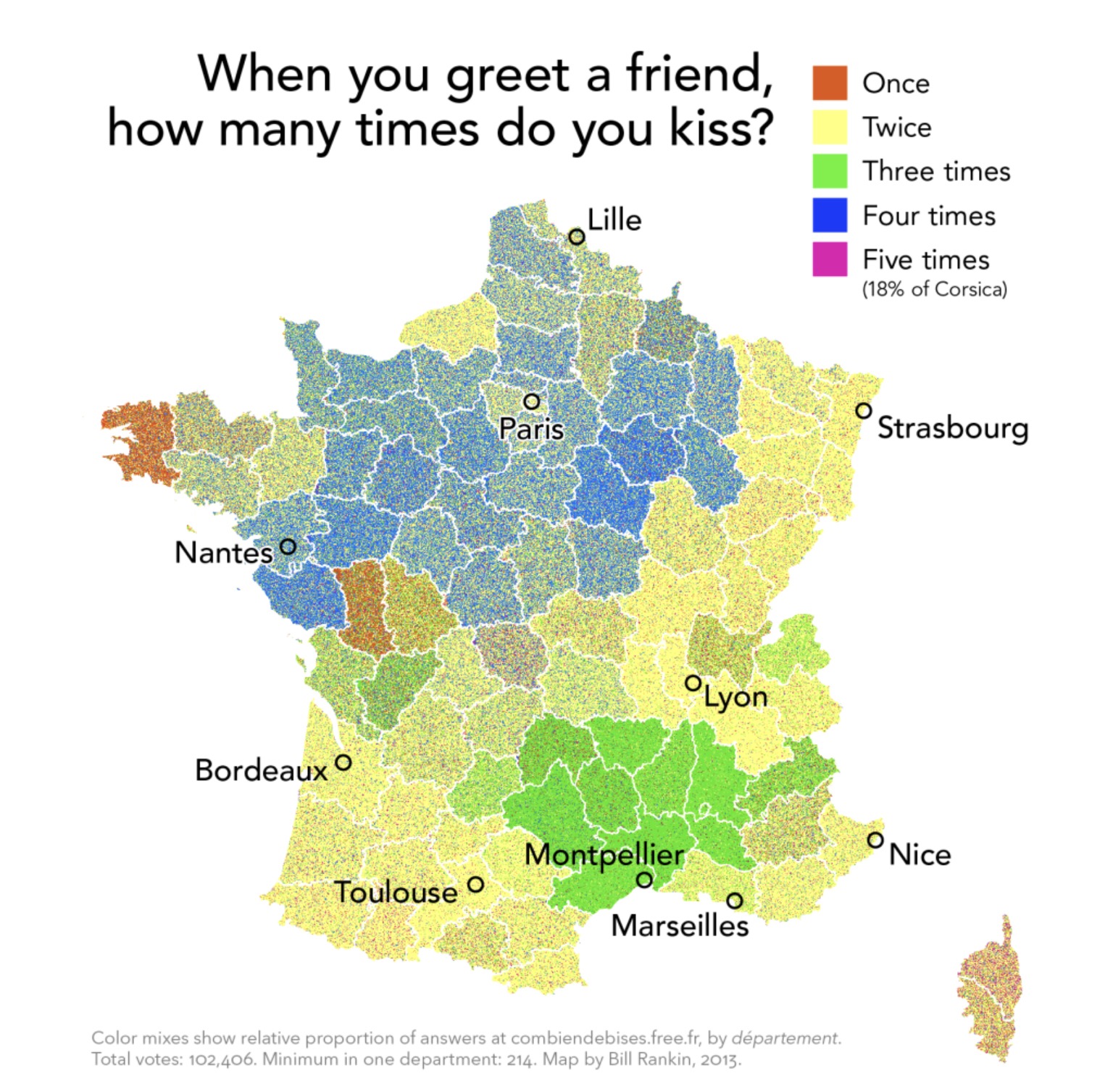
The number (from two to four or even, I am told, five in Corsica) depends less on the degree of affection or acquaintance than on the region. I even found a map of France on the web, showing the number of kisses current in each region. Someone probably got a Master's thesis out of that. 

“A popular French joke is that you may recognize the city you are in by counting the number of cheek kisses, as it is so varied across the country. An online map of France even shows the number of kisses currently claimed to be used in each region. It shows it's more common in the southern parts of France, even between males, whether they be relatives or friends. In the north however, it is less usual for two unrelated males to share 'la bise'. “In the Netherlands and Belgium cheek kissing is commonly used as a greeting between relatives and friends. But women will kiss both women and men, while men will kiss women and refrain from kissing other men. They prefer to shake hands, especially with strangers. Usually three kisses are exchanged in the Netherlands and the Dutch part of Belgium. The same is found to be true in Switzerland. In Francophone Belgium, the custom is usually one or three kisses. “On occasion, you may exchange bises with the same person three times: when you arrive, congratulating an achievement or thanking him or her for a gift, and then again when one is leaving.”


After almost eight years in the Morvan, I offer my own take on la bise. Here, men mostly shake hands with each other with optional back-slapping, but men kiss women. Women kiss women. Everyone kisses children: both sexes hold up their faces to be kissed. So our friend Alain from Auxerre shakes hands enthusiastically with my husband John, while I am treated to la bise. When you have known someone a while and exchanged handshakes, one of you will say, "On fait la bise?" and the kissing can begin.

My advice is go with the flow – and remember next time you meet that person. My extrovert friend Gigi delivers quadruple bises accompanied by a hug, whereas Simone, an equally dear friend but older and more reserved, does two, with no body contact. La bise says "hello" and "goodbye". My cleaning lady Yvonne and I exchange kisses when she arrives for work and again when she leaves.

Dionne Warwick sang: What do you get when you kiss a guy?
You get enough germs to catch pneumonia
After you do, he'll never phone ya
I'll never fall in love again.

In my experience, la bise does not spread contagion. To give an extreme example, the Bazolles oldies' club meets monthly and any woman with a birthday during that month faces what to many Brits would be Ordeal by Kissing. All 50 members claim their osculatory rights. If the lady is at all personable, several sprightly old buffers will queue up twice for the privilege. Amazingly, however, I have had just one cold since we arrived here in 2005. Maybe I had a natural immunity when we settled. My theory, however, is that the absence of mouth-to-mouth contact explains this. –By Rosy Rabson for Telegraph Weekly World, 2013 


Etiquette Enthusiast, Maura J Graber is the Site Editor for the Etiquipedia© Etiquette Encyclopedia 

Wednesday, August 24, 2016

Etiquette, Golf and Kissing

Since the early days of the genteel game of golf, kissing was not permitted on the golf course. Public displays of affection were frowned upon, even in 1967,  
English Oldsters Ban Kissing

YORK, England (UPl)—Senior golf club members watched aghast from the clubhouse. They said what happened on the first tee “broke the club’s rules of etiquette.” So twenty young golfers, who had been given a reduced rate to play at the club, were banned because two sweethearts kissed on the first tee. – The Dessert Sun, 1967 


Etiquette Enthusiast, Maura J Graber, is the Site Moderator and Editor for the Etiquipedia© Etiquette Encyclopedia