Showing posts with label Soup Etiquette. Show all posts

Friday, January 23, 2026

Etiquette and Appreciation of Soup

What Have We Here? — A Gilded Age place setting with a French écuelle. An écuelle is a 2 handled bowl, generally with a cover to keep soup hot. The écuelle is perfect for a broth or light soup. A small round (bouillon) soup spoon sits to the right. – From the book, “Yesteryear… More of What Have We Here?: The Etiquette and Essentials of Past Times to the Mid-20th Century
NEW YORK Every eater has a special set of gastronomic obsessions. One of my most persistent has to do with hot soup, by which I really mean hot ' soup. Anything less than a curtain of steam that obscures an eating partner across the table is to me soup that borders on the tepid, a soup that must be hurried through before it is actually cold and therefore inedible. 

Today one is generally served soup that ranges from barely tepid to very warm. Or which, at best, is Just a few degrees above body temperature, so that it feels hot to the lips but dies a chilly death by the time it reaches the back of the tongue. Nor do a few wan wisps of rising steam prove that soup is really hot. but merely that the liquid is somewhat warmer than the room in which it is being served. 

A combination of reasons Is behind this creeping tepidism that is understandable, if not excusable. For one thing, hardly anyone under 45 really knows what hot means when related to soup. At least two generations separate today's eaters from forbears who emigrated from Russia, Germany, Eastern Europe, Scandinavia and China, where even today Microwave, like it not, hot soup is taken seriously. 

Ever frugal, wise old housewives served soup so hot that the preheated tureens added to the warmth of the room and one could thaw winter chilled hands by sliding them over the outside of the bowl. Finally, when eaten, these soups served as personalized central heating systems. Hot soup has also met Its demise partly at the hands of etiquette snobs who decry blowing on broth or slurping It from a spoon. Many restaurants deliberately serve tepid soup for economic reasons. If they are relatively inexpensive eating places that rely on turnover, they cannot afford to have chairs occupied an extra 10 minutes per seating by customers waiting for soup (or coffee, tea or cocoa) to cool. 

To work one's way through a bowlful of incendiary soup is to pass through several stages of enjoyment, almost Oriental In their subtle refinements. Start with a bowl of soup that is topped by a mushroom cloud of steam, a soup that is still atremble with its own inner heat, and you begin by inhaling a heady essence, as the scent pervades your nostrils long before its substance can touch your tongue. Soon you pick up a small amount on the tip of the spoon and between whispering sips and lightly exhaled, cooling puffs, you begin carefully to get a sense of what the liquid portion of the soup holds in store. 

These early sips must exclude solids, still too hot to handle in the throat. In a few minutes the soup is merely hot and larger mouthfuls can be handled, revealing liquid and solids in full-bodied splendor. After that, and eating ever more quickly, the warm soup is a luxurious comfort, full of taste but allowing freedom from caution. Now you can really consider the tastes behind tastes, the textures of solids, the herbs and pot vegetables that perfume the brew. As always when eating soup, intermittent bites of bread renew the palate to the subtleties of the liquid. – By Mimi Sheraton, New York Times News Service, 1979


 🍽️Etiquette Enthusiast, Maura J. Graber of The RSVP Institute of Etiquette, is the Site Editor of the Etiquipedia© Etiquette Encyclopedia 

Thursday, July 11, 2024

Etiquette of Service and Soup Plates

“When a soup plate is removed from the service plate the latter is not used for the next course. It is removed when the course is served to make room for the filled plate. That is strict etiquette, although in some families both soup plate and the one beneath it are removed together.” – “Service plates” are also known as “chargers,” “place plates” and “buffet plates” in various hospitality, restaurant and home entertaining and dining circles.
BETTY BRADEEN'S DAILY CHAT

USUALLY questions sent to me demand an impossibly prompt reply, but a few received yesterday can be answered in this column and reach the interested parties early enough to do them some good. The first concerns the head of a rectangular table- it is not at the center of either long side, but at one of the short sides where there is but one plate as a usual thing. I know of no better rule for it than custom, in families where nice points in living receive due attention.

When a soup plate is removed from the service plate the latter is not used for the next course. It is removed when the course is served to make room for the filled plate. That is strict etiquette, although in some families both soup plate and the one beneath it are removed together. There is a strong tendency toward simplicity in the serving of meals save in families where helpers are plentiful. It comes from apartment living, where small quarters entail many sacrifices. There are hundreds of homes where meals are sent up from the cafe and served inn the living room or in a dining-room of a pretentious suite- naturally service under these conditions would be simple.– From the Sacramento Daily Union, 1913


🍽Etiquette Enthusiast, Maura J. Graber, is the Site Editor for the Etiquipedia© Etiquette Encyclopedia 

Sunday, November 12, 2023

Bad Manners Show Poor Breeding

      
Letty is wrecking her chance to get into the smart crowd she admires with all of her etiquette blunders!

Bad Manners at Table Betray Poor Breeding

Here's Letty—wrecking her chance to get into the smart crowd she admires. Etiquette blunders — such as spreading jam over a whole slice of bread— betray her lack of breeding. She doesn’t know that well-bred people break off, butter and spread with jam, one morsel at a time. 
She smothers her fish in tartar sauce. The deft way is to dab a little sauce with the fork on each bite of fish. She spoons up all her bouillon, not knowing it’s proper to drink it straight from the cup, after sipping with a spoon to see if it’s cool enough. Avoid these telltale blunders. — Santa Ana Journal, 1936


 🍽Etiquette Enthusiast, Maura J. Graber, is the Site Editor for the Etiquipedia© Etiquette Encyclopedia

Monday, October 30, 2023

Poor Manners Equal Poor Business

Reason For Some Failures


For the average man success frequently depends more upon his manner and appearance than upon his knowledge of his trade or business, or, one might also say, of his profession. A Chicago newspaper has lately been noting some failures and their causes. It cites the case of one man who was a successful saleman in a business house in Chicago, but was unable to get any customers when sent on the road. The general manager of the business went to lunch with him one day, to talk over the matter. 

The man crumbled crackers into his soup until it was thick and then ate the mixture from the end of his spoon in great mouthfuls. When the meat was served, he shoveled it in with his knife, and had finished eating and was noisily picking his teeth almost before the manager had begun his meal. In reply to a question, he told the manager that he always took his customers out to lunch, and used every method to win their confidence and friendship. 

The manager then said, “You couldn't sell me a stick of gum. No man whose personal habits are so obtrusively vulgar as yours could have the slightest influence with me. Had I lunched with you before sending you out on the road, I would never have disgraced our house by giving it such a representative.” These words hurt, but the man profited by them, and today is one of the most gentlemanly as well as one of the most successful salesmen on the road. 

Another case cited is that of a minister whose unrefined manners annoyed his women relatives. They tried to help him, but he resented their suggestions, and men less able intellectually, but with more of the graces of refinement in their manners, were called to the opportunities for service in the pulpits of the large and influential churches. 

They used to teach manners in the old days. Now there is little formal instruction. If a youth does not learn good manners at home, he has to pick them up when he gets out into the world, or else be handicapped. Great geniuses have commanded respect in spite of boorishness, but it is never safe for a young man to assume that he is a genius.– San Pedro Daily News, 1906


 🍽Etiquette Enthusiast, Maura J. Graber, is the Site Editor for the Etiquipedia© Etiquette Encyclopedia

Wednesday, September 27, 2023

Manners are for Holidays and Everyday

Always use the soup spoon provided to eat as much soup as you can, before picking up the handled-cup to drink from it, leaving the used spoon resting on the accompanying saucer -“Soup should be dipped away, never toward the individual. If clear soup is served in cups, a small round bowled spoon is used, or the bouillon may be sipped from the cup.”

In Your Market Basket: A Lesson in Holiday Table Manners


Every newspaper editor often finds this kind of a query in the mail; 
Dear Editor—My early training in etiquette was much neglected. Now I have made a fortune, travel considerably and am often embarrassed by my Ignorance about table manners. Will you aid me? – Signed “Worried
Table manners are, of course, for the home table all of the year around, but it is at the holiday season when dinner engagements are most numerous, that a great many persons require a little extra preparedness. 

The experienced hostess will see that forks and spoons are placed in the order in which they are to be used. If the dinner is of many courses, the appropriate silver is laid with each course. 

Soup should be dipped away, never toward the individual. If clear soup is served in cups, a small round bowled spoon is used, or the bouillon may be sipped from the cup.

The knife should never be held in the left hand, but the fork may be transferred to the right hand. The English way of keeping the fork in the left hand is the present fashion among very fastidious society folk. 

At the end of the course the knife and fork should be placed side by side with the tips in the middle of the plate and the handles resting on its edge. —From Kiddi Bye in the San Luis Obispo Daily Telegram, December, 1916


🍽Etiquette Enthusiast, Maura J. Graber, is the Site Editor for the Etiquipedia© Etiquette Encyclopedia

Sunday, August 20, 2023

10 Etiquette Tips of 1940

To help children acquire poise and ease of manner at the table, they should be given a reasonable amount of attention. They should be encouraged to join in the general conversation and not rudely interrupted, or how can they learn to listen attentively and politely to others? 

 Hints on Etiquette from 1940

  1. Ice cream served à la mode (on pie) is eaten with a fork. 
  2. The bride rides to church in the car with her father, not with the bridesmaid or with her husband-to-be. 
  3. To help children acquire poise and ease of manner at the table, they should be given a reasonable amount of attention. They should be encouraged to join in the general conversation and not rudely interrupted, or how can they learn to listen attentively and politely to others? 
  4. It is the woman's place to proffer her hand to a man if she wishes to shake hands with him. However, if the man is used to shaking hands at meeting, and holds out his hand, she should shake hands with him even if she didn't intend to. 
  5. You can train yourself to be a good mixer if you make a habit of always being interested in other people and showing it by your speech and actions.
  6. Talk of one's personal problems and woes in public places, and in a tone of voice which easily carries to those within range, is never good taste. 
  7. When you have finished your soup, if it is served in a regular soup bowl, wide and shallow, put the spoon in the bowl itself when you have finished. When eating soup out of a bouillon cup, however, put the spoon in the saucer or plate in which the cup stands.
  8. It is good manners as well as good morals to suppress any unpleasant thing you may have heard of a person and tell those which are pleasant and to their credit. 
  9. It is not considered good manners to smoke while dancing.
  10. Ushers at a church wedding should be at the church about an hour before the time set for the ceremony. 

From the “Grab Bag” feature in the Imperial Valley Press, 1940


🍽Etiquette Enthusiast, Maura J. Graber, is the Site Editor for the Etiquipedia© Etiquette Encyclopedia

Wednesday, May 10, 2023

Onion Soup Etiquette

How to Eat French Onion Soup 
and Other Soup Tips

French Onion Soup

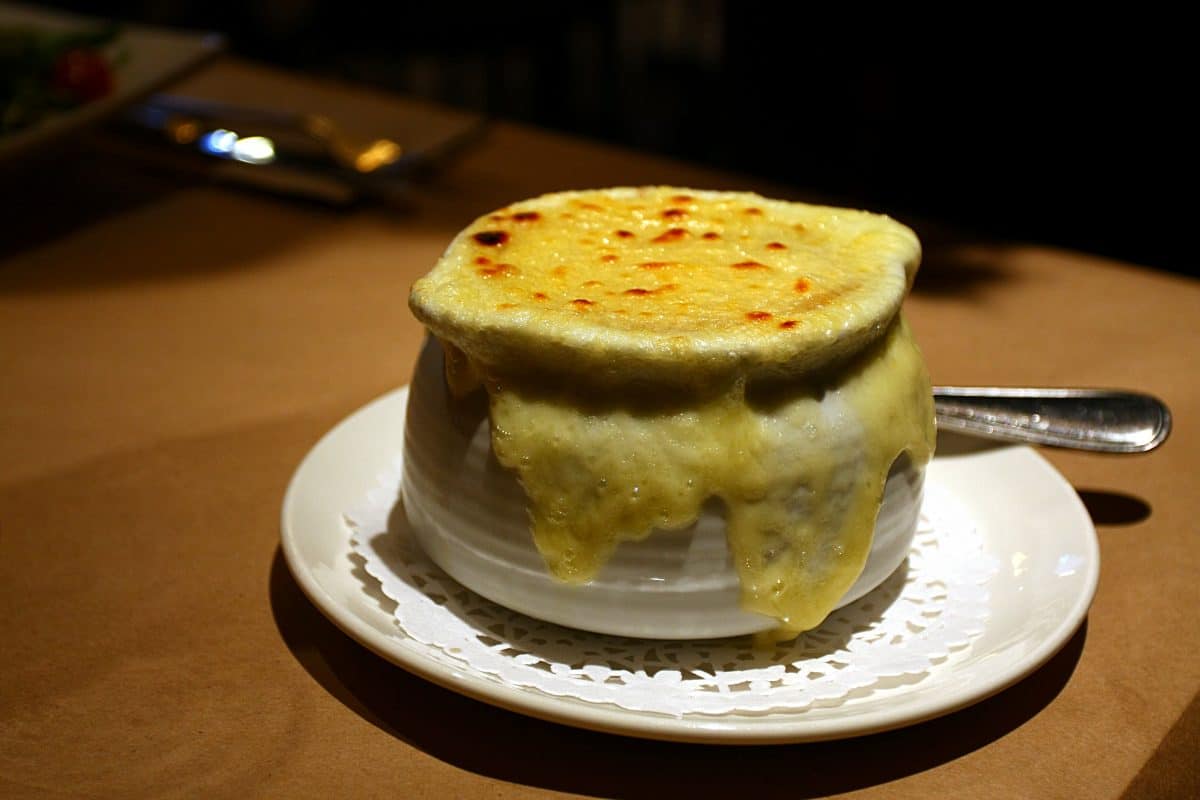
A friend recently shared an interview experience with a person who was applying to work at his law firm. The employment offer was off the table after having lunch with the applicant. The person completely blew eating their French Onion soup! (Details left to the reader’s imagination.)

How to Eat French Onion Soup

It’s interesting how one little bowl of soup can bring about the level of anxiety this one does. Although steeped in tradition, served in French market cafés primarily as late-night fare, the bread and cheese hooding the fragrant broth and onions creates confusion for those hoping to eat it with some semblance of decorum. 

So, how DO you eat French Onion Soup with confidence and fewer drips?  Etiquette experts, Emily Post and daughter, Peggy, have shared, “With such a soup, a knife is your friend, not your enemy.” That’s right, it is acceptable to use a knife when eating this soup, especially when it helps avoid your wearing strings of cheese on your face.

  • Much can depend on the soup as prepared by the chef.  If, as in the picture above, cheese has baked down firmly onto the sides of the bowl, the diner must be careful with the first knife move to avoid a possible burst of steam.
  • With the soup spoon in your dominant hand and a knife in the other hand, push the cheese from the middle outward to the rim of the bowl.
  • Use the knife to cut and nudge bits of cheese onto your spoon. In the case of long strands of cheese that are difficult to get into the spoon, you can twist the strand around the wide part of the spoon and then cut it with the knife.
  • You can also switch hands and use the knife to cut the crispy bread, while using the soup spoon to leverage it.
  • It's tricky!

Doing Business During a Meal

If your business includes working with clients, the business lunch is a perfect social occasion with a goal that is professional. On a very small scale it is like a networking event with food and drink involved. And, if you are being interviewed over lunch, know that the potential employer will be imagining how you will interact with their clients. Having good dining skills is paramount. 

When you are dining with a potential employer, it’s no time to be adventurous with food. Make sure your meal is within your skill level comfort zone. If you order soup, make sure that it is creamy or a broth and that can easily be eaten with a soup spoon alone, never requiring the use of any other utensil or bread. 

When you order soup at a business lunch or dinner:

  • Order “easy” to eat soup that will allow you to concentrate on the conversation at hand.
  • Never add salt or pepper without first tasting. 
  • Hold the spoon so that the bowl of the spoon is angled away from you.
  • Do not fill the bowl of the spoon too full or make any slurping sound.

A business or working lunch, like any meal, is meant to nourish you and be enjoyed. But primarily, it is intended to make doing business more convenient and in a social context.

In most gatherings where people are eating, we tend to make food the primary subject. But when business is being conducted during mealtime, business should be the primary subject. Which makes knowing how to eat French onion soup, and many other foods that require special knowledge, worth the time and practice.


 Contributor, Candace Smith is a retired, national award-winning secondary school educator, Candace Smith teaches university students and professionals the soft skills of etiquette and protocol. She found these skills necessary in her own life after her husband received international recognition in 2002. Plunged into a new “normal” of travel and formal social gatherings with global leaders, she discovered how uncomfortable she was in many important social situations. After extensive training in etiquette and protocol, Candace realized a markedly increased confidence level in meeting and greeting and dining skills and was inspired to share these skills that will help others gain comfort and confidence in dining and networking situations. Learn more at http://www.candacesmithetiquette.com/


 🍽Etiquette Enthusiast, Maura J. Graber, is the Site Editor for the Etiquipedia© Etiquette Encyclopedia
Thursday, January 7, 2021

Royal Tea and Soup Faux Pas


Princess Victoria Adelaide Mary Louise, “Vicky” was the eldest child of Britain's Queen Victoria and Prince Albert — Through marriage she became Empress Consort in Germany and Queen of Prussia, late 19th century.
Public domain image, Wikipedia 


You may stir your tea so as to rattle the spoon and cup, and it is your privilege to sip soup from the side or the point of the tablespoon, and still be counted as Courtly; for so doth the Empress of Germany and the Queen of Prussia. — Chicago Times, 1888


Etiquette Enthusiast, Maura J. Graber, is the Site Editor for the Etiquipedia© Etiquette Encyclopedia


Tuesday, December 22, 2020

Gilded Age Dining Room “Pigs”

There is a poser for ‘society’: If a man with a mustache cannot drink soup sensibly and decently, he should be sent to the trough in the back yard to keep company with the man who tucks a napkin in his collar. It is all right for a woman to drink soup from the side of her spoon, or for a man with a shaven upper lip; but men with mustaches have some rights that ‘society’ is bound for its own sense of decency to respect, especially as ‘society’ decrees that every man should wear a mustache!


A Woman’s 1886 Take on “Pigs” 

The Various Society Pigs — The Pig with a Chin Bib, the Pig Who Sucks Soup from His Mustache and the Fork Used as a Comb


There is one practice that is becoming altogether too common with men and one that ought to be abandoned as soon as possible. It is their habit of tucking a napkin under their chins at table. In my younger days, such a thing would have been considered coarse and vulgar and no gentleman would have thought of doing it. A napkin so used, takes the place of a bib, but is not nearly so neat or effectual as a bib. Yet what gentleman is there who would be willing to acknowledge himself so much of a baby, or a pet pig, as to require a bib? If the napkin is so worn to keep the food from falling on the clothes, it is an acknowledgment that the wearer is entirely out of place in a public dining-room or in the company of ladies and gentlemen. If he is such a hog as to let food slip out of his mouth and trickle down his breast, he should be made to feed out of a trough in the backyard.


Not long ago I sat opposite an evidently refined young lady at a public table, and near both of us sat a man with a napkin tucked under his chin. When I am eating I avoid looking at such men, as they are more than apt to be piggish and disgusting while they feed. I noticed that the young lady sitting opposite me glanced at the man with the napkin under his chin, and then turned pale and lay down her knife and fork. In another moment she had left the table, and the poor waiter thought she was offended at his service. But she was not. She had caught the bibbed lout doing a very disgusting thing and it made her sick. I looked to see what it was. He was combing his mustache with his fork!


And then, we all know the man who with a loud hissing sound, sucks the soup from his mustache. Everybody in the dining room hears it, and many appetites are spoiled. Now, “society” tells us that it is vulgar to take soup from the point of the spoon, and insists that it must be taken from the side. Allow me to say that in this particular society is a fool. A man with a mustache cannot take soup from the side of a spoon without soaking his mustache, and then he drips, slobbers and sucks. It is fair to ask, “Which is better— drinking from the point of the spoon and keeping the mustache clean, or drinking from the side and producing a soaked, dripping spectacle that turns the stomach of an ordinary beholder upside down? 


There is a poser for “society”: If a man with a mustache cannot drink soup sensibly and decently, he should be sent to the trough in the back yard to keep company with the man who tucks a napkin in his collar. It is all right for a woman to drink soup from the side of her spoon, or for a man with a shaven upper lip; but men with mustaches have some rights that “society” is bound for its own sense of decency to respect, especially as “society” decrees that every man should wear a mustache. — “Jeannette“ in the San Jose Herald, 1886

Even though gilded age society decried the practice of wearing one’s napkin as an adult bib, there were plenty of patented “napkin holders“ and “napkin supporters” out on the market for men and women alike. Some were quite imaginative, but they were still placing napkins upon the breasts of diners, which remained quite the public faux pas.


Etiquette Enthusiast, Maura J. Graber, is the Site Editor for the Etiquipedia© Etiquette Encyclopedia

Sunday, December 20, 2020

A Noiseless Spoon for Soup

“The ‘muffler’ which has been applied to the spoon is simply a ‘lid’ that covers one half the surface of the bowl, a slit being provided at the edge through which the liquid enters the mouth of the user...” — So it was basically a “mustache spoon” with a different name? Yes!


A spoon that permits the most careless person to eat soup without noise has been invented by a St.Louis man. The inventor claims that a person using this spoon cannot make a noise, even if he feels inclined to do so. The “muffler” which has been applied to the spoon is simply a “lid” that covers one half the surface of the bowl, a slit being provided at the edge through which the liquid enters the mouth of the user. 

The device is somewhat like the old fashioned “mustache cups.” In the results obtained, and is recommended to men with heavy mustaches for use with all manner of liquids taken with a spoon. A spoon with a wider silt or aperture is to be made for use with soups other than the “clear’’ or “strained” varieties.— Los Angeles Herald, 1901


Etiquette Enthusiast, Maura J. Graber, is the Site Editor for the Etiquipedia© Etiquette Encyclopedia

Thursday, August 27, 2020

Soup Etiquette Tips

    Sherry is the first wine offered at dinner, and then usually with a soup that contains Sherry in the preparation. Sherry should never be offered with cream of chicken soup or vichyssoise, but with turtle or black-bean soup, for instance. Clear soups are often served in a shallow bowl rather than a cup. When the level of soup is so low that you must lift the bowl to avoid scraping the bottom, lift the near edge with your left hand and tip the bowl away from you. Then spoon the soup away from you.

    When soup is served for a luncheon or dinner, Emily Post’s “Etiquette” offers the following advice:

    • Soup should be the first of six courses. It should be followed by fish, the entree, salad, dessert and coffee. Six is the maximum number of courses for even the most elaborate dinner; and for an informal luncheon, two or three courses are sufficient— soup, entree and dessert.
    • Soup at a luncheon is served in two-handled cups. The soup is eaten with a teaspoon, or the cup may be picked up and the soup may be sipped, if it has sufficiently cooled. A clear soup is usually served.
    • Sherry is the first wine offered at dinner, and then usually with a soup that contains Sherry in the preparation. Sherry should never be offered with cream of chicken soup or vichyssoise, but with turtle or black-bean soup, for instance.
    • Clear soups are often served in a shallow bowl rather than a cup. When the level of soup is so low that you must lift the bowl to avoid scraping the bottom, lift the near edge with your left hand and tip the bowl away from you. Then spoon the soup away from you.
    • Both soup cups and soup bowls should be served with a saucer or plate beneath them. The spoon, when not in use or when the soup is finished, is laid on the saucer underneath.
    Amy Vanderbilt, in the “Amy Vanderbilt Complete Book of Etiquette,” says: 
    • Soup should always be kept flowing in the opposite direction from one’s lap. The soup spoon should be filled from its far side, and soup then poured gently into the mouth with its near side.
    • Vanderbilt says that if dumplings, vegetables, mushrooms or other garnishes are floating on top, eat these first by using the spoon, before the liquid part of the soup is drunk. If noodles are at the bottom of the bowl, spoon them up before consuming the liquid.
    • If you take a large spoonful of extremely hot soup, don’t spit it out, concludes Vanderbilt. Instead, take a quick drink of water to cool your mouth. If you have burned your mouth, an exception may be made to the rule against drinking with food already in your mouth.


    Etiquette Enthusiast, Maura J Graber, is the Site Editor for the Etiquipedia© Etiquette Encyclopedia

    Saturday, May 23, 2020

    Etiquette for Soup

    For Continental or American Dining, the spoon is dipped away from those dining, then brought to mouth level, and the soup sipped from the side of the spoon bowls. — “Hold your spoon on, or in, your hand, not under it. Do not grasp spoon or knife or fork as if you feared they might escape from you. Hold your spoon and fork in eating something, as you ought to hold your pen in writing. Do not put the spoon into your mouth, but drink from the side near the point.”


    In how to serve and eat a dinner, a writer in the “Congregationalist” says of the first course at dinner; Never refuse soup, and never ask for a second helping. “He was such a fellow, now, as would ask for more soup at dinner,” was the condensed criticism passed upon some one by a famous English exquisite; and really it is more comprehensive than would appear on the surface, since one person at the table may keep all others waiting if he asked for a second dish of soup. 

    If you wish for more salt, and have an individual cellar and no spoon, do not take the salt in your thumb and fingers; and do not after taking it on the end of your knife, perform upon the knife with your fork or spoon a tattoo. Shake the salt from your knife silently at all times; but do not take the trouble to shake it all over your plate of soup, as if it were solid, when one stir-about is all sufficient to season it to its remotest corner. At all times be sure to keep your fork out of your salt-cellar. 

    Never crumble bread into your soup, and do not butter the bread you eat with it. Do not perform a circle all round the plate at every spoonful. Dip from the middle of the plate, and do not tip it to get the last drop. Be careful not to make the least sound with your lips in eating soup, or anything else; the clatter of knives and forks and dishes, and the sound of scraping, are not to be tolerated among refined people. 

    Hold your spoon on, or in, your hand, not under it. Do not grasp spoon or knife or fork as if you feared they might escape from you. Hold your spoon and fork in eating something, as you ought to hold your pen in writing. Do not put the spoon into your mouth, but drink from the side near the point. — The Morning Union, 1888


    Etiquette Enthusiast, Maura J Graber, is the Site Editor for the Etiquipedia©️ Etiquette Encyclopedia 

    Sunday, April 12, 2020

    Medieval Seating and Dining

     The origins of modern day seating arrangements for dining. — “As a rule, one knife had to serve for two people, and often a bowl of soup was used by two persons. For this reason the party giving the dinner arranged his guests in couples, trying to place people together who would be congenial and not adverse to this common use of table appointments.”— Image source, Pinterest


    A description of a dinner given in 1350 shows that there has been a vast improvement in table manners since then:
    As a rule, one knife had to serve for two people, and often a bowl of soup was used by two persons. For this reason the party giving the dinner arranged his guests in couples, trying to place people together who would be congenial and not adverse to this common use of table appointments. Spoons were seldom supplied to the guests, and the soup was drunk directly from the bowl, the latter usually having side handles by which it was held. 
    In less refined company, there were no separate soup bowls, only one large porringer, which was passed around to the guests in turn. The diners helped themselves to the pieces of meat they desired from the common dish with their fingers. Napkins were considered a luxury, and were only provided in very aristocratic and wealthy families.—Philadelphia Inquirer, 1903

    Etiquette Enthusiast, Maura J Graber, is the Site Editor for the Etiquipedia© Etiquette Encyclopedia

    Wednesday, September 11, 2019

    As Eastern Slurps Met Western Soup

    Yukio Mishima (三島 由紀夫 Mishima Yukio) was the pen name of Kimitake Hiraoka , a Japanese author, poet, playwright, Japanese nationalist, and founder of the “Tatenokai,” or Shield Society. The Tatenokai was a private militia in Japan, which was dedicated to traditional Japanese values and veneration of the Emperor. It was founded and led by Mishima, considered one of the most influential Japanese authors of the 20th century. After WWII, “lamenting the rise of Coca-Cola in Japan, General Douglas McArthur, and the dimming glow of the Emperor's sun,” Mishima longed for the olden days of “bushido” –– a time when nationalism, honor and dignity seemed so effortlessly bound together. He committed suicide in 1970 after a failed attempt to overthrow the post-war, Japanese government.


    Japan’s Top Novelist Frowns on Western Etiquette, Says Slurping of Soup Okay


    An Atlanta Georgia ramen restaurant display to order one’s soup from 

    TOKYO, Jan. 1 — Slurp your soup and prove you are no social sheep. So advises Yukio Mishima, one of Japan’s most popular postwar novelists. “Amidst a quiet first class restaurant,” Mishima admits, “it requires social courage.” The 33-year old author frowns on efforts-to cram Western table manners down Japanese throats. “Never to make noise when you have soup,” he argues, “is to force Western etiquette on the Japanese who have been used to noisily slurping soybean soup and tea since childhood.” And girls, he argues, are too easily influenced by books on superficial etiquette. 

    He quotes a confession appearing in a women’s magazine: “The first time I went out with him to dine, my boy friend started sipping soup with the ‘z-z-zhu’ sound as if he were swallowing a bowl of noodles down his throat. Instantly I felt sick physiologically . . . since then I’ve had no affection for him.” Mishima says such confessions usually appear in women’s magazines under special subjects as “Delicacy of Love Psychology.” “This kind of women’s psychology has nothing to do with feminine delicacy but rather with vanity,” he says. “What is elegant is what is decided by the greater numbers of a society.” – Shin Nichibei, 1959


    Etiquette Enthusiast, Maura J. Graber, is the Site Editor for the Etiquipedia© Etiquette Encyclopedia 

    Tuesday, August 6, 2019

    Serving Soup and Etiquette Advice

    When soup is served as the first course, the soup spoon will be the first utensil on the far right of the place setting. If soup is to be the second course, a small utensil (appetizer fork, caviar spoon or spreader, individual asparagus tongs) for the first course will usually be located to the right of the soup spoon. At an informal lunch setting, soup may be served and eaten alongside another type of food, like a salad or a sandwich. 

    A Kindhearted Waiter – Helpful? 
    Or giving unsolicited advice? 
    Etiquipedia says he was trying to be helpful, and she most gracious.

    A surprising experience was that of a lady who received a bit of advice on table etiquette. She is sufficiently free from vanity to tell the story herself. She says: I know that I am not a person of impressive appearance. I am inclined to be short and stout and to dress plainly. Still, I had hoped that I had an air of acquaintance with polite society. But now I shall be more modest than ever in my idea of the impression I make upon strangers. 

    At my first meal at the hotel where I passed last summer, I was pleased with the face of my waiter, it was radiant with kindliness and good nature. I began my dinner with soup and fish. As the waiter set them in front of me, he glanced at the persons of fashionable appearance who were my neighbors at table. His kind heart was suddenly struck with the fear that I might make an unfortunate impression on them. He bent down and whispered in my ear: “Eat your soup first.” – Press Democrat, 1909


    Etiquette Enthusiast, Maura J Graber, is the Site Editor for the Etiquipedia© Etiquette Encyclopedia 

    Tuesday, September 18, 2018

    Etiquette and the Royal Breakfast

     The Prince of Wales’ set recently adopted the idea from the French and all London’s rapidly taking up the custom! – No doubt the Americans who have gone to England to help celebrate the Queen's Jubilee will return imbued with the idea that soup for breakfast is the only proper and polite thing. The custom has long been prevalent in France, and is now being introduced in London.


    The Prince’s New Breakfast 
    The Prince of Wales Has Recently Set the Fashion 

    No doubt the Americans who have gone to England to help celebrate the Queen's Jubilee will return imbued with the idea that soup for breakfast is the only proper and polite thing. The custom has long been prevalent in France, and is now being introduced in London. “At all the first-class cafés in Paris,” says a gentleman recently returned from the other side, “the patrons can get soups of various kinds for breakfast, and a great many Parisians sip soup before putting anything more substantial in their stomachs. In London, two months ago, Henry White, the swell secretary of the American legation, invited me to breakfast, and the first thing on the menu was soup. He told me that the Prince of Wales’ set had recently adopted the idea from the French and that all London was rapidly taking up the custom.” 


    Mr. White set the pace for Americans over there, and whether or not he entertains all of his countrymen who are flocking to the Queen’s Jubilee, he can introduce enough of them to this new fad to cause the whole outfit to come back home singing its praises. “It is really one of the most sensible gastronomic innovations I can imagine. Soup, when properly made, is both soothing and stimulating. The over-taxed stomach of the average American needs both to be soothed and stimulated the first thing in the morning. Therefore, I look for the soup idea to become immediately popular when it is brought over by our tourists. Doubtless they will invent a name for it, as the fashionable folk of this country are afraid to risk their standing among the gourmets by eating for breakfast a dish with so plain and vulgar a name as ‘soup’.” – Los Angeles Herald, 1897


    Etiquette Enthusiast, Maura J. Graber, is the Site Editor for the Etiquipedia© Etiquette Encyclopedia

    Wednesday, August 8, 2018

    23 Victorian Dining Rules

    Though catalogs and shops in the 1870’s, 1880’s and 1890’s featured the newest and latest designs in tableware, knowledge of the “correct fork” to use is nowhere on this list of good table manners for guests, and hosts, alike. Knowing all of the correct utensils is wonderful, but the premise of good manners being based on kindness towards our fellow man, remains the same. 


    Dining at the 19th C. Table

    True politeness has its origin in Christian charity and kindness. All standard rules of etiquette were founded for the greater convenience and happiness of all the members of society. Although the reasons may not be obvious at first sight, they exist, and will be apparent on a careful consideration. 
    1. Do not keep others waiting for you, either at the beginning or at the close of the meal. 
    2. Do not sip soup from the tip, but from the side of the spoon. 
    3. Be careful not to drop nor spill anything on the table cloth. 
    4. Keep your plate neat; do not heap all sorts of food on it at once. 
    5. In passing your plate to be refilled, retain the knife and fork. 
    6. When asked for a dish, do not shove, but hand it. 
    7. While drinking, do not look around. 
    8. Instruct the servant to hand the cup at the left side, so that it may be received by the right hand. 
    9. Do not drink your tea or coffee without first removing the teaspoon from the cup to the saucer. 
    10. Use the knife for cutting only; never put it to the lips nor in the mouth. 
    11. Break your bread into small pieces and rest them on your plate while spreading. 
    12. Do not eat too fast. Besides giving one the appearance of greed, it is not healthy. 
    13. If you find anything disagreeable in your food, put it aside as quietly as possible, without drawing the attention of anyone to it. 
    14. Do not open the lips nor make any unnecessary noise in chewing. 
    15. Do not touch the head. 
    16. Do not rest the elbows on the table. 
    17. Do not speak with the mouth full. 
    18. Brush the table neatly before bringing on the dessert. 
    19. Be thoughtful and attentive to the wants of those about you. 
    20. Converse on pleasant subjects with those sitting near you. 
    21. Do not say anything not intended for all present to hear. 
    22. Leave your plate with the knife and fork lying parallel, the handles pointing to the right. 
    23. Never leave the table before others, without asking the lady or gentleman who presides to excuse you. — Russian River Flag, 1871


    Etiquette Enthusiast, Maura J. Graber, is the Site Editor for the Etiquipedia© Etiquette Encyclopedia

    Monday, September 11, 2017

    Etiquette — Salty but Polite

    Food service on airplane flights used to be expected and plentiful, but those days are long gone for regular airline travelers. Nowadays, if you don't bring your own, you're likely to go without, unless you are in first-class. — "Some people will tell you to bring a cup of noodles or other instant soup aboard a flight and ask the flight attendant for boiling water during meal service. Although a mug of hot soup may sound enticing, it’s a bad idea to keep a cup of scalding liquid near your lap when turbulence could strike at any second. Plus, many prepackaged ramen cups have close to half of your daily recommendation of sodium, which certainly won’t help you fight jet bloat." —from SmarterTravel.com

    An airplane manufacturer has just announced that all passenger machines will be equipped with regular dining rooms, so— That leaves it up to some etiquette expert to suggest something salty, but polite, for the passenger to say when the ship goes into a tail-spin during dinner and spills the soup in his lap. — Coronado Eagle and Journal, 1932

    Etiquette Enthusiast, Maura J. Graber, is the Site Editor for the Etiquipedia© Etiquette Encyclopedia 

    Saturday, November 19, 2016

    Collegiate Etiquette Class

    Three common types of soup spoons — A bouillon spoon, a cream soup spoon and a regular soup spoon: For Continental or American Dining, the spoon is dipped away from those dining, then brought to mouth level, and the soup sipped from the side of the spoon bowls. 

    Etiquette Class to Put Silencer on Soup Spoons

    No longer will it be necessary for the students of the New York University to be heard eating their soup, for Professor Arthur H. Nason has organized a class in etiquette where all such social difficulties will he straightened out.

    Professor Nason takes the stand that the knowledge of which is the proper fork, is just as necessary nowadays as is which is the proper mathematical formula, and he has offered to conduct his new class gratis for the benefit of the university students. – International News Service, New York, 1916


    Etiquette Enthusiast, Maura J Graber, is the Site Editor for the Etiquipedia© Etiquette Encyclopedia

    Sunday, June 29, 2014

    Yesteryear: Edwardian Table Etiquette

    though 95% of these still apply today!

    Send ten cents for our beautifully illustrated book “How to Set the Table” by Mrs. Rorer (Sarah Tyson Rorer)  ~1901

    Table Etiquette

    A man should not seat himself at the dinner table until his wife or his hostess is seated. This rule holds good in the home, for if it is not practised there, it will not be observed gracefully in society.

    Seat yourself not too close to nor too far from the table.

    One should sit quietly at the table, without handling the cutlery or making useless motions, while waiting to be served.  One, however, should not ever appear this bored at the dinner table.
    Erect position at table is the first requisite. One should so place one's seat that correct position is possible, and then should keep it.

    Elbows should never be placed upon the table.

    The hands should be kept quietly in the lap while not busy with the food.

    One should sit quietly at the table, without handling the cutlery or making useless motions, while waiting to be served.

    If there is some form of grace said, or some simple ceremony preliminary to the meal, one should pay respectful attention silently.
    A properly set dinner table by Mrs. Rorer
    Do not seem impatient to be served. The meal is a social occasion and the food is an adjunct to friendly intercourse. The success of the meal depends equally perhaps upon the food and the conversation. Because of the interruptions of service, conversation cannot be long continued, or deeply thoughtful. It must be on subjects of no great moment nor grave interest, or on such subjects lightly touched; but it should be on bright, cheerful topics, and as witty as the talent of the company affords.

    Eating should be slow, and mastication of the food thorough, for reasons of health as well as for the sake of appearance. No meal can be eaten properly and adequately in less than thirty minutes, but more than an hour for a meal is sheer waste of both time and food, unless the company is large, the times of waiting between courses long, and the portions served very small.

    Eat silently. The noise of food being masticated is very distressing, and except in cases of crusts and crisp vegetables, perfectly unnecessary.

    The napkin is unfolded and spread over the lap. One is supposed to be skillful enough in raising food to the lips not to need the napkin in front of the dress or coat to prevent injury.

    In case you do not care for a course, you should not refuse it. Receive it, and take what part of it you desire, trying to take some; or, if you wish, leave it untouched, but do not have the appearance of being neglected or ill-provided for, even if you do not eat of it. A little more attention to conversation on your part may make unnoticeable to those about you the fact that you do not eat of a certain course.

    If your preference is consulted as to food, whether the matter be trivial to you or not, express some preference so that the one who is serving, and who has asked to be guided, may be so far assisted.

    Never place food or waste matter upon the tablecloth. An exception to this may be made in regard to hard breads and celery, when individual dishes for these are not furnished. Always use the side of some one of the dishes about you for chips and scraps.

    The fork is used in general except with semi-liquid sauces, where a spoon is of necessity used. It is not permissible to eat peas with a spoon.

    The mouth should be closed while it contains food. It should not be too full, as it is often necessary to reply to some question when there is food in the mouth. Do not leave the table until you have quite ceased chewing. 
    An invitation for breakfast meant one would probably be dining on several courses, over a few hours or so.

    Be dainty and skillful in using your napkin and cutlery, avoiding soiling the tablecloth.

    Discussions and unpleasant topics of conversation should never be introduced. One should regard not only one's own aversions but those of the others present.

    Never put your finger in your mouth at table, nor pick your teeth.

    Tidiness of personal appearance is never at a higher premium than at the dining table. Soiled hands, negligee dress, shirt sleeves, and disheveled hair are disgusting there.


    It is quite proper to take the last helping of any dish which may be passed you. To refrain looks as if you  doubted the supply.

    Bread is not cut, but broken into fairly small pieces. One should never nibble from a large piece.

    It is permissible to eat crackers, olives, celery, radishes, salted nuts, crystallized fruits, corn on the cob, bonbons, and most raw fruits from the fingers. 

    Apples, pears, and peaches are quartered, peeled, and then cut into small pieces.

    Cherries, plums, and grapes are eaten one by one, the stones being removed with the fingers and laid upon the plate.

    Cheese may be laid in small pieces on bread or crackers, and conveyed to the mouth in that way.

    Asparagus should be eaten with the fork, the part which is not readily broken off by it being left.

       
    Tidiness of personal appearance is never at a higher premium than at the dining table.

    At a formal meal a second helping of a dish is never offered, and should never be asked for; but at an informal dinner party it is not out of place to accept a second helping, if one is offered, but is complimentary to the hostess, who is responsible for the cook.

    In passing the plate for a second helping, the knife and fork should be laid across it full length,—not held in the hand until the plate returns.

    One may ask the waiter for a second or third glass of water, as even at a formal dinner that is always permissible.

    Lettuce, cress, and chicory are never cut with a knife, but rolled up on the fork and so conveyed to the mouth.

    Never leave the spoon in any cup while drinking from it.

    Liquid bouillon,—not jellied,—should be drunk from the bouillon cup.

    Spoons are used for grape fruit and oranges, when cut in halves and put upon a plate, for soft-boiled eggs, puddings, custards, and gelatins.

    With fruit, finger-bowls should always be passed. A bowl half-full of water is placed upon a plate covered with a doily. Unless the fruit is passed upon a second plate, the bowl and doily are removed from this and set at one side, the fruit being eaten from this plate. The fingers are then dipped, one hand at a time, into the water, and wiped upon the napkin.

    Supper defined by Mrs. Rorer: A full supper service consists of silver tea set, plates, bread tray, cold meat dish, silver covered hot water dish ...
    Salt should never be put upon the tablecloth, but always on the side of the plate, unless the individual salts are provided.

    Never spit out a prune, peach, or cherry stone.

    Never hold food on the fork while you are talking, ready as soon as you reach a period to be put into your mouth. Having once picked it up, eat it promptly.

    A bit of bread, but nothing else, may be used, if necessary, to help one put food upon the fork.

    If one tastes of something which one does not care to swallow, it may be removed from the mouth with the closed left hand and placed on the plate. This should be done silently and with as little attention as possible.

    Never take a chicken or chop bone in the fingers. Cut the meat from the bone, leaving all that does not readily separate.

    Bread and butter plates, with the butter spreader, are always used, except at formal dinners, when the dinner-roll is laid in the fold of the napkin. 

    The knife is used only for cutting, and for spreading butter on bread in the absence of butter spreaders.

    Almost all foods are eaten with the fork, which should always be used in the right hand with the tines up. It may be held in the left hand, tines down, when one is cutting, the knife being in the right hand.

    The soup spoon is an almost circular and quite deep spoon. Therefore it is obvious that the soup should be noiselessly sipped from the side of it. When the oval dessert spoon is used for soup, it is especially necessary to sip the liquid from the side.

    Special spoon-shaped forks are provided for salads, ices, and creams, but for these spoons may always be substituted.

    No hot drink should be poured from the cup into the saucer to cool it.

    Toothpicks should not be passed at the table. They may be left on the sideboard, and if one is needed, it may be requested of the waiter or taken as you leave the room, but always used in private.

    Wherein elderly people do differently from the established ways of to-day, they are not to be criticised.

    Manners change even several times within a generation, and such may be simply following the customs they were taught. When the three-tined fork was the only one in common use, the blade of the knife was much more in requisition than now.

    On leaving the table the dishes of the last course should be left exactly as used, and the napkin left unfolded by the side of the plate. In case one is at home, or visiting a friend, and the napkins usually serve for two or three meals, then neatly fold it. Many families have clean napkins once a day, that is, at dinner.

    The chair should either be pushed quite back from the table, or close to it, so that others may easily pass by.

    If obliged to leave the table in the midst of a meal, one should address the hostess, saying, “Please excuse me,” as he rises.


    –From “The Etiquette of To-Day,” by Edith Ordway, 1918

    Etiquette Enthusiast, Maura J. Graber, is the Site Editor for the Etiquipedia© Etiquette Encyclopedia