Showing posts with label Japanese Etiquette. Show all posts

Friday, June 12, 2026

Good Table Manners are Globally Fun

“Everyone likes to be social when they dine. The French have carried this to the extreme and aim for an air of style and elegance. A French meal can be a “masterpiece,” reports Mrs. Stewart. She says there is complete attention to detail with an “interweaving” of fine food, good company, sparkling conversation, beautiful service, fresh flowers, and the ever present wines.”

Global Manners Make Foreign Food More Fun!

The kimono-clad waitress bows slightly and offers you a moist towel on a rattan tray. Uncertainty sets in. Now what? Moisten your mandible? Clean your clavicle? According to Marjabelle Stewart, mentor of manners, the moist towels, called “oshibori”and found in Japanese restaurants, are for cleaning the hands before dining.

Mrs. Stewart is an expert on global globbling in good taste. She spent many years among foreign dignitaries in Washington, D.C., teaching the elite to eat with elan. Working with the chief of protocol, she advised families, who would be traveling abroad in an official capacity, on the proper manners for all kinds of occasions with a foreign flavor. Author of. several etiquette books, Mrs. Stewart is now emissary for the frozen potato people.

According to Mrs. Stewart, ethnic etiquette isn't only for the elite, however. Along with those who breakfast in Belgium, lunch in Liberia and sup in Spain, are millions who are discovering the delights of dining with a foreign flair in their own home towns. The ethnic eatery is the place to be seen. “And,” says Mrs. Stewart, “you’ll feel most comfortable if you’re seen partaking properly. What’s polite in Poughkeepsie could be rude in Rumania.”

For instance, in a Japanese restaurant it is considered correct to hold the rice bowl close to your mouth and, of course, to use chopsticks to carry the food to your waiting lips.

If you find yourself actually in Japan, be sure to say “Thank you” before and after the meal. You are expected to remove your shoes if there is a tatami (woven straw) mat on the floor, says Mrs. Stewart. In rural Japan the diner must keep eating all that is offered, even if he is full. And in all of Japan, slurping noises when eating indicate enjoyment.

A Dutch “aardappellepel” or a potato spoon. It’s for serving potatoes. It is round with a lip on each side so designed to keep the potatoes from falling onto the table when they are being served.

Mrs. Stewart reports that Continental manners are being seen more and more here in the States. “It's not at all unusual,” she says, “to see diners holding their forks in their left hands and their knives in their right hands, and eating with their left hands as they do in Europe.” Europeans also keep their right hands on the table, at about wrist length, instead of on their laps, which is considered rude.

If you are in a European eatery, don't expect to find a glass of water. You must ask for the water and the ice. But why bother? The wine that is served is bound to be delicious!

In Germany and Austria you’ll get a sandwich served on a little wooden board. Don't pick it up - use your knife and fork. Europeans eat nothing with their fingers… not even french fries. (“Of course,”  asserts Mrs. Stewart, “in the United States, any way you eat a french fry is all right.”)

In Holland, or in Dutch restaurants in this country, you will find a fish fork and fish knife. The short, flat fork has three large tines. The wide, tapered knife is excellent for removing fish bones.

Another Dutch specialty is a potato spoon which is round with a lip on each side so designed to keep the potatoes from falling onto the table. Mrs. Stewart would like to see the potato spoon used in this country.

“No one should chance dropping a tater tot,” she said.

In Ethiopia, as in other Arab countries, one eats from a communal pot with the right hand. Since the left hand is used for sanitary purposes, this custom is adhered to strictly. Not too many years ago, an Ethiopian who ate with his left hand was punished by having his right (eating) hand cut off. He would then starve to death. And you thought your Mother was strict!

Our own state of Hawaii also has a dish eaten with fingers from a communal potpoi. Poi is a glutinous substance made from taro root. It is eaten by putting the index and middle finger in the pot and licking them off. Sharing poi is a very social thing to do ... much like eating fondue, which is. a Swiss dish.

Everyone likes to be social when they dine. The French have carried this to the extreme and aim for an air of style and elegance. A French meal can be a “masterpiece,” reports Mrs. Stewart. She says there is complete attention to detail with an “interweaving” of fine food, good company, sparkling conversation, beautiful service, fresh flowers, and the ever present wines.

However, a guest in a French home or restaurant need not be intimidated by the array of wine glasses and silverware.

Mrs. Stewart says, "The fork and large spoon at the top of the plate are for dessert. When the meal begins, start by using the silverware farthest from your plate and work your way in. Your dinner fork will be removed with your dinner plate. Your dinner knife should be left resting on the small crystal or silver knife holder and used again for the cheese course."

Even in a private home in France, there may be three or four wine glasses per left hand is used for sanitary purposes, this custom is adhered to strict- ly. Not too many years ago, an Ethiopian who ate with his left hand was punished by having his right (eating) hand cut off. He would then starve to death. And you thought your Mother was strict!

Our own state of Hawaii also has a dish eaten with fingers from a communal potpoi. Poi is a glutinous substance made from taro root. It is eaten by putting the index and middle finger in the pot and licking them off. Sharing poi is a very social thing to do ... much like eating fondue, which is. a Swiss dish.

Everyone likes to be social when they dine. The French have carried this to the extreme and aim for an air of style and elegance. A French meal can be a "masterpiece," reports Mrs. Stewart. She says there is complete attention to detail with an “interweaving” of fine food, good company, sparkling conversation, beautiful service, fresh flowers, and the ever present wines.

However, a guest in a French home or restaurant need not be intimidated by the array of wine glasses and silverware.

Mrs. Stewart says, “The fork and large spoon at the top of the plate are for dessert. When the meal begins, start by using the silverware farthest from your plate and work your way in. Your dinner fork will be removed with your dinner plate. Your dinner knife should be left resting on the small crystal or silver knife holder and used again for the cheese course.”

Even in a private home in France, there may be three or four wine glasses per person. Mrs. Stewart says, “In a French home it is considered rude to leave wine in a glass. However, it is perfectly permissible to signal the butler that you've had enough.

‘If you find yourself confused, watch what your hostess does,” advises Mrs. Stewart, “and just follow her lead.”

Course after course, the French meal goes on. It is not unusual for the meal to continue for 2½ hours. It is perfectly all right to smoke between the courses cigarettes only, no cigars and pipes.

Following dinner in France, the guests adjourn to the salon (living room) for coffee, brandy and bon bons. After an especially large meal, with many wines, cold orange juice is also served just before the guests depart.

Interestingly, the English divide the sexes after dinner. The men remain in the dining room for port and cigars while the ladies retire to the living room for coffee. In France, the men and women stay together for coffee and liquers.

Mrs. Stewart further advises that one never tips the maids who serve dinner in a European home, but, if you are a guest overnight, you are expected to leave a small tip on the dresser. — Rancho Cucamonga Times, 1978


🍽️Etiquette Enthusiast, Maura J. Graber of The RSVP Institute of Etiquette, is the Site Editor of the Etiquipedia© Etiquette Encyclopedia

Tuesday, July 2, 2024

Etiquette of Banknotes in Japan

In Japan, there are books on etiquette for children, where there is always a chapter or even a separate book that talks about banknotes, who is depicted on them, and how to correctly understand and manage something. Moreover, for example, in Japan, according to tradition, children are given envelopes with money - “otoshidama” - on New Year’s Day. 

The topic of money and financial status is not directly a topic of etiquette. It is not customary to develop your own well-being, much less be interested in the well-being of other people. And just as we live in a world where paper bills are still used, I think it is important to know and have small talk on this topic.  

For example, in Japan there are books on etiquette for children, where there is always a chapter or even a separate book that talks about banknotes, who is depicted on them, and how to correctly understand and manage something. Moreover, for example, in Japan, according to tradition, children are given envelopes with money - “otoshidama” - on New Year’s Day. 

There are rules on how to put money in envelopes and how to give them. This suggests that traditions are preserved in this way, and children can learn to manage money from childhood. Perhaps this is why there are a large number of millionaires living in Japan.

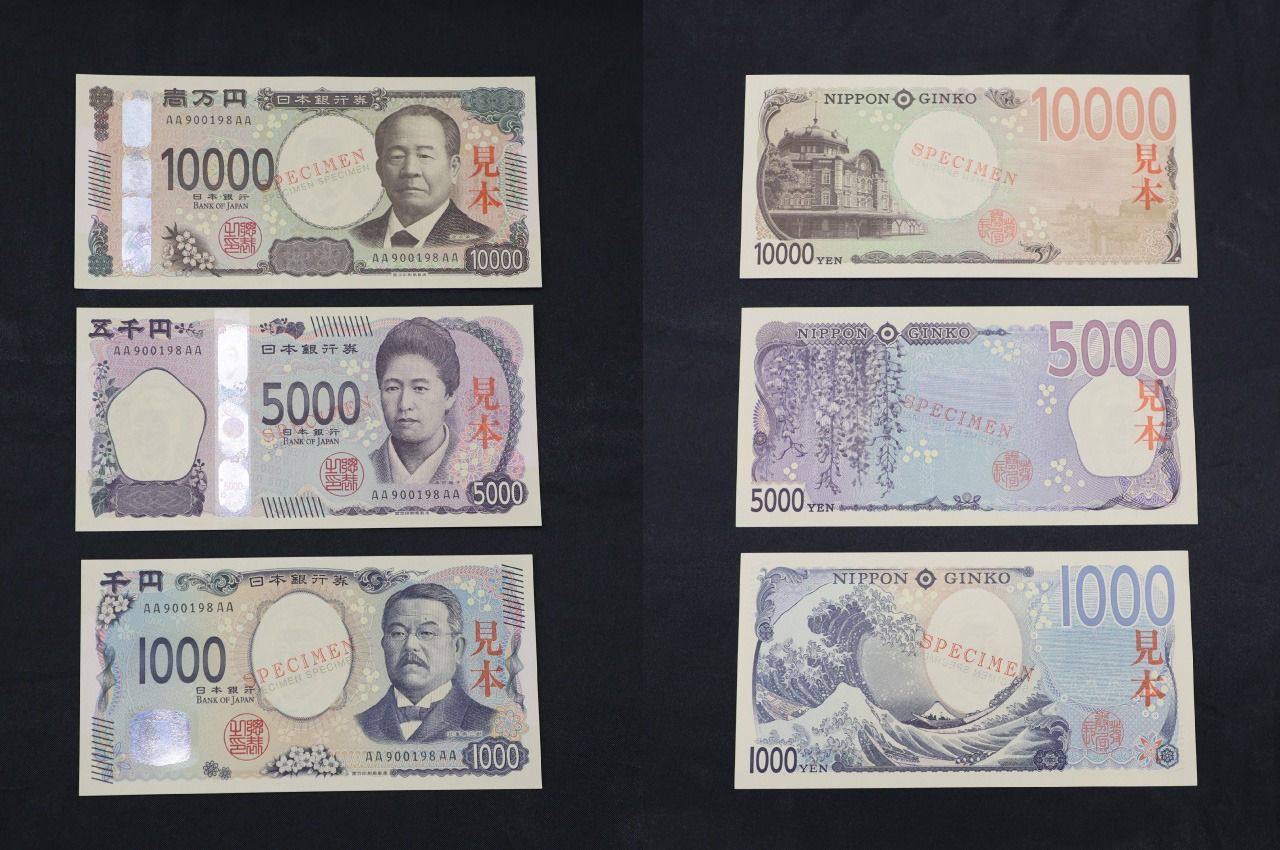
Each country has its own traditions about who and what is depicted on banknotes. Since I live in Japan, I want to tell you that new banknotes will be issued this year, namely on July 3, 2024. This was announced on December 12, 2023 by the Ministry of Finance and the Bank of Japan. I would like to note that this is the first update of banknotes in 20 years since 2004. 
In Japan, there is a tradition of depicting famous people; it so happens that on banknotes we see people from four main areas of life: representatives of education, business, medicine and art. The new 10,000 yen note features Shibusawa Eiichi, known as the "father of Japanese capitalism." Currently, this banknote depicts the writer, translator and philosopher, founder of Keio University, the first president of Tokyo Academy - Fukuzawa Yukichi. His portrait graced the 10,000 yen bill in 1984 and remains on the 2004 banknote, so the face on this banknote will change for the first time in 40 years.

On the 5,000 yen note, instead of Higuchi Ichiyo, the Meiji era writer (1868-1912), the portrait of Tsuda Umeko, who contributed to the development of women's education, will be used. It is recently that the situation of women has been changing. Beautiful representatives of Japan occupy high positions in various fields of activity. On the 1000 yen banknote, Noguchi Hideyo, a bacteriologist and eminent physician, will be replaced by Kitasato Shibasaburo - known as the "father of modern medicine" in Japan.
The reverse side of the bills has also been changed. So on the back of 10,000 yen there will be an image of the Tokyo station building, on the 5,000 yen note there will be wisteria flowers, and on the 1,000 yen note there will be the famous “Great Wave off Kanagawa” by the Japanese artist of the Edo period Katsushika Hokusai. This work influenced foreign artists and modern designers and jewelers.

I would also like to note that for the first time in the world, the banknotes will use hologram technology, which allows you to see portraits in three dimensions when viewed from different angles. As part of efforts to create a barrier-free environment, the bills have markings for tactile recognition of the denomination, and the numbers on the front side themselves are larger than on bills currently in use. 
From the moment the new banknotes are released, they will be available at cash desks of financial institutions and automated teller machines (ATMs). Banknotes currently in circulation can continue to be used. This is how you can pick up a banknote and learn the history of the country. In Japan, they treat everything with care, especially banknotes. For me, as an expert in the field of etiquette, the topic of banknotes from the point of view of historical facts and prominent people of Japan is both a good topic for small talk and a wonderful topic for small talk.

Meet Elena Gavrilina-Fujiyama, our newest contributor to Etiquipedia. Elena is a specialist in Japanese protocol and etiquette, and European social etiquette. The founder of the project Etiquette748, Elena is also a member of the National Association Specialist of Protocol. She authored the best-selling book “Japanese Etiquette: Ancient Traditions and Modern Rules” after living in Japan for over 20 years.
 

🍽️Etiquette Enthusiast, Maura J. Graber, is the Site Editor for the Etiquipedia© Etiquette Encyclopedia

Friday, December 23, 2022

Japanese Etiquette Shines at World Cup

Etiquipedia feels it’s a sad commentary on sporting fans that every few years, news articles about the cleanliness of Japanese fans (and Japanese athletes in the locker rooms!) cleaning up their area of the stands, can cause such astonishment on social media. — “Japanese fans STILL clean up the stadium after their match despite the heartbreak of seeing their side lose 3-2 in the last minute” - Mail Online


In 2015, Online Magazine Tone Deaf printed these headlines “The Aftermath Of This Aussie Music Festival Last Weekend Is Revolting”. Why? Aussies failed in a big way to clean up their rubbish after weekend long festivals leaving the environment not as they found it. A significant contrast to the fans and players at the 2022 FIFA World Cup held in Qatar.

MailOnline wrote: “Japanese fans STILL clean up the stadium after their match despite the heartbreak of seeing their side lose 3-2 in the last minute”. It is simply amazing to see a country's people to be tidy, neat and clean and even after defeat. What propels this nation to be so environmentally conscience and stand out from the crowd?

It has been said that cleanliness in Japan was noted in historical texts pertaining to the government in the book called the Engishiki - Procedures of the Engi Era. A book written about 927 A.D. about the laws and customs that governed people of that time period. These volumized works spoke about religious practices, governance and regulations.

Generated over time came practices from palaces, Buddhist temples and Shinto shrines, and everyday households in December and January devoted to cleaning the house in readiness for the new year and the positive things it may bring. Noted observations from Sir Rutherford Alcock, the first British diplomatic representative to live in Japan, the son of the physician and himself a surgeon discovered whilst serving in Japan from 1858, that the Japanese favoured order and relished cleanliness. This would have tickled the diplomats fancy understanding a correlation between cleanliness and the body.

From childhood, the Japanese are trained at school age. They are not only taught that cleaning is essential but it is also practised in class as a daily routine. Children must clean, dust and pick up litter daily and weekly. The result is homes and businesses being kept clean. Not only are the children involved, but prefectures throughout Japan will have selected days for their citizens to do a clean-up day, not only to tidy up, but to act as a bonding experience for its residents. 

Homeowners, in the early mornings from 7 am onwards, will be seen brushing up leaves to keep the streets presentable, and at the end of a long hard day, a truckie's job is to wash down their truck meticulously, to be shine for the subsequent day of work ahead. 

 The Shinkansen, the name of the famous Japanese bullet train, has a specialised cleaning time called the TESSI. Their crack team can scrupulously clean and prep each train in seven minutes from start to finish. So, the Japanese are sticklers for cleanliness and order.

After Japan’s defeat to Belgium, media took snapshots of the Japanese fans consciously picking up discarded fan paraphernalia and food wrappers and placing them in a blue rubbish liners, cleaning the stadium, not even waiting for other fans to leave as they walked up and down the aisles. These snaps of fans cleaning before departing, naturally
 went viral to an astonished world of social media . Even though the Japanese soccer team lost, Japan can be proud of fans and players alike for their excellent attitude. — By Etiquipedia Contributor Elizabeth Soos


For many years, Etiquipedia contributor, Elizabeth Soos, has had a keen interest in cultural customs. With her European background and extensive travel, Soos developed an interest in the many forms of respect and cultural expectations in the countries she has visited. With her 20 years’ experience in customer service within private international companies based in Australia, and her lifetime interest in manners and research, she decided to branch out into the field of etiquette and deportment. Through her self-directed studies and by completing the Train-The-Trainer’s course offered by Emma Dupont’s School of Etiquette in London and by Guillaume Rue de Bernadac at Academie de Bernadac based in Paris and Shanghai, she founded Auersmont School of Etiquette.


🍽️Etiquette Enthusiast, Maura J Graber, is the Site Editor for the Etiquipedia© Etiquette Encyclopedia
Monday, March 7, 2022

Japanese Knot Etiquette

There is one way to tie the brocade bag of the tea jar when the latter is empty and another when it is full. Not only general ignorance of social customs but deadly insults may be communicated by the way a knot is tied, foreigners often making dreadful mistakes either through not knowing or from ignoring the niceties of knot etiquette. 


Tying Knots in Japan
It Is a Serious Art, as a Mistake May Mean no Insult

Like the arranging of flowers, the tying of knots has been carried to the point of a complex art by the Japanese. There is one way—one right way, that is—to knot the cord that confines a birthday or New Year's present. There is one way to tie the brocade bag of the tea jar when the latter is empty and another when it is full. Not only general ignorance of social customs but deadly insults may be communicated by the way a knot is tied, foreigners often making dreadful mistakes either through not knowing or from ignoring the niceties of knot etiquette. 

Hooks and eyes, buttons and buckles are unknown so far as Japanese dress is concerned. They do not have much to fasten, but what they do have, they fasten with cord. That is why they have carried the tying of cord so far. The Japanese have hundreds of ornamental knots, some of them so old that they antedate written history. 

Japanese children are taught to make knots just as they are taught to write and draw. All sorts of flower and animal forms are copied. There is the chrysanthemum knot, the iris knot, plum blossom, pine tree and cherry blossom knots. There is a stork knot, a turtle knot, a knot named for the sacred mountain Fujiyama. An easy knot is called the “old man’s knot.” There is-also an “old woman’s knot.” – Hanford Journal, 1904


Etiquette Enthusiast, Maura J. Graber, is the Site Editor for the Etiquipedia© Etiquette Encyclopedia

Wednesday, June 9, 2021

Visiting Etiquette in Japan


Ignorance of Oriental etiquette sometimes leads to awkward situations in fashionable quarters. Lately the English lady received a morning call from a Japanese gentleman, who, instead of making his first visit very brief, as she expected, stayed to luncheon. After lunch he still stayed on, while the lady grew extremely weary of her visitor, and every minute expected him to leave. Dinner came; the Japanese man was still a fixture, and the host took his turn at entertainment till he was so tired that he retired to the smoking-room and left his wife in charge. At last, just at midnight, the Japanese man departed, with most abject and elaborate apologies for quitting his hostess. Next day he confided to a friend that he had never passed through such an ordeal. According to Japanese etiquette, the lady receiving the gentleman should give the signal for his departure, so he thought she would never let him go, and finally he had to leave without her permission. – Hanford Journal, 1897


Etiquette Enthusiast, Maura J. Graber, is the Site Editor for the Etiquipedia© Etiquette Encyclopedia


Tuesday, May 11, 2021

Chanoyu Etiquette – Japanese Tea

They were all society people, but they found that Japanese etiquette differed very materially from their own social functions. They studied the slips of paper given them until they knew that the bits of cake given them were to be eaten first, and the bowl of tea to be taken in the right hand and placed on the left palm and so held, no matter how warm the tea, until the first guest had sipped his tea in three gulps and a half when the rest of the company were at liberty to drink the steaming beverage, each bowl being drained in succession. The guests, meanwhile, watching each other with great interest to know what would be expected of them when their turn came. 


San Francisco, California – Do you know what a “chanoyu” is? Well, it is simply a Japanese ceremonial tea. The dainty little Geisha, Mme. Yucca and some members of the company, which, by-the-way, is the only real Japanese troupe ever in this country, who performed recently at the California theater, gave a chanoyu in the Maple room of the Palace Hotel that was a decidedly novel and interesting affair. The decorations were in keeping with the event, all Japanese, of course, with Japanese lanterns and richly embroidered screens which formed a back-ground to the tea-drinking room. The affair was invitational, and to each guest was presented little slips of paper describing etiquette of a Japanese ceremonial tea. 

They were all society people, but they found that Japanese etiquette differed very materially from their own social functions. They studied the slips of paper given them until they knew that the bits of cake given them were to be eaten first, and the bowl of tea to be taken in the right hand and placed on the left palm and so held, no matter how warm the tea, until the first guest had sipped his tea in three gulps and a half when the rest of the company were at liberty to drink the steaming beverage, each bowl being drained in succession. The guests, meanwhile, watching each other with great interest to know what would be expected of them when their turn came. 

Mme. Yucca brewed the tea with her own tiny hands on a raised dais, using a special blend, costing a fabulous sum per pound, and a tiny maid, Miss Otsuru by name, passed the refreshments, making a graceful and profound bow to each guest. One of the features of the evening was a geisha dance by Mme. Butterfly, 300 years old, the dance, not the dancer, bearing the ancient record. It was full of life and grace, combining all of the best movements of the Delsarte system. – Polly Larkin, 1899


Etiquette Enthusiast, Maura J. Graber, is the Site Editor for the Etiquipedia© Etiquette Encyclopedia

Tuesday, November 3, 2020

The Geisha: An Exquisite Hostess

                                                                                
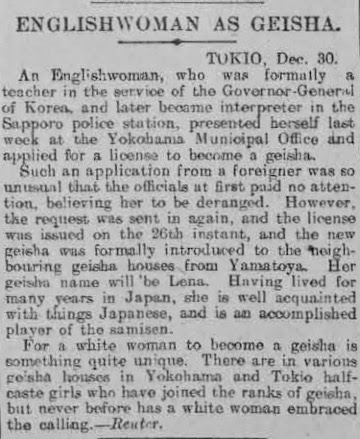
A geisha is a traditional entertainer trained in classical arts such as dance, tea ceremony, and music. In the modern era geisha are understood to be female, but historically there were male geisha as well. In 1913, an Englishwoman applied for a license to become a geisha. There were already many "half-caste" girls who were geisha in Japan, however "Lena" would be the first white woman to hold such a license.  The application was at first thought to be from someone who had to be "deranged," so it was ignored by Yokohama officials. A second application was sent in and she was granted the license on the 26th of December, 1913.


Like ghosts from another time, the real geisha seem to float silently along the streets at twilight, making their way to tea houses and restaurants where they will entertain elite, powerful men.

Trained to be exquisite hostesses, they are accomplished musicians, singers, dancers and most importantly conversationalists. To have a geisha in your company, to be in the presence of a beautiful, articulate, talented companion for the evening, is considered a status symbol. Their clients used to be samurai and shogun. Now it’s politicians, actors and corporate CEOs who hire the geisha by the hour for private dinners at ryotei (traditional Japanese restaurants) and ochaya (tea houses).

They are not courtesans or prostitutes. Before World War II, a geisha’s virginity was auctioned to the highest bidder, but sex is no longer part of the transaction. To be a geisha is to be part of a community, a vocation. They are career women. They are performance artists.

An endangered species, the numbers of real geisha in Japan are dwindling. From a reported 80,000 throughout Japan in the early 20th century, they now number only a few thousand. “In Kyoto, there are about 150 geiko geisha in the local dialect and maiko, geisha in training, left in Kyoto,” according to Anne Alene, an in-country guide for a recent trip to Japan arranged by the Carnegie Museums of Pittsburgh Travel Program.

The group toured the Gion district, one of several historically preserved neighborhoods in Kyoto and the place where the 2005 movie “Memoirs of a Geisha” was filmed. It was based on the novel of the same name by Arthur Golden.

In Kyoto, authentic geisha are not nearly as prevalent as faux geisha young women who dress in traditional Japanese kimono complete with obi, white tabi socks and wooden geta sandals. While they enjoy being stopped by tourists to have pictures taken, wearing traditional ensembles also appeals to the Japanese reverence for ritual and tradition.

“For many Japanese girls, it’s fun to dress up in something they would never ordinarily get to wear,” said Amy Boots, executive director of the Japan-America Society of Pennsylvania.

“I think it might be like doing a Renaissance or Old West-style photo shoot for us.”

Visitors can also give it a try. In Kyoto, there are several places that rent a kimono ensemble or the men’s version, a black kimono with montsuki haori, the short coat over top. 
                                                        
A hand-colored photo of a group of Geishas, 1890
—Photo source Pinterest


“Kimonos have many layers and are difficult to put on without a helper,” said Katsuko Shellhammer, education outreach coordinator for the Japan-America Society of Pennsylvania. “They are also very expensive, and seasonal patterns are important. It can be like wearing a piece of art.”

Department stores in both Tokyo and Kyoto have sections dedicated to kimono wear; you can buy off the rack or have a custom-made kimono and obi from the bolts of material offered. A less expensive option is a used kimono, and there are many stores that deal strictly in pre-owned. Kimonos are often passed down from mother to daughter.

Modernizing the look is all about the material and new, more graphic patterns. Sou Sou, a Japanese clothing company, has taken the plain tabi shoe and sock and covered them in a riot of color and designs. They have also re-imagined other traditional Japanese garments.

Just looking like geisha is not enough for some young women. Turning away from Hello Kitty and the modernity of Japanese life, they make the choice to earn a living as a geisha. Maiko as young as 15 must live in the geisha house, or okiya, learning the nuances of life under the robes and white makeup. The apprentice period lasts between three and five years, during which the okiya and the geisha mother invest in them, paying for lessons and kimonos and providing room and board. Maiko, pronounced MY-ko, are tested before they can advance. At the erikae ceremony, they don the white collar of geisha.

Twice a year, in spring and fall, the public is treated to a display of geisha talents during the Miyako Odori at the theater in the Gion district. The 142nd annual Miyako Odori was held earlier this month during the Carnegie Museums group’s visit. The travelers enjoyed a glimpse into this exclusive world, including a very brief tea ceremony with a complicated etiquette that must become second nature to real geisha.

As the living embodiment of history and fantasy, geisha are not allowed to marry ever. If they do they must leave.

“Geisha and maiko are very special to the Japanese people. They are part of a separate world from ordinary Japanese life,” Boots said. — Pittsburgh Post-Gazette, Kyoto, Japan, 2014


Etiquette Enthusiast, Maura J. Graber, is the Site Editor  for Etiquipedia© Etiquette Encyclopedia 

Wednesday, September 11, 2019

Japanese Table Etiquette

Japanese food is usually cut up conveniently for eating, so a knife is not necessary. 
Photo source, Tumblr

On the whole, this is the same as for foreign meals, but the following points should be noted...
  • 1) When various dishes appear together, for example miso-soup, clear soup, chawanmushi (steamed egg and fish or meat), the hot things should be partaken of first. 
  • 2) The lids of bowls containing hot things are somewhat difficult to remove, owing to the steam inside, so the bowl must be held firmly, and then the lid may be easily taken off, and put upside down on the table. 
  • 3) Japanese food is usually cut up conveniently for eating, so a knife is not necessary. 
  • 4) Chopsticks—One of the two chopsticks is held between the first and second fingers, and moved, the other chopstick is held between the thumb and third finger. 
  • 5) The vessel is taken up in the right hand, placed in the palm of the left, and the food is eaten with the right hand holding the chopsticks. 
  • 6) When the meal is over, all lids must be replaced. 
  • 7) When chopsticks are taken from an envelope, they should be put back in it after use. 
  • 8) When no more wine is desired, the cup should be placed on the stand upside down. –Shin Nichibei, 1954 


Etiquette Enthusiast, Maura J Graber, is the Site Editor for the Etiquipedia© Etiquette Encyclopedia

Thursday, October 19, 2017

19th C. Japanese Etiquette

Table etiquette has elaborate rules, which high-bred ladies and gentlemen must strictly follow. A maid-servant always waits, kneeling, at a short distance, before a clean pan of boiled rice, with lacquered tray, on which she receives and delivers the bowls for replenishing them. Fragrant green tea is always used at the end of a meal, but sugar and cream never.

The Japanese Home:
The Dwellings and the Domestic Life of the Quaint People


If a man of taste should enter a Japanese parlor he would not fail to be surprised at the display of marvelous and exquisite taste. Yet I have often heard the sayings of foreigners that "the Japanese house has no furniture and is absolutely cheerless and empty." This is quite wrong. I must say that they have no taste of the Japanese art, for the men of taste are agreed in saying that the art of decoration in Japan is excellent. If anyone has some taste in this art, he will perceive that the hanging picture on the toko wall, elaborate arrangement of flowers, pictures on the framed partitions and all decoration, however trifling, reveal infinite taste.

The tastes of the Western people differ so much from ours that the decoration in the chambers seems almost childish to the Japanese eyes. The gorgeous display of colors in their rooms would please our children to look at. Drawingrooms piled up from corner to corner with toys, shells stones, dishes, spoons and different novel things always remind us of our curio-shops, a bunch of flowers is stuck in a vase without form and without order. The pictures in the rooms hang perpetually, though the face of nature and feeling of man chance from time to time. All these sights which we are accustomed to see in the European house excite in us nothing but wonder. Yet this is the taste of the Western people; we have no right to criticize it.

In Japan, the family never gathers around one table as the European or other Asiatic peoples do, but each person has his or her own separate small table, a foot square and a foot high, and always highly decorated. When they take their meals they kneel upon the mat, each taking his table before him. The little lacquered table generally contains a small porcelain bowl, heaped up with deliciously cooked rice, and several lacquered wooden bowls containing soup or meat, and numbers of little porcelain plates with fish, radishes and the like. The way of cooking, of course, is entirely different from the European. 

Two pretty chopsticks, made of lacquered bamboo or wood, silver or ivory, are used, instead of knife, fork and spoon, and all people use them with great skill. All foods are prepared in the kitchen so as to avoid any trouble to use knife and fork. Soup is to be drunk from the bowl by carrying it to the mouth by hand, in the same way as people drink tea or coffee. Table etiquette has elaborate rules, which high-bred ladies and gentlemen must strictly follow. A maid-servant always waits, kneeling, at a short distance, before a clean pan of boiled rice, with lacquered tray, on which she receives and delivers the bowls for replenishing them. Fragrant green tea is always used at the end of a meal, but sugar and cream never. — Harper's Bazar, 1895


Etiquette Enthusiast, Maura J. Graber, is the Site Editor for the Etiquipedia© Etiquette Encyclopedia 

Sunday, August 20, 2017

Japanese Telephone Etiquette


In a world where good manners and decorum are vanishing almost as fast as the polar icecap, Japan is one country where proper telephone courtesy is still practiced, especially in the business environment.

Dial up a Good Impression 

with Denwa Echiketto


“Moshi-moshi. Kochira wa Japan Taimuzu no Shuraibaa to moshimasu. Itsumo wo sewa ni natte orimasu” (“Hello, this is Schreiber of the Japan Times. Thanks as always for your kind support.”)


In a world where good manners and decorum are vanishing almost as fast as the polar icecap, Japan is one country where proper telephone courtesy is still practiced, especially in the business environment. Business-related calls generally demand the use of honorifics, and this requires some rote memorization and probably pronunciation drills. Fortunately, however, learning a dozen or so standard phrases will get you through most situations.


First, obviously, identify yourself and state the purpose of your call. If you’re calling a company’s 0120 furi daiyaru (toll-free) number, have your reason rehearsed in advance, e.g., “I am calling from Maebashi City, where I just purchased a box of your Krunchy Kornflakes and it’s crawling with mealworms.”


If you wish to speak to a certain Mr. Sato that works in a big office, it’s better to add his first name — say Hiroshi — so you would ask, “Sato Hiroshi-sama irasshaimasu ka? (Is Mr. Hiroshi Sato there?).”


Perhaps the section or person you’re calling has a chokutsu bango (direct dial number). If you go through the main switchboard the operator might ask, “Okyakusama wa?” or “Dochira sama desho ka? (May I ask who’s calling?).” You reply with your affiliation and surname, followed by to moshimasu(speaking). The response is likely to be, “Ima omawashi itashimasu node, shosho omachi kudasai (Please wait, I’ll transfer you).”


If you are asked “Goyoken wa nan desho ka? (What is the purpose of your call?),” you can explain, or simply say, “Kojinteki no koto desu (It’s a personal matter).”


Say you get put right through, only to be told, “Taihen osoreirimasu ga . . . (I’m very sorry but . . .)” followed by explanations like:


* “Chotto mada kaisha ni dete orimasen (He hasn’t come in yet).”


* “Taidaima denwachu desu . . . (He’s on the other line).”


* “Ima chotto seki wo hazushite orimasu ga. . . (He’s not at his desk now).” This means he’s come to work but not visible to the speaker.


* “Honjitsu wa oyasumi wo totte orimasu (He’s off today).”


* “Ima dete orimashite, honjitsu wa modoranai yotei desu (He’s left and probably won’t be coming back to the office).”


* “Honjitsu wa mo kaerimashita (He’s already left for the day).”


A helpful colleague might offer, “Orikashi denwa wo sasemasho ka? (Shall I have him call you back?)” to which you can respond, “Iie, nochi hodo aratamete denwa itashimasu (No, I’ll call back later).”


Or you can request that you be called by saying, “Daiji na yoken desu node, daishikyu denwa wo itadakitai no desu ga (It’s an important matter, so I’d like him to return my call urgently).” When you give your number, note that zero should be pronounced as either “rei” or “zero,” and never as “oh.” Four is always pronounced “yon” since its other reading, “shi,” can easily be mistaken for shichi (seven).


If you didn’t get through the first time and are calling back, you can say, “Tabi-tabi sumimasen (Sorry to keep bothering you),” and then take it from there. If the person has been transferred to a new department and you’re informed of his or her new number, read it back to confirm you’ve heard correctly, by saying, “Kurikashimasu or fukusho shimasu (let me repeat that),” followed by the number. A few old-fashioned people might still use the words shigai bango (city code, e.g., Tokyo zero san) or kyoku (exchange).


Finally, it is very important to also end the conversation politely. You might say, “Sore dewa, yoroshiku (Please remember me),” and when you hear the other party say “Shitsurei itashimasu” (which in this particular case means, “I’m going to hang up now”), That’s your cue to repeat the same.


Proper telephone etiquette will win favor with the denwa toban, the person delegated to answer the phone and relay calls. This in turn can help you cut through red tape to get things done faster — and with less confusion and frustration. — Japan Times, 2007

Monday, June 20, 2016

Etiquette Relaxed for Hero

 Admiral Count Togo of Japan— Everyday life of the Japanese Imperial Court was practically unknown to the public in spite of the increasing enterprise of Japanese journalism, which had made repeated efforts to break down the barrier of excluslveness and mystery that had hitherto guarded all approach to the inner apartments of the Chiyoda Palace.

Japanese Hero Honored with
 Relaxed Etiquette of the Imperial Court  
Admiral Count Togo, commander of the Japanese fleet which destroyed the Russian squadrons in the battle of the Sea of Japan in May, 1905. Now enfeebled by his eighty years, has special permission to carry a cane when visiting the Imperial Court.

The carrying of sticks of any sort in the presence of the nation's rulers is forbidden by court etiquette, but exception in the case of the aged sea hero was made by formal ruling of the Minister of the Imperial household . — Healdsburg Enterprise, 1926


🍽Etiquette Enthusiast, Maura J. Graber, of The RSVP Institute of Etiquette, is the Site Editor for the Etiquipedia© Etiquette Encyclopedia

Sunday, June 5, 2016

Etiquette and Japanese Courtesy

There are honorific terms of varying significance to be applied to people of every rank, to objects possessed by a superior and to articles of dress and food belonging to another. There are, on the other hand, humble terms to be used on one's self, or of one's own family, when addressing outsiders. 


The Language of Courtesy

Nothing more truly shows the courtesies and formalities of the nation than the language itself. Innumerable phrases with many and delicate shades of meaning abound for every act. There are honorific terms of varying significance to be applied to people of every rank, to objects possessed by a superior and to articles of dress and food belonging to another. There are, on the other hand, humble terms to be used on one's self, or of one's own family, when addressing outsiders. 

One does not eat or dress or go about or perform  many acts in the same word as another. A man speaks of his own wife, using an entirely different word from that which he would use for the wife of a third person, and this again may be a different and less polite word than the term he would use for the wife of the person addressed. 

The language may be roughly divided into three divisions —the language to superiors, the language to equals and the language to inferiors—but it is, of course, a delicate matter on many occasions to decide in which language to speak, whether to use all the honorable prefixes and long terminations, or to cut every sentence off short, as in the language to inferiors. 

The general rule in most cases is that in speaking to equals one employs, for courtesy's sake, the language for superiors, and to certain inferiors, such as servants of other people, to workmen and tradesmen, the language of equals, while the rougher and less polite language is rarely used except to one's own servants, and very frequently by ladies not at all.

It is impossible to go into the details of the ceremonials which accompany weddings, funerals, birth rejoicing and the entertainments of various sorts, interesting as many of them are. Many of these have changed, and will change more in this transition period, but let us hope that it may be long before Japan will become too busy for its pretty courtesies, its long, stately bows and graceful speeches, which are one of the most charming things in this land of the orient. 
—Sacramento Daily Union, 1897


Etiquette Enthusiast, Maura J Graber, is the Site Editor for the Etiquipedia© Etiquette Encyclopedia
Friday, June 3, 2016

Japanese Etiquette

Bowing when one is seated on the soft mats of a Japanese house (by far the politest method) is much more complicated. 
Why the Japanese Are Called
 the “French of the East”
 👘⛩🗾🎏👘⛩🗾🎏

They Even Pass Beyond the Gauls in Their Excess of Formality

The Japanese are called the French of the East, and their complicated system of etiquette is indeed not unworthy of the most polished nation of Europe. The old-time ceremonies were long and laborious, and have to a great extent disappeared with the present busy era. But the every-day etiquette still remains, and many of the forms are pretty and quaint, and especially interesting to the foreign traveler in Japan as being so peculiarly oriental. 


It is especially curious to see how even the lowest classes, the coolies and the jinricksha men, keep up a form of etiquette among themselves and are exceedingly polite and ceremonious while pulling their two-wheeled vehicles or pursuing the lowest trades in the humble walks of life. 

One from the West would hardly expect to find a coolie bowing profoundly and apologizing to another in the most courteous of language for some mishap, or shouting out some expression of sympathy when a heavy burden was being carried or pushed along, and yet these are common, everyday occurrences in Tokyo.

In learning the etiquette of Japan a stranger will always do well to remember that self-abasement and humility to the extreme must be the guiding principle on which all actions are to be ruled. In America it is often the duty of a guest to accept little courtesies from his host, not because he thinks it is due him as a superior, but because he is simply the guest, and he receives them as a kindness which hospitality extends to him, and which he cannot refuse without appearing ungracious. 

In Japan the laws of hospitality for the host are no less rigid than in America, To welcome the coming and speed the parting, to entertain with the best that one has in the kindest and most friendly manner, to see that the guest lacks nothing which thoughtfulness might provide—these are rigidly the duty of the Japanese host.

The duty of the guest differs in that each separate act of courtesy, even though accepted in the end, must be met with many protests and expostulations, and must on no account be simply accepted. The extreme to which this is carried would no doubt seem tiresome to those accustomed to the free-and-easy etiquette of American life. 

Tedious Expostulations 

Every Japanese parlor has its place of honor and its honorable and less honorable side, the latter being usually toward the door leading to the other apartments, the bedrooms and the kitchen. The seat of honor is in the part removed from the door, and is in front of a raised alcove, where are placed a hanging scroll, a vase of flowers and the few ornaments which a room possesses. 

It is a matter of time, energy and many bows before a guest can be induced to take this place of honor, and it is a contest in which the host must be the victor in the end, or, if not entirely successful, he must at least persuade his guest to sit in the more honorable side of the room, so that he himself may take the humblest place on the other side. It is also a matter of importance as to who shall precede in entering a room, and much time is spent by two people, one waiting for the other and each refusing to enter first. 


In entertaining many guests the host's duties are arduous, and as each separate guest is bound to consider himself the humblest of all the company, it is no little work to persuade him to the contrary.

There is a great deal in the etiquette of bows. Handshaking is a foreign innovation, and bowing hitherto has been the only mode of salutation. When two acquaintances meet in the street a bow is made by placing the hands in front as far down as they will reach, and then bowing from the waist downward until the upper part of the body is almost at rignt angles with the lower. 


One bow is not usually sufficient at a meeting, for if words are exchanged a bow must accompany each expression of good-will and friendship. Bowing when one is seated on the soft mats of a Japanese house (by far the politest method) is much more complicated. One is not expected to hurry through as in the street, and there is no excuse for the omissions of all the formal phrases of courtesy, each of which must be accompanied by bows made with the hands placed on the floor and the head bent down to them. 


There must always be an exchange of congratulations on the continued good health of the families, thanks for past kindnesses or favor shown by any member of one family to the other, and very often a visit is accompanied by a gift, which is formally presented and accepted.
 —Sacramento Daily Union, 1897


Etiquette Enthusiast, Maura J Graber, is the Site Editor for the Etiquipedia© Etiquette Encyclopedia 

Monday, May 30, 2016

Japanese Toilette Etiquette

 Victorian era view of a “Japanese belle” making her toilette — or as we know it today— she is engaging in her beauty regime.

The New Year Toilette of a Japanese Belle

The most elaborate New Year toilettes in the world are made by Japanese belles. The women of Japan have been having a New Year for hundreds of years before the women of Christian countries, according to their chronology of the age of the world, and they have learned to make much more of it than the women of shorter-lived nations. 

The New Year in Japan, falling a little later than ours, brings the flowery kingdom into its full floweriness; and on that day, the whole glad New Year is called in to celebrate the advent of another twelfth month. It is commonly supposed  that women in Japan hold a secondary place to men and that no festival could be carried on by them and for them. But, far from being the case, there is no nation on earth that values its women as highly as the Japanese, and no country where the New Year is more beautifully ushered in by them. 

Women have a strange way, all over the world, of bringing in the New Year. Other holidays are common to all, men and women, but the New Year seems devoted to women alone. In Japan on New Year's day the ladies are up early and making a most elaborate toilette. The toilette of a Japanese women is always a refined one, and the sweetest of cosmetics and the most delicate of scents are employed for her beautification. But the New Year toilet is something specially fine. 

On the New Year, the Japanese belle, like the Chinese one, wears no old clothes. Everything from her flowing silk outer garments to her straight, delicately woven undergarments is all new. Her favorite color is pink, and ter robes are gorgeous in colors of pink and red. She makes her toilette sitting on the floor with a silk robe around her. When she gets out of her peculiar little bed upon the floor and lifts her shapely head from her smooth, round pillow, she gets into a perfumed bath, in the taking of which she is assisted by her female servants, if she be a woman of very high rank, and by the women of her household if she be of good family but not wealthy. Her perfumed bath is poured into a tub and a little matting screen is set around the tub. Into the water she gets, while her women sit outside the screen upon the clean matting floor.

When the time comes for a shampoo of the flesh, the bather rises and the women of the family assist her, making a sport of this daily ablution. In this respect, the heathen differs from the Christian. A Christian woman conceals the fact that she bathes, and beyond doing so daily for cleanliness spends no time in the bath. It is not even etiquette to mention it. But the heathen talks of it, and the fables are full of the wives of high dignitaries whose daily round of happenings took place in the gardens through which they walked while going to and from the bath.

The bath over, and on New Year's day it is prolonged, the Japanese woman bather sets up her little easel and, taking her place upon the floor, begins to beautify herself. Her fine, soft, brown skin is massaged with grease perfumes and washed with scents. Then into the long brows are smoothed streaks of black greased paint to make them longer. The peculiar slanting eyes of the Japanese belle are caused largely by the way she puts on the brow paint, and the tales that are told of operations to change the form of the Japanese eyes are mostly without foundation. The style for the eyes is less slanting than it used to be, and what we would flippantly call the style for 1898 is almost as straight as our own. A touch of carmine is rubbed into the lips of the belle to make a pointed pout and a tiny bit of rouge is put upon the point of her chin.

The Japanese rouge is a smooth, soft thing, much like our vaseline, and is not unpleasant to thought or touch. When her toilet is made the Japanese belle plays with her children upon the floor, talks with her women, embroiders and conducts her household affairs. She does not receive strangers into the house, as it is not etiquette to do so, nor does she receive men callers unless they accompany her husband home, in which case she may, if they be specially honored friends of the family, wait upon them with the New Year rice cake and the whey. The Japanese belle makes her pretty New Year toilette for her own husband, and when you see how carefully she prepares herself to be beautiful in his eyes you think that, after all, the religion that animates her life is not so bad
—Ralph Cruger, January 2, 1898


Etiquette Enthusiast, Maura J Graber, is the Site Editor for the Etiquipedia© Etiquette Encyclopedia 

Tuesday, March 8, 2016

Etiquette for Japanese Empress


The Japanese Way

Rules That Must Be Observed When Her Majesty Passes Along A Street 

A recent visitor to Japan says that there has existed in Japan for many centuries a curious law to the effect that whenever the Emperor or Empress appeared in public no other person should seem to occupy a higher place than this member of the royal family; therefore, on such occasions the shutters of all upper stories were drawn and the upper parts of the houses through which the royal party moved, were seemingly deserted.

The Law Is Still In Effect

Three months ago, when the Empress went into the country for a brief period, an elaborate announcement was posted in conspicuous places along the line of her contemplated route commanding the public to observe strictly certain requirements of etiquette, to wit: 

When her Majesty shall past along no one must look at her from the frame built on houses for the drying of clothes, or through cracks in doors, or from any position in the upper part of their houses. 

If anybody wishes to see her Majesty, he or she must sit down at the side at the road by which her Majesty will pass. 

All children must be taken particular care of that they do not play in the road and so obstruct the passage of her Majesty through the streets. 

No one must look at her Majesty without taking off his hat, in neck-cloth or turban, or whatever else be may be wearing on his head. 

Moreover, no one must be smoking while he or she is looking at her Majesty, nor must anyone carry a stick or cane. 

Only women wearing the clothes of foreigners will be permitted to retain their head-covering.

Although it may rain, no person will be allowed to put up an umbrella while her Majesty maybe passing. 

Dogs must not be allowed to wander on the road by which her Majesty will pass. 

Until the passage of her Majesty, the route by which she will come will be kept free from carriages and jinrikashas. The roads which she will take must be completely free from all traffic. 

As her Majesty passes, no one must raise his voice, nor must any sound be heard, nor must the crowd close in and follow her carriage, for no noise must be made. 

When her Majesty reaches Umeda Station there will be a discharge of fifty fire-works. — New Orleans' Picayune, 1890

Etiquette Enthusiast, Maura J Graber, is the Site Editor for the Etiquipedia© Etiquette Encyclopedia