Showing posts with label 2nd Annual Place Setting Competition. Show all posts

Friday, March 10, 2023

An Interview with Alisa Kazka

Meet Alisa Kazka. Alisa is Blue Ribbon Award Winner from our Second Annual International Place Setting Competition. Alisa is shown sitting at her Regency Era place setting.
🍽️🍽️🍽️🍽️🍽️🍽️
Alisa Kazka is an etiquette consultant and a table setting specialist from Ukraine. Alisa writes, lectures and provides etiquette training. She told us that she is currently living in Kyiv, because her hometown is not safe. Alisa wrote, “The love for this topic appeared in my childhood and I gradually studied and got acquainted with etiquette and art of table setting. I really love the beauty and cosiness in the house, so I apply the knowledge that I share with my students to my home. I love beautiful porcelain and use it every day in serving.” 
Congratulations, Alisa!
Alisa’s choice of table elements was surprising, until we learned of her circumstances. Alisa was living away from her home and her country, due to the war in Ukraine. She could only use what was on-hand where she was temporarily living.   
           What an inviting menu for an Italian with a love for Italian foods! This is a table I’d love to sit at for dinner. We would have loved to have seen a menu more in line with foods that one generally thinks of during the Regency Era, but I’m certain that a soup, vegetables with pasta, fish with white wine, and ices, etc… were likely served on fine tables of the era.
              

1. How did you choose the menu and various elements you used in your setting and why? Please explain each of the utensils in your setting… For which of the foods on your menu (or course) was each different item intended? 

1) My table setting consists primarily of knowledge and love for porcelain, history, etiquette, and beauty. The menu is made up of favorite dishes of the Italian kitchen, which I am a fan of.

You may notice that cutlery is not from the same collection and modern production. Unfortunately, due to the war in Ukraine, I am far from home, my favorite dishes and serving items were left at home, so I didn’t have to choose dishes and cutlery. But, it was very important for me to take part in this competition, to represent my country and myself as a professional, so I took what was in my temporary home and fit the beautiful Regency Era theme.

I wanted to create an airy, romantic table setting that would capture the spirit of the era - Royal Albert porcelain did a great job of emphasizing this, and antique-style glasses from a nearby store helped to set the necessary accent.

2. Why did you choose this particular period in time to set your table?

2) Regency Era is my favorite, it's an inspiring time with a unique style and exquisite porcelain, the spirit of that era, dresses and balls, good manners, and incredibly beautiful table setting. When I saw the proposed list, I didn’t doubt for a second what to choose! I really wanted to show this in my table setting.

3. How, if at all, did Covid-related social restrictions affect your choice of setting? Were you ready to celebrate? Feeling in the mood to do something different? Etc… 

3) Covid did not affect the choice of conditions. And if my family were nearby, I would gladly celebrate with them. But, due to the events in Ukraine, I was forced to leave the house, so I will celebrate with my relatives via video call.

4. Have you always enjoyed a properly set table? Or, if not, was the table setting something you learned to enjoy through your social life and/or business later on in life? 

4) I have loved tableware since childhood. It has always been important for me that the table should be beautiful: a white tablecloth, porcelain, and beautiful tea pairs for breakfast.

I often helped my grandmother to decorate the table, and arrange cutlery. Like many years ago, I still love the perfect table, beautifully served food, English porcelain, and French faience, always flowers and appropriate decor. In such an atmosphere, communication with family becomes special.

5. Did you do any research on table setting etiquette before setting your elements at the table? 

5) Yes, sure! I professionally study the subject of etiquette and table setting. Before participating in the International Place Setting Competition, I also re-read Maura Graber's articles about the Regency Era and was inspired by films about this era.

 6. Do you plan on entering again next year?

6) Yes, with great pleasure! I was very happy to take part in the International Place Setting Competition, it gave me inspiration and the push to move on! I want to thank Elizabeth Soos and Maura J. Graber for the opportunity to participate and show my knowledge, experience, and love for table setting, to be inspired and filled with strength to go forward!


Elizabeth Soos and I would both like to congratulate Alisa on her award winning setting. We are honored that she entered our contest and love meeting others who are so willing to share their talents, enthusiasm for etiquette, and their wealth of knowledge. Congratulations!


🍽️Etiquette Enthusiast, Maura J. Graber, is the Site Editor for the Etiquipedia© Etiquette Encyclopedia

Tuesday, February 28, 2023

An Interview with Natalya Listishenkova


Meet Natalya Listishenkova, shown with her granddaughter Milana, a teacher in Chelyabinsk, Ural Federal District, Russia. Natalya is a Blue Ribbon Award Winner from our Second Annual International Place Setting Competition. Natalya is shown sitting at her Regency era place setting.
🍽🍽🍽🍽🍽🍽 
Natalya wrote that pre-Covid, she often, (about once every two months), “hosted house parties in various styles” for her Women's Club guests. She wrote that this was her hobby. We think this is a great hobby to have!

The harmonious colors and elements which Natalya carefully chose for her setting, show the research Natalya was able to do on the era. That research included a book she read on the life of the British Politician and Statesman, Benjamin Disraeli.

Natalya’s menu is an inviting mix of dishes she found from the period. The Raspberry Tart and Crème Nouveau sound especially tasty.
The mixed metals were a great choice for the Regency era. This was a time in which the Prince Regent had a lot of gilt tableware on display at the palace. According to the Royal Collection Trust, “The Grand Service is the magnificent silver-gilt dining service commissioned by George IV (1762–1830) when Prince of Wales. It is made up of over 4,000 pieces for dining and display in a vast range of styles. Among them are elaborate dessert stands, candelabra and ice pails, as well as simpler items like trays and egg cups.”

1. How did you choose the menu and various elements you used in your setting and why? Please explain each of the utensils in your setting… For which of the foods on your menu (or course) was each different item intended?

1. Since in the competition was the condition to set the table for at least five different dishes, I settled on the following:
  1. The first hot dish is chicken broth with celery (after cooking the celery, it is removed along with the chicken), the broth remains clear-and can be eaten with a broth spoon or drunk from a broth cup, holding the handles. The bouillon cup is visible in the picture.
  2. Next on the menu is a soft-boiled egg and bread toast. (I was specifically interested in whether eggs were served for dinner inEngland. It turned out that they were). For soft-boiled egg, an egg-stand is provided on the table, an egg spoon and a small plate for the shell.
  3. Further on the menu, after the broth, Strasbourg pie is presented(a bread plate is intended for it on the top left). Since often theStrasbourg pie is a meat pate, a pate knife is intended for it, which also lies on a bread plate;
  4. Before the main hot dish, a warm salad of green beans in a creamy sauce is served. A salad fork and knife are intended for it(they are slightly smaller in size than a table fork and knife), as well as an upper shallow plate;
  5. The main hot dish – roast beef with mustard sauce and a side dish of mashed potatoes and spinach stewed in butter. For it, a lower, shallow plate and a dinner fork and knife are intended (fully gilded), as well as an individual gravy boat for mustard sauce and a set for spices( salt and pepper)
  6. After the break, guests move on to desserts. For desserts a spoon-scoop (for Creme Nouveau) and a fork for raspberry tart are intended. Desserts are brought after the used dishes are removed from the table;
  7. For drinks there is a large crystal glass on a stem (Mineral water), a glass for red wine (it is located in the middle) and a glass-bowl for Sussex sparkling wine, which is served with dessert;
  8. Besides of these elements in a personal cover has a linen napkin with a ring, a cover card and a menu on a stand. 
  9. …a s well as a personal compliment for the guest – a small boutonnière of garden flowers from the hosts of the reception. 
2. Why did you choose this particular period in time to set your table?

2. When I carefully read the conditions of the competition, I studied all the eras, the recipes corresponding to these eras, the elements of table setting, I also watched several films, the Regency Era seemed closest to me in terms of aesthetics. I carefully studied the dishes and cutlery that were produced by manufactories indifferent eras, compared with what I have at home in the cupboard. I had to buy a few things from an antique shop, so you could say that the owner of the shop shared the excitement of the competition with me. So I bought dinner plates, a plate for bread, a part of knives, forks and spoons decorated with oak leaves in this store, as well as an individual gravy bowl and a device for salt and pepper.

I did a little historical research and found in the book of old English cuisine a reception menu dating back to the Regency Era (1811-1830), I also found in the Internet several examples of menus in the French, Polish and Russian aristocratic environment of that time I also love to cook, I am interested in cooking from different countries and eras. I really like the Regency era for a large number of balls and parties, for combining different cuisines, for an abundance of beautiful dishes. This is the era of carelessness and lightness

3. How, if at all, did Covid-related social restrictions affect your choice of setting? Were you ready to celebrate? Feeling in the mood to do something different? Etc… 

3.Before Covid, as I mentioned, we got together very often with family and friends at my home and I set the table for 12 people. Then there was a period of apathy, when there was no desire for parties at all. And now we are going as a family again. And I'm planning to have a Christmas party for my friends at home. Most likely, I will even cook dishes from this menu for them. And I'll tell you about participation and victory in your competition

4. Have you always enjoyed a properly set table? Or, if not, was the table setting something you learned to enjoy through your social life and/or business later on in life? 

4. Oh! For as long as I can remember, mom and dad have always set the table beautifully, prepared delicious dishes and decorated them beautifully. There was a white tablecloth and linen napkins, a complete set of cutlery and crockery. So you could say I grew up with good table manners.

5. Did you do any research on table setting etiquette before setting your elements at the table? 

5. Of course, I had to consider various patterns of dishes and cutlery in order to get as faithfully as possible to the Regency Era style. Floral motifs on plates and cutlery handles, romanticism and tenderness in decorative elements, English solidity and French elegance - this is how I imagine this table. Just by chance, while reading the biography of Benjamin Disraeli, I found a mention that glasses with a wide bowl for sparkling vine were only in vogue then. And I chose this one.

 6. Do you plan on entering again next year? 

6. I would like very much to enter the competition next year.

Elizabeth Soos and I would both like to congratulate Natalya on her award winning setting. We are honored that she entered our contest and love meeting others who are so willing to share their talents, enthusiasm for etiquette, and their wealth of knowledge. Congratulations!


🍽Etiquette Enthusiast, Maura J. Graber, is the Site Editor for the Etiquipedia© Etiquette Encyclopedia

Friday, January 27, 2023

An Interview with Gabriela Angelica Rostani

Meet Gabriela Angelica Rostani, a Blue Ribbon Award winner from our Second Annual International Place Setting Competition. Gabriela is shown sitting at her Edwardian era place setting.
🍽🍽🍽🍽🍽🍽
Gabriela was born in Uruguay, but has spent her life in Italy. Always interested in image, wardrobe, fashion, jewelry and etiquette, her career path has seen her seek out training in all areas of cultural and diplomatic development. Following a degree cum laude in International Relations - Diplomatic and Consular Sciences, Gabriela undertook multiple work experiences in the international arena that led her to study the field of cultural diplomacy in-depth.
Her expertise in personal branding and business etiquette, the “anthropology of the table” and royal etiquette, along with the larger fields of study of manners and ceremonial etiquette, has led her to found her own school and teach various image enhancing and personal development courses. She consults for individuals, schools, institutions and companies. She is a member of ANCEP (Association of Ceremonialists for Public Institute) among other notable international associations. Congratulations Gabriela, on your Blue Ribbon win!
The monochrome table linens and dishes give this middle-class Edwardian setting a subdued and pristine appearance. It would have been wonderful to see the colorful foods come to life, plated at this setting. The white with the silver trim is the perfect background for highlighting the inviting menu’s culinary selections. The trinket box above the plate was not explained, so we guessed this was a table favor or gift of some kind.

Menu for an
Edwardian Era Dinner in Tuscany Italy

 Extra virgin olive oil cream with spun-curd cheese 
Served with white wine

Agnolotto (small semicircular raviolo) with maize porridge 
and overcooked beef 
Served with red wine

Knuckles of ham stuffed with guanciale (bacon) and mustard berries 
Served with red wine (timed to exactly when it will bring out the flavors best)

Nut chocolate mousse with cocoa bean biscuits 

Grapes from the garden
Brought with finger bowl

Gabriela’s mouthwatering menu was perfect for a modest dining room of the time period, however, her choice of faceted crystal stemware was an interesting one, as the stemware and flatware should generally compliment one another. Gabriela explained her choices this way, “After centuries of attention placed on culinary and receiving manners of the courts and privileged classes, the simpler people felt the need to imitate the habits at the table, but in a much simpler and more accessible way. That's why in the choice of tools, I opted for objects that were as simple as possible in common materials (as in the case of silverware). At the same time, since the early 19th century in Tuscany, there has been a flourishing production of objects engraved in white glass according to the tradition of Bohemian crystal, the presence of glasses and crystal objects testifies to the growth and development of this important processing.” 

Another view of Gabriela’s setting — Again, it would have been nice to have the setting in use, with wine in one of the glasses, or even in the wine carafe, to see how the color and light played off one another. It is possible the stemware choice was perfect for this setting, but not having wine in them, we can only imagine.

1. How did you choose the menu and various elements you used in your setting and why? Please explain each of the utensils in your setting… For which of the foods on your menu (or course) was each different item intended?

To set the table I imagined to jump right into a special evening in a Tuscan family during the Edwardian Era. In that period, there was a phenomenon of imitation of the “noble art of the table” by the middle class. After centuries of attention placed on culinary and receiving manners of the courts and privileged classes, the simpler people felt the need to imitate the habits at the table, but in a much simpler and more accessible way. That's why in the choice of tools, I opted for objects that were as simple as possible in common materials (as in the case of silverware).
At the same time, since the early 19th century in Tuscany there has been a flourishing production of objects engraved in white glass according to the tradition of Bohemian crystal, the presence of glasses and crystal objects testifies to the growth and development of this important processing.

Crystals and ceramics show the desire to demonstrate the increasingly growing purchasing power of bourgeois families.
Menu is typically Tuscan, based on locally production and high quality raw material. The larger fork is intended for meat, which needs a larger cutlery. There is only one knife, intended for meat (the pasta does not require cutting). The dessert is spooned, being an evening event, and grapes are normally eaten with the hands.

Both the glass of red wine for meat and the finger wash arrive at the time of the corresponding dish (as the etiquette teaches).

2. Why did you choose this particular period in time to set your table?

I chose to take care of the Edwardian Era because it represented a moment of impactful change in architecture, fashion, lifestyle and manners. Economic and social changes also created an environment in which greater social mobility was achieved than ever before. The economic opportunities of the middle classes are increasing, thanks to rapid industrialization. In the field of table education and nutrition, an important literature begins to deal with bourgeois social classes for the first time. For this reason, I wanted to think about how a bourgeois family of the time could behave, far removed from the dynamics of the “palace”…but, at the same time, being careful to imitate the model of the nobles!

3. How, if at all, did Covid-related social restrictions affect your choice of setting? Were you ready to celebrate? Feeling in the mood to do something different? Etc…

No, Covid did not interfere with my way of setting the table. Surely we all felt the need to meet again, especially at the table. I went through this difficult moment with my husband and my children, experiencing the beauty of the simplest things. We should not forget how valuable relationships are and take better care of them in the future.

4. Have you always enjoyed a properly set table? Or, if not, was the table setting something you learned to enjoy through your social life and/or business later on in life?

I have always shown a great interest in the “art of receiving” and good table manners. From an early age, I was educated to have good behavior at the table, which necessarily requires care in setting up and in welcoming guests. I remember that from an early age, I was committed to setting the “family table” with details and attention, above all during the most important events.

I have always had a passion for collecting rare instruments or instruments suitable for every single situation. Over time, I then learned the basic techniques and rules. Today I also deal with setting up tables during institutional events, following the strict ceremonial rules.

5. Did you do any research on table setting etiquette before setting your elements at the table? 

Yes, I always do research on new setting the table manners, on details and on various historical periods. Everything is a source of study and learning. There is always something new to learn! I consider Maura Graber's texts unique and special, as well as the contents of the Etiquipedia blog and website.

 6. Do you plan on entering again next year? 

I'm sure I want to participate in the competition again next year! Maura J. Graber and Elizabeth Soos are the greatest experts in the world and it is very inspiring for me to be judged by such experienced staff.


Elizabeth Soos and I would both like to congratulate Gabriela on her award winning setting. We are honored that she entered our contest and love meeting others who are so willing to share their talents, enthusiasm for etiquette, and their wealth of knowledge. Congratulations!


🍽️Etiquette Enthusiast, Maura J. Graber, is the Site Editor for the Etiquipedia© Etiquette Encyclopedia

Saturday, November 26, 2022

An Interview with Victoria B. Edwards

Victoria B. Edwards’ delightful and colorful tablescapes and place settings are popular images on her Instagram feed. She was one of our “Blue Ribbon” award winners from the Etiquette Community for both our 1st and our 2nd Annual Etiquipedia Place Setting Competitions. This is Victoria at her lovely, American Gilded Age place setting. 
🍽 🍽 🍽 🍽 
Ms. Edwards is a graduate of Marygrove College and the Emily Post Institute. Her firm has provided customized training seminars on anti-bullying, civility, etiquette, and dining protocol to after-school and summer programs throughout the Metropolitan Detroit area for over 20 years.
As a Girl Scouts of Southeastern Michigan community partner, Ms. Edwards’ firm has delivered badge and petal earning workshops that have provided over 500 Daisies, Brownies, and Juniors with the skills they need to feel self-assured and confident in any situation.
Each the summer, the “Aces, Birdies and Clubs” program authored by Ms. Edwards, introduces children to the fundamentals of golf in a fun and positive environment as part of the week-long Summer Etiquette and Golf Camp, sponsored by Edwards Etiquette. Golf is highlighted as a tool to help children expand and comprehend how courtesy and kindness can be put into use at home, school and everyday life.
Ms. Edwards volunteers her time and resources to children’s causes in and around Detroit through her service in various organizations. These would include the North End Youth Improvement Council, Junior League of Detroit, Detroit Association of Women’s Clubs, and Gamma Phi Delta, Sorority, Incorporated.  Congratulations, Victoria!

I loved the calm and tranquil look of this setting, even down to the lotus-shaped bowl. Victoria’s choice of colors for her American Gilded Age place setting was lovely and it gave the alfresco dining spot a “cool” feel, which was not only inviting, but important during the season with the hottest temperatures of the year. This was the prime peach picking season — from July to September — in which she set her table in. Adding to the cooling feel and look of the setting, was a novel and sweet way of helping one’s guests stay comfortable, prior to air conditioning. Victoria’s menu boasts four different sorbets, served in small amounts, as palate cleansers throughout the meal. Though this is not a traditional Gilded Age menu, the inclusion of the four palate cleansers was ingenious and represents well an era known for its excess. Very impressive! 

The Menu

Appetizer
Spicy Peach Gazpacho (chilled soup) 
Notes: Served in the floral white bowl, utilizing the first spoon to the right 

Palate Refresher
*Cucumber Sorbet 
- usually a bite sized serving (about the size of a grape) just enough to cleanse the palate and make ready for the next course

Salad Course
Michigan Cherry Salad 
Notes: A popular green salad in the Detroit area and other parts of Michigan typically topped with dried cherries, apples, blue cheese {I use Feta cheese crumbles as a substitute for the bleu cheese}, and a vinaigrette dressing) served on the gray plate utilizing the first fork on the left and the first knife to the right

Palate Refresher
*Apple Sorbet
 - another bite sized serving (about the size of a grape) to cleanse the palate for the next course

Fish/Seafood Course
Seared Lemon Butter Scallops Fresh from North Carolina 
Notes: Served on a cream "Scalloped" plate utilizing the fork on the left and the middle knife 

Palate Refresher
*Carrot Sorbet 
- yet another bite sized serving to prepare the palate for the next course

Entrée/Main Course
Cornish Hen w/Kentucky Wonder Green Beans
Notes: Chicken for one and green beans. Who doesn’t love an entire chicken? Cornish are easily baked of grilled and served with vegetable. This course is served on the pink plate and utilizes the remaining knife and fork both of which are closest to the plate.

Palate Refresher
*Lime Sorbet
- the last preparation of the palate for the last course

Dessert
Peach Pie a la Mode

Butter Croissant

Cucumber Lemonade

California Sauvignon

Prosecco

Notes: While Michigan’s cold climate makes our Peach season shorter than most other states, the moderating effect of Lake Michigan, allows peaches (Red Haven, Flaming Fury and Stellar varieties mainly) to thrive along the western shore of the state produces and enjoys a significant amount of peaches during the season. At the time of competition entry, Michigan’s peach season was coming to a close, thus the Peach Gazpacho and Peach dessert.

Both the spoon and fork above the plate are used in the conclusion of the meal, one is used to assist with the other as the pie it typically warmer and ice cream has already begun to melt. While quite delectable, this dessert is rather messy and requires the assistance of both the fork and spoon.


Six Questions for Victoria:

1. How did you choose the menu and various elements you used in your setting and why? Please explain each of the utensils at your setting… For which of the foods on your menu (or course) was each different item intended?
I wanted my entry to reflect what a first time visitor would enjoy and be inclined to rave about it and attempt to recreate once they returned home. At the time of entry, it was still Summer here in Michigan and dining 'Alfresco' which means enjoying a meal outside is what Summer is all about here.

2. Why did you choose this particular period in time to set your table? Please go into as much detail as you can.
I chose the American Gilded Age for this year’s competition as my hometown during the Gilded Age, was the “Stove Capital of the World” and stoves are an integral part of any worthwhile meal. During the 19th century and by 1890, cast iron stove manufacturing was Detroit’s top industry.
FYI: The World's Largest Stove was an oversized reproduction of Michigan Stove Company's popular kitchen cooking stove. The company, founded by Jeremiah Dwyer in 1872, wanted to grab the attention of visitors attending the 1893 Chicago World's Fair so had the replica built to represent what the company manufactured at the Detroit factory.
3. How, if at all, did Covid-related social restrictions affect your choice of setting? Were you ready to celebrate? Feeling in the mood to do something different?  
COVID-19 is STILL raging here in Michigan, so safety is a priority. Besides the aesthetics and benefits (enjoying fresh air, eating in a more relaxed setting and less stressed which aids in digestion and being outdoors helps you sleep better) of dining outdoors, outdoor settings allow for social distancing, yet remaining social. I am always ready to celebrate once the taste of mouthwash subsides from the morning routine. Since COVID-19, everything is different so I guess that make me “always in the mood to something different”

4. Have you always enjoyed a properly set table? Or, if not, was the table setting something you learned to enjoy through your social life and/or business later on in life?
I have always enjoyed a properly set table from as far back as I can recall a setting a table “properly”. My etiquette business and “pivot” enterprise during COVID table scaping company certainly added to the enjoyment of setting a socially distanced weekly table.

5. Did you do any research on table setting etiquette before setting your elements at the table?
The research I did was mainly on what was going on in Detroit during each of the proposed themes for this year’s competition and what would a competitive dinner have looked liked; which what brought me to Peaches, Stoves and Michigan. I never thought Michigan and Peaches had much of a relationship besides pie and cobbler competitions prior to the 2nd Annual International Table Setting Competition – now I know why THAT even is still a thing.

6. Do you plan on entering again next year?
I do plan to enter again next year.


Elizabeth Soos and I would both like to congratulate Victoria on her award winning setting. We are honored that she entered our contest and love meeting others who are so willing to share their talents, enthusiasm for etiquette, and their wealth of knowledge. Congratulations!

🍽Etiquette Enthusiast, Maura J Graber, is the Site Editor for the Etiquipedia© Etiquette Encyclopedia

Sunday, November 6, 2022

An Interview with Stephen Hanson

The Best in Show Winner for the Amateur category in our 2nd Annual Etiquipedia Place Setting Competition is Stephen Hanson. He is shown above with his 
Christmas Dinner for Four table setting entry.
🍽 🍽 🍽 🍽
When asked about himself, Stephen wrote, “ I am Australian by birth and nationality, but Japan has been my home for the last thirty years. I became enchanted with the place when I first came here as a high school exchange student in the mid-1980s. I am a translator by profession. For the past twenty-odd years, I have been lucky to live in a leafy area in the western outskirts of Tokyo. My passions are cooking, gardening, and reading.”

This formal Christmas Dinner setting was our Best in Show for the Amateur entries. Stephen’s inspired choices of his crystal, dinnerware and flatware impressed us. It is a mix of Australian, British and Irish elements which harmonize well together. We love the Art Deco, antique and vintage touches. They are a delightful complement to the menu and wines.  The non-traditional color scheme is perfect for celebrating Christmas, in a country where Christmas is not traditionally celebrated nation-wide. The table, which only needed to be set for 2 persons but was set for 4, is inviting and very well done. Congratulations!


🎄Christmas Dinner Menu🎄

Country-style terrine with assorted pickles and green salad
Crab bisque
Roast sirloin beef, with roast potatoes, peas and gravy
Assorted cheeses and dried persimmons
Christmas pudding, with custard, yuzu butter, and crème Chantilly
Champagne Taittinger Brut Reserve
Champagne Boizel Rosé Tradition
E. Guigal Condrieu 2017
Domaine Bertagna Vougeot Premier Cru Clos de la Perritère Monopole 2016
Château Pichon Longueville Comtesse de LalandePauillac 2015
Dow’s 10-year old Tawny Port
Stephen’s menu is imaginative in both the foods and wines chosen. Stephen has been able to cleverly meld the availability of traditional Christmastime foods in Japan with traditional Christmas family menus which he grew up with in Australia. Elizabeth and I would love to be invited to this dinner and to dine at Stephen’s table.


1. How did you choose the menu and various elements you used in your setting and why? Please explain each of the utensils at your setting… For which of the foods on your menu (or course) was each different item intended?

When I am in Japan at Christmas time, I serve roast beef and a Christmas pudding. (Interestingly, the Japanese idea of Christmas dinner is roast chicken and strawberry shortcake, served on Christmas Eve.)

The Christmas pudding has some Japanese touches. It has rum from Okinawa (the southernmost part of Japan)in it, and the juice and zest of a yuzu (Japanese citron). The latter has a great fragrance, which means it goes into the rum butter as well. Seafood is plentiful in this country, so it appears in this menu in the form of a crab bisque. Dried persimmons are available in Japan from the late autumn, and are a lovely accompaniment to cheese.

The Art Deco-style plates, produced by John Maddock & Sons, were part of my paternal grandmother’s wedding china. My grandmother married in January 1939 and built up a set for eight people. These plates were always brought out at Christmas time in Australia. The pattern, I believe, is called Sundown.

The dessert spoons and forks also belonged to my grandmother – the Josephine pattern produced in the 1960s by the Australian silverware firm Rodd.

The other cutlery is English sterling silver dating from the late 18th to the 20th centuries. The pattern is Old English. The faux-bone handled knives are also English, dating from the 1930s.

The champagne flutes are Stuart Crystal (Glengarry pattern), the wine glasses are Riedel, while the water goblets are Waterford Crystal (Lismore pattern).

The table linen is antique Irish damask linen sourced from eBay, where it can often be bought in mint condition for a song. The sterling silver hurricane lamps, produced by the US-based Preisner, were also acquired from eBay at a bargain-basement price.

The meal of roast beef and Christmas pudding is my own tradition, which I have developed since living in the northern hemisphere. (It took me years to get accustomed to spending Christmas and New Year in the middle of winter!)

Christmas fare in Australia usually consists of roast turkey, ham, and Christmas pudding, which are eaten at lunchtime. My late mother could never see the point of a heavy baked dinner in the middle of the day in the middle of an Australian summer. Our Christmas meal was at nighttime, and featured a roast leg of pork, an apple and celery salad, and a cucumber salad, with a fruit salad for dessert. My mother decorated the table with flowers and candles, a touch I have inherited from her.

2. Why did you choose this particular period in time to set your table? Please go into as much detail as you can.

There is no one particular period or style, as I prefer to mix them. Growing up with and subsequently inheriting a number of family heirlooms, I try to use them where possible. Why just look at them or stash them away in a cupboard? I am a great fan of Art Deco, so much of the silver is in that style and from that period.

3. How, if at all, did Covid-related social restrictions affect your choice of setting? Were you ready to celebrate? Feeling in the mood to do something different? Etc…

Covid hasn’t had any impact on this setting, except in one minor area. Salt mills have been used instead of the usual open salt cellars. The pandemic has unfortunately curtailed the amount of entertaining my partner and I do.

4. Have you always enjoyed a properly set table? Or, if not, was the table setting something you learned to enjoy through your social life and/or business later on in life?

Yes, I have. My late mother loved to entertain, and I learned the basics of setting a table from her. If nothing else, my mother felt there should be flowers on the table.

I also owe much to of an elderly lady of my acquaintance in the small country town where I grew up. She was part of that generation of women who set out a tablecloth at every meal.

There are, I believe, four key elements to any proper meal. Good cooking, of course, is paramount. Second is good wines (or other suitable beverages) to partner the food. Third is a properly set table and pleasant surroundings to complement the food and the wine. And fourth, family and friends to share it.

It grieves me to see so many people these days hunched over disposable containers of takeaway food, eyes glued to the smartphone screen, and oblivious to their surroundings and other people.

5. Did you do any research on table setting etiquette before setting your elements at the table?

Not really. It just seems to have developed organically. Having said that, all of the years spent in Japan have undoubtedly been a major influence. Japanese cuisine puts emphasis on using the ingredients of each season, and ideally a Japanese meal should feature a range of different flavours, colours, and textures. Presentation is all important – the food and the dishes in which it is served should be pleasing to the eye.

6. Do you plan on entering again next year?

Yes, if there is an Art Deco category. 


Elizabeth Soos and I would both like to congratulate Stephen on his award winning setting. We are honored that he entered our contest and love meeting others who are so willing to share their talents, enthusiasm for etiquette, and their wealth of knowledge. Bravo!
 

🍽Etiquette Enthusiast, Maura J. Graber, is the Site Editor for the Etiquipedia© Etiquette Encyclopedia


Wednesday, October 12, 2022

An Interview with Amy Willcock

The Best in Show Winner for the Etiquette Community in our 2nd Annual Etiquipedia Place Setting Competition is Amy Willcock of the United Kingdom. Amy is shown above with her Georgian Era dinner place setting.
🍽 🍽 🍽 🍽
Amy Willcock is a successful writer of nine cookery and entertainment books. Born in Chicago, she moved to the UK in 1980. Specialising in country living and game recipes, Amy wrote a regular monthly column for The Shooting Gazette for over 19 years writing about food, country lifestyle and gundogs. During the Covid lockdown in Spring 2020, Amy started a new venture, KBO Cakes. The only way she could “send a slice of home” to her children serving in the forces and at university, was to send them a cake. “Nothing says “I’m thinking about you” more than a homemade cake. Everyone needs a little morale booster every now and then” says Amy. www.kbocakes.co.uk Amy was previously in the hotel business - one of which, The George on the Isle of Wight, had a Michelin starred restaurant. Amy held Lifestyle, Cookery and Aga Workshops teaching people to cook, arrange flowers and set beautiful tables along with how to run a house. Her lifestyle and Aga workshops have been described as ‘finishing schools for people in their 30’s’ and Nigella Lawson wrote in Vogue, “Amy Willcock, hand holder to Aga owners everywhere”. She is a founder member of Yarmouth Women’s Institute, the subject of a BBC 4 documentary, and is a WI Cookery and Preserves judge. Amy has appeared on Market Kitchen, Kirstie’s Homemade home, Celebrity Masterchef, and judged the perfect Sunday Lunch with John Torode and Gregg Wallace on Masterchef and is a regular Food and Lifestyle contributor to local radio. Amy lives in Yorkshire where she manages Warter Priory Shoot office, trains her gundogs, endlessly entertaining friends and family.
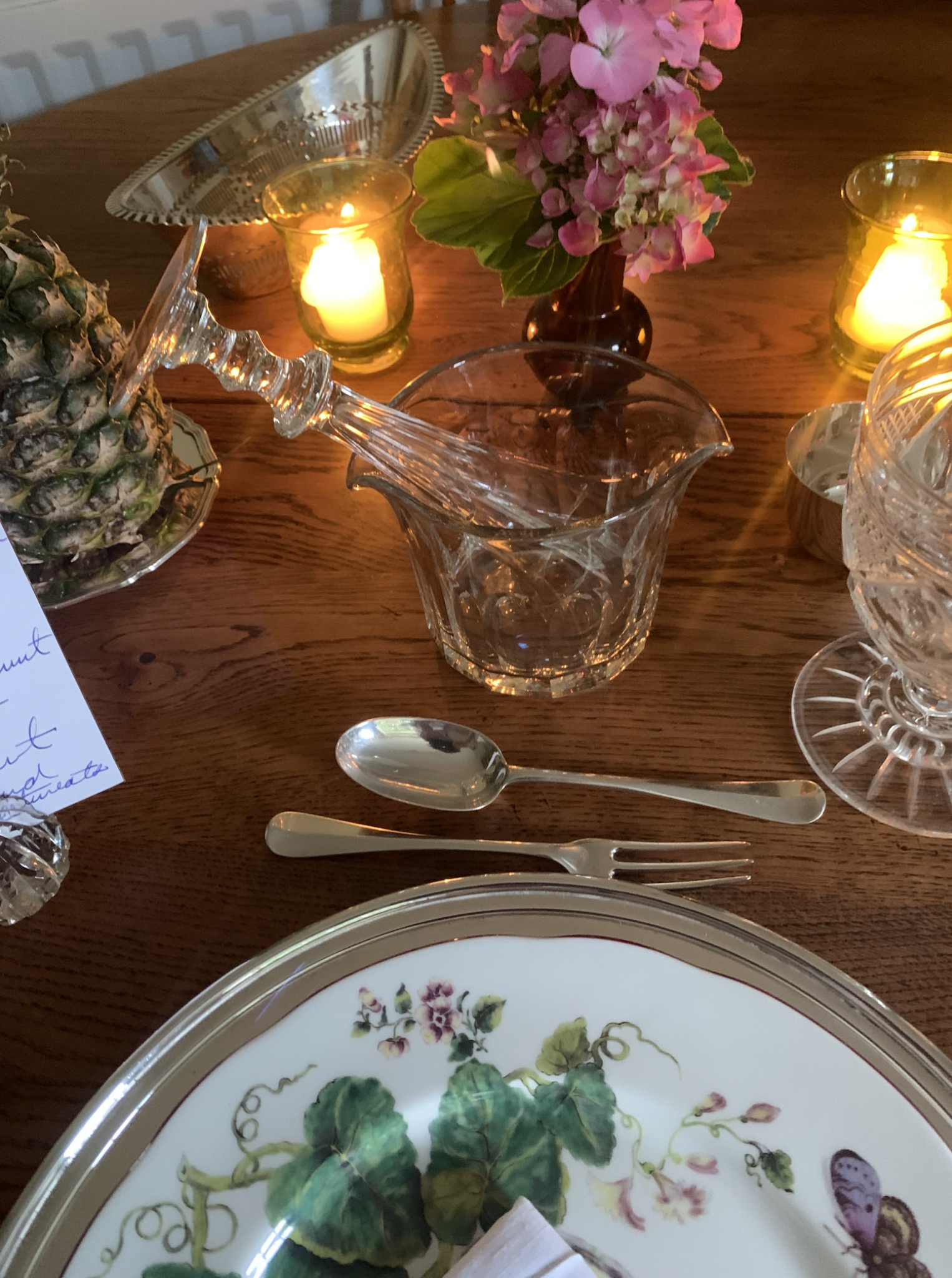
Amy’s formal Georgian setting was our Best in Show for the Professional and Etiquette Community entries. It is a mix of 18th century elements  that work beautifully together to create a real feel for the era. Starting with the candle light reflecting off of the silver and warm wood, the table is set with the pistol grip handled flatware so common to the time period. The pineapple is the quintessential Georgian fruit to accompany a fine, formal meal... all of these elements, along with the colors chosen, work seamlessly together. We’d love to dine at this table!

A few etiquette notes on Amy’s setting: 

Amy’s place setting and the overall look  and feeling it evoked was absolutely charming. She went into great detail in her description, so we only sent a follow-up request for explanations on each piece of flatware. You will find her explanation below the photo of Amy’s menu,


Six questions for Amy: 

1. How did you choose the menu and various elements you used in your setting and why? Please explain each of the utensils at your setting… For which of the foods on your menu (or course) was each different item intended? 
Amy’s menu is a perfect melange of Georgian fare and suits the setting to a T. The utensils are for the foods as follows: On the far right the small knife is a bread knife and the tablespoon is for soup. The small forks on either side are for fish (fish used to be eaten with two forks before fish knife and fork sets were created in the 19th century.) The joint knife and fork are for the lamb. The pudding-fork and spoon are for Cambridge burnt cream (“they slide down when main course is cleared”) and the small knife closest to the plate is for the dessert course.
“I always cook according to the seasons and what is easy to prepare and serve when you are the cook, hostess and bottlewasher! I collect silver it is a passion of mine along with old glass but I do love William Yeoward glasses.

“Soup spoons didn’t exist in the Georgian era, table spoons were used,which is so sensible – I do not possess a soup spoon!
In the late 17th and early 18th century knives were made of carbon steel and would taint delicate foods such as fish so two silver forks would be used. Much later in Victorian times silver fish knives and forks were used, although some are very beautiful, I use small silver forks and pistol handled knives with stainless steel blades and set two forks at dinner parties and it’s always fun to watch you guests try and figure out what is going on.

“I am rather fond of three pronged forks as you can see and my pistol handled knives do have very old blades so they need a bit of TLC every now and then. Rack of Lamb is so tender it should cut like butter and of course it is quite correct to pick up the bones and eat, just remember to give everyone a finger bowl after the main course!

“Cambridge Burnt cream is a delicious thick cold custard topped with a layer of crispy caramelised burnt sugar so a good whack with a sliver spoon will do the trick in England, apart from ice cream we always serve “pudding” as we call the sweet course, with a fork and spoon. 

The dessert course is always fruit, nuts, and sweetmeats – little candied bon bons made of marzipan and dates. That’s also where the pineapple comes in and you will see form the photo that the pineapple is taken out of it’s skin and then reassembled back inside, rather cleverly acting as a table decoration and fruit course.”

2. Why did you choose this particular period in time to set your table? Please go into as much detail as you can.


“I love everything about the Georgian period – the silver, the architecture, the china etc… that is when the dining room came into it’s own.”
Later this month we will be posting an extract from a book Amy wrote for English Heritage.
3. How, if at all, did Covid-related social restrictions affect your choice of setting? Were you ready to celebrate? Feeling in the mood to do something different? Etc…

I live in the middle of the country and covid had very little effect really except entertaining was out, but I still set a beautiful table every day.

4. Have you always enjoyed a properly set table? Or, if not, was the table setting something you learned to enjoy through your social life and/or business later on in life?

My mother always insisted on a properly laid table at every meal – breakfast lunch and dinner–  and never put a milk bottle on the table! I have always loved setting fun, beautiful tables. In the UK Tea is served around 4-5 pm and was usually served in the drawing room or sitting room, delicious little sandwiches, and cake- FYI cake would not be served with cake forks! High tea would be things like cottage pie or boiled egg and soldiers for children around 5pm. A properly laid table transforms whatever you are eating, even if it is just bread and cheese. My biggest tip is use everything all the time, don’t save anything for “best”, enjoy everything. I love Joan Didion’s reply when she was asked why she used the good silver every day, Didion replied, “Well every day is all there is.”

5. Did you do any research on table setting etiquette before setting your elements at the table? 

I entered the professional section as I have written, lectured and worked on tables in stately houses such as Castle Howard in Yorkshire extensively.


6. Do you plan on entering again next year? 

Definitely!

More on AmyWillcock–

Nigella Lawson wrote in Vogue, “Amy Willcock, hand holder to Aga owners everywhere”

Books published by Ebury Press

Amy Willcock’s Aga Bible

Troubleshooting tips for your Aga

Cooking for One

At home with Amy Willcock

Amy Willcock’s B&B Know How

Amy Willcock’s Aga Seasons

Amy Willcock’s Aga Know How

Amy Willcock’s Aga Baking

Aga Cooking

Magazines– Amy is a contributor to The Shooting Gazette, Country Life, The Lady, Aga Living, Homes and Garden, Country Kitchen, Waitrose.   

Elizabeth Soos and I would both like to congratulate Amy on her award winning setting. We are honored that she entered our contest and love meeting others who are so willing to share their talents, enthusiasm for etiquette, and their wealth of knowledge. Congratulations!


🍽Etiquette Enthusiast, Maura J. Graber, is the Site Editor for the Etiquipedia© Etiquette Encyclopedia


Saturday, August 20, 2022

The 2nd Annual Etiquipedia International Place Setting Competition

 There are still a few weeks left for you to enter!! 

The 2nd Annual Etiquipedia International Place Setting Competition


Special Announcement: 

The opening and closing dates for the
Second Annual Etiquipedia 
International Place Setting Competition 
will be decided soon.
We hope that everyone globally will be able to participate. We are currently still discussing what categories we will be offering awards in this year.
Please continue reading to see what the categories were in 2021, who our winners were, and what each winner received.

Elizabeth Soos and Maura J. Graber


The Winners of Etiquipedia’s First Annual International Place Setting Competition Won: 
1. A USD $100.00 eBay gift card.
2. A signed copy of Maura J. Graber’s upcoming book, “What Have We Here?”
3. Collectible etiquette books from the library of Elizabeth Soos of Auersmont Etiquette, personally chosen for each winner.
4. A blog post featuring the winner and their setting on the Etiquipedia Etiquette Encyclopedia (see the link below.)
5. Some surprise gifts from the historic, Graber Olive House, in Ontario California.

Congratulations to all of our winners in the Etiquette Community and Amateur Community categories for their submissions.
Here is a list of the 2021 Place Setting Competition Winners with links to their settings and stories:


🍽Etiquette Enthusiast, Maura J. Graber, is the Site Editor for the Etiquipedia© Etiquette Encyclopedia