Salutations
 |
| Greetings and salutations are always nicer when flowers are added. |
From 1877
A lady of rank, speaking of salutations, makes the following remarks: "It would seem that good manners were originally the expression of submission from the weaker to the stronger. In a rude state of society every salutation is to this day an act of worship. Hence the commonest acts, phrases and signs of courtesy with which we are now familiar date from those earlier stages when the strong hand ruled and the inferior demonstrated his allegiance by studied servility.
Let us take, for example, the words 'sir' and 'madam.' 'Sir' is derived from seigneur, sieur, and originally meant lord, king, ruler and, in its patriarchal sense, father. The title of sire was last borne by some of the ancient feudal families of France, who, as Selden has said, 'affected rather to be styled by the name of sire than baron, as Le Sire de Montmorenci and the like.' 'Madam' or 'madame,' corrupted by servants into 'ma'am,' and by Mrs. Gamp and her tribe into 'mum,' is in substance equivalent to 'your exalted,' or 'your highness,' madame originally meaning high-born or stately, and being applied only to ladies of the highest rank.
To turn to our every-day forms of salutation. We take off our hats on visiting an acquaintance. We bow on being introduced to strangers. We rise when visitors enter our drawing-room. We wave our hand to our friend as he passes the window or drives away from our door. The Oriental, in like manner, leaves his shoes on the threshold when he pays a visit. The natives of the Tonga Islands kiss the soles of a chieftain's feet. The Siberian peasant grovels in the dust before a Russian noble. Each of these acts has a primary, a historical significance. The very word 'salutation,' in the first place, derived as it is from salutatio, the daily homage paid by a Roman client to his patron, suggests in itself a history of manners.
To bare the head was originally an act of submission to gods and rulers. A bow is a modified prostration. A lady's curtsey is a modified genuflection. Rising and standing are acts of homage; and when we wave our hand to a friend on the opposite side of the street, we are unconsciously imitating the Romans, who, as Selden tells us, used to stand 'somewhat off before the images of their gods, solemnly moving the right hand to the lips and casting it, as if they had cast kisses.' Again, men remove the glove when they shake hands with a lady—a custom evidently of feudal origin. The knight removed his iron gauntlet, the pressure of which would have been all too harsh for the palm of a fair chatelaine; and the custom, which began in necessity, has traveled down to us as a point of etiquette.
Salutations Of Different Nations
 |
| Saying hello with your noses when in Saudi Arabia |
 |
| A curtsy to the royals |
 |
| Jacques Chirac clasping and kissing the hand of Laura Bush |
Each nation has its own method of salutation. In Southern Africa it is the custom to rub toes. In Lapland your friend rubs his nose against yours. The Turk folds his arms upon his breast and bends his head very low. The Moors of Morocco have a somewhat startling mode of salutation. They ride at a gallop toward a stranger, as though they would unhorse him, and when close at hand suddenly check their horse and fire a pistol over the person's head. The Egyptian solicitously asks you, "How do you perspire?" and lets his hand fall to the knee. The Chinese bows low and inquires, "Have you eaten?" The Spaniard says, "God be with you, sir," or, "How do you stand?" And the Neapolitan piously remarks, "Grow in holiness." The German asks, "Wie gehts ?"—How goes it with you? The Frenchman bows profoundly and inquires, "How do you carry yourself?"
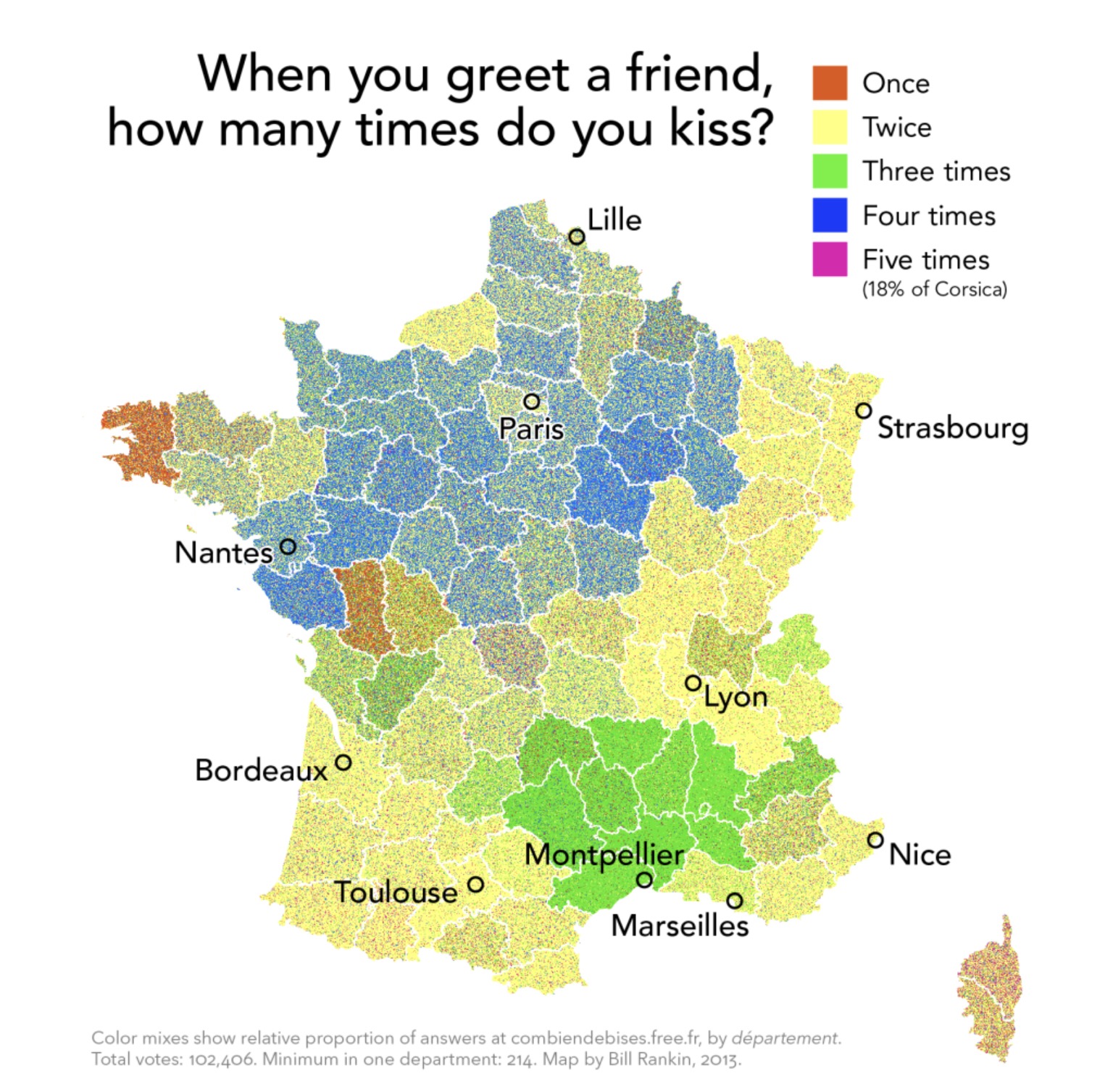
Foreigners are given to embracing. In France and Germany the parent kisses his grown-up son on the forehead, men throw their arms around the necks of their friends, and brothers embrace like lovers. It is a curious sight to Americans, with their natural prejudices against publicity in kissing.
In England and America there are three modes of salutation—the bow, the handshake and the kiss.
The Bow
 |
| Customary greeting by bowing in Japan |
 |
| Kowtow, which comes from kòu tóu in Mandarin Chinese, is an act of deep respect shown by kneeling & bowing so low as to have one's head touching the ground. |
The bow is the proper mode of salutation to exchange between acquaintances in public, and, in certain circumstances, in private. The bow should never be a mere nod. A gentleman should raise his hat completely from his head and slightly incline the whole body. Ladies should recognize their gentleman friends with a bow or graceful inclination. It is their place to bow first, although among intimate acquaintances the recognition may be simultaneous.
A young lady should show the same deference to an elderly lady, or one occupying a higher social position, that a gentleman does to a lady.
A well-bred man always removes his cigar from his lips whenever he bows to a lady.
A slight acquaintance should always receive the courtesy of a bow; and it is absurd that you should refuse to recognize a person in the street because you may happen to have a trifling difference with him.
Words Of Salutation
 |
| Meeting and greeting others; Martin Luther King, Jr. looks on as Coretta Scott King meets New York City Mayor Robert Wagner |
The most common forms of salutation are—"How d'ye do?" "How are you?" "Good-morning," and "Good-evening." The two latter forms seem the most appropriate, as it is most absurd to ask after a person's health and not stop to receive the answer. A respectful bow should always accompany the words of salutation.
Shaking Hands
Among friends the shaking of the hand is the most genuine and cordial expression of good-will. It is not necessary, though in certain cases it is not forbidden, upon introduction; but when acquaintanceship has reached any degree of intimacy, it is perfectly proper.
Etiquette Of Handshaking
 |
| Theodore Roosevelt meets a Native-American gent |
Says an authority upon this subject: "The etiquette of handshaking is simple. A man has no right to take a lady's hand until it is offered. He has even less right to pinch or retain it. Two ladies shake hands gently and softly. A young lady gives her hand, but does not shake a gentleman's unless she is his friend. A lady should always rise to give her hand; a gentleman, of course, never dares to do so seated."
On introduction in a room a married lady generally offers her hand; a young lady, not in a ballroom, where the introduction is to dancing, not to friendship, you never shake hands; and as a general rule, an introduction is not followed by shaking hands, only by a bow.
It may perhaps be laid down that the more public the place of introduction, the less handshaking takes place. But if the introduction be particular, if it be accompanied by personal recommendation, such as, 'I want you to know my friend Jones,' or if Jones comes with a letter of presentation, then you give Jones your hand, and warmly then, too.
Lastly, it is the privilege of a superior to offer or withhold his or her hand, so that an inferior should never put his forward first."
When a lady so far puts aside her reserve as to shake hands at all, she should give her hand with frankness and cordiality. There should be equal frankness and cordiality on the gentleman's part, and even more warmth, though a careful avoidance of anything like offensive familiarity or that which might be mistaken as such. A lady who has only two fingers to give in handshaking had better keep them to herself; and a gentleman who rudely presses the hand offered him in salutation, or too violently shakes it, ought never to have an opportunity to repeat his offence.
In shaking hands the right hand should always be offered, unless it be so engaged as to make it impossible, and then an excuse should be offered. The French give the left hand, as nearest the heart.
Strict etiquette requires that a gentleman should remove his glove previous to shaking hands, but common sense and the example of many well-bred people sanction its retention upon the hand if there is any difficulty or inconvenience in removing it.
The mistress of a household should offer her hand to every guest.
The Kiss
 |
| Kissing can be memorable when one adds the element of surprise! |
The most familiar and affectionate form of salutation is the kiss. It need scarcely be said that this is only proper on special occasions and between special parties.
The Kiss Of Respect
 |
| Some cultures kiss upon greeting and it is good manners to follow accepted protocol when world leaders meet. |
The kiss of mere respect—almost obsolete, I am «sorry to say, in this country—is made on the hand. This custom is retained in Germany and among gentlemen of the most courtly manners in England.
The Kiss Of Friendship
 |
Friendship
The kiss of friendship and relationship is on the cheeks and forehead. As a general rule, this act of affection is excluded from public eyes in this country—in the case of parents and children unnecessarily so; for there is no more pleasing and touching sight than to see a young man kiss his mother, or a young woman her father, upon meeting or parting.
|
Women Kissing In Public
Custom seems to give a kind of sanction to women kissing each other in public; but there is, nevertheless, a touch of vulgarity about it, and a lady of really delicate perceptions will avoid it. I think every effort should be made to bring the practice into disuse.
The
kiss of mere respect—almost obsolete, I am sorry to say, in this
country—is made on the hand. This custom is retained in Germany and
among gentlemen of the most courtly manners in England.
 |
| The "Lover's Kiss" |
The Lover's Kiss
 |
| Not to be paraded in public! |
It is hardly necessary to say that the lovers' kiss is never paraded in public. —From Eliza B. Duffey, 1877
🍽️Etiquette Enthusiast, Maura J. Graber of The RSVP Institute of Etiquette, is the Site Editor of the Etiquipedia© Etiquette Encyclopedia