Showing posts with label Serving Pineapple. Show all posts

Monday, June 5, 2023

Royal Pineapple Etiquette

This magnificent work of art is part of a set of four: “A set of four silver-gilt dessert stands, each comprising a pierced dish with palmette border, supported in a pineapple leaf bracket above six scroll branches with vine leaf dishes. The stem is cast in the form of an amphora, flat chased with angels and scrolling foliage, on a spirally fluted drum, surrounded by cast figures of Bacchus and two dancing maenads. On a circular base with scroll feet and acanthus leaves.
“These stands were described in the Rundells' invoice of 1811 as '4 very superb and elegant Ornaments for the Desert consisting of Groups of figures to receive Pine apples', although at that date they were not completed. The various elements were probably assembled over the next few years - they were finally delivered to Carlton House in 1817, with the branches arriving two years later. It is likely that the figures were designed by Flaxman. The final bill for the dessert stands has not been traced but later inventories state that they cost £1538 11s 8d.
“The Grand Service is the magnificent dining service of silver gilt commissioned by George IV, when Prince of Wales, from the Royal Goldsmiths Rundell, Bridge & Rundell. The initial commission was made in 1806 and the first delivery took place in 1811.” For more on these fabulous and exceptional works, see the website for the Royal Collection Trust

Pineapples make a particularly decorative feature with their hint of the exotic. At the Palace, they have always played a large part in the dessert course. Charles II is depicted in a painting receiving a pineapple from one of his gardeners. For a time this painting was thought to represent the first pineapple grown in England, but in fact it is too early for this to be the case. The fruit must instead have come from the West Indies.

John Evelyn, who waited on the King at a banquet held for the French Ambassador in 1668, recorded in his diary that the King offered him a taste of a pineapple from his own plate. Evelyn was rather disappointed with the taste, saying 'It has a grateful acidity but tastes more of the quince or the melon. He excused its flavour, attributing it to the distance the fruit had travelled. Pineapples are represented in the silver and porcelain services created for George IV and William IV respectively.

George IV's coronation banquet, held in Westminster Hall, London, also featured pineapples. The menu of the third course of the dinner shows that the pineapple was placed directly in front of the King during the meal. The Earl of Denbigh, who waited on him, records in his description of the banquet that 'Lord Colchester was my assistant carver and cut up a pineapple weighing 11 pounds.' — From “The Royal Table: Dining at the Palace,” by Kathryn Jones, 2008


🍽Etiquette Enthusiast, Maura J. Graber, is the Site Editor for the Etiquipedia© Etiquette Encyclopedia

Sunday, September 20, 2020

Centerpiece Etiquette and History

A thing of beauty, and social one-upmanship: An epergne, heavily laden with pineapples... an extravagant and expensive fruit in the Regency Era — “Fresh flowers were not used until the 19th century, but flowers of porcelain or silk often were part of the decoration in the 18th century. Because decorations were meant to show one’s status, rare, make-believe decorations were preferred. Large epergnes often were filled with fruit or dessert sweets in the center of the table. The 19th century hostess preferred fresh fruit, foliage and flower centerpieces. One writer suggested using a board for the table with a hole in the center. The hostess would place a tall plant beneath the hole so the leaves would form a large centerpiece.”


When Dinner-Party Centerpieces Spoke Volumes

Dinner-party decorations have been relatively unchanged for centuries. Many a hostess has been faced with a large, long table that had nothing in the center. The void has been filled with attractive vases, epergnes, figurines and fruit and flowers.

The 17th century table featured large and small platters of food. The platters, often made of silver or gold, helped to declare the wealth and importance of the host.

The food on the platters was prepared to be decorative. A cooked peacock was served with its colorful feathers adorning the platter, for instance. Some cooked animals were presented using their head and feet as decorations.

Fresh flowers were not used until the 19th century, but flowers of porcelain or silk often were part of the decoration in the 18th century. Because decorations were meant to show one’s status, rare, make-believe decorations were preferred.

Large epergnes often were filled with fruit or dessert sweets in the center of the table.

The 19th century hostess preferred fresh fruit, foliage and flower centerpieces.

One writer suggested using a board for the table with a hole in the center. The hostess would place a tall plant beneath the hole so the leaves would form a large centerpiece.

Other hostesses used high stands decorated with greenery and flowers.

Tables continued to have large centerpieces in the 20th century. Etiquette suggested that the arrangements should be low so the dinner guests could talk across the table. The wealthy arranged fruit or low flowers in silver bowls with decorations of three-dimensional cherubs or animals. Those with less money used simple bowls. — By Ralph and Terry Kovel, the Times, 1999


🍽️Etiquette Enthusiast, Maura J. Graber of The RSVP Institute of Etiquette, is the Site Editor for Etiquipedia© Etiquette Encyclopedia

Sunday, December 1, 2019

Gilded Age Tabletops and Etiquette

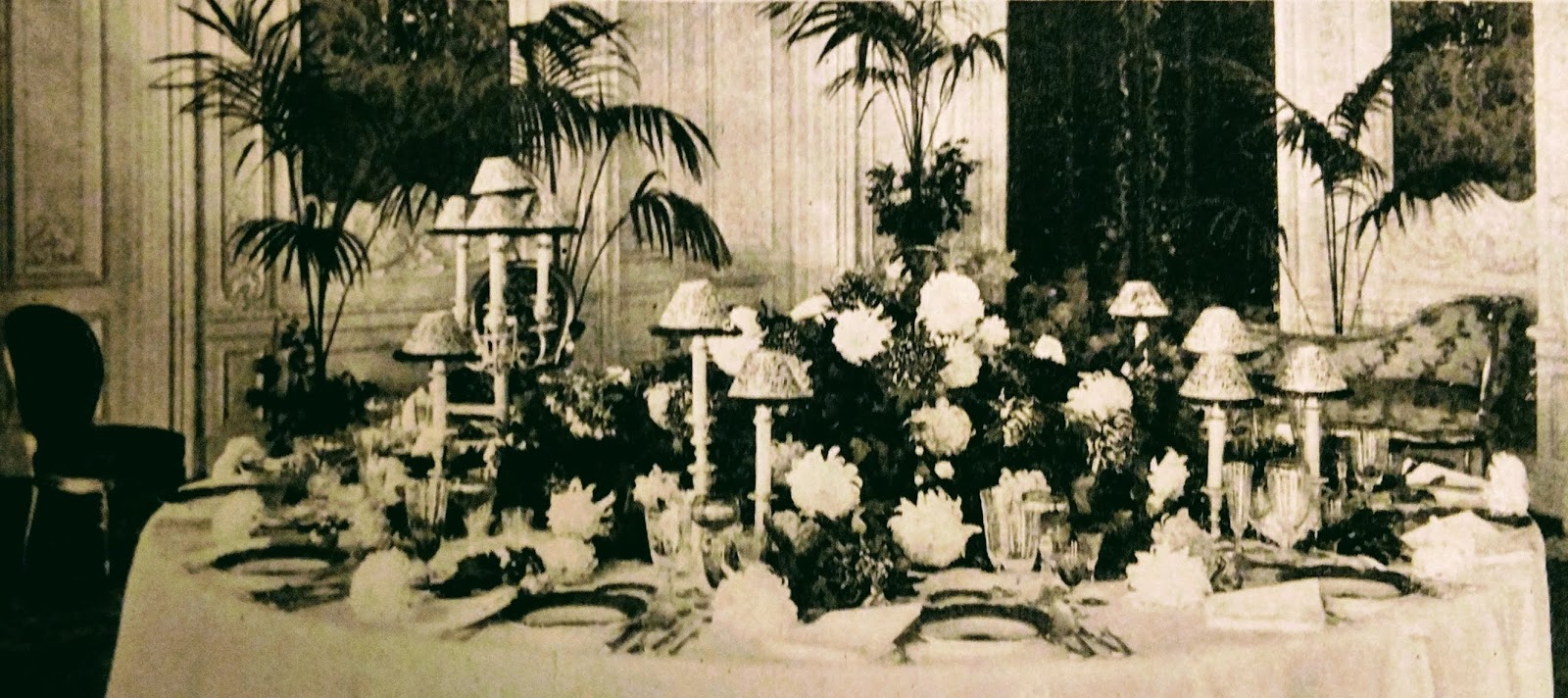
Those pretty candle shades, so much in use, were decorative to the furnishings of the table, but they prevented the most effective and becoming light at Victorian dinner parties.

Etiquette Notes for the Victorian Woman and the Home


A woman who has carefully studied the effects of light at her dinners says that unshaded candles in high, old fashioned candelabra that branch out in many directions, are absolutely the perfection of light for a table, and are, too a most becoming light to the faces of the guests gathered around it. The candelabra should be tall enough to carry the lights fairly high. The pretty candle shades so much in use are decorative to the furnishings of the table, but they prevent the most effective and becoming light.

A knitted table padding is being offered for use under table cloths. It is especially recommended because it does not grow hard after washing, as does the ordinary table pad. For a polished table, too, its protection is claimed to be more perfect. 


Cosmos and pansies are preferred for cloths intended for round tables. Sometimes entire plants are used to form a double border, with a plain linen center, and a plain strip between. The latest and most fashionable tablecloths have centers of plain linen, to which deep floral borders extend from the hem. Poppies, lilacs or goldenrod are favorite designs. Floral designs are preferred, the figures being larger and more pronounced than ever, this season.

Some damasks show the representations of whole plants or of a great branch bearing both flowers and foliage. Lace-trlmmed table linen is more fashionable than it was last season. Three new laces are used in ornamenting it. One is a French lace, resembling heavy linen torchon of elaborate patterns; another is a Russian lace of close meshes and clumsy figures.

Table linen that is not trimmed with lace, should be marked with embroidered initials. The accepted size for letters on tablecloths is two and one-half inches, and for napkins one and one-half inches. The initials should be intertwined, but the old-fashioned monogram style is no longer admissible.

In the serving of a pineapple:  Slice it, dip it in grated coconut, and pile high on a dish of fine white china.

A jelly sauce that is used for meats or the game course, requires that the jelly should be melted to the liquid state, and a tablespoonful of wine added just as it is sent around.
–Sacramento Daily Union, 1898


  🍽Etiquette Enthusiast, Maura J Graber, is the Site Editor for the Etiquipedia© Etiquette Encyclopedia