Showing posts with label Galatime by Petra Carsetti. Show all posts

Friday, April 17, 2026

Art and Etiquette of Afternoon Tea

Finally, on the top part of the stand, the third tier, small pastries are served, also typically English, which bring this moment of conviviality to a close.

The British Afternoon Tea Ceremony

Around the world, the ritual of tea is known as one of the most cherished and meaningful moments to enjoy a good infusion, alone or in company. It is well known that this precious beverage spread from China to all of Europe precisely from Great Britain, becoming a fundamental part of English life. However, not everyone knows that there are very specific rules that should be followed.

First of all, you need to choose a good loose-leaf tea and steep it in boiling water — depending on the type of infusion chosen — for three to six minutes. For each guest, the teapot should contain one teaspoon of loose-leaf tea, plus one extra “for the pot.” Separately, of course, there will be the sugar bowl and milk jug. And what about lemon? The English almost never use lemon, substituting it with milk. Do you know why? Not for a reason that’s fundamentally about taste, but for a logistical one to solve a serious problem: at one time, English teacups couldn’t withstand the heat of the tea and would break. To get around this problem, the English started putting the milk in the cup first to cool down the hot tea that would be poured in right after. 

Naturally, after 1700, with the founding of historic companies like Wedgwood, Spode, Minton, etc…, the materials used were able to keep cups from cracking under heat thanks to the use of kaolin, effectively leading to the birth of porcelain and bone china. Afternoon tea, thanks to Anna Maria Russell, Duchess of Bedford, people began to accompany the drink with both sweet and savory bites. It’s no coincidence that a three-tiered plate is served with very specific foods: on the first tier, the lowest one, sandwiches made with white and brown bread are served, filled with chicken, eggs, salmon, etc…

On the second tier, buns sometimes studded with raisins called scones are served; they are split in half by hand, never with a knife, and filled with clotted cream and strawberry jam. In reality, there’s a historic dispute between Devonshire, which says you should put the clotted cream on first and then the jam, and Cornish, which says you should spread the jam first and then the clotted cream. The latter is a sort of butter-cream similar to mascarpone that is really hard to find in many countries.
Above, a patent for a gilded age “Sandwich Plate” by Haviland. The “sandwich set” with plate and cup has a very wide saucer to hold biscuits, scones, finger sandwiches or pastries.

Finally, on the top part of the stand, the third tier, small pastries are served, also typically English, which bring this moment of conviviality to a close. Many hotels around the world recreate this ritual, adding the option to serve Prosecco or champagne. The most interesting thing, though, is seeing what tools have been invented to fill the table with dishware and surprise the guests. Among the cups, for example, there’s the “mustache cup,” which has ceramic or porcelain ledges to keep mustaches from getting dirty, or the “luncheon set” or “sandwich set,” which have a very wide saucer to hold biscuits, scones, finger sandwiches or pastries. 

Other interesting items are new utensils like the lemon fork with spread out or “splayed” tines for picking up lemon slices, the jam spoon with a chiseled edge, the bird-shaped lemon squeezer, the sugar cube tongs, and strainers of various shapes and materials. In short, it’s a ritual that becomes an experience and can be compared to the beauty of the Japanese, Chinese, French, New Zealand, or Italian tea ceremony.
Other interesting items are new utensils like the lemon fork with spread out or “splayed” tines for picking up lemon slices, the jam spoon with a chiseled edge, the bird-shaped lemon squeezer, the sugar cube tongs, and strainers of various shapes and materials.


This Month’s Contributor Spotlight

Petra Carsetti was born into a gastronomic minded family… true lovers of excellent foods and wines. From an early age she showed a great passion for the table, which she later developed by working in important, well-known Italian restaurants. Since 2005, she has written many books on food and wine, along with guides to Italian restaurants, specializing also in galateo and etiquette at the Accademia Italiana Galateo and ANCEP (the Association of Ceremonialists for Public Institute). She teaches etiquette in schools to adults and children, is a consultant for various political and economic authorities, and she has a weekly column in a historic newspaper. She also writes for various other newspapers, is a frequent television guest. Very active on Instagram @galateopetra_carsetti, Petra is happily married to well-known wine and food aficionado, journalist and author, Carlo Cambi and together they have one daughter. Her books Galatime and Galatime II are full of etiquette and entertaining advice.


🍽️Etiquette Enthusiast, Maura J. Graber of The RSVP Institute of Etiquette, is the Site Editor of the Etiquipedia© Etiquette Encyclopedia

Wednesday, April 1, 2026

Spotlight on Petra Carsetti

IN JULY 2021 THE ITALIAN PETRA CARSETTI JUMPED TO THE NEWS FOR WINNING A WORLD RACE OF WHAT?

Meet Italian Etiquette Authority and Etiquipedia Contributor, Petra Carsetti, Author of Galatime and Galatime Act II

Petra Carsetti was born into a gastronomic minded family… true lovers of excellent foods and wines. From an early age she showed a great passion for the table, which she later developed by working in important, well-known Italian restaurants. Since 2005, she has written many books on food and wine, along with guides to Italian restaurants, specializing also in galateo and etiquette at the Accademia Italiana Galateo and ANCEP (the Association of Ceremonialists for Public Institute). She teaches etiquette in schools to adults and children, is a consultant for various political and economic authorities, and she has a weekly column in a historic newspaper. She also writes for various other newspapers, is a frequent television guest. Very active on Instagram @galateopetra_carsetti, Petra is happily married to well-known wine and food aficionado, journalist and author, Carlo Cambi and together they have one daughter.
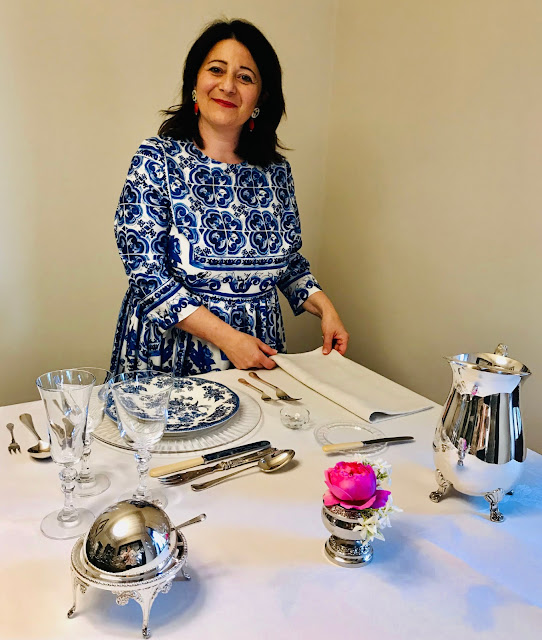
Petra with one of her lovely, al fresco tablescapes
 Below are links to just a few of Petra Carsetti’s numerous articles on etiquette and table settings you’ll find on Etiquipedia:

The following is a Q. & A. with Petra:

What was the impetus for starting your Etiquette business?
In reality, I've always had the impulse! Since I was a child I paid particular attention to how to set a table, empathize with people in front of me and know how to converse with everyone.

Why did you start? 
The 2016 the earthquake in the central part of Italy forced me to change my life. I therefore decided to enroll at the Italian Etiquette Academy to become a teacher of etiquette. In 2021 I also began to write books about etiquette.

What do you enjoy teaching the most regarding Etiquette? Surely the thing I like most is to make people understand that etiquette is the best tool for respect towards others and the use of kindness is the only true weapon to develop real progress towards the world and towards oneself.

What do you find rewarding about teaching Etiquette? 
I really love the amazement that I find in kids and teenagers when I teach them etiquette! They are always full of enthusiasm and curiosity.

What types of classes do you offer? 
I give lessons for all ages. I enter primary and secondary school, organize workshops around Italy, chair private and public events to deal with etiquette issues at 360°.

What age group do you enjoy working with most? And why? 
As already written, I love working with kids because there is a purity without superstructures that allow me to awaken hidden passions and make them feel more confident about themselves and the world around them.

Who are some of the older etiquette authors or authorities you enjoy reading most? 
Surely one of them is Monsignor Giovanni della Casa, he is the founder of good manners in Italy and his rules (from about 1550) are still valid today. Another author is a woman, she is Elda Lanza and she wrote a book with a very clear title: Il tovagliolo va a sinistra (The napkin goes to the left, first edition 2016)

If you would like to reach Petra, you can find her on Instagram. She is very active there @galateopetra_carsetti — Petra’s etiquette books, Galatime and Galatime Act II are both available on Amazon.


🍽Etiquette Enthusiast, Maura J. Graber, is the Site Editor for the Etiquipedia© Etiquette Encyclopedia

Thursday, May 1, 2025

Spotlight on Petra Carsetti


IN JULY 2021 THE ITALIAN PETRA CARSETTI JUMPED TO THE NEWS FOR WINNING A WORLD RACE OF WHAT?

Meet Italian Etiquette Authority and Etiquipedia Contributor, Petra Carsetti, Author of Galatime and Galatime Act II

Petra Carsetti was born into a gastronomic minded family… true lovers of excellent foods and wines. From an early age she showed a great passion for the table, which she later developed by working in important, well-known Italian restaurants. Since 2005, she has written many books on food and wine, along with guides to Italian restaurants, specializing also in galateo and etiquette at the Accademia Italiana Galateo and ANCEP (the Association of Ceremonialists for Public Institute). She teaches etiquette in schools to adults and children, is a consultant for various political and economic authorities, and she has a weekly column in a historic newspaper. She also writes for various other newspapers, is a frequent television guest. Very active on Instagram @galateopetra_carsetti, Petra is happily married to well-known wine and food aficionado, journalist and author, Carlo Cambi and together they have one daughter.

Below are links to just a few of Petra Carsetti’s numerous articles on etiquette and table settings you’ll find on Etiquipedia:

The following is a Q. & A. with Petra:

What was the impetus for starting your Etiquette business?
In reality, I've always had the impulse! Since I was a child I paid particular attention to how to set a table, empathize with people in front of me and know how to converse with everyone.

Why did you start? 
The 2016 the earthquake in the central part of Italy forced me to change my life. I therefore decided to enroll at the Italian Etiquette Academy to become a teacher of etiquette. In 2021 I also began to write books about etiquette.

What do you enjoy teaching the most regarding Etiquette? Surely the thing I like most is to make people understand that etiquette is the best tool for respect towards others and the use of kindness is the only true weapon to develop real progress towards the world and towards oneself.

What do you find rewarding about teaching Etiquette? 
I really love the amazement that I find in kids and teenagers when I teach them etiquette! They are always full of enthusiasm and curiosity.

What types of classes do you offer? 
I give lessons for all ages. I enter primary and secondary school, organize workshops around Italy, chair private and public events to deal with etiquette issues at 360°.

What age group do you enjoy working with most? And why? 
As already written, I love working with kids because there is a purity without superstructures that allow me to awaken hidden passions and make them feel more confident about themselves and the world around them.

Who are some of the older etiquette authors or authorities you enjoy reading most? 
Surely one of them is Monsignor Giovanni della Casa, he is the founder of good manners in Italy and his rules (from about 1550) are still valid today. Another author is a woman, she is Elda Lanza and she wrote a book with a very clear title: Il tovagliolo va a sinistra (The napkin goes to the left, first edition 2016)

If you would like to reach Petra, you can find her on Instagram. She is very active there @galateopetra_carsetti — Petra’s etiquette books, Galatime and Galatime Act II are both available on Amazon.


🍽Etiquette Enthusiast, Maura J. Graber, is the Site Editor for the Etiquipedia© Etiquette Encyclopedia

Wednesday, May 1, 2024

Spotlight on Petra Carsetti


IN JULY 2021 THE ITALIAN PETRA CARSETTI JUMPED TO THE NEWS FOR WINNING A WORLD RACE OF WHAT?

Meet Italian Etiquette Authority and Etiquipedia Contributor, Petra Carsetti, Author of Galatime and Galatime Act II

Petra Carsetti was born into a gastronomic minded family… true lovers of excellent foods and wines. From an early age she showed a great passion for the table, which she later developed by working in important, well-known Italian restaurants. Since 2005, she has written many books on food and wine, along with guides to Italian restaurants, specializing also in galateo and etiquette at the Accademia Italiana Galateo and ANCEP (the Association of Ceremonialists for Public Institute). She teaches etiquette in schools to adults and children, is a consultant for various political and economic authorities, and she has a weekly column in a historic newspaper. She also writes for various other newspapers, is a frequent television guest. Very active on Instagram @galateopetra_carsetti, Petra is happily married to well-known wine and food aficionado, journalist and author, Carlo Cambi and together they have one daughter.

Below are links to just a few of Petra Carsetti’s numerous articles on etiquette and table settings you’ll find on Etiquipedia:

The following is a Q. & A. with Petra:

What was the impetus for starting your Etiquette business?
In reality, I've always had the impulse! Since I was a child I paid particular attention to how to set a table, empathize with people in front of me and know how to converse with everyone.

Why did you start? 
The 2016 the earthquake in the central part of Italy forced me to change my life. I therefore decided to enroll at the Italian Etiquette Academy to become a teacher of etiquette. In 2021 I also began to write books about etiquette.

What do you enjoy teaching the most regarding Etiquette? Surely the thing I like most is to make people understand that etiquette is the best tool for respect towards others and the use of kindness is the only true weapon to develop real progress towards the world and towards oneself.

What do you find rewarding about teaching Etiquette? 
I really love the amazement that I find in kids and teenagers when I teach them etiquette! They are always full of enthusiasm and curiosity.

What types of classes do you offer? 
I give lessons for all ages. I enter primary and secondary school, organize workshops around Italy, chair private and public events to deal with etiquette issues at 360°.

What age group do you enjoy working with most? And why? 
As already written, I love working with kids because there is a purity without superstructures that allow me to awaken hidden passions and make them feel more confident about themselves and the world around them.

Who are some of the older etiquette authors or authorities you enjoy reading most? 
Surely one of them is Monsignor Giovanni della Casa, he is the founder of good manners in Italy and his rules (from about 1550) are still valid today. Another author is a woman, she is Elda Lanza and she wrote a book with a very clear title: Il tovagliolo va a sinistra (The napkin goes to the left, first edition 2016)

If you would like to reach Petra, you can find her on Instagram. She is very active there @galateopetra_carsetti — Petra’s etiquette books, Galatime and Galatime Act II are both available on Amazon.


🍽Etiquette Enthusiast, Maura J. Graber, is the Site Editor for the Etiquipedia© Etiquette Encyclopedia

Thursday, November 25, 2021

Italian Place-Setting Etiquette for Wines


A semi-formal place setting example from the new Italian etiquette book, by Petra Carsetti and Carlo Cambi,
“GalaTime: it is always time for good manners”!

Taking as a reference the arrangement assumed by sommeliers (now more in vogue and certainly more used today) it must be specified that the water glass is placed in front of the tip of the main knife because it is a simple tumbler and has no stem: a low glass (that's why in the front row) which will be followed by the second-order glasses of service, starting therefore from those for the white and then for the reds (gradually more and more structured). 

In this case, in order to better enhance the organoleptic properties of the wines and their scents, glasses of different shapes and sizes are set, both for whites and reds such as tulip or balloon (the latter must be placed at the table at the time of serving the specific wine and not before). If you follow the rules of the sommelier, the “battery” of the glasses should be made up of at least six different containers for the wine (which must not be set all together but with a maximum of 3 glasses.) – Translated from “Galatime,” by Petra Carsetti and Carlo Cambi


Petra Carsetti was born into a gastronomic minded family… true lovers of excellent foods and wines. From an early age she showed a great passion for the table, which she later developed by working in important, well-known Italian restaurants. Since 2005, she has written many books on food and wine, along with guides to Italian restaurants, specializing also in galateo and etiquette at the Accademia Italiana Galateo and ANCEP (the Association of Ceremonialists for Public Institute). She teaches etiquette in schools to adults and children, is a consultant for various political and economic authorities, and she has a weekly column in a historic newspaper. She also writes for various other newspapers, and in September she will come out with her new book, “GalaTime: it is always time for good manners”!


Etiquette Enthusiast, Maura J. Graber, is the Site Editor for the Etiquipedia© Etiquette Encyclopedia

Friday, October 29, 2021

Table Etiquette and Beverages


Tipologie di bicchieri e tazze secondo il codice internazionale. Or… Types of glasses and cups according to the international code.- From “GalaTime: it is always time for good manners”!


When setting the table, always pick up every object on the table with a cloth, a towel or gloves (preferably white and cotton) so as not to leave fingerprints and streaks; I have happened to see some people holding the glasses by putting their fingers inside the glass. Never do this! Always pick up glasses from the stem or from the bottom, checking that there are no lime stains, that they are clear and transparent.

As we have already said, make certain that they do not have the smell of a cupboard, because it can happen that if glasses are not often used, scents or smells can emanate from them and alter the scents of the wines. It should also be emphasized that etiquette requires that wine or other beverage glasses are never colored. They may have small decorations, but they are always transparent.

Plan for that every four diners at your dinner table, you will have at least one jug of water, a wine decanter, a salt shaker each time. (If you are a guest, never ask the hostess for salt if it is not already on the table).

Water and all other beverages are not properly brought in plastic containers to the table: crystal, silver or glass are absolutely the materials which are preferred when entertaining; we can decide to decant a wine in special decanters, but nowadays, in agreement with the sommellerie, the original bottle on the table is granted, perhaps accompanied by a coaster, to avoid staining the tablecloth. 

Although already mentioned in another chapter, it is reiterated that the cans of the various beverages on the market are banned from the table and not only for a good aesthetic taste linked to the art of the device, according to etiquette, but above all because we know well that many they contain too much sugar which is harmful to both the figure and our health. Therefore, let us eliminate them from the diet, especially that of our children, so as not to accustom them to a wrong taste: better then replace these drinks with home-made infusions or healthy citrus juices. – Translated from “Galatime,” by Petra Carsetti and Carlo Cambi


Petra Carsetti was born into a gastronomic minded family… true lovers of excellent foods and wines. From an early age she showed a great passion for the table, which she later developed by working in important, well-known Italian restaurants. Since 2005, she has written many books on food and wine, along with guides to Italian restaurants, specializing also in galateo and etiquette at the Accademia Italiana Galateo and ANCEP (the Association of Ceremonialists for Public Institute). She teaches etiquette in schools to adults and children, is a consultant for various political and economic authorities, and she has a weekly column in a historic newspaper. She also writes for various other newspapers, and in September she will come out with her new book, “GalaTime: it is always time for good manners”!


Etiquette Enthusiast, Maura J. Graber, is the Site Editor for the Etiquipedia© Etiquette Encyclopedia

Saturday, October 16, 2021

Etiquette and Table Service Styles

This post below is from “Galatime” the new Italian Etiquette book by Petra Carsetti and her husband, Carlo Cambi – I am very pleased to say that I will be sharing more from Petra’s new book in the coming weeks:
“The etiquette of the new millennium for those who love to live well and in harmony with others; for those who are curious to know the origins of “good manners,” for those who want to socialize with certainty of manners and education of thought. It is a sort of invitation to the renaissance of the encounter. But it is also an essay, which can be read almost in the form of a novel, on the history of costume, as well as a friend to ask for advice on doing the right thing at the right time. Because beyond the fashions, the ways count. To understand this there is Galatime”

English, Russian, French and Italian Service


Here is a review of the main existing services:

Russian (or guéridon) service takes advantage of a trolley placed near the table from which a waiter (a servant in the house) divides and makes the dishes that are served to the right of the diner; this type of service requires expert hands in portioning.

English service: the waiter (or the servant) from the serving dish divides and serves the diner directly from the left with tongs; this method is widely used in receptions and banquets because the service is very quick and fast, but often if it is not performed by expert hands, it could lead to splashes of sauce, stains and food falling from the serving plate directly on the tablecloth or on the clothes of bystanders.

French service which in turn is divided into: 
1. Direct, in which a servant or a waiter hands a serving dish to the left of the diner with a serving utensil (or utensils) from which he will serve himself according to his own taste and hunger; this type of service allows guests either to be able to take the desired food without exaggerating the portion if it is not to one's liking or by abounding a little more (never excessively) if it is a very popular dish;
2. Indirect when the different foods are served in trays set on other tables or trolleys and each table serves itself using the servers found in each individual serving dish. It is a very informal method that can be taken into consideration, for example, in dinners with a large number of guests; naturally if you choose this type, you must set up tables with free spaces to be able to move, food warmers for dishes that must be kept warm, far from those that must be kept cold.
Italian service (or al plate, service surassiette) is that which involves the preparation of the dish in the kitchen and then brought directly to the diner, served from the right. This system is the most used, perhaps the most elegant and refined (it is no coincidence that in starred restaurants it is the only type of service, in which the dishes are often covered by a cloche) but it has the flaw that the guest cannot decide the quantity of food to be taken and therefore he will be forced to eat a large portion even if he does not find it to his liking. In a formal meeting at home, if there is no domestic help, it would impose a prolonged or continuous absence on the hostess. 

From all these types of service we learn to choose the one that best suits your occasion, knowing however that the dishes are always removed from the right and put back clean from the left; one or more trolleys are set up to place both the dirty dishes (on the floor below, covered with a cloth) that will never be stacked one on top of the other on the table, but cleared one at a time with the respective cutlery even if they are not used (maybe put all in a special container), and the clean dishes that will have been prepared previously on the upper level of the trolley and then given to diners without having to be absent continuously.
From “Galatime. È sempre tempo di buone maniere”
It should be specified that the cheese must of course be brought just before serving the pasta or soup and removed immediately afterwards; the menage must be removed when the saucer or crescent for the salad is removed; first the serving dishes must be removed and then the dinner plates. Finally, remember that everything must be cleared before dessert, except the glass of water (with its carafe) and the centerpiece. – From “Galatime,” by Petra Carsetti and Carlo Cambi


Petra Carsetti was born into a gastronomic minded family… true lovers of excellent foods and wines. From an early age she showed a great passion for the table, which she later developed by working in important, well-known Italian restaurants. Since 2005, she has written many books on food and wine, along with guides to Italian restaurants, specializing also in galateo and etiquette at the Accademia Italiana Galateo and ANCEP (the Association of Ceremonialists for Public Institute). She teaches etiquette in schools to adults and children, is a consultant for various political and economic authorities, and she has a weekly column in a historic newspaper. She also writes for various other newspapers, and in September she will come out with her new book, “GalaTime: it is always time for good manners”!


Etiquette Enthusiast, Maura J. Graber, is the Site Editor for the Etiquipedia© Etiquette Encyclopedia