Showing posts with label Manners for Company. Show all posts

Saturday, October 5, 2024

How Children Learn Ease of Manner

Good manners aren’t only for when “company” comes to visit. ~The mother was stressing the old idea of “company manners,” and expecting the children to put on culture just as they put on clothes for the dinner party. And because they didn't she was deeply grieved and disappointed.
A mother remarked the other day in the course of a conversation on child discipline, “I don't see why it is that my children always act worse when we have guests than at any other time. I'm sure it isn't because they haven't been instructed how to behave.”

Now this mother was perfectly sincere in her remark, yet her own phrasing contains the secret of her distress over her children's behavior. Would a child learn to play the piano by being instructed if he didn't practice playing every day? Yet that mother was expecting just as improbable a performance in behavior. She was stressing the old idea of “company manners,” and expecting the children to put on culture just as they put on clothes for the dinner party. And because they didn't she was deeply grieved and disappointed.

The reason why children of this type act worse when there are guests than they do ordinarily is because of strain and nervous tension. In the mother's anxiety to have affairs move smoothly she has held out threats as to what will happen if all the last minute “Don'ts” aren't observed, and the result has been to create an unnatural condition that is confusing and disastrous to poise and courtesy.

But aside from the mother's embarrassment over slips of etiquette and behavior, this idea of “putting on manners” is very unwise training for children. They gradually learn to act on artificial motives and lose sight of the genuine and vital character traits that are worth while and lasting.

Just the idea of alluding to the various articles of table appointment as “company silver” and “guest linen,” and so on, through all the china and glassware, suggests to the child a feeling of stiffness, and an atmosphere formal and conventional, though he does not analyze it in just those terms.

Why not use the good dishes and linen and silverware occasionally for just the home folks? Then daughter Lois will not cause a panic when there are guests by piping up, “Oh, goody, we have the fruit in the best hand-painted bowl.” If the little ones become accustomed every day to what is good enough for guests, a great deal of strain for both parents and children is bound to be eliminated.

Right in line with this follows the fact that the place to start preparing the child in “company manners” is the first day he sits in his high chair to eat a meal. There is no need for a tot even this age to throw his spoon and cracker on the floor continually, or to upset his broth or porridge. He may as well learn right then not to stand up in his chair, not to put his face down in his plate, and not to scream for what he can’t have. This much at least can then be omitted from the “instructions” when the Browns come over to dine a few years later.

When mother is alone and playing with the babies she can teach them much by pretending visitors. They may come in and call on her and advance and take her hand. It will become natural in a very short time. A mother who includes good manners and polite behavior in the everyday home life will never have reason to force courtesy upon her children.– 
By Edith Lochridge Reid, 1923


🍽Etiquette Enthusiast, Maura J. Graber, is the Site Editor for the Etiquipedia© Etiquette Encyclopedia

Saturday, August 1, 2020

Manners Due Equally to Family

Oh, these “company manners!” They are the ruination of a household. They cannot always be put on and off at will. Traces of the every day discord and lack of harmony will manifest themselves through the affectation of all the mere “company manners” one can assume. Habitual politeness and kindness and gentleness should be the unwavering rule in every house, even on “Blue Mondays.”
photo source, Pinterest 

Good Manners at Home

I know a woman who is always harping about “culture” and “refinement” and “etiquette,” and who does not this minute know the meaning of that old fashioned term, “good manners.” She is always regretting the lack of culture among her neighbors, and there is not one of them who is more polite than she is. I have heard her actually yell at her servants, and storm at her children, and I do not think her husband is the happiest man in the world. 
In society, she is a charming woman. She knows always just what to say and how to say it. I never saw a woman who could excel her in gliding across a room and sinking gracefully into a chair. 

Her little boys can tip their hats so prettily to ladies on the street; her little girls can enter a room with toes properly turned out and with the grace of little queens; and, alas! both the little boys and the little girls can be as impertinent and display the worst manners of any children I ever saw. And they literally fight among themselves. They are not taught to be polite to each other. Their mother seldom favors them with her own properly chosen words and graceful manners when they are alone with her. Discord reigns until the door bell rings and then the entire household must put on good manners. “If we don’t,” one of the children said, “we catch it when the company’s gone!” 

This is an extreme case, but do we not all have our “company manners?” Do we speak just as gently and sweetly to our children, to our husbands and wives, when we are alone with them as when in the presence of the chance caller? Do we say to a transgressing Johnnie or Katie, “Don’t do that, dear,” or, “Stop that this minute, I tell you!” Which is it? Do we say “please” and “thank you” to each other and to our servants at all times, or are these pleasing little words held in reserve with the rest of our “company manners?” Is it only in the presence of strangers that we smilingly overlook or gently chide the trifling faults of our children? 

Oh, these “company manners!” They are the ruination of a household. They cannot always be put on and off at will. Traces of the every day discord and lack of harmony will manifest themselves through the affectation of all the mere “company manners” one can assume. Habitual politeness and kindness and gentleness should be the unwavering rule in every house, even on “Blue Mondays.” — -Zenas Dane in Good Housekeeping, 1888

Etiquette Enthusiast, Maura J Graber, is the Site Editor for the Etiquipedia© Etiquette Encyclopedia
Wednesday, April 1, 2020

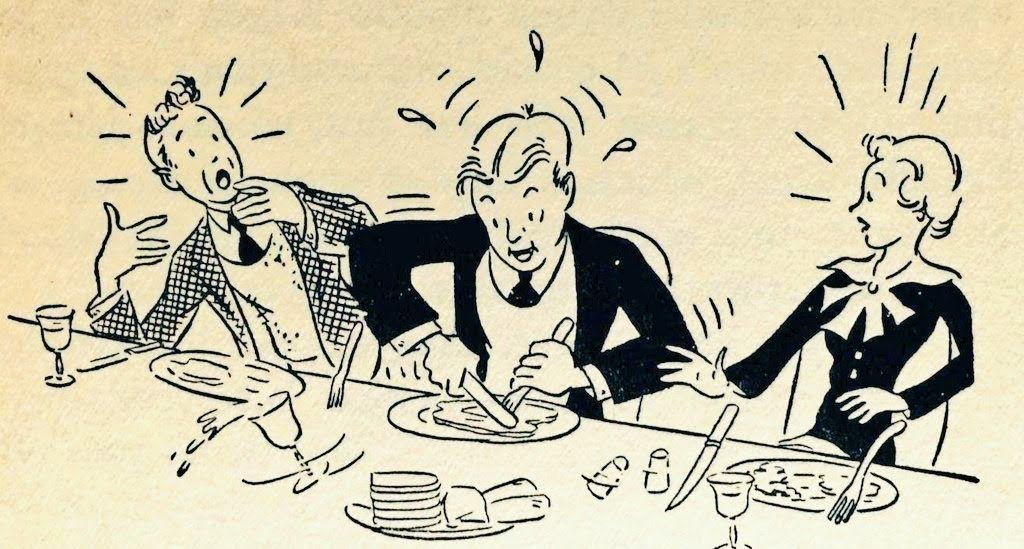
Company Table Manners

As soon as a child is old enough to come to the table he should be taught by precept and example what good table manners are... Let it be understood that good manners are not the acquiring of every new wrinkle that fashionable society may prescribe. There is a great difference between good manners and good form. What is good form to-day may be very bad form tomorrow, but good manners are not changeable.

There seems to be an idea among many people that there must be a different set of manners for company from what is observed in everyday life. While it is the proper thing to have for an invited company a more elaborate dinner and a little more ceremony in the service than at the family table, it must be remembered that one should not put on and take off good manners as one would a garment. They are a part of one's self, and whether the family meal consist of many courses, or only a cup of tea and a slice of toast, it should always be served decently and in order, and the manners of the members of the household should be such that one need not blush for them, even in the finest company. As soon as a child is old enough to come to the table he should be taught by precept and example what good table manners are. If the father and mother be so unfortunate as not to have had proper training themselves, they should study to correct any bad habits they may have, for the sake of their children. 


Let it be understood that good manners are not the acquiring of every new wrinkle that fashionable society may prescribe. There is a great difference between good manners and good form. What is good form to-day may be very bad form tomorrow, but good manners are not changeable. Unselfishness, kindly feelings and politeness are the foundation of good manners. Good table manners demand that one shall take soup from the side of a spoon; shall eat with a fork, rather than a knife; shall take small mouthfuls of food and masticate quietly, making no unpleasent sound; shall take in the fingers no food except fruit, confectionary, olives, bread, cake,celery, etc., and that the members of the family shali be as polite to each other as to any guest. Where people rush through their meals there is not much chance fo: table maners or good digestion. If properly managed, the table can be made one of the most refining influences of the home. —Ladies Home Journal, 1892


Etiquette Enthusiast, Maura J Graber, is the Site Editor for the Etiquipedia©️ Etiquette Encyclopedia