“Table knives,” says Eliel Saarinen, the Detroit architect who showed a dining-room at the Metropolitan Museum exhibit, have been constructed on the wrong principle. “The blades have been much longer than necessary, while the handles have been much too short, so that the user, when cutting, has always been obliged to brace his finger well down on the blade, which has obvious disadvantages.”
In 1929, House Beautiful Magazine interviewed Eliel Saarinen, a well-known Finnish architect who immigrated to the U.S., on the Metropolitan Museum’s exhibit he had participated in. Mr. Saarinen has designed some new knives which are quite as attractive as they are practical, and one wonders why we have so long clung to the old irrational and conventional kind. This search for the logical and simple is leading us away from some of our outdated habits.” — House Beautiful, May 1929
The science of ergonomic design really only started in earnest during WWII, but just a little over a decade earlier Eliel Saarinen came up with an ergonomically designed knife and a matching fork when he created this line of flatware.— Public domain image of architect Eliel Saarinen, courtesy of Wikipedia


More on the briefly popular Grille Flatware
This settings above feature the style flatware known as, “Grille”, “Viande” and “Vogue.” The knife is about 2/3 handle and 1/3 blade, as opposed to the normal 1/2 handle with 1/2 blade. The handle of the fork is nearly 3/4 of the fork with the bowl and tines 1/4. This “modern” style of flatware was introduced first to the public in 1927.
According to a 2003 article by William P. Hood of Magazine Antiques, “The story begins in 1927 or 1928, when nine architects were invited by the Metropolitan Museum of Art in New York City to design thirteen room settings for The Architect and the Industrial Arts, its eleventh exhibition of contemporary American design. The organizers requested that all furnishings and accessories for a room be included, and they stipulated that no object to be displayed could already be in production.
The new flatware designed was sleek with patterns reminiscent of the skyscrapers dotting the skylines of modern cities. Several different American flatware companies produced the knives, forks and spoons. “The dinner knife executed by International Silver, for example, was 9 1/4 inches long, with its handle measuring about 6 inches. The handle of its dinner fork was about average (approximately 5 inches), but the functional end was shorter than usual, to match the abbreviated knife blade. The idea for the new style of table knife came from the perception that it is uncomfortable for the extended index finger to press against the narrow back (or ‘top’) of the blade when one cuts with a conventional knife.”
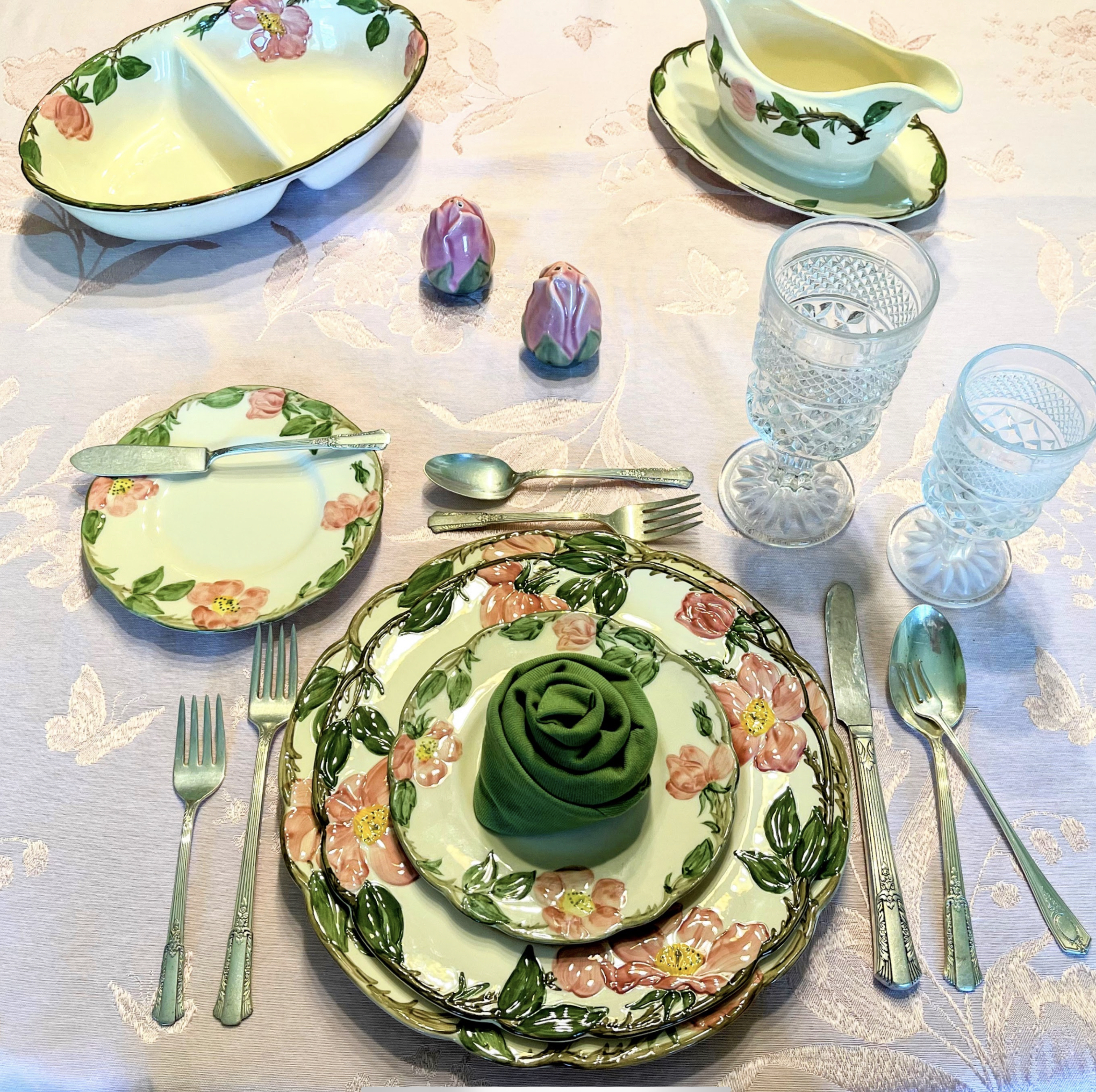
By 1930, the new style of flatware was available to the public, but its popularity only lasted about 25 to 30 years. The flatware shown in the setting above is the 1940 “Treasure” pattern, by Wm. Rogers. The dishes are early 1940’s “Desert Rose” Franciscan ware. — Maura J. Graber, 2023

🍽️Etiquette Enthusiast, Maura J. Graber of The RSVP Institute of Etiquette, is the Site Editor of the Etiquipedia© Etiquette Encyclopedia