Showing posts with label Etiquette for Tea. Show all posts

Tuesday, June 30, 2020

Chinese Tea Etiquette

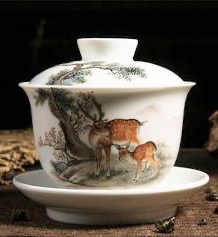
A traditional Chinese covered tea cup in dish, with naturalistic scene 
Photo source, Pinterest 


How the Chinese Man Drinks Tea


The Chinese man, in preparing tea, places a pinch of leaves in a Chinese teacup, which is without a handle, pours boiling water over them and places the cover on the cup. In a few seconds the tea is ready for drinking; the covered cup is raised to the mouth, and, with the fingers of the hand holding the cup, the lid is moved just sufficiently to permit the liquid to flow into the mouth as the cup is tilted. — By United States, Bureau of Foreign and Domestic Commerce, 1919


Etiquette Enthusiast, Maura J Graber, is the Site Editor for the Etiquipedia© Etiquette Encyclopedia

Friday, February 9, 2018

Miss Manners on Tea Etiquette

“Tea is made in the drawing room in full view of the guests, so get it right. The proper method is this: Rinse the teapot with boiling water. Give your teaspoons a chance to do the job for which they were trained by putting in one teaspoon of loose tea (tea is claustrophobic and hates being stuffed into little bags) for each tea drinker, plus one. Now pour on the rapidly boiling water. There are few things worse than tepid tea.” 


Tea for Two or 3,000 

Dear Miss Manners: I should like to begin having tea on a daily schedule with friends stopping in, with or without invitations. A couple of questions do require answering: At what time is “teatime,” and should coffee be offered or placed on the table? 

Gentle Reader: Miss Manners adores afternoon tea, from “oh-do-join-me-for-a-cup” to royal receptions for 3,000 people. She would advise you to get some practice in the former before attempting the latter. There are few more charming ways to spend an afternoon than to sit, surrounded by fine china and friends, wolfing down scones and bringing up epigrams. 

If you wish to test the water before jumping in even on a weekly basis water for tea should always be boiling invite people for a specific day writing: Tea Tuesday the Seventeenth. Four to Six o’clock. All should be written in the lower left corner of your visiting cards. Later it may be “Tuesdays 4 to 6 p.m.” Place on a tray a large silver or copper kettle over an alcohol burner and tea caddy, with a teapot, cups (which have been warmed with boiling water), teaspoons, a slops bowl, a tea strainer, a milk pitcher (cream overpowers a dainty cup of tea), a bowl of lump sugar, little plates and napkins. 

Tea is made in the drawing room in full view of the guests, so get it right. The proper method is this: Rinse the teapot with boiling water. Give your teaspoons a chance to do the job for which they were trained by putting in one teaspoon of loose tea (tea is claustrophobic and hates being stuffed into little bags) for each tea drinker, plus one. Now pour on the rapidly boiling water. There are few things worse than tepid tea. 

When the tea has steeped for about four minutes, ask your guest of honor how she takes it. Using the strainer, pour straight from the pot for strong tea and dilute it from the kettle for weak. Then add sugar (the reason for using lump sugar is so you may ask the traditional “One lump or two?”) and milk, according to the taste. Some troublemakers prefer lemon to milk and you may put slices in a glass dish on the tray, but you are only encouraging them. 

When this ritual is performed, the guest takes her tea from the hostess or if there is a gentleman present, he takes it to her. She then takes a plate, napkins and a modest selection from your platters of hot breads, tiny sandwiches, cookies and a slice of whatever luscious cake your cook has baked that day. If you become addicted to this form of entertaining, you may need to to move on to stronger doses, such as the reception, which is tea served in the dining room.

The tea service is placed at one end of the table, and the teacups napkins, plates, forks if needed, and a larger supply of tea food (at least two of each kind mentioned above) go in the middle. At the other end stands an urn of chocolate, boullion, or more often lately to Miss Manners' dismay, coffee. You may ask friends “to pour,” that is to serve the tea and chocolate for you as you move among your guests. Being asked to pour is an honor just short of knighthood.

The traditional time for tea is four o'clock, which is perfect if you have your afternoons free. However, coffee is only one of the sad things that has happened to tea over the years. Some people have the idea that there is something more important to do in the afternoon than sip tea and eat buttered bread, such as earning a living. If you have friends who work, Miss Manners suggests that you schedule your tea on a weekend or at a time convenient to them on their way home when you could give them yet another variation, “high tea,” so as to replace, rather than interfere with, their supper. 

High tea is more substantial in all matters of food and drink than afternoon tea. It could include a whiskey and soda tray. Along with the dainty foods traditional to afternoon tea, there are soft boiled eggs, sausages, sardines on toast, kippers, chicken livers and such. While some unscrupulous restaurants try to make afternoon tea sound more “high society” by calling it “high tea,” the word “high” is actually related to “it's high time we had something to eat.” As social events go, high tea is lower on the scale than afternoon tea, because the chances of being fed dinner are small on a day you are given high tea. In that respect it is like the “cocktail-buffet,” than which there are few lower social events. – From Judith Martin’s, “Miss Manners’ "Guide to Excruciatingly Correct Behavior,” 1985


Etiquette Enthusiast, Maura J. Graber, is the Site Editor for the Etiquipedia© Etiquette Encyclopedia
Tuesday, November 17, 2015

Etiquette and Tea Visiters

The domestic that attends the door should be instructed to show the guest up-stairs, as soon as she arrives; conducting her to an unoccupied apartment, where she may take off her bonnet, and arrange her hair, or any part of her dress that may require change or improvement. 


TEA VISITERS (sic)

When you have invited a friend to take tea with you, endeavour to render her visit as agreeable as you can; and try by all means to make her comfortable. See that your lamps are lighted at an early hour, particularly those of the entry and stair-case, those parts of the house always becoming dark as soon as the sun is down; and to persons coming in directly from the light of the open air, they always seem darker than they really are. 


Have the parlours lighted rather earlier than usual, that your guest, on her entrance, may be in no danger of running against the tables, or stumbling over chairs. In rooms heated by a furnace, or by any other invisible fire, it is still more necessary to have the lamps lighted early.

If there is a coal-grate, see that the fire is burning clear and brightly, that the bottom has been well-raked of cinders and ashes, and the hearth swept clean. A dull fire, half-choked with dead cinders, and an ashy hearth, give a slovenly and dreary aspect to the most elegantly furnished parlour. A sufficiently large grate (if the fire is well made up, and plenty of fresh coal put on about six o'clock) will generally require no further replenishing during the evening, unless the weather is unusually cold; and then more fuel should be added at eight or nine o'clock, so as to make the room comfortable.

In summer evenings, let the window-sashes be kept up, or the slats of the venetian blinds turned open, so that your guest may find the atmosphere of the rooms cool and pleasant. There should always be fans (feather or palm-leaf) on the centre-tables.

The domestic that attends the door should be instructed to show the guest up-stairs, as soon as she arrives; conducting her to an unoccupied apartment, where she may take off her bonnet, and arrange her hair, or any part of her dress that may require change or improvement. The lady should then be left to herself. Nothing is polite that can possibly incommode or embarrass —therefore, it is a mistaken civility for the hostess, or some female member of the family to follow the visiter up-stairs, and remain with her all the time she is preparing for her appearance in the parlour. 

                                         
Let both mothers and children understand that, on all occasions, over-officiousness is not politeness, and that nothing troublesome and inconvenient is ever agreeable.

We have seen an inquisitive little girl permitted by her mother to accompany a guest to the dressing-table, and watch her all the while she was at the glass; even following her to the corner in which she changed her shoes; the child talking, and asking questions incessantly. This should not be. Let both mothers and children understand that, on all occasions, over-officiousness is not politeness, and that nothing troublesome and inconvenient is ever agreeable.

The toilet-table should be always furnished with a clean hair-brush, and a nice comb. We recommend those hair-brushes that have a mirror on the back, so as to afford the lady a glimpse of the back of her head and neck. Better still, as an appendage to a dressing-table, is a regular hand-mirror, of sufficient size to allow a really satisfactory view. These hand-mirrors are very convenient, to be used in conjunction with the large dressing-glass. Their cost is but trifling. 


The toilet-pincushion should always have pins in it. A small work-box properly furnished with needles, scissors, thimble, and cotton-spools, ought also to find a place on the dressing-table, in case the visiter may have occasion to repair any accident that may have happened to her dress.

For want of proper attention to such things, in an ill-ordered, though perhaps a very showy establishment, we have known an expected visiter ushered first into a dark entry, then shown into a dark parlour with an ashy hearth, and the fire nearly out: then, after groping her way to a seat, obliged to wait till a small hand-lamp could be procured to light her dimly up a steep, sharp-turning stair-case; and then, by the same lamp, finding on the neglected dressing-table a broken comb, an old brush, and an empty pincushion,—or (quite as probably) nothing at all—not to mention two or three children coming to watch and stare at her. On returning to the parlour, the visiter would probably find the fire just then making up, and the lamp still unlighted, because it had first to be trimmed. 


Meanwhile, the guest commences her visit with an uncomfortable feeling of self-reproach for coming too early; all things denoting that she was not expected so soon. In such houses everybody comes too early. However late, there will be nothing in readiness.

The hostess should be in the parlour, prepared to receive her visiter, and to give her at once a seat in the corner of a sofa, or in a fauteuil, or large comfortable chair; if a rocking-chair, a footstool is an indispensable appendage. 


By-the-bye, the dizzy and ungraceful practice of rocking in a rocking-chair is now discontinued by all genteel people, except when entirely alone. A lady should never be seen to rock in a chair, and the rocking of a gentleman looks silly. Rocking is only fit for a nurse putting a baby to sleep. When children get into a large rocking-chair, they usually rock it over backward, and fall out. These chairs are now seldom seen in a parlour. Handsome, stuffed easy chairs, that are moved on castors, are substituted—and of these, half a dozen of various forms are not considered too many.

Give your visiter a fan to cool herself, if the room is warm, or to shade her eyes from the glare of the fire or the light—for the latter purpose, a broad hand-screen is generally used, but a palm-leaf fan will do for both. In buying these fans, choose those whose handle is the firm natural stem, left remaining on the leaf. They are far better than those with handles of bamboo, which in a short time become loose and rickety.

There are many persons who, professing never to use a fan themselves, seem to think that nobody can by any chance require one; and therefore they selfishly keep nothing of the sort in their rooms.

If, in consequence of dining very late, you are in the custom of also taking tea at a late hour—or making but slight preparations for that repast—waive that custom when you expect a friend whom you know to be in the practice of dining early, and who, perhaps, has walked far enough to feel fatigued, and to acquire an appetite. For her accommodation, order the tea earlier than usual, and let it be what is called "a good tea." If there is ample room at table, do not have the tea carried round,—particularly if you have but one servant to hand the whole. 


It is tedious, inconvenient, and unsatisfactory. There is no comfortable way of eating bread and butter, toast, or buttered cakes, except when seated at table. When handed round, there is always a risk of their greasing the dresses of the ladies—the greasing of fingers is inevitable—though that is of less consequence, now that the absurd practice of eating in gloves is wisely abolished among genteel people.– From The Ladies Guide to True Politeness and Perfect Manners, by Miss Leslie, 1864


Etiquette Enthusiast, Maura J. Graber, is the Site Editor for the Etiquipedia© Etiquette Encyclopedia